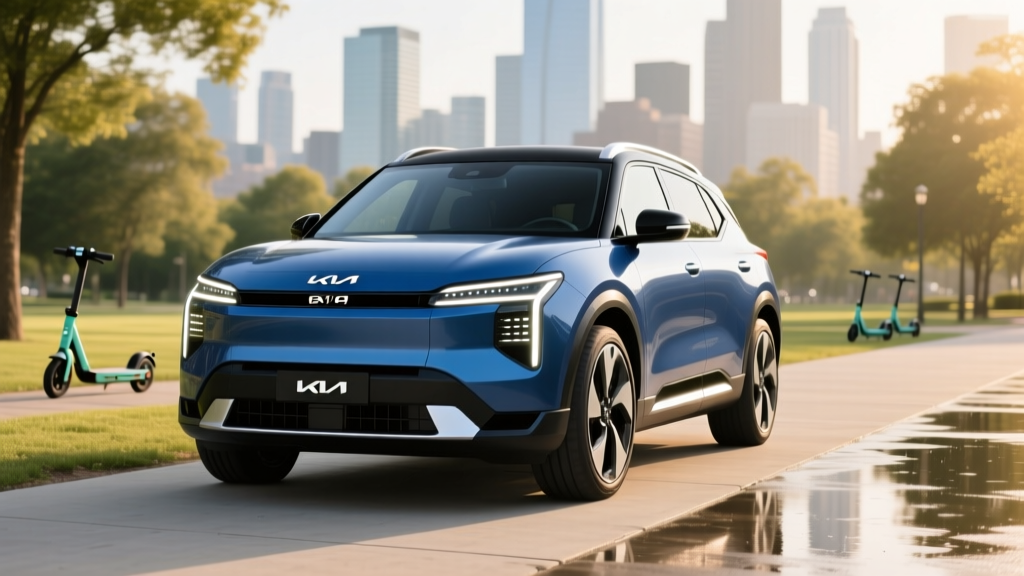
The 2025 Kia EV9 is the only mainstream three-row electric SUV that doesn't cost north of $70,000 to start. After a year on the road, owners and reviewers have enough real-world data to look past the press-release numbers and evaluate what this large-format EV actually delivers in daily driving, road trips, and winter conditions. Below is a comprehensive spec-by-spec analysis with real-world context.
Quick Verdict: Who the EV9 Is For
The 2025 EV9 targets families who need genuine third-row seating and cargo space but want to avoid the luxury-EV price tag of a Rivian R1S or BMW iX. It works best for suburban households with home charging access, moderate road-trip habits, and a need for flexible interior space. It is not the longest-range EV in its price band, and cold-weather drivers should budget for 20-30% range loss in sub-freezing temperatures.
Look elsewhere if: You regularly drive 300+ mile one-way trips, need maximum towing (5,000 lbs max), or want one-pedal driving with full regen stop.
Range, Battery, and Efficiency
| Trim / Drivetrain | Battery (kWh usable) | Chemistry | EPA Range (mi) | Combined MPGe | kWh/100 mi |
|---|---|---|---|---|---|
| Light RWD (Standard Range) | 76.1 | NMC | 230 | 89 | 38 |
| Light Long Range RWD | 99.8 | NMC | 304 | 88 | 38 |
| Wind / Land AWD | 99.8 | NMC | 282 | 83 | 40 |
| GT-Line AWD | 99.8 | NMC | 270 | 80 | 42 |
The EV9 uses nickel-manganese-cobalt (NMC) chemistry across the lineup, which prioritizes energy density over the longer cycle life of LFP cells. This is typical for large SUVs where packaging 100+ kWh in a limited floor area matters. The 99.8 kWh usable capacity is substantial — larger than the Hyundai Ioniq 5's 77.4 kWh and competitive with the Rivian R1S's 128.9 kWh pack (though the Rivian is heavier).
Charging Speed and Infrastructure
| Level | Power / Voltage | Rate | Time (10–80%) |
|---|---|---|---|
| Level 1 (120V) | 1.4 kW | ~3–4 mi/hr | Not practical for full charge |
| Level 2 (240V home) | 10.9 kW (48A) | ~28–32 mi/hr | ~9 hours (10–100%) |
| DC Fast Charge | 210 kW peak (800V architecture) | ~170 kW sustained avg | ~24 minutes (10–80%) |
The EV9's 800-volt electrical architecture is its charging differentiator. On a 350 kW-capable Electrify America or Ionity station, the EV9 can accept up to 210 kW peak. However, like all EVs, it does not sustain peak rate across the entire session. The charge curve tapers noticeably above 65% state of charge, and the 10–80% time of approximately 24 minutes reflects that taper. On a 150 kW station, expect 35–40 minutes for the same 10–80% window.
Home charging at 10.9 kW (the onboard charger limit) requires a 48-amp or higher Level 2 wallbox on a 60-amp circuit. A full overnight charge from near-empty takes roughly 9 hours — manageable for most commuters who plug in upon returning home.
Performance and Drivetrain
| Trim | Drivetrain | Horsepower | Torque (lb-ft) | 0–60 mph | Towing Capacity |
|---|---|---|---|---|---|
| Light RWD | Rear-wheel drive | 215 | 258 | 7.8 sec | 2,000 lbs |
| Light Long Range RWD | Rear-wheel drive | 201 | 258 | 8.2 sec | 2,000 lbs |
| Wind / Land / GT-Line AWD | Dual-motor AWD | 379 | 516 | 5.0 sec | 5,000 lbs |
The dual-motor AWD models transform the EV9 from a sedate family hauler into a genuinely quick SUV. The 5.0-second 0–60 time in the GT-Line is faster than a base Porsche Cayenne and puts it in the same territory as the Tesla Model X Long Range (though the Model X starts considerably higher in price). The RWD models prioritize efficiency over acceleration — adequate for merging and passing but not exciting.
Regenerative braking offers multiple levels via steering-wheel paddles, but the EV9 does not offer true one-pedal driving that brings the vehicle to a complete stop. You will still use the friction brake pedal at low speeds. This is a notable omission for EV enthusiasts accustomed to full regen-stop functionality in vehicles like the Hyundai Ioniq 5 or Chevrolet Bolt.
Interior Space, Cargo, and Technology
| Measurement | Value |
|---|---|
| Seating capacity | 6 (captain's chairs) or 7 (bench 2nd row) |
| 1st-row legroom | 41.4 in |
| 2nd-row legroom | 42.8 in |
| 3rd-row legroom | 32.0 in |
| Cargo behind 3rd row | 20.2 cu ft |
| Cargo behind 2nd row | 43.5 cu ft |
| Cargo behind 1st row (max) | 81.7 cu ft |
| Frunk (front trunk) | 1.8 cu ft (AWD) / 3.2 cu ft (RWD) |
The EV9's third row is genuinely usable for adults on shorter trips — a rarity in this segment. The 32 inches of third-row legroom trails the minivan benchmark (Chrysler Pacifica offers 36.5 in) but exceeds the Volkswagen Atlas's third row. Cargo space behind the third row is tight for a week-long family trip with full seating; most owners will need a roof box or tow cargo for extended travel with six or seven passengers.
Standout tech features:
- Dual 12.3-inch displays (instrument cluster + infotainment) with wireless Apple CarPlay and Android Auto
- Vehicle-to-Load (V2L) capability — powers devices up to 3.6 kW via interior and exterior outlets (adapter required)
- Highway Driving Assist 2 (HDA2) — SAE Level 2 driver assistance with lane-centering, adaptive cruise, and lane-change assist
- Digital key via smartphone (NFC + UWB)
- Over-the-air (OTA) software updates for powertrain and infotainment
- Relaxation seats (first row) with powered leg rests — available on Land and GT-Line trims
Notable drawbacks:
- Infotainment relies heavily on touch controls — physical buttons are minimal, and the dual-screen layout can require menu diving for climate adjustments
- Third-row ingress requires effort due to the high floor (battery pack height)
- Frunk space is minimal, especially on AWD trims
- No frunk 12V outlet for powering accessories from the front compartment
Pricing, Trims, and Federal Tax Credit
| Trim | Base MSRP | Federal §30D Credit | Effective Price (if eligible) |
|---|---|---|---|
| Light RWD (Standard Range) | $54,900 | $7,500 | $47,400 |
| Light Long Range RWD | $59,900 | $7,500 | $52,400 |
| Wind AWD | $63,900 | $7,500 | $56,400 |
| Land AWD | $69,900 | $7,500 | $62,400 |
| GT-Line AWD | $73,900 | $7,500 | $66,400 |
Tax credit eligibility (§30D) is not automatic. Per IRS guidelines, the 2025 EV9 qualifies for the full $7,500 credit only if the buyer meets all of the following:
- Income caps: Modified AGI ≤ $150,000 (single), ≤ $225,000 (head of household), ≤ $300,000 (joint)
- MSRP cap: The EV9's MSRP is under the $80,000 SUV cap — all trims qualify on price
- Battery sourcing: Kia has confirmed the EV9's battery meets critical-mineral and battery-component requirements for the full $7,500 (as of the 2025 model year — verify at point of sale, as sourcing rules tighten annually)
- Point-of-sale transfer: Buyers can elect to transfer the credit to the dealer at purchase, reducing the purchase price directly rather than waiting for a tax refund
- Assembly: The EV9 for the US market is assembled at Kia's West Point, Georgia plant, satisfying North American final-assembly requirements
Consult a tax professional or the DOE/EPA fueleconomy.gov tax credit page to confirm your personal eligibility before purchase. State and utility incentives may stack on top of the federal credit but vary by jurisdiction.
Warranty and Ownership Costs
| Coverage | Term |
|---|---|
| Basic (bumper-to-bumper) | 5 years / 60,000 miles |
| Powertrain | 10 years / 100,000 miles |
| Battery (capacity retention) | 10 years / 100,000 miles (≥70% capacity) |
| Roadside assistance | 5 years / 60,000 miles |
Kia's 10-year/100,000-mile battery warranty with a 70% capacity-retention threshold is among the strongest in the segment. If the pack degrades below 70% of original usable capacity within the warranty period, Kia will repair or replace it. For context, Tesla's Model X battery warranty is 8 years/150,000 miles at the same 70% threshold — Kia offers more years but fewer miles.
Estimated 5-year total cost of ownership (assuming 12,000 miles/year, home charging at $0.14/kWh, no major repairs):
- Energy cost: ~$3,200 (vs. ~$7,500 for a comparable gas SUV at $3.50/gal and 22 mpg)
- Insurance: Expect 15–25% higher premiums vs. a gas Telluride (EV insurance averages higher due to repair costs)
- Maintenance: Minimal — no oil changes, brake wear reduced by regen, cabin air filter every 15k miles
- Depreciation: Large EVs have depreciated 40–55% over 3 years in recent market conditions; the EV9's mainstream pricing may hold better than luxury EVs, but data is still emerging
How It Compares
| Spec | Kia EV9 Land AWD | Rivian R1S Dual-Motor | Tesla Model X LR |
|---|---|---|---|
| Base MSRP | $69,900 | $79,900 | $92,990 |
| EPA Range | 282 mi | 352 mi (Max Pack) | 335 mi |
| DC Fast Charge (peak) | 210 kW | 220 kW | 250 kW |
| 3rd-Row Legroom | 32.0 in | 30.4 in | 37.1 in |
| Towing | 5,000 lbs | 7,700 lbs | 5,000 lbs |
| Federal Tax Credit | $7,500 | $7,500 | $7,500 |
| Battery Warranty | 10yr/100k mi | 8yr/175k mi | 8yr/150k mi |
The EV9's advantage is clear: it undercuts the R1S by $10,000 and the Model X by over $20,000 at the base level, while offering competitive (if not class-leading) range and charging. The Rivian wins on towing and off-road capability. The Tesla wins on range and Supercharger network access (though Kia now supports NACS adapters for Tesla Supercharger access on 2025 models).
Pros and Cons
- Only mainstream 3-row EV under $60k (Light Long Range RWD)
- 800V architecture enables 210 kW DC fast charging
- 10-year/100k-mile battery and powertrain warranty
- V2L capability for camping, tailgating, emergency power
- US assembly (Georgia) supports tax credit eligibility
- Comfortable ride quality with well-tuned suspension
- 270-mile max EPA range (GT-Line) is modest for the price
- No full one-pedal driving (regen does not bring to complete stop)
- Heavy infotainment reliance on touchscreens
- Small frunk, especially on AWD trims
- Third-row ingress is awkward due to high floor
- Insurance costs notably higher than gas equivalents
Frequently Asked Questions
What is the real-world range of the 2025 Kia EV9?
The Long Range RWD achieves 304 miles EPA, but real-world highway driving at 70–75 mph yields approximately 250–270 miles in mild weather. In freezing temperatures, expect 210–230 miles without preconditioning. AWD trims see 250–260 miles real-world in mild conditions, dropping to 190–210 miles in cold weather.
How fast does the EV9 charge at home and on the road?
On a Level 2 home charger (240V, 48A), the EV9 charges at up to 10.9 kW, adding roughly 28–32 miles of range per hour. A full overnight charge takes about 9 hours. On a 350 kW DC fast charger, it peaks at 210 kW and charges 10–80% in approximately 24 minutes. On a 150 kW station, expect 35–40 minutes for the same window.
Does the 2025 EV9 qualify for the $7,500 federal tax credit?
Yes — all trims qualify on MSRP (under the $80,000 SUV cap), and Kia has confirmed the battery meets critical-mineral and component-sourcing requirements for the full $7,500. However, the buyer must also meet income caps ($150k single / $300k joint modified AGI) and the vehicle must be placed in service for personal use. Verify current-year rules at irs.gov before purchasing.
Is the EV9 worth buying over a Rivian R1S or Tesla Model X?
If budget is the primary concern and you need three rows for occasional use, the EV9 offers the best value proposition — saving $10,000–$23,000 versus the competition. If you need maximum range (350+ miles), heavy towing (7,700 lbs), or off-road capability, the Rivian R1S is the better choice. The Tesla Model X offers the most third-row legroom and longest range but at a steep premium and with no federal credit advantage over the Kia.
Does the EV9 have one-pedal driving?
No. The EV9 offers adjustable regenerative braking via steering-wheel paddles, but even at the highest setting, the vehicle will not come to a complete stop without using the friction brake pedal. This differs from Hyundai/Kia's own Ioniq 5, which does offer full one-pedal stop capability.
Can the EV9 power my home or devices?
The EV9 supports Vehicle-to-Load (V2L) at up to 3.6 kW via interior and exterior outlets (adapter required). This can power a laptop, small appliances, or camping equipment. Full Vehicle-to-Home (V2H) bi-directional charging requires a compatible home energy system and is not widely supported as of the 2025 model year.
What is the EV9's safety rating?
The 2025 EV9 earned the IIHS Top Safety Pick+ designation (the highest rating) and a 5-star overall NHTSA rating. Standard safety equipment includes forward collision-avoidance assist, blind-spot monitoring, rear cross-traffic alert, and Highway Driving Assist 2 (SAE Level 2 — driver must remain engaged at all times).
Sources: EPA fueleconomy.gov, IRS §30D Clean Vehicle Credit, Kia Motors America official specifications.