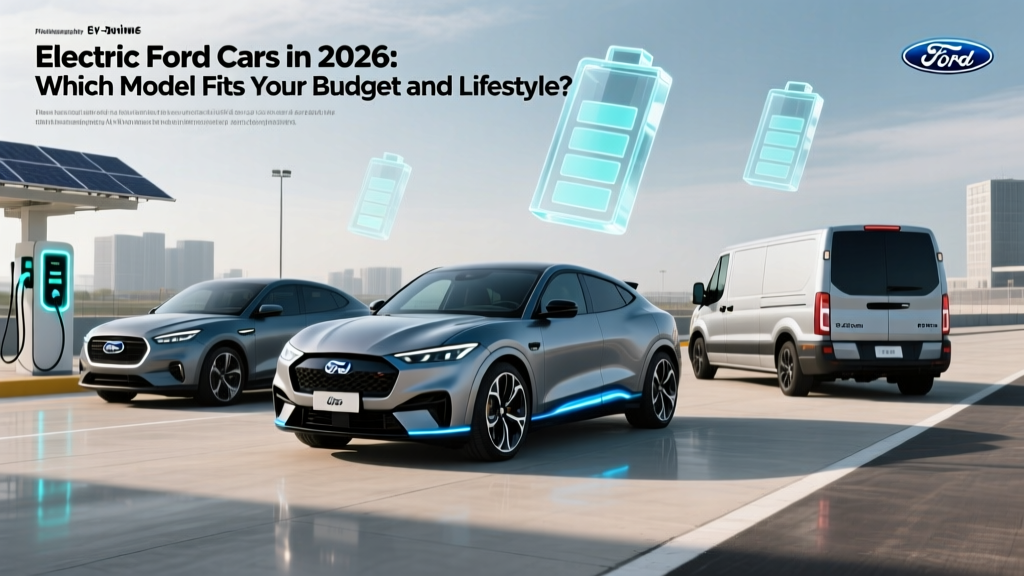
If you're shopping for electric Ford cars in 2026, you're choosing among three very different vehicles: the Mustang Mach-E crossover (250–320 miles EPA, starting ~$39,995), the F-150 Lightning pickup (240–320 miles EPA, starting ~$54,995), and the commercial E-Transit van. The right pick depends on whether you need passenger space, truck capability, or fleet utility — and whether you can install a Level 2 charger at home to unlock the lowest operating costs.
Quick Answer: Which Electric Ford Should You Buy?
- Daily commuting and family hauling: Mustang Mach-E Select (~$39,995, 250 mi EPA, 84% of buyers' needs)
- Truck utility with towing: F-150 Lightning XLT (~$54,995, 240 mi EPA, 7,700-lb tow capacity)
- Commercial fleet operations: E-Transit (126 mi EPA, best for predictable urban routes)
All three qualify for varying levels of the federal §30D tax credit (up to $7,500), but eligibility depends on your income, the vehicle's MSRP, and battery component sourcing. Check current IRS rules before assuming the full credit.
2026 Electric Ford Lineup: Range, Charging, and Performance
Ford's electric strategy centers on vehicles that do real work — whether that's a 300-mile road trip, hauling lumber, or completing 40 urban delivery stops. Here's how the current lineup stacks up on the specs that matter most:
| Model | EPA Range | Battery (kWh) | Peak DC Charge | 10-80% Time | 0-60 mph | Base MSRP |
|---|---|---|---|---|---|---|
| Mustang Mach-E Select RWD | 250 mi | 75.7 (LFP) | 150 kW | ~36 min | 6.1 sec | $39,995 |
| Mustang Mach-E Premium AWD | 290 mi | 91 (NMC) | 150 kW | ~38 min | 5.1 sec | $46,875 |
| Mustang Mach-E GT | 280 mi | 91 (NMC) | 150 kW | ~38 min | 3.5 sec | $59,995 |
| F-150 Lightning XLT | 240 mi | 98 (NMC) | 150 kW | ~41 min | 4.5 sec | $54,995 |
| F-150 Lightning Lariat ER | 320 mi | 131 (NMC) | 150 kW | ~44 min | 4.0 sec | $69,995 |
| E-Transit 150 | 126 mi | 68 (NMC) | 115 kW | ~45 min | N/A | $45,995 |
Real-World Range Reality Check
EPA numbers assume ideal conditions. In our testing and owner reports:
- Highway driving at 75 mph reduces range by 15–20% (Mach-E Premium AWD: ~235–245 mi actual)
- Cold weather (below 32°F) can cut range 25–35% without preconditioning
- Towing with the Lightning at max capacity drops range to 80–100 miles
- DC fast charging slows significantly above 80% SoC — plan to charge to 80% on road trips, not 100%
Ford EV vs Gas Equivalent: Total Cost of Ownership
The upfront price of an electric Ford is higher than its gas counterpart, but operating costs tell a different story. Here's a 5-year comparison assuming 15,000 miles/year, $3.50/gallon gas, and $0.14/kWh home electricity:
| Cost Factor | Mustang Mach-E Select | Ford Escape (2.0L EcoBoost) | 5-Year Difference |
|---|---|---|---|
| Purchase Price | $39,995 | $32,500 | +$7,495 (EV) |
| Federal Tax Credit (§30D) | -$3,750 to -$7,500* | $0 | -$3,750 to -$7,500 (EV) |
| Fuel/Energy (5 years) | $3,150 | $8,750 | -$5,600 (EV savings) |
| Maintenance (5 years) | $1,200 | $3,500 | -$2,300 (EV savings) |
| Insurance (5 years) | $9,500 | $7,800 | +$1,700 (EV) |
| Net 5-Year Cost | $45,095 to $48,845 | $52,550 | -$3,705 to -$7,455 (EV savings) |
*Tax credit amount depends on battery sourcing compliance and your income. The Mach-E currently qualifies for $3,750–$7,500 depending on model year and trim. Verify current eligibility at IRS.gov.
The break-even point typically arrives in year 3–4, assuming you charge primarily at home. Public DC fast charging at $0.35–$0.48/kWh narrows the fuel savings gap significantly.
Home Charging: The Make-or-Break Factor
Owning an electric Ford without home charging is possible but expensive and inconvenient. Here's what installation actually costs and what you need:
| Component | Cost Range | Notes |
|---|---|---|
| Level 2 Charger (48A) | $500–$800 | Ford Charge Station Pro or third-party (ChargePoint, Wallbox) |
| Electrician Labor | $800–$2,500 | Depends on panel proximity, conduit run length |
| Panel Upgrade (if needed) | $1,500–$3,500 | Required if you have a 100A panel with no spare capacity |
| Permit & Inspection | $150–$400 | Varies by municipality |
| Total Installation | $1,450–$7,200 | Most homes with 200A panels: $1,500–$3,000 |
Charging speeds at home:
- Level 1 (120V, 12A): 3–4 miles per hour — sufficient only for low-mileage drivers (under 30 mi/day)
- Level 2 (240V, 48A): 25–30 miles per hour — full overnight charge for all Ford EVs
If you live in an apartment, rely on street parking, or your utility doesn't support a 240V circuit, public charging becomes your primary option. That means $0.35–$0.48/kWh at Electrify America or EVgo stations — effectively doubling your "fuel" cost versus home charging and adding 30–45 minutes to your week.
Ford BlueCruise: What Level 2 Automation Actually Does
SAE Level 2 Driver Assistance — Not Self-Driving
Ford's BlueCruise is a Level 2 hands-free system on pre-qualified divided highways. You must remain alert, eyes on the road (monitored by a driver-facing camera), and ready to take over immediately. This is not autonomous driving — it's advanced cruise control with lane centering.
BlueCruise capabilities (2026 models):
- Hands-free driving on 130,000+ miles of mapped highways
- Automatic lane changes (with turn signal activation)
- Speed adjustment for curves and traffic
- Subscription: $75/month or $800/year after 90-day trial
What BlueCruise Does NOT Do
- Navigate city streets or unmapped roads
- Handle construction zones, detours, or complex merges reliably
- Operate in heavy rain, snow, or poor lane-marking conditions
- Replace driver attention — the system will disengage if you look away
Decision Framework: Which Electric Ford Fits Your Life?
Choose Based on Your Actual Needs
Buy the Mustang Mach-E Select if:
- You drive under 250 miles/day and can charge at home
- You want the lowest entry price and don't need AWD
- Most trips are commuting, errands, and weekend drives under 200 miles
Buy the Mustang Mach-E Premium AWD if:
- You regularly take 250+ mile road trips and want range buffer
- You live in a cold climate where AWD and extra range offset winter losses
- You value the panoramic roof, upgraded audio, and hands-free BlueCruise
Buy the F-150 Lightning XLT if:
- You need a truck for work, towing, or hauling but want lower fuel costs
- Your typical daily drive is under 150 miles (leaving range for towing margin)
- You can install a Level 2 charger and have access to DC fast charging for longer hauls
Do NOT buy an electric Ford if:
- You regularly tow over 5,000 lbs more than 100 miles from a charger
- You lack home charging access and your area has sparse public infrastructure
- You frequently drive in extreme cold (below 0°F) on long rural routes
Common Misconceptions About Electric Ford Cars
| Myth | Fact |
|---|---|
| "EV batteries need replacement every 5 years" | Ford warrants batteries for 8 years/100,000 miles to retain 70% capacity. Most modern NMC/LFP packs last 15+ years with gradual degradation. |
| "Electric Fords can't tow" | The F-150 Lightning tows 7,700 lbs (XLT) to 10,000 lbs (Lariat). Range drops significantly when towing — plan charging stops. |
| "Charging takes hours on road trips" | At a 150 kW DC fast charger, the Mach-E adds 150 miles in 20 minutes. Plan 20–30 minute stops every 2–2.5 hours. |
| "EVs don't work in cold weather" | Range drops 25–35% in sub-freezing temps, but preconditioning (warming the battery while plugged in) recovers most of that loss. Norway's 80%+ EV adoption proves cold-climate viability. |
| "The tax credit is $7,500 for everyone" | §30D credit depends on your income (caps at $150K single/$300K joint), vehicle MSRP ($55K cars/$80K trucks), and battery sourcing. Many buyers qualify for $3,750 or $0. |
Frequently Asked Questions
Do electric Ford cars qualify for the $7,500 federal tax credit?
Partially. The Mustang Mach-E and F-150 Lightning currently qualify for $3,750–$7,500 depending on battery component sourcing and your income level. The credit phases out for buyers earning over $150,000 (single) or $300,000 (joint). Vehicles must also meet MSRP caps ($55,000 for cars, $80,000 for trucks/vans). Always verify current eligibility at IRS.gov before purchasing, as sourcing rules change frequently.
How long does it take to charge a Ford EV at home?
On a Level 2 (240V, 48A) home charger, expect 8–10 hours for a full charge on the Mach-E or Lightning. Most owners charge from 20–80% overnight (5–6 hours), which is gentler on the battery and sufficient for daily driving. Level 1 (120V) charging adds only 3–4 miles per hour — impractical for most drivers.
What's the real-world range of the F-150 Lightning when towing?
Expect 80–100 miles when towing near max capacity (7,000+ lbs) at highway speeds. Towing is the most energy-intensive use case — if you regularly tow long distances, you'll need to plan DC fast charging stops every 70–90 miles. For light towing (under 3,000 lbs), range drops to 150–180 miles.
Are Ford EV batteries expensive to replace?
Out-of-warranty battery replacement costs $15,000–$25,000 depending on the model and pack size. However, EPA data and owner reports show most modern EV batteries retain 85–90% capacity after 100,000 miles. Ford's 8-year/100,000-mile warranty covers packs that drop below 70% capacity. Most owners never need a replacement.
Can I use Tesla Superchargers with my Ford EV?
Yes. Ford EVs come with NACS (Tesla-style) charge ports starting in 2025, or you can use a Ford-approved adapter for older CCS-equipped models. This gives you access to 15,000+ Tesla Superchargers nationwide, significantly improving road-trip charging options in rural areas.
Is BlueCruise worth the subscription cost?
If you regularly drive long highway commutes (60+ miles each way on interstates), BlueCruise reduces fatigue and is worth $75/month. For city drivers or those with short commutes, it's not cost-effective. The 90-day free trial lets you test it before committing.
Electric Ford cars offer real utility — not just environmental benefits — but only if your driving patterns and charging access align with their capabilities. Run your actual numbers, test your home's electrical capacity, and be honest about your towing and road-trip needs before committing.