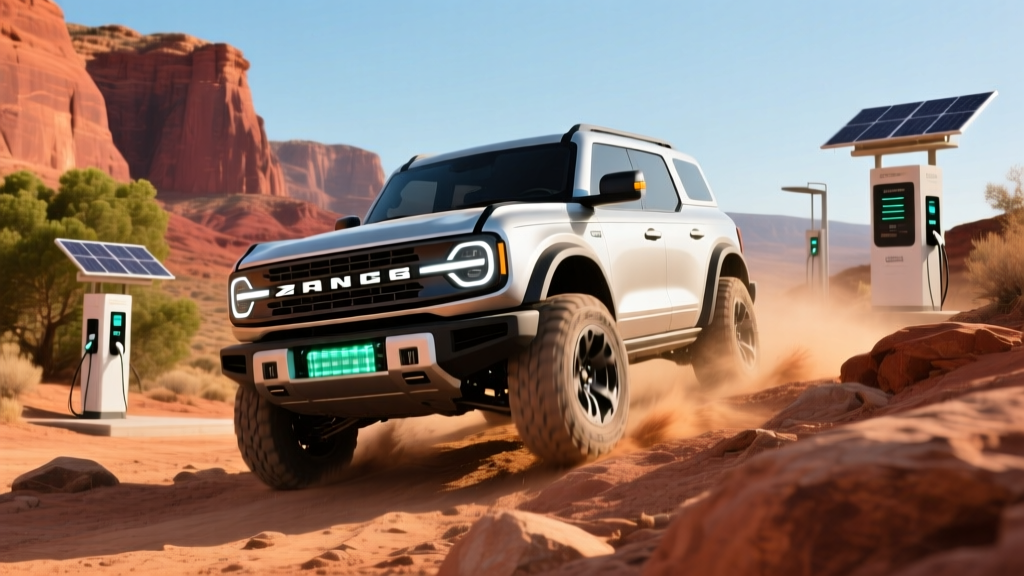
The Quick Answer: Is There an Electric Bronco?
No. As of the 2026 model year, Ford does not sell a fully electric Bronco. The current sixth-generation Bronco (two-door and four-door) is available only with gasoline turbocharged engines — a 2.3L EcoBoost I-4 and a 2.7L EcoBoost V-6. Ford has not announced a production date, pricing, or battery specs for an electric Bronco.
What Ford does offer is the Bronco Sport Hybrid (introduced for the 2025 model year), which pairs a 1.5L three-cylinder with an electric motor for improved fuel economy — but this is a hybrid, not a plug-in or battery-electric vehicle. If you want an electric SUV with genuine off-road capability today, you'll need to look at alternatives like the Rivian R1S, Jeep Wrangler 4xe (PHEV), or the upcoming electric Jeep Recon.
Why Ford Hasn't Built an Electric Bronco Yet
Ford's EV strategy has prioritized high-volume, on-road vehicles. The Mustang Mach-E and F-150 Lightning were logical first movers — the Mustang brand carries global recognition, and the F-Series is America's best-selling vehicle. The Bronco, while iconic, occupies a narrower niche: a body-on-frame off-roader competing against the Jeep Wrangler in a segment where buyers prioritize trail capability, ground clearance, and aftermarket modification over efficiency.
Several engineering challenges complicate an electric Bronco:
- Battery placement vs. ground clearance: A skateboard-style battery pack sits beneath the floor. For a serious off-roader, that pack needs robust skid-plate protection and enough ground clearance to avoid damage on rocks and ruts. Rivian solved this with the R1S (8.7–14.9 inches of adjustable air-suspension clearance), but it added significant cost and weight.
- Weight and trail performance: EV batteries are heavy. A 100+ kWh pack adds 1,000–1,300 lbs. On sand, mud, or steep climbs, extra mass works against traction and increases the risk of getting stuck.
- Range anxiety on the trail: Off-roading is energy-intensive — low-speed crawling, steep grades, and soft surfaces like sand can cut an EV's effective range by 40–60%. A Bronco BEV would need a massive battery to maintain confidence in remote areas far from chargers.
- Charging infrastructure gap: Trailheads, national forests, and off-road parks rarely have DC fast chargers. Until rural charging networks expand, a pure-electric hardcore off-roader carries real logistical risk.
Ford's CEO Jim Farley has signaled that an electric Bronco is "under consideration," but the company's near-term EV roadmap focuses on a next-generation platform for midsize trucks and SUVs. Industry analysts expect a Bronco EV could arrive around the 2028–2029 model year, but nothing is confirmed.
What You Can Buy: Current Bronco Powertrains vs. Electric Off-Road Alternatives
Let's compare the gasoline Bronco against the closest electrified alternatives in the off-road SUV segment. All figures reflect 2025/2026 model-year data.
| Spec | 2026 Ford Bronco (2.7L V-6) | 2026 Bronco Sport Hybrid | Jeep Wrangler 4xe (PHEV) | Rivian R1S (Dual-Motor Max) |
|---|---|---|---|---|
| Powertrain | Gas turbo V-6 | Hybrid (HEV) | Plug-in hybrid | Battery electric |
| Horsepower | 330 hp | ~198 hp (combined) | 375 hp | 665 hp |
| EPA Fuel Economy | 18 city / 22 hwy / 20 combined MPG | ~32 combined MPG (est.) | 49 MPGe (elec+gas) / 20 MPG (gas only) | 73 MPGe combined |
| Electric-Only Range | N/A | N/A | 22 miles | ~410 miles (full battery) |
| Battery Capacity | N/A | ~1.1 kWh (small assist) | 17.3 kWh usable | 141 kWh usable (Max Pack) |
| 0-60 mph | ~6.5 sec | ~8.0 sec (est.) | ~6.0 sec | ~3.5 sec |
| Ground Clearance | 8.3–11.6 in (Sasquatch) | 8.8 in (Badlands) | 10.8 in | 8.7–14.9 in (air suspension) |
| Towing Capacity | 3,500 lbs | 2,200 lbs | 3,500 lbs | 7,700 lbs |
| Base MSRP | ~$39,995 | ~$35,000 (est.) | ~$51,795 | ~$79,900 (Dual-Motor Max) |
| Federal Tax Credit | None | None | $3,750 (§30D partial, subject to sourcing) | $0–$7,500 (subject to sourcing/income caps) |
Sources: fueleconomy.gov, Ford.com, Rivian.com. Tax credit eligibility depends on battery sourcing, buyer income, and MSRP caps per IRS §30D rules. Always verify current-year requirements with a tax professional.
Real Cost of Ownership: Bronco Gas vs. Electrified Alternatives
Purchase price is only part of the equation. Let's compare five-year ownership costs for a driver covering 15,000 miles per year, with home charging access and electricity at $0.16/kWh (national average for 2026).
| 5-Year Cost Category | Bronco 2.7L V-6 | Wrangler 4xe (PHEV) | Rivian R1S (Dual-Motor Max) |
|---|---|---|---|
| Purchase Price (base MSRP) | $39,995 | $51,795 | $79,900 |
| Federal Tax Credit | $0 | –$3,750 | –$7,500 (if eligible) |
| Net Purchase | $39,995 | $48,045 | $72,400 |
| Fuel / Energy (75,000 mi) | $11,250 (gas at $3.50/gal, 20 MPG) | $6,800 (blended elec + gas) | $3,840 (electricity) |
| Maintenance (5 yr) | $3,500 | $3,200 | $1,800 |
| Insurance (avg. 5 yr) | $8,500 | $9,200 | $12,000 |
| Estimated Depreciation | $18,000 | $22,000 | $32,000 |
| 5-Year Total | ~$81,245 | ~$89,245 | ~$122,040 |
The gasoline Bronco wins on five-year cost primarily due to its lower purchase price and slower depreciation. The Wrangler 4xe saves significantly on fuel but carries a higher upfront premium. The Rivian R1S is the most expensive option by a wide margin, though it delivers far more power, towing capacity, and near-silent trail operation. For buyers who prioritize low running costs above all, the R1S's per-mile energy cost (~$0.05/mi) versus the gas Bronco's (~$0.15/mi) is compelling — but you need to drive it well past 100,000 miles to close the purchase-price gap.
Real-World Ownership Considerations for Electrified Off-Roaders
If you're weighing an electric or plug-in hybrid off-roader, these practical factors matter more than spec-sheet numbers:
Home Charging Access
For the Wrangler 4xe, a standard 120V outlet (Level 1) adds roughly 5–7 miles of electric range per hour of charging — enough to replenish its 22-mile battery overnight. A Level 2 home charger (240V, ~7.2 kW) fully recharges it in about 2.5 hours. For the Rivian R1S with its 141 kWh Max Pack, Level 1 charging is impractical (adding ~3 miles/hour — that's 47 hours for a full charge). You'll need a Level 2 installation (typically 11.5 kW, requiring a 60-amp circuit), which costs $800–$2,500 depending on your electrical panel. If your home has a 100-amp panel, expect an additional $1,500–$3,000 for a panel upgrade.
Cold-Weather Range Loss
EV batteries lose 20–40% of their rated range in freezing temperatures due to increased internal resistance and cabin-heating energy demands. The Rivian R1S's EPA-estimated 410-mile range could drop to 250–320 miles in sustained sub-30°F driving. The Wrangler 4xe's 22-mile electric range may shrink to 14–17 miles in winter. The gasoline Bronco is largely immune to this effect — cold weather reduces gas-engine efficiency by only 10–15%.
Trail Range Reality
Low-speed rock crawling and sand driving consume energy at 2–3x the rate of highway driving. On a demanding trail, expect the Rivian R1S to use roughly 2.5–3.5 miles of range per actual mile traveled. That turns its 410-mile EPA range into roughly 120–160 miles of trail range. For day trips to a local off-road park, this is fine. For multi-day expeditions in remote areas (Moab, the Rubicon Trail, remote national forests), you'll need to plan charging carefully — or carry a gas generator as backup.
Charging Infrastructure Near Trails
Major trailheads near towns (Sedona, Moab, Ouray) increasingly have DC fast chargers. But deep backcountry staging areas often don't. Check PlugShare or the Electrify America app before committing to an electric off-roader for remote adventures. As of early 2026, the public charging network has expanded significantly along interstate corridors, but rural trail access remains a genuine limitation.
Common Misconceptions About an Electric Bronco
| Myth | Fact |
|---|---|
| "Ford is releasing an electric Bronco in 2026." | No official announcement exists. Ford's confirmed near-term EV plans focus on next-gen trucks and crossovers. A Bronco EV remains speculative. |
| "The Bronco Sport Hybrid is a plug-in electric vehicle." | The Bronco Sport Hybrid is a conventional hybrid (HEV), not a PHEV. It cannot be plugged in and has no meaningful electric-only range. It simply uses a small battery and electric motor to assist the gas engine and improve MPG. |
| "Electric off-roaders can't handle real trails." | The Rivian R1S and R1T have completed the Rubicon Trail, and EVs offer instant torque with precise low-speed control — an advantage in rock crawling. The limitation is range and charging access, not capability. |
| "An electric Bronco would qualify for the full $7,500 tax credit." | Under current §30D rules, the credit depends on battery critical-mineral sourcing, buyer income (≤$150K single / $300K joint), MSRP caps ($80K for SUVs), and North American assembly. Even if Ford built it, eligibility is not guaranteed. Always check the IRS Clean Vehicle Credit page for current requirements. |
| "EVs are worse for the environment because of battery mining." | Lifecycle analyses by Argonne National Lab and the ICCT consistently show that EVs produce 50–70% fewer lifetime greenhouse gas emissions than comparable gas vehicles in the U.S. grid mix, even accounting for battery manufacturing. The grid is also getting cleaner each year, improving EV emissions over time. |
Decision Framework: What Should You Buy?
Choose the Gasoline Ford Bronco If:
- You regularly drive to remote trailheads with no charging infrastructure
- You want a proven platform with massive aftermarket support (bumpers, lifts, lockers)
- Your budget is under $50,000
- You want a removable roof and doors for open-air trail riding
- You tow frequently and need simple, predictable range
Choose the Jeep Wrangler 4xe (PHEV) If:
- You want a plug-in off-roader you can actually buy today
- Your daily commute is under 20 miles (you can run mostly on electricity)
- You have home charging access (even a standard 120V outlet works for the small battery)
- You want open-air capability with better fuel economy than a gas-only Wrangler
- You're okay with a higher purchase price in exchange for lower daily running costs
Choose the Rivian R1S If:
- You want a true battery-electric off-road SUV with no gasoline backup
- Your budget is $75,000+
- You prioritize performance (665 hp, 3.5-second 0-60) alongside trail capability
- You have Level 2 home charging installed or can install it
- Your off-road trips are day excursions within ~100 miles of a charger, or you're willing to plan multi-day trips around DC fast-charging stops
- You value quiet, vibration-free trail driving and one-pedal crawling control
Wait for an Electric Bronco If:
- The Bronco's specific styling, removable roof/doors, and brand identity are non-negotiable for you
- You're not in a rush — a Bronco EV is plausible in the 2028–2029 timeframe
- You'd rather buy a Ford product and support the dealer network you already know
What a Future Electric Bronco Would Need to Succeed
Based on what the Rivian R1S and electric off-road concept vehicles have demonstrated, a production Bronco EV would need to hit these benchmarks to satisfy the off-road community:
- Minimum 300 miles EPA range (to yield ~100–120 miles of trail range)
- At least 10.5 inches of ground clearance with battery skid-plate protection
- Peak DC fast charging of 200+ kW (10–80% in ~25 minutes) for quick trailhead top-ups
- Front and rear locking differentials (or torque-vectoring dual-motor equivalent)
- Approach/departure/breakover angles competitive with the Sasquatch-package gas Bronco
- Removable roof and doors — a core Bronco identity element
- MSRP under $65,000 to remain accessible to the traditional Bronco buyer
- V2L (vehicle-to-load) capability for powering campsite equipment and tools
If Ford can deliver on these specs using its next-generation EV platform, an electric Bronco could be a serious contender. Until then, the options above are what's available.
Frequently Asked Questions
Will Ford make an electric Bronco?
Ford has not confirmed an electric Bronco. Company executives have acknowledged the possibility, and Ford's long-term EV roadmap includes electrifying its "iconic" nameplates. However, no production timeline, concept vehicle, or detailed specifications have been released as of early 2026. Industry estimates suggest 2028–2029 at the earliest.
Is the Bronco Sport Hybrid a plug-in?
No. The Bronco Sport Hybrid is a conventional hybrid (HEV) like a Toyota RAV4 Hybrid. It uses a small battery charged by regenerative braking and the gas engine — you never plug it in. It does not qualify for any federal EV tax credit. If you want plug-in capability, look at the Jeep Wrangler 4xe instead.
What's the best electric SUV for off-roading right now?
The Rivian R1S is the most capable all-electric off-road SUV available in 2026, with adjustable air suspension (up to 14.9 inches of ground clearance), a wading mode for water crossings, quad- or dual-motor AWD, and 410 miles of EPA range with the Max Pack. It starts at roughly $74,000 for the Dual-Motor Standard configuration. For a plug-in hybrid alternative, the Jeep Wrangler 4xe offers 22 miles of electric range plus a gas engine for unlimited range.
Does the Jeep Wrangler 4xe qualify for the $7,500 tax credit?
Under current §30D rules, the Wrangler 4xe may qualify for up to $3,750 (the critical-minerals portion of the credit), depending on the specific model year and battery-sourcing compliance. The full $7,500 requires meeting both critical-mineral and battery-component requirements. Buyer income must not exceed $150,000 (single) or $300,000 (joint), and the MSRP must be under $80,000 for an SUV. The credit can now be transferred to the dealer at point of sale as an instant discount. Always verify current eligibility at the IRS Clean Vehicle Credit page or with a qualified tax professional.
Can electric vehicles really handle serious off-road trails?
Yes, with caveats. Electric motors deliver instant torque at zero RPM, which gives precise control in rock crawling. Rivian owners have completed the Rubicon Trail, and EVs offer a lower center of gravity (thanks to the floor-mounted battery) that improves stability on side slopes. The real limitations are range (energy consumption spikes 2–3x off-road) and charging access in remote areas. For day trips near civilization, an EV off-roader works well. For multi-day backcountry expeditions, a PHEV or gas vehicle remains the pragmatic choice.
How much does it cost to install a home charger for an electric SUV?
A Level 2 home charging station (240V, 40–48 amps) typically costs $500–$800 for the equipment plus $500–$2,000 for professional installation by a licensed electrician, depending on the distance from your electrical panel and whether a permit is required. If your home has a 100-amp electrical panel, you may need a $1,500–$3,000 panel upgrade to 200 amps to support a high-amperage charger. Total installed cost usually ranges from $1,200 to $4,000. Some utilities offer rebates of $200–$500 that offset installation costs.