Quick Answer: Is Electric Farm Machinery Ready for Your Operation?
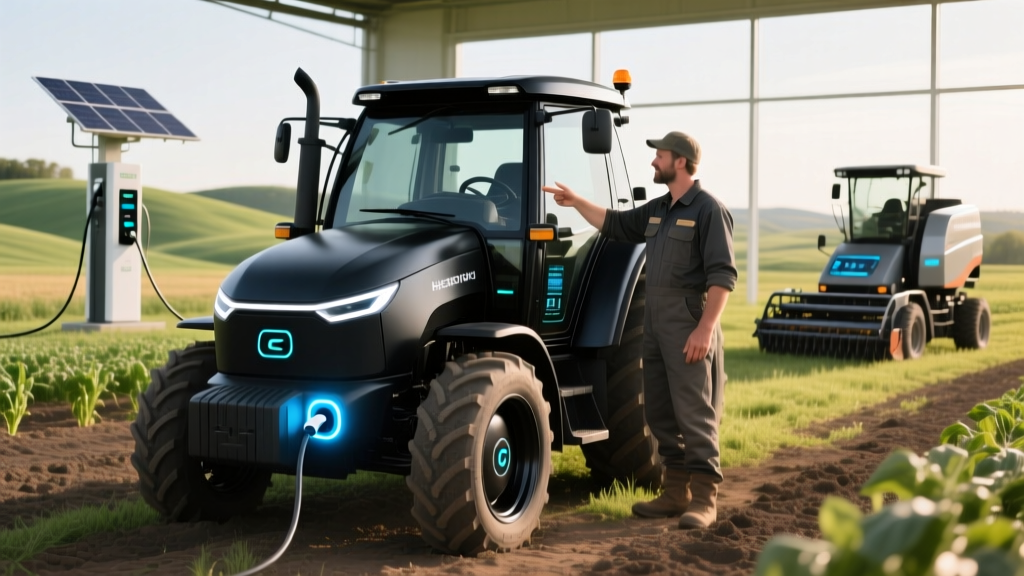
Electric farm machinery — primarily compact and utility tractors, along with emerging electric utility task vehicles (UTVs) and light-duty implements — is viable in 2026 for small-to-mid-size operations running under 40 horsepower-equivalent tasks, short daily duty cycles (4–8 hours), and reliable access to Level 2 (240V) charging. Battery packs on current models range from 40–120 kWh, delivering 6–10 hours of mixed fieldwork per charge. However, high-horsepower row-crop tractors (100+ HP equivalent) remain almost exclusively diesel, with no mainstream electric options available yet. Expect purchase prices 30–60% higher than diesel equivalents, offset by 50–70% lower per-hour energy costs and dramatically reduced maintenance. Federal tax incentives like the §45W Commercial Clean Vehicle Credit (up to $40,000 for heavy-duty commercial EVs) can significantly reduce net cost for qualifying farm businesses.
The Current State of Electric Farm Machinery in 2026
The electrification of agriculture is real but segmented. Unlike passenger EVs, where dozens of models compete across every segment, electric farm machinery in 2026 is concentrated in specific niches where battery-electric powertrains offer clear advantages: low-speed, high-torque tasks, indoor or ventilation-sensitive environments (livestock barns, greenhouses), and operations with short daily run times and predictable routes back to a charging point.
Here is what is actually available and what remains in the pipeline:
| Category | Examples (2026) | Battery / Power | Status |
|---|---|---|---|
| Compact Electric Tractors (20–40 HP eq.) | Solectrac e70, Monarch MK-V | 40–80 kWh, LFP | Available / Shipping |
| Autonomous Electric Tractors | Monarch MK-V (driver-optional) | ~75 kWh, LFP | Available (limited regions) |
| Electric UTVs / Utility Vehicles | Polaris Ranger EV, John Deere Gator EV (announced) | 15–30 kWh | Available / Announced |
| Electric Skid Steers / Compact Loaders | Volvo ECR25 Electric, Bobcat compact electric | 40–60 kWh, NMC/LFP | Available (construction crossover) |
| Mid-Range Row-Crop Tractors (80–150 HP) | Various prototypes (CNH, John Deere concepts) | N/A | Prototype / Announced only |
| High-HP Combines & Heavy Tractors (200+ HP) | None commercially available | N/A | Not yet feasible |
The honest takeaway: if your operation centers on a 150 HP diesel tractor pulling a 24-foot planter across 2,000 acres of corn, electric machinery is not your solution in 2026. If you run a 50-acre diversified vegetable farm, a vineyard, an orchard, or a livestock operation needing a compact tractor for mowing, tilling, loader work, and spraying — electric is worth a serious look.
Electric vs. Diesel Tractors: The Numbers That Matter
Comparing electric farm machinery to diesel requires looking beyond sticker price. The economic case hinges on fuel displacement, maintenance reduction, and duty-cycle fit. Below is a realistic comparison for a compact-tractor use case — roughly 1,000 operating hours per year doing mixed light fieldwork, loader tasks, and mowing.
| Cost Factor | Electric (e.g., Solectrac e70, ~40 HP eq.) | Diesel (e.g., Kubota L4701, ~47 HP) |
|---|---|---|
| Purchase Price (MSRP) | $55,000–$75,000 | $30,000–$38,000 |
| Federal Tax Credit (§45W, commercial) | Up to $40,000 (GVWR-dependent) | $0 |
| Net Purchase After Credit | $15,000–$35,000 | $30,000–$38,000 |
| Energy/Fuel Cost per Hour | $1.50–$3.00 (electricity at $0.12–$0.18/kWh) | $6.00–$9.00 (diesel at ~$3.80/gal, 1.5–2 gal/hr) |
| Annual Energy Cost (1,000 hrs) | $1,500–$3,000 | $6,000–$9,000 |
| Annual Maintenance | $200–$500 (no oil, filters, DEF, minimal fluids) | $1,200–$2,500 (oil changes, filters, DEF, coolant) |
| 5-Year Total Operating Cost (energy + maint.) | $8,500–$17,500 | $36,000–$57,500 |
Key insight: The §45W Commercial Clean Vehicle Credit, detailed on IRS.gov, is distinct from the consumer §30D credit. It applies to business-use vehicles and can cover up to $40,000 for vehicles with GVWR above 14,000 lbs, or 15% of the vehicle cost (30% if domestic content requirements are met) for lighter vehicles. Farm businesses structured as sole proprietorships, LLCs, or corporations may qualify. Consult a tax professional — eligibility depends on your specific business structure, vehicle specifications, and battery sourcing compliance.
Battery Specs, Chemistry, and What They Mean for Farm Use
Understanding the battery in electric farm machinery requires the same fundamentals as passenger EVs — but with agricultural priorities.
kWh vs. kW: The Critical Distinction
kWh (kilowatt-hours) measures energy capacity — how much "fuel" is in the tank. A 75 kWh battery pack can theoretically deliver 75 kW for one hour, or 15 kW for five hours. kW (kilowatts) measures power — the rate of energy delivery or charging. Confusing these is the single most common mistake new EV buyers make.
LFP vs. NMC Chemistry in Agricultural Equipment
| Factor | LFP (Lithium Iron Phosphate) | NMC (Nickel Manganese Cobalt) |
|---|---|---|
| Energy Density | Lower (~160 Wh/kg) — heavier packs | Higher (~250 Wh/kg) — lighter packs |
| Cycle Life | 3,000–5,000+ cycles to 80% SoH | 1,000–2,000 cycles to 80% SoH |
| Thermal Stability | Excellent — less risk of thermal runaway | Good — requires robust thermal management |
| Cold-Weather Performance | Moderate — capacity drops 15–30% below freezing | Better — capacity drops 10–20% below freezing |
| Cost per kWh | Lower ($90–$120/kWh in 2026) | Higher ($120–$160/kWh in 2026) |
| Best Farm Use Case | Daily cycling, warm climates, long ownership horizon | Cold climates, weight-sensitive applications |
Most purpose-built electric tractors in 2026 use LFP chemistry, and for good reason: farm equipment sees daily deep cycling, operates in dusty and hot environments, and buyers intend to keep it for 10–15+ years. The lower energy density (meaning a heavier battery for the same kWh) matters less on a tractor, where weight actually improves traction. The Monarch MK-V, for instance, uses an LFP pack rated at approximately 75 kWh with a stated cycle life exceeding 4,000 cycles — translating to over a decade of daily use before reaching 80% State of Health.
Real-World Runtime Expectations
Manufacturer-stated runtimes assume moderate loads. In practice:
- Light duty (mowing flat pasture, light transport): expect 8–10 hours from a 75 kWh pack
- Mixed duty (tilling, loader work, PTO-driven implements): expect 5–7 hours
- Heavy continuous load (deep PTO work, steep terrain): expect 3–4 hours
- Cold weather (below 32°F): reduce all estimates by 15–30%, and charging times will increase due to battery preconditioning requirements
Charging Logistics: What Your Farm Needs
This is where most electric farm machinery purchases succeed or fail. Unlike a passenger EV that can rely on public DC fast-charging networks, farm equipment charges where it lives — and that means your operation needs adequate electrical infrastructure.
| Level | Voltage / Power | Charge Time (0–100%, 75 kWh pack) | Infrastructure Needed |
|---|---|---|---|
| Level 1 (Standard Outlet) | 120V / 1.4–1.9 kW | 40–54 hours | Standard 15A/20A outlet — impractical for daily use |
| Level 2 (Standard Farm Charging) | 240V / 7.2–19.2 kW | 4–10 hours | 240V circuit (50A–80A), hardwired EVSE or NEMA 14-50 |
| DC Fast Charge (if equipped) | 50–150 kW | ~45–90 min (10–80%) | Commercial-grade 480V service, transformer upgrade likely |
The practical reality for most farms: Level 2 at 240V is the workhorse. If your tractor has a 75 kWh battery and you charge at 10 kW (a typical Level 2 farm setup on a 50A circuit), a full recharge takes roughly 7.5 hours. Plug in at 9 PM after evening chores, and you are fully charged by 4:30 AM — well before the next workday.
Infrastructure cost breakdown for a typical farm Level 2 installation:
- Level 2 EVSE unit (commercial-grade, 40–80A): $600–$2,000
- Electrical panel capacity assessment: $150–$300
- 240V circuit run (distance-dependent, barn/shop wiring): $800–$4,000
- Permit and inspection: $100–$500
- Panel upgrade (if needed — common on older farms with 100A service): $2,000–$5,000
- Total typical range: $1,650–$11,800, with most farms landing in the $2,500–$5,000 range if panel capacity exists
One advantage farms have over residential settings: many already have 240V service in barns and equipment sheds for welders, grain dryers, or air compressors. If you have an existing 240V/50A circuit near your tractor parking area, installation costs drop dramatically. Always have a licensed electrician assess your panel load before adding an EV circuit — simultaneous operation of heavy equipment and charging can exceed panel capacity.
Decision Framework: Should Your Farm Go Electric?
If-Then Decision Guide for Electric Farm Machinery
Choose electric if:
- Your daily tractor use is under 8 hours of mixed-duty work
- You operate primarily in the 20–40 HP equivalent range (compact/utility tasks)
- You have 240V power available at or near your equipment storage
- You run a diversified farm, vineyard, orchard, or livestock operation with varied light-to-moderate tasks
- You plan to own the equipment 10+ years (amortizing the higher upfront cost against fuel/maintenance savings)
- You operate in noise-sensitive or indoor environments (barns, greenhouses, near residences)
- You qualify for the §45W commercial credit or USDA REAP (Rural Energy for America Program) grants
Stick with diesel if:
- You need 80+ HP for heavy tillage, large-acreage planting, or continuous PTO-driven implements
- Your daily run time exceeds 10 hours during peak seasons (harvest, planting)
- You operate across multiple dispersed fields without returning to a charging point
- Your electrical service is limited (100A or less) with no feasible upgrade path
- You operate in extreme cold (below 0°F regularly) where battery performance drops significantly
- You need immediate implement compatibility — electric PTO standards are still evolving, and most existing implements require mechanical PTO or hydraulic drives
Common Misconceptions About Electric Farm Equipment
| Myth | Fact |
|---|---|
| "Electric tractors have no torque" | Electric motors deliver peak torque at 0 RPM. Compact electric tractors routinely match or exceed the breakout force and drawbar pull of diesel equivalents in the same HP class. |
| "Batteries won't last in farm conditions" | LFP packs in current models are rated for 3,000–5,000+ cycles. IP65+ ingress protection handles dust and moisture. Most carry 5–8 year warranties with 70–80% capacity retention guarantees. |
| "You can't use standard implements" | Most electric compact tractors use standard Category 1 three-point hitches. Mechanical PTO is available on models like the Solectrac e70. The limitation is continuous heavy PTO loads that drain batteries faster than the duty cycle allows. |
| "The grid can't handle farm charging" | A single Level 2 charger at 10 kW draws roughly the same as a large window AC unit or a small grain dryer element. Most farm electrical services accommodate this easily. Problems arise only when multiple high-draw systems run simultaneously without panel capacity planning. |
| "Electric tractors are zero-emission" | Tailpipe emissions are zero. Upstream emissions depend entirely on your electricity source. A farm with rooftop solar or a wind PPA achieves near-zero lifecycle emissions. A farm on a coal-heavy grid still reduces emissions significantly (electric motors are 85–90% efficient vs. diesel engines at 35–45%), but not to zero. |
Total Cost of Ownership: A 10-Year Farm Perspective
| Cost Category | Electric Tractor (~40 HP eq.) | Diesel Tractor (~47 HP) |
|---|---|---|
| Purchase Price | $65,000 | $34,000 |
| Federal Tax Credit (§45W) | –$9,750 (15% base, varies) | $0 |
| Charging Infrastructure | $3,500 | $0 |
| Net Acquisition Cost | $58,750 | $34,000 |
| 10-Year Energy/Fuel | $22,000 (avg. $2,200/yr) | $75,000 (avg. $7,500/yr) |
| 10-Year Maintenance | $3,500 | $18,000 |
| Battery Replacement (if needed) | $8,000–$15,000 (year 8–12, LFP may not need it) | Engine rebuild potential: $5,000–$10,000 |
| Insurance (10-year est.) | $8,000–$12,000 | $6,000–$9,000 |
| Estimated 10-Year TCO | $92,250–$111,250 | $133,000–$146,000 |
The crossover point — where cumulative electric savings offset the higher purchase price — typically arrives between years 3 and 5, depending on annual hours, local diesel prices, and electricity rates. Operations running 1,500+ hours per year reach payback faster. Lower-use operations (under 500 hours/year) may not justify the premium within a typical ownership window.
For additional data on agricultural energy costs and efficiency benchmarks, the USDA Energy Council publishes annual reports on farm energy use and renewable integration that provide useful context for electrification decisions.
What First-Time Electric Farm Equipment Buyers Should Know
If you are transitioning from decades of diesel to your first electric tractor or utility vehicle, these practical points will save frustration:
- Charge discipline matters more than with diesel. You cannot "top off" in five minutes at a co-op. Plan your workday around the battery: heavy tasks in the morning on a full charge, lighter tasks as the State of Charge drops.
- Preconditioning is not just for cars. If your equipment sits in an unheated shed in winter, the battery management system (BMS) will limit power output and charging speed until the pack warms up. Store indoors when possible, or budget 30–60 minutes of reduced performance at the start of cold-weather workdays.
- Regenerative braking works differently on tractors. On a passenger EV, regen recovers energy during deceleration. On a tractor doing loader work or operating on hills, regen can add 5–15% to effective runtime. On flat, steady-state mowing, the benefit is minimal.
- Implement compatibility requires homework. Confirm three-point hitch category, PTO type (mechanical vs. electric, RPM), hydraulic flow requirements, and electrical system voltage before pairing implements. Some electric tractors offer electric PTO at variable RPM — an advantage for certain implements but incompatible with standard 540/1000 RPM mechanical PTO-driven equipment.
- Dealer support is thinner than diesel. Established diesel brands (John Deere, Kubota, New Holland) have dealer networks within an hour's drive of most US farmland. Electric tractor companies like Solectrac and Monarch are building service networks but are not yet at that density. Factor in potential downtime logistics and remote diagnostic capabilities.
- Explore USDA REAP grants. The Rural Energy for America Program can cover up to 50% of renewable energy system costs, and in some cases, energy-efficient equipment including electric agricultural machinery. Stack this with §45W for maximum offset — but verify current-year eligibility with your local USDA Rural Development office.
Can I charge an electric tractor from solar panels on my barn?
Yes, and this is one of the strongest economic cases for electric farm machinery. A 15–20 kW barn-roof solar array can generate 60–90 kWh per day in peak season — enough to fully recharge a 75 kWh tractor battery. Net energy cost drops to near zero after the solar system payback period (typically 5–8 years with federal solar tax credits). The key constraint is timing: solar generation peaks midday, so you either charge during the day (when the tractor might be in use) or invest in battery storage to shift solar energy to overnight charging.
How long do electric tractor batteries last before replacement?
LFP batteries in current agricultural equipment are rated for 3,000–5,000 charge cycles before degrading to 80% State of Health. At one full cycle per day, 300 days per year, that equates to 10–17 years before meaningful capacity loss. Most manufacturers offer 5–8 year battery warranties guaranteeing 70–80% capacity retention. Unlike diesel engines, which can require expensive overhauls, battery replacement costs for LFP packs are declining — roughly $90–$120/kWh in 2026, meaning a 75 kWh pack replacement would cost approximately $6,750–$9,000, though many packs will outlast the tractor's useful life.
Are there any fully electric tractors above 80 HP available in 2026?
No mainstream production models exist in the 80+ HP equivalent range for broad-acre farming. Major manufacturers including John Deere, CNH Industrial (Case IH/New Holland), and AGCO have shown electric and hybrid-electric tractor concepts, but none are commercially available for purchase. The energy density challenge is significant: a 150 HP tractor running 10 hours at full load would need roughly 400–500 kWh of battery capacity — adding thousands of pounds and $40,000–$60,000 in battery cost alone. Hybrid-electric and range-extender configurations are more likely to bridge this gap before fully battery-electric heavy tractors become viable.
Does the §45W commercial clean vehicle credit apply to tractors?
The §45W credit applies to qualified commercial clean vehicles, which the IRS defines broadly to include mobile machinery used in a trade or business. Purpose-built electric agricultural tractors can qualify if they meet the vehicle classification requirements and battery sourcing rules outlined on IRS.gov. The credit amount varies: for vehicles under 14,000 lbs GVWR, it is the lesser of 15% of cost (30% with domestic content) or $7,500. For heavier vehicles, it can reach $40,000. Eligibility rules, including critical mineral and battery component sourcing requirements, are specific and change — always confirm with a qualified tax professional before relying on credit projections in your purchase decision.
What happens if the battery runs out mid-task in the field?
Unlike a diesel tractor that can be refueled from a jerry can in minutes, a depleted electric tractor must be charged — which requires either a portable generator-based charger (slow, 3–5 kW typical), towing back to your charging station, or planning your operations to avoid this scenario. Most operators report that after a 2–3 week adjustment period, they naturally plan tasks around battery capacity, much as they plan around diesel fuel levels. The Monarch MK-V offers an optional swappable battery system, allowing a second charged pack to be swapped in roughly 10 minutes — extending effective runtime indefinitely if you invest in a spare pack (~$15,000–$20,000).