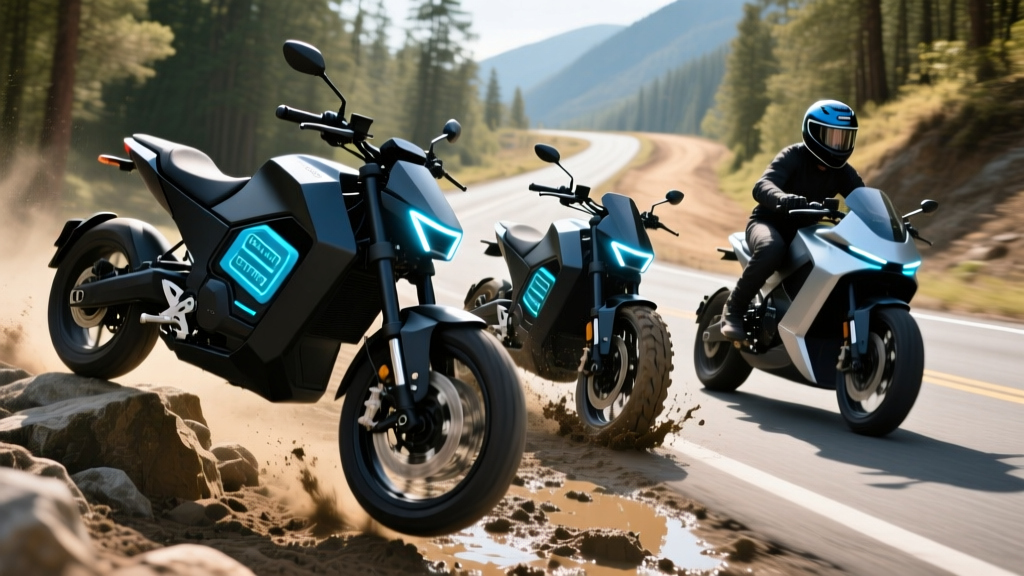
Quick Answer: The electric dual sport category in 2026 remains niche but viable for riders who prioritize low noise, zero trailside emissions, and minimal maintenance over long range. Current street-legal electric dual sport options like the Zero FXE (~$12,495) deliver 40–50 real-world mixed-use miles on a 7.2 kWh battery, while off-road-only models like the KTM Freeride E-XC (~$9,299) offer roughly 60–90 minutes of hard trail riding. Compared to gas dual sports averaging 60–100 miles on a 2–3 gallon tank, range is the primary trade-off — but charging at home costs roughly $0.50–$1.00 per full charge versus $8–$12 per fill-up.
Electric dual sport motorcycles occupy a narrow but growing slice of the EV market. Unlike four-wheeled EVs with 250+ mile ranges and DC fast-charging capability, electric dual sport bikes are constrained by battery packaging, weight distribution, and the physical limits of a motorcycle frame. This guide breaks down what's actually available in 2026, what the numbers mean in real riding conditions, and whether an electric dual sport makes sense for your riding pattern.
What Is an Electric Dual Sport — and What's Actually Available?
A dual sport motorcycle is designed for both on-road and off-road use, typically featuring street-legal lighting, mirrors, and registration alongside knobby tires, long-travel suspension, and skid plates. The electric dual sport applies battery-electric propulsion to this formula, replacing the single-cylinder gas engine with a motor, controller, and lithium-ion battery pack.
The 2026 market is limited. Here's what's currently in production and available for purchase:
| Model | Street Legal? | Battery (kWh) | Peak Power | Claimed Range | Weight (lbs) | MSRP |
|---|---|---|---|---|---|---|
| Zero FXE | Yes | 7.2 kWh (usable) | 46 hp / 70 lb-ft | 50 mi city (EPA-like) | 289 | $12,495 |
| Zero FX (Z-Force 7.2) | Yes (with kit) | 7.2 kWh | 46 hp / 70 lb-ft | 46 mi combined | 293 | $12,995 |
| KTM Freeride E-XC | No (off-road only) | 3.9 kWh | 24 hp / 31 lb-ft | ~60–90 min trail time | 245 | $9,299 |
| Sur-Ron Light Bee X | No (off-road only) | 2.3 kWh (60V) | 6 hp peak | ~40 mi (eco mode) | 110 | $4,500 |
The critical distinction: only the Zero FXE and Zero FX come street-legal from the factory or with a street-legal kit. The KTM Freeride E-XC and Sur-Ron are off-road machines — useful for trail systems and private land, but not registrable for highway use in most states.
Electric Dual Sport vs. Gas Dual Sport: The Numbers
The most common comparison shoppers make is against gas dual sport benchmarks like the Honda CRF300L ($5,399), Kawasaki KLR650 ($6,899), or Yamaha TW200 ($4,899). Here's how the ownership math actually breaks down:
| Metric | Zero FXE (Electric) | Honda CRF300L (Gas) |
|---|---|---|
| MSRP | $12,495 | $5,399 |
| Fuel/Energy Cost Per Mile | ~$0.01–$0.02 (home charging) | ~$0.10–$0.14 (gas at $3.80/gal, 70 MPG) |
| Real-World Range | 35–50 mi (mixed riding) | 130–180 mi (2.1 gal tank) |
| Refuel/Recharge Time | ~4.5 hours (Level 1, 120V) | ~2 minutes at pump |
| Oil Changes | None | Every 4,000 mi (~$40 each) |
| Air Filter Service | None | Every 8,000 mi |
| Chain Maintenance | Belt drive — minimal | Chain lube/adjust every 500 mi |
| Valve Adjustment | None | Every 16,000 mi (~$300) |
| Estimated 5-Year Maintenance | ~$400 (tires, brakes, fluid) | ~$2,200 (oil, filters, valves, chain) |
| Noise Level (stationary) | Silent | ~85 dB |
The upfront cost gap is significant: a Zero FXE costs roughly $7,100 more than a Honda CRF300L. Even with near-zero fuel and maintenance costs, the electric dual sport does not reach cost parity within a typical ownership period unless you ride very high mileage in urban commuting scenarios. The value proposition is instead about what the electric dual sport enables — silent trail riding where noise complaints close OHV areas, apartment-friendly ownership with no exhaust fumes, and dramatically simplified maintenance.
Real-World Range: What the Battery Actually Delivers
Manufacturer range claims for electric dual sport motorcycles are measured under optimal conditions — flat terrain, moderate throttle, 70°F ambient temperature. Real-world riding tells a different story, and understanding the variables is essential before purchasing.
Zero FXE (7.2 kWh usable, Z-Force battery):
- City commuting (25–35 mph): 45–55 miles achievable. Regenerative braking recaptures energy in stop-and-go traffic.
- Mixed on/off-road: 35–45 miles. Trail sections with elevation gain and loose surfaces increase energy consumption by 20–40%.
- Sustained highway (55–65 mph): 25–35 miles. Aerodynamic drag dominates at speed, and the FXE's upright dual sport posture creates significant wind resistance.
- Cold weather (below 40°F): Expect 15–25% range reduction. Lithium-ion internal resistance increases in cold, and the battery management system may limit discharge rate to protect cell health.
The Zero FXE uses NMC (nickel manganese cobalt) lithium-ion cells, which offer higher energy density than LFP (lithium iron phosphate) chemistry but are more sensitive to sustained high temperatures and deep discharge cycles. Zero Motorcycles warranties the battery for 5 years with no mileage cap, guaranteeing the pack retains at least 70% of original capacity — a reasonable threshold given that a 30% degradation on a 50-mile-range bike drops you to roughly 35 miles.
Real-World Range Reality: The Zero FXE's 50-mile city claim translates to approximately 35–45 miles in mixed riding, 25–35 miles at sustained highway speed, and as low as 20–28 miles in aggressive off-road use or cold weather. Plan your rides around 30 usable miles to maintain a safety margin.
Charging an Electric Dual Sport: Home, Time, and Infrastructure
Unlike electric cars, most electric dual sport motorcycles charge exclusively on Level 1 (standard 120V household outlet). This is both their greatest convenience and their greatest limitation.
| Charging Method | Power (kW) | Zero FXE (7.2 kWh) 0–100% | Availability |
|---|---|---|---|
| Level 1 (120V, 15A circuit) | ~1.3 kW | ~5.5 hours | Any household outlet |
| Zero Charge Tank accessory (adds Level 2) | ~2.8 kW (240V) | ~2.8 hours | Requires 240V outlet (dryer/outlet or installed circuit) |
| DC Fast Charging | N/A | Not supported | Not available on any current electric dual sport |
Here's what this means practically: if you ride 30 miles in a day and plug in at home when you return, the bike will be fully recharged by morning. The 1.3 kW Level 1 draw is gentle on household electrical systems — no panel upgrade, no special wiring, no electrician visit required. You're plugging in a motorcycle the same way you'd plug in a space heater.
However, the lack of DC fast charging is a hard constraint. You cannot pull up to a public charging station and add 20 miles in 10 minutes. If you deplete the battery on a ride, you're trailered home or waiting hours at a 120V outlet. This makes the electric dual sport fundamentally a local-use vehicle — excellent for commuting, trail loops near home, and urban errands, but unsuitable for adventure touring or long-distance dual sport routes like the Trans-America Trail.
Home charging cost breakdown:
- At the US average electricity rate of ~$0.16/kWh (EIA, 2025 data), a full 7.2 kWh charge on the Zero FXE costs approximately $1.15.
- Riding 40 miles per charge, that's roughly $0.029 per mile in energy cost.
- By comparison, a CRF300L at 70 MPG and $3.80/gallon costs $0.054 per mile in fuel.
- Annual savings at 3,000 miles/year: approximately $75 in fuel alone, plus $300–$500 in avoided maintenance.
Ownership Considerations: Who Should — and Shouldn't — Buy
The electric dual sport isn't for everyone, and being honest about limitations prevents expensive disappointment. Here's a decision framework based on real ownership patterns:
Choose an electric dual sport if:
- You ride primarily within 25 miles of home (commuting, local trails, errands)
- Noise restrictions affect your riding area (HOA rules, noise-sensitive trail systems, early-morning urban riding)
- You have access to a standard 120V outlet where you park (garage, carport, covered patio)
- You want near-zero maintenance between rides (no oil, no filters, no valve checks, no carburetor issues)
- You ride in areas where OHV access is threatened by noise complaints — silent electric operation helps preserve trail access
Stick with a gas dual sport if:
- You regularly ride routes longer than 50 miles between refueling points
- You adventure-tour or ride remote backcountry where charging access is nonexistent
- You need to refuel in under 5 minutes and keep moving
- Your budget is under $8,000 — the gas dual sport market offers proven, capable machines at half the price
- You ride in sustained sub-freezing temperatures where battery range drops 20%+ and trailside charging isn't an option
Insurance and registration: Electric motorcycles typically carry insurance premiums 10–20% higher than equivalent gas models due to higher replacement cost and limited repair network familiarity. Expect $200–$400/year for liability + comprehensive on a Zero FXE, depending on your state, age, and riding record. Registration fees are identical to gas motorcycles in most states; a few (California, Oregon) offer reduced registration fees for zero-emission vehicles.
Federal tax credit (§30D): As of 2026, the federal electric vehicle tax credit under IRS §30D applies to two- and three-wheeled electric vehicles that meet battery sourcing and MSRP requirements. The Zero FXE may qualify for up to $2,500 (the credit for motorcycles is lower than the $7,500 car credit) depending on battery component sourcing and your tax liability. Consult a tax professional — the credit is non-refundable and requires you to owe at least that amount in federal taxes. Point-of-sale transfer is available for qualifying purchases, reducing the dealer price directly.
Common Misconceptions About Electric Dual Sport Motorcycles
| Myth | Fact |
|---|---|
| "Electric dual sports have no power for real off-road use" | The Zero FX delivers 70 lb-ft of torque from zero RPM — more instantaneous torque than a CRF300L's 19 lb-ft. The limitation is sustained high-speed power and range, not low-speed trail capability. |
| "The battery will need replacing in 3 years" | Zero Motorcycles warranties the battery for 5 years with a 70% capacity retention guarantee. Real-world data from fleet operators shows 8–12% degradation over 5 years with normal use. Full replacement (if out of warranty) costs approximately $4,000–$5,500. |
| "You can't ride electric motorcycles in the rain or through water crossings" | The Zero FXE carries an IP67-rated battery enclosure and sealed motor. It handles rain, puddles, and shallow water crossings equivalent to gas dual sports. Deep submersion (above the motor housing) should be avoided, same as any motorcycle's air intake. |
| "Charging takes forever and you're always waiting" | If you charge at home between rides (the way most owners use these bikes), the bike is always full when you need it. The 5.5-hour Level 1 charge time only matters if you deplete the battery mid-day and need to ride again immediately. |
| "Electric dual sports are heavier than gas equivalents" | The Zero FXE weighs 289 lbs — comparable to the Honda CRF300L at 309 lbs wet. The KTM Freeride E-XC at 245 lbs is lighter than most 250cc gas enduros. Battery weight is offset by eliminating the engine, transmission, exhaust, and fuel tank. |
Long-Term Ownership: Battery Degradation, Resale, and Total Cost
Electric motorcycle battery degradation follows a similar curve to EVs: the most significant capacity loss occurs in the first 12–18 months (typically 3–5%), after which degradation slows to roughly 1–2% per year. For a 7.2 kWh pack, this means you'll likely have 6.3–6.6 kWh of usable capacity at year five — translating to roughly 40–42 real-world miles instead of 50.
Resale value remains an open question. Electric motorcycles depreciate faster than established gas dual sports, partly due to buyer unfamiliarity and partly due to battery health uncertainty. Expect a 3-year-old Zero FXE to retain 45–55% of its purchase price, versus 60–70% for a comparable CRF300L. The gap may narrow as the used-EV market matures and battery health reporting becomes standardized.
| 5-Year Cost Category | Zero FXE | Honda CRF300L |
|---|---|---|
| Purchase Price | $12,495 | $5,399 |
| Federal Tax Credit (est.) | –$2,500 | $0 |
| Net Purchase | $9,995 | $5,399 |
| Fuel/Energy (15,000 mi total) | $435 | $815 |
| Maintenance (5 years) | $400 | $2,200 |
| Insurance (5 years, est.) | $1,500 | $1,200 |
| Total 5-Year Cost | $12,330 | $9,614 |
| Estimated Resale Value | $5,500 | $3,500 |
| Net Cost of Ownership | $6,830 | $6,114 |
The net cost gap narrows to roughly $700 over five years when accounting for the tax credit, fuel savings, and maintenance savings. For riders who value silence, zero trailside emissions, and minimal wrenching, that premium is justifiable. For riders who need range, quick refueling, and maximum resale, the gas dual sport remains the practical choice.
Frequently Asked Questions
Can I ride an electric dual sport on highways?
Yes, the Zero FXE is street-legal and capable of 70+ mph. However, sustained highway speeds drain the battery rapidly — expect 25–35 miles of range at 60 mph. It's viable for short highway commutes (10–15 miles each way) but not long-distance highway touring.
Do electric dual sport motorcycles qualify for the federal EV tax credit?
Potentially. Under IRS §30D rules, two-wheeled electric vehicles may qualify for a credit of up to $2,500 (10% of the purchase price, capped at $2,500 for motorcycles). Eligibility depends on battery component sourcing, your federal tax liability, and the manufacturer's compliance with critical mineral requirements. Confirm eligibility with the dealer and a tax professional before purchase.
How long do electric motorcycle batteries last?
Zero Motorcycles warranties its Z-Force battery for 5 years with no mileage limit, guaranteeing 70% capacity retention. Real-world data suggests 8–12% degradation over 5 years with typical use. With proper care (avoiding prolonged storage at 100% or 0% charge, minimizing exposure to extreme heat), the battery should remain functional for 8–12 years before degradation makes the bike impractical for anything beyond short rides.
Can I charge an electric dual sport from a standard household outlet?
Yes. All current electric dual sport models charge on a standard 120V/15A household outlet. The Zero FXE draws approximately 1.3 kW and charges from 0–100% in about 5.5 hours. No electrical upgrades or special equipment are required — you plug it in the same way you'd plug in any household appliance.
Are electric dual sports good for beginners?
They can be excellent beginner bikes: no clutch, no gears, instant but controllable torque, and a lightweight chassis (the FXE at 289 lbs is manageable for most riders). The silent operation also reduces beginner intimidation. However, the limited range means a beginner shouldn't plan rides that exceed the battery's realistic 30–40 mile envelope without a charging plan.
What happens if the battery dies on a trail?
Unlike a gas bike that can be kick-started or siphoned fuel from a companion, a dead electric dual sport battery means the bike must be physically pushed, loaded onto a truck, or carried to a 120V outlet. There is no field-recharge option without a portable generator. Plan rides conservatively and turn back with 20% battery remaining.
The electric dual sport segment in 2026 is real but constrained. If your riding pattern fits within a 30-mile radius of home, you have access to a household outlet, and you value silence and simplicity over range and adventure-touring capability, the Zero FXE is the most complete street-legal option available. If you need to ride 100 miles between fuel stops, explore remote backcountry, or operate on a sub-$6,000 budget, a gas dual sport remains the right tool. The technology is improving — expect battery energy density gains and faster charging to widen the electric dual sport's practical envelope within the next few model years — but today's buyer should purchase for what these bikes are, not what future iterations might become.