Quick Answer: Is an Electric Delivery Vehicle Worth It in 2026?
For last-mile urban and suburban delivery routes under 150 miles per day with depot charging access, a commercial electric delivery vehicle cuts per-mile operating costs by 40–60% compared to a gasoline or diesel van. Expect $0.08–$0.14 per mile in electricity versus $0.22–$0.35 per mile in fuel, plus 30–50% lower maintenance spend. However, if your routes exceed 200 daily miles, lack overnight depot charging, or operate in sustained sub-20°F climates without preconditioning infrastructure, a conventional or hybrid van remains the safer financial bet today.
The 2026 Commercial EV Van Landscape
The electric delivery vehicle market has consolidated around a handful of proven platforms after several high-profile startups exited or pivoted. The vehicles currently dominating fleet purchase orders share common traits: 150–250 miles of EPA-estimated range, 110–170 kW DC fast charging capability, and cargo volumes between 250 and 480 cubic feet. Here is how the major contenders stack up.
| Spec | Ford E-Transit (2026) | BrightDrop Zevo 600 (2026) | Mercedes-Benz eSprinter (2026) | Rivian EDV 700 (2026) |
|---|---|---|---|---|
| EPA Range | 126 mi (low-roof) | ~160 mi (est.) | ~150 mi (est.) | ~161 mi (est.) |
| Usable Battery | 68 kWh (NMC) | ~115 kWh (NMC) | ~113 kWh (NMC) | ~106 kWh (NMC) |
| Max DC Fast Charge | 115 kW | ~150 kW | ~115 kW | ~150 kW |
| 10–80% DC Time | ~45 min | ~40 min (est.) | ~42 min (est.) | ~38 min (est.) |
| Level 2 Rate | 10.5 kW | 11.5 kW | 9.6 kW | 11.5 kW |
| Horsepower | 266 hp | ~240 hp | 201 hp | ~250 hp |
| Cargo Volume | 246–487 cu ft | ~412 cu ft | ~312 cu ft | ~660 cu ft (max) |
| Payload Capacity | ~3,880 lbs | ~2,700 lbs | ~2,600 lbs | ~2,735 lbs |
| Starting MSRP | ~$48,000 | ~$60,000 (est.) | ~$55,000 (est.) | Fleet/contract |
| Warranty | 8 yr / 100k mi (batt.) | 8 yr / 100k mi (batt.) | 8 yr / 100k mi (batt.) | 8 yr / 175k mi (batt.) |
Real-world range caveat: These EPA estimates assume moderate temperatures and mixed driving. In actual last-mile delivery use — frequent stops, idling for loading, and low-speed urban cycling — expect range to track close to EPA figures because stop-and-go driving favors EV efficiency. However, sustained highway segments at 65+ mph will drop range by 15–25%. In sub-30°F weather without a heat pump or preconditioning, plan for 25–40% range reduction.
Electric Delivery Vehicle vs. Gas Van: The Real Cost Breakdown
The purchase price of an electric delivery vehicle runs $10,000–$20,000 higher than an equivalent internal combustion van. The economic case rests entirely on operating-cost recovery over the vehicle's service life. Here is a side-by-side comparison based on a typical last-mile route profile: 120 miles/day, 250 working days/year, over 5 years (150,000 total miles).
| Cost Category (5-Year) | Ford E-Transit (EV) | Ford Transit 250 Gas Van | Difference |
|---|---|---|---|
| Purchase Price (MSRP) | $48,000 | $43,000 | +$5,000 (EV) |
| Federal Commercial Clean Vehicle Credit (§45W) | −$7,500 | $0 | −$7,500 (EV) |
| Depot Charger Install (shared/vehicle) | $3,500 | $0 | +$3,500 (EV) |
| Net Acquisition Cost | $44,000 | $43,000 | +$1,000 (EV) |
| Fuel/Energy (150k miles) | $5,040 (at $0.14/kWh, 2.5 mi/kWh) | $18,750 (at $3.50/gal, 14 MPG) | −$13,710 (EV) |
| Maintenance | $3,200 | $7,800 | −$4,600 (EV) |
| Insurance (est.) | $11,500 | $9,800 | +$1,700 (EV) |
| Tires (heavier vehicle wear) | $2,400 | $1,800 | +$600 (EV) |
| Total 5-Year Cost | $66,140 | $81,150 | −$15,010 (EV) |
Source data references: fueleconomy.gov EV efficiency data and IRS §45W commercial clean vehicle credit guidelines.
Key insight: The EV delivery van breaks even on its higher acquisition cost within roughly 18–24 months of daily operation, then generates net savings for the remainder of its service life. The savings widen further if your depot electricity rate falls below $0.12/kWh or if you can schedule charging during off-peak utility hours.
Charging Infrastructure: What Fleet Operators Actually Need
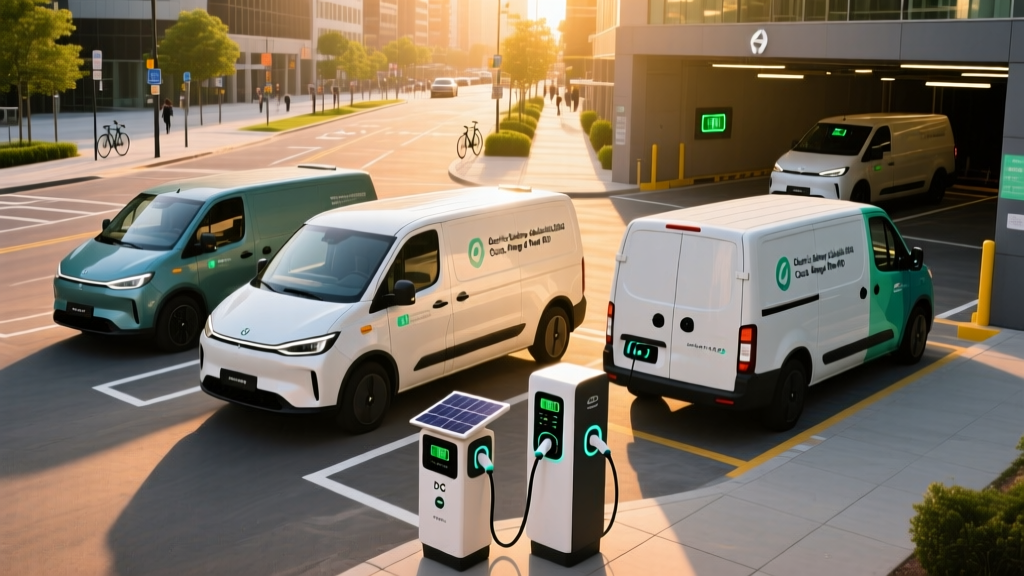
The single biggest barrier to electric delivery vehicle adoption is not the vehicle — it is depot charging infrastructure. Here is what a realistic installation looks like for a small fleet of 5–10 vans.
| Component | Cost Range (per stall) | Notes |
|---|---|---|
| Level 2 Charger (11.5 kW) | $800–$2,500 | Commercial-rated units; Wi-Fi enabled for fleet management |
| Electrical Panel Upgrade | $2,000–$8,000 | Required if existing service cannot handle added load; 400A+ service common for 5+ chargers |
| Conduit, Wiring, Trenching | $1,500–$5,000 | Highly variable by site; parking-lot trenching drives cost |
| Electrician Labor | $2,000–$6,000 | Commercial rates; licensed electrician required |
| Permits & Utility Interconnection | $500–$3,000 | Utility may require demand study for large installations |
| Network/Software (annual) | $200–$500/yr | Fleet management software for scheduling and load balancing |
| Total per Stall | $7,000–$24,500 | Average small-fleet install: ~$10,000–$14,000 per stall |
Critical power distinction: kW (kilowatts) is the rate of power delivery — how fast energy flows. kWh (kilowatt-hours) is the total energy stored in the battery. A 68 kWh battery charged at 11.5 kW takes roughly 6 hours from empty. Overnight depot charging on Level 2 is sufficient for most last-mile routes that return to base each evening. DC fast charging (100–150 kW) is useful for mid-day top-ups but should not be the primary charging strategy — frequent DC fast charging accelerates battery degradation and incurs higher demand charges from your utility.
Load management tip: For fleets of 5+ vehicles, invest in smart load-balancing software. Charging 10 vans simultaneously at 11.5 kW draws 115 kW continuously — enough to trigger utility demand charges of $10–$25 per peak kW per month in many commercial rate structures. Staggered or software-managed charging can cut demand charges by 30–50%.
Real-World Ownership: Route Planning, Climate, and Battery Longevity
Route-to-Range Matching
The cardinal rule of electric delivery vehicle deployment: your daily route must consume no more than 70–75% of rated range under worst-case conditions. For a van rated at 126 miles EPA, that means planning routes of 90–95 miles maximum in cold weather. For a 160-mile van, plan for 115–120 miles worst-case. This buffer accounts for:
- Cold-weather range loss (25–40% below 30°F without preconditioning)
- Highway segments that reduce efficiency vs. urban stop-and-go
- Detours, traffic idling with HVAC running, and payload weight variation
- Battery degradation over years 4–8 of service (expect 10–15% capacity loss by year 5)
Battery Degradation and Warranty Reality
Commercial delivery use is actually gentler on batteries than consumer use in some respects. Fleet vehicles charge predictably on Level 2 overnight, rarely sit at 100% state of charge for extended periods, and benefit from managed charging profiles. Most manufacturers warrant their commercial EV batteries at 70% capacity retention for 8 years or 100,000 miles (Rivian extends to 175,000 miles for fleet contracts).
Independent fleet data suggests NMC batteries in delivery service retain 80–85% of original capacity at 100,000 miles when charged primarily on Level 2. Battery replacement costs remain significant — $12,000–$22,000 depending on the platform — but are rarely needed within the first 8 years of commercial use under normal charging protocols.
What About Routes Without Depot Charging?
If your operation relies on street parking, shared lots, or routes that do not return to a central depot, the electric delivery vehicle equation becomes far more difficult. Public DC fast charging at $0.30–$0.48/kWh eliminates most of the fuel-cost advantage and introduces downtime (40+ minutes per session) and reliability risk. For these operations, a plug-in hybrid or conventional van with a transition plan remains more practical until depot or dedicated yard charging is available.
Tax Credits and Incentives for Commercial EV Fleets
Commercial electric delivery vehicles do not qualify for the consumer §30D tax credit. Instead, they fall under IRS §45W — the Commercial Clean Vehicle Credit. Key parameters for 2026:
- Maximum credit: $7,500 for vehicles under 14,000 lbs GVWR; $40,000 for heavier vehicles
- Eligibility: Must be purchased for business use and placed in service in the US
- No MSRP cap (unlike the consumer credit)
- No buyer income cap
- Battery sourcing requirements apply: Battery components must meet progressive domestic-content thresholds that tighten annually through 2029
- Point-of-sale transfer: Available for commercial credits — you can transfer the credit to the dealer for an upfront price reduction
- Stacking: Some states and utilities offer additional rebates ($2,500–$10,000) on top of federal credits; check your state energy office and local utility
Always verify current-year eligibility with a tax professional — battery sourcing rules change annually, and specific vehicle configurations may or may not meet the threshold in a given model year.
Common Misconceptions About Electric Delivery Vans
| Myth | Fact |
|---|---|
| "EVs can't handle stop-and-go delivery routes." | Stop-and-go is actually where EVs excel. Regenerative braking recaptures energy during deceleration, and electric motors are most efficient at low speeds. Urban delivery routes often yield better-than-EPA efficiency. |
| "Batteries will need replacing every 3–5 years." | Modern NMC commercial batteries are warrantied for 8 years / 100,000+ miles at 70% retention. Fleet data shows 80–85% retention at 100k miles with Level 2 depot charging. |
| "Charging takes too long for commercial use." | Overnight Level 2 charging (6–8 hours) fully replenishes any delivery van battery. DC fast charging is a backup option, not a daily requirement. |
| "Electric vans cost more to insure, wiping out savings." | Commercial EV insurance runs 10–20% higher due to repair costs and parts pricing. On a 5-year TCO, this adds ~$1,500–$2,500 — a fraction of the $13,000+ fuel savings. |
| "Cold weather makes EV delivery impossible." | Cold reduces range by 25–40%, but depot preconditioning (warming the van while still plugged in) mitigates this significantly. Routes planned at 65–70% of rated range remain viable in most US climates. |
Decision Framework: Should Your Fleet Go Electric?
Choose an Electric Delivery Vehicle If:
- Your average daily route is under 150 miles (or under 100 miles in cold-climate regions)
- Vehicles return to a depot or yard overnight where Level 2 chargers can be installed
- Your operation is primarily urban or suburban with frequent stops (parcel delivery, food distribution, service calls)
- You can access the §45W commercial clean vehicle credit and any state/utility incentives
- Your fleet replacement cycle aligns with a 5–8 year vehicle hold period (to capture full TCO savings)
Stick With Gas, Diesel, or Hybrid If:
- Daily routes regularly exceed 200 miles or include long highway segments between metro areas
- No depot charging access and no feasible path to install it (street-parked urban fleets, shared lots)
- Operations are in sustained sub-0°F regions where range loss and battery heating demands are extreme
- Your fleet turns vehicles every 2–3 years (insufficient time to recover the acquisition premium)
- You need heavy towing or upfitting that pushes payload beyond the EV platform's capacity
Frequently Asked Questions
What is the cheapest electric delivery vehicle available in 2026?
The Ford E-Transit remains the entry-price leader at approximately $48,000 MSRP before incentives. After the $7,500 §45W credit, effective cost drops to roughly $40,500 — competitive with a well-equipped gas Transit 250. Its trade-off is shorter range (126 mi EPA) compared to rivals, which suits routes under 90 miles.
How much does it cost to charge an electric delivery van per day?
At a commercial electricity rate of $0.12/kWh and an efficiency of 2.5 miles per kWh, a 120-mile daily route consumes approximately 48 kWh, costing $5.76. The same route in a gas van at 14 MPG and $3.50/gallon costs $30.00 in fuel. That is a daily savings of roughly $24 per vehicle.
Can I use a Tesla Supercharger with a commercial EV delivery van?
No. Tesla's Supercharger network uses the NACS connector and is designed for passenger vehicles. Commercial delivery vans use CCS1 connectors (or NACS on some newer platforms) and rely on depot Level 2 charging plus commercial DC fast-charging networks like Electrify America, EVgo, or ChargePoint's commercial offerings. Van dimensions also make most Supercharger stalls impractical.
Do electric delivery vans qualify for the $7,500 consumer tax credit?
No. Commercial fleet vehicles purchased for business use fall under the §45W Commercial Clean Vehicle Credit, not the §30D consumer credit. The maximum credit is the same $7,500 for vehicles under 14,000 lbs GVWR, but the eligibility rules differ — there is no MSRP cap or buyer income cap, though battery sourcing requirements still apply. Consult a tax professional for your specific situation.
What happens if the battery fails out of warranty?
Battery replacement costs range from $12,000 to $22,000 depending on the platform and battery size. However, catastrophic battery failure is rare. Gradual degradation to 70–80% capacity over 8–10 years is the norm, and many fleets continue operating vehicles at reduced range or reassign them to shorter routes rather than replacing the battery outright. Third-party battery refurbishment services are emerging as a lower-cost alternative to full replacement.
Is an electric delivery van practical for rural routes?
Generally no, unless the rural route is short and the vehicle returns to a depot with charging access. Rural delivery often involves long distances at highway speeds (where EV efficiency drops 15–25%), limited charging infrastructure, and routes exceeding 200 miles. For these applications, a diesel or hybrid van remains more practical in 2026.