If you have been searching for an electric converter for car projects, you are likely looking at EV conversion kits that replace a gas engine with an electric motor and battery pack. Here is the direct answer: while it is mechanically possible to convert a combustion vehicle to electric using an aftermarket kit, the process typically costs between $10,000 and $40,000+ (excluding the donor vehicle), yields 80–180 miles of real-world range depending on battery size, and requires significant technical skill or expensive professional labor. For most buyers in 2026, purchasing a used or new production EV remains more practical, more reliable, and often cheaper when factoring in federal tax credits, warranties, and safety certifications.
Quick Answer: EV Conversion at a Glance
- Average conversion cost: $10,000–$40,000 (parts and labor, excluding donor car)
- Typical range after conversion: 80–180 miles (varies by battery kWh installed)
- Time to complete: 200–500+ hours for a competent DIY builder
- Street legality: Varies by state; many states require special inspection or do not permit converted vehicles easily
- Better alternative for most: A used EV like the Chevy Bolt EUV (~$18,000–$25,000 used, 247 miles EPA range) or a new Tesla Model 3 ($38,990 MSRP, 346 miles EPA)
What Is an Electric Converter for Car Projects?
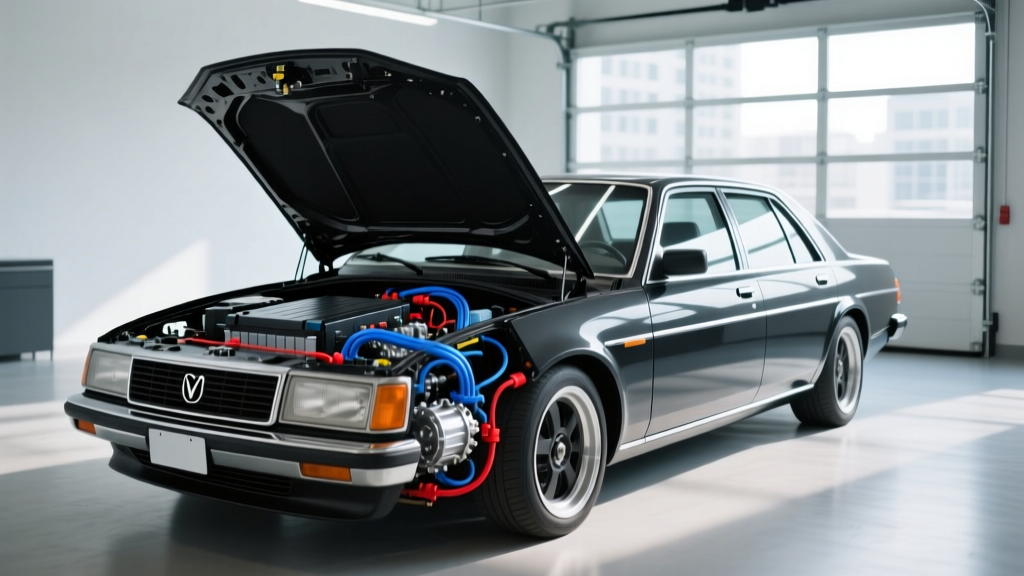
An electric converter for car applications—more accurately called an EV conversion kit—is a collection of components that replaces an internal combustion engine (ICE), fuel tank, and exhaust system with an electric motor, motor controller, high-voltage battery pack, and associated wiring. The term "electric converter" is sometimes confused with power electronics (like a DC-DC converter or onboard charger), but in the context of vehicle conversions, it refers to the full powertrain swap.
A typical conversion kit includes:
- Electric motor: Usually an AC induction or permanent magnet motor (50–150 kW output typical for conversions)
- Motor controller: Manages power delivery from battery to motor
- Battery pack: Lithium-ion cells (often repurposed from Nissan Leaf, Tesla modules, or new LFP cells), typically 20–60 kWh usable capacity
- Battery Management System (BMS): Monitors cell voltage, temperature, and State of Health (SoH)
- DC-DC converter: Steps down high-voltage DC to 12V for accessories (lights, wipers, infotainment)
- Onboard charger: Allows Level 1/Level 2 AC charging from the grid
- Throttle adapter, mounts, and custom fabrication hardware
Popular kit suppliers in 2026 include EV West, Electric GT, and NetGain, with kit prices ranging from $6,000 for a basic 50 kW setup to over $25,000 for a high-performance package with a 60+ kWh battery.
EV Conversion Cost Breakdown: What You Will Actually Spend
The sticker price of a conversion kit is only the beginning. Here is a realistic cost breakdown based on common conversion builds in 2026:
| Component / Service | DIY Build (Budget) | Professional Build |
|---|---|---|
| Donor vehicle (used ICE car) | $2,000–$5,000 | $2,000–$8,000 |
| EV conversion kit (motor, controller, mounts) | $6,000–$12,000 | $8,000–$18,000 |
| Battery pack (20–60 kWh) | $4,000–$12,000 | $8,000–$20,000 |
| BMS, DC-DC converter, wiring, charger | $1,500–$4,000 | $2,000–$6,000 |
| Fabrication and labor | $0 (your time, 200–500 hrs) | $8,000–$20,000 |
| Inspection, registration, title work | $500–$2,000 | $500–$2,000 |
| Total estimated cost | $14,000–$35,000 | $28,500–$74,000 |
To put this in perspective: a 2025 Chevrolet Equinox EV starts at approximately $33,600 MSRP, delivers 315 miles of EPA range, qualifies for the federal §30D tax credit (up to $7,500 at point of sale for eligible buyers), and comes with an 8-year/100,000-mile battery warranty. The math rarely favors a conversion unless you are deeply committed to a specific classic or specialty vehicle.
EV Conversion vs. Buying a New or Used EV: Data Comparison
Here is how a typical EV conversion stacks up against production EVs available in 2026:
| Attribute | DIY EV Conversion | Used Chevy Bolt (2022–2023) | New Tesla Model 3 (2026) |
|---|---|---|---|
| Total cost | $14,000–$35,000+ | $18,000–$25,000 | $38,990 (before credit) |
| EPA or estimated range | 80–180 mi (not EPA-certified) | 247–259 mi (EPA) | 346 mi (EPA) |
| Battery capacity | 20–60 kWh (varies) | 65 kWh (NMC) | ~60 kWh (LFP, RWD) / ~75 kWh (NMC, LR) |
| DC fast charging | Usually none or very slow (3–20 kW) | 55 kW peak, 10–80% in ~45 min | 170–250 kW peak, 10–80% in ~20–25 min |
| Battery warranty | None (or cell manufacturer only) | 8 yr / 100,000 mi (remaining) | 8 yr / 120,000 mi |
| Federal tax credit (§30D) | Not eligible | Used EV credit up to $4,000 (§25E) | Up to $7,500 (if eligible) |
| Safety ratings (NHTSA/IIHS) | Not crash-tested post-conversion | NHTSA 5-star, IIHS Top Safety Pick | NHTSA 5-star, IIHS Top Safety Pick+ |
| Insurance availability | Limited; specialty insurers only | Standard insurers | Standard insurers |
The data is clear: a production EV wins on range, charging speed, warranty, safety, and total cost in almost every scenario. Conversions make sense primarily for vintage or specialty vehicles where no production EV equivalent exists—think classic Porsche 911s, vintage VW buses, or fleet/commercial vehicles with specific body requirements.
Real-World Ownership Considerations Before Converting
If you are seriously considering an electric converter for car projects, these practical factors will determine whether the build is viable for your situation:
Home Charging Access
Most conversions support only Level 1 (120V, ~1.4 kW) or Level 2 (240V, 3.3–7.2 kW) charging. Without DC fast charging capability, a converted car is effectively limited to local driving unless you can charge at home overnight. If you live in an apartment without charging access, a conversion becomes impractical for daily use.
Climate and Range Impact
Converted vehicles rarely include the sophisticated thermal management systems found in production EVs. In cold weather (below 32°F), expect 20–35% range loss from a conversion with an air-cooled battery pack, compared to roughly 10–20% loss in a production EV with a heat pump and active battery preconditioning. A conversion with 150 miles of rated range may deliver only 100 miles in a Minnesota winter.
Driving Patterns
Conversions suit low-mileage, predictable commutes. If your daily round trip is under 60 miles and you can charge at home, a conversion with a 30–40 kWh pack is adequate. For frequent highway driving, road trips, or towing, the limited range, lack of fast charging, and reduced top speed of most conversions make them impractical.
Legal and Registration Hurdles
State laws on EV conversions vary dramatically. California, Oregon, and a few others have established inspection pathways for converted vehicles. Many states have no clear process, meaning you may face difficulties obtaining a title, registration, or insurance. Check your state DMV requirements before purchasing any kit.
Common EV Conversion Misconceptions: Myth vs. Fact
| Myth | Fact |
|---|---|
| "I can convert any car for under $5,000." | Realistic conversions cost $14,000–$35,000+ including the donor vehicle. Budget kits under $5,000 typically yield under 50 miles of range and require extensive custom fabrication. |
| "Converted EVs are just as efficient as production EVs." | Conversions are typically heavier (due to non-optimized weight distribution) and less aerodynamic, yielding 2.5–4.0 kWh/mile compared to 3.0–3.5 mi/kWh (250–330 Wh/mile) in production EVs. Real-world efficiency is often 20–40% worse. |
| "I will get fast charging on a converted EV." | Most conversion kits do not support DC fast charging (CCS or NACS). Adding CCS capability requires an expensive DC-DC fast-charge module ($2,000–$5,000+) and is not universally compatible. |
| "A conversion qualifies for the federal EV tax credit." | IRS §30D and §25E credits apply only to qualifying production vehicles from certified manufacturers. Converted vehicles are not eligible. See IRS guidelines on clean vehicle credits. |
| "Conversions are maintenance-free." | While conversions eliminate oil changes and exhaust repairs, they introduce new maintenance concerns: battery cell balancing, BMS calibration, contactor wear, cooling system upkeep, and custom-fabricated mount fatigue. Budget for ongoing electrical diagnostics. |
| "Any mechanic can service a converted EV." | Most general mechanics will not touch a one-off conversion due to liability and unfamiliarity. You will likely need to self-service or find a specialized EV conversion shop, which are rare and expensive. |
When Does an EV Conversion Actually Make Sense?
Despite the cost and complexity, EV conversions have legitimate use cases. Here is a practical decision framework:
Should You Convert or Buy?
Choose an EV conversion if:
- You own a classic, vintage, or specialty vehicle you want to preserve and drive regularly (e.g., 1965–1980 Porsche 911, VW Type 2, classic Ford truck)
- You have advanced mechanical and electrical skills (or a trusted conversion shop) and enjoy multi-month fabrication projects
- The vehicle is for local driving only (under 80 miles/day) and you have reliable home Level 2 charging
- You value the project experience and uniqueness over warranty, safety ratings, and resale value
- You understand the converted vehicle will likely depreciate faster than a production EV and may be difficult to insure or sell
Choose a production EV (new or used) if:
- You need reliable daily transportation with 200+ miles of range
- You want DC fast charging for road trips or highway driving
- You need NHTSA/IIHS safety ratings and standard airbag systems
- You want to take advantage of the federal §30D tax credit (up to $7,500 for new EVs) or §25E credit (up to $4,000 for used EVs)
- You want a manufacturer battery warranty (8 years/100,000+ miles) and dealer service network
- Your total budget is under $25,000 (a used Bolt, Bolt EUV, or Nissan Leaf is more practical and cheaper)
What First-Time EV Buyers Should Know Instead
If you are researching electric converters for car projects because you want an affordable entry into EV ownership, there are far more practical paths in 2026:
- Used EVs under $25,000: The 2022–2023 Chevrolet Bolt (259 mi EPA), Nissan Leaf SV Plus (212 mi EPA), and Hyundai Kona Electric (258 mi EPA) are widely available with remaining battery warranty. The §25E used EV credit offers up to $4,000 (30% of sale price, max $4,000) for eligible buyers on vehicles priced under $25,000.
- New EVs under $40,000: The 2026 Tesla Model 3 RWD ($38,990, 346 mi EPA), Chevy Equinox EV ($33,600, 315 mi EPA), and Hyundai Ioniq 5 ($42,450, 303 mi EPA) offer modern range, fast charging, and full tax credit eligibility.
- PHEV alternative: If charging access is uncertain, a plug-in hybrid like the Toyota RAV4 Prime (42 mi electric-only, 94 MPGe combined) provides electric commuting without range anxiety, starting around $43,000.
For first-time EV buyers, the priorities should be: (1) confirm you can install Level 2 home charging (expect $500–$2,000 for a 240V/48A circuit and charger), (2) check your federal and state incentive eligibility via fueleconomy.gov, and (3) choose a vehicle whose EPA range exceeds your longest typical drive day by at least 30% to account for cold weather and highway efficiency loss.
Frequently Asked Questions
Can I convert any gas car to electric?
Technically, yes—any vehicle with an internal combustion engine can be converted. However, lighter vehicles (under 3,000 lbs curb weight) with manual transmissions are the easiest and most efficient candidates. Heavy trucks and SUVs require much larger (and more expensive) battery packs to achieve usable range, and automatic transmissions add complexity because the torque converter must be replaced or bypassed.
How long does an EV conversion take?
A competent DIY builder working evenings and weekends should expect 200–500 hours over 3–12 months. Professional shops typically quote 4–8 weeks of calendar time, but lead times for parts and shop availability can extend this significantly.
Is it legal to drive a converted EV on public roads?
It depends on your state. Some states like California have a special inspection process for converted vehicles (through the California DMV enhanced emissions/verification program). Other states have no pathway, meaning your conversion may not be registrable for street use. Always check your state DMV and DOT requirements before beginning a project.
What range can I expect from a conversion?
Range depends on battery capacity (kWh) and vehicle efficiency. A typical conversion with a 40 kWh usable battery in a lightweight coupe (efficiency of ~3.0 mi/kWh) will deliver approximately 120 miles of real-world range. Add 20–30% buffer for cold weather or highway driving. This is significantly less than production EVs, which average 250–350 miles EPA.
Can a converted EV use Tesla Superchargers or public DC fast chargers?
Almost never. Most conversions lack DC fast-charge capability entirely. Even if you add a CCS-compatible inlet and fast-charge module, communication protocol compatibility with networks like Electrify America, EVgo, or Tesla Superchargers is not guaranteed, and many networks will not authenticate a vehicle with a non-standard VIN.
Is an EV conversion cheaper than buying a used EV?
No, in nearly every case. A well-executed conversion costs $14,000–$35,000+ and produces a vehicle with 80–180 miles of range, no warranty, no safety ratings, and limited insurance options. A used 2022 Chevrolet Bolt can be purchased for $18,000–$22,000, delivers 259 miles of EPA range, includes DC fast charging, and may qualify for the $4,000 used EV tax credit.