Quick Answer: Is an Electric Conversion Kit for a VW Bug Worth It?
An electric conversion kit for a VW Bug (classic Beetle, 1950–1979) typically costs between $9,000 and $25,000+ for parts alone, with professional installation pushing total project costs to $20,000–$50,000. Expect 50–150 miles of real-world range depending on battery capacity (usually 15–40 kWh of usable lithium-ion or LFP cells), a top speed of 70–90 mph, and Level 2 charging that refills the pack in 3–8 hours. Conversions are best suited for enthusiasts who want a zero-emission classic for city driving and weekend use — not as a primary commuter or road-trip car. If you need reliable daily transportation with 250+ miles of range, a modern production EV like the Chevrolet Equinox EV (~$33,000, 319 mi EPA) will cost the same or less and deliver far more practicality.
What Exactly Is a VW Bug EV Conversion Kit?
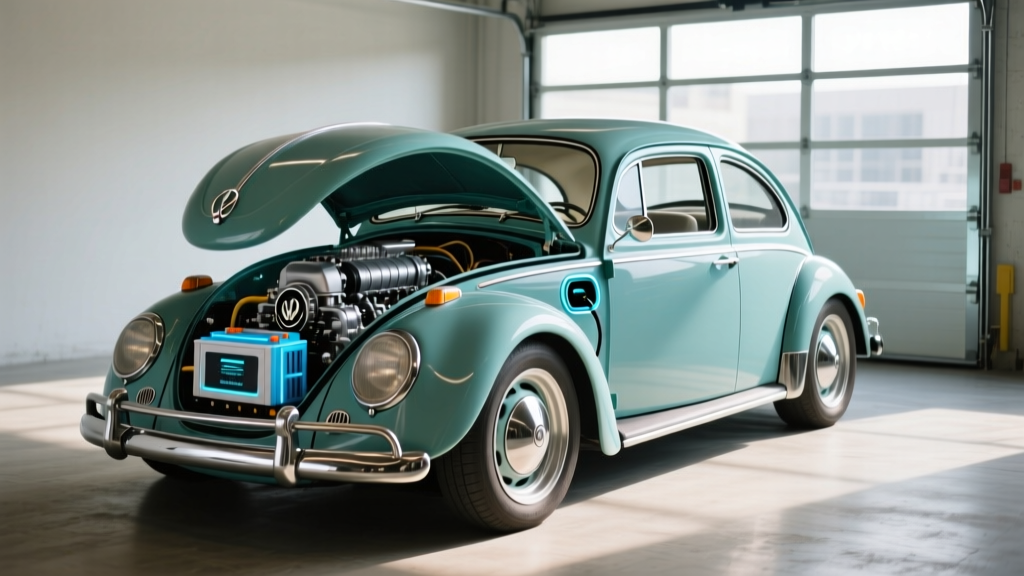
An electric conversion kit replaces the Beetle's original air-cooled flat-four gasoline engine, fuel tank, and exhaust system with an electric motor, motor controller, battery pack, onboard charger, and DC-DC converter. The most popular kits and approaches for the classic VW Beetle include:
- Hub-motor or trans-axle adapter kits — Companies like EV West and Electric Classics have historically offered adapter plates that mate an electric motor (commonly a NetGain Hyper9 or similar AC motor) to the Beetle's original transaxle, preserving the rear-engine, rear-wheel-drive layout.
- Complete turnkey kits — Some suppliers bundle the motor, controller, battery modules, BMS (battery management system), charger, throttle assembly, and wiring harness. Prices for these comprehensive packages typically run $12,000–$22,000 before batteries.
- Custom/builder-sourced builds — Experienced fabricators source individual components (e.g., a Cascadia Motion iDM or a salvaged Tesla drive unit) and engineer a custom solution. These builds can exceed $30,000 in parts.
The battery pack is usually the single largest expense. A 20–30 kWh usable pack built from new LFP (lithium iron phosphate) prismatic cells might cost $4,000–$8,000, while higher-energy NMC modules (salvaged from a Nissan Leaf or Chevrolet Bolt, for example) can range from $3,000–$6,000 depending on condition and capacity.
Performance, Range, and Charging: The Real Numbers
Marketing materials from kit manufacturers often highlight peak horsepower figures, but the numbers that matter for daily driving are usable battery capacity (kWh), sustained motor power (kW), and charging rate. Here's what a typical VW Beetle EV conversion delivers:
| Specification | Budget Build | Mid-Range Build | High-End Build |
|---|---|---|---|
| Battery Capacity (usable) | 15–20 kWh | 25–35 kWh | 40–60 kWh |
| Battery Chemistry | Salvaged NMC | New LFP or NMC | New NMC/LFP |
| Motor Power (peak) | 40–60 kW (54–80 hp) | 70–100 kW (94–134 hp) | 100–150 kW (134–201 hp) |
| EPA-Equivalent Range | 50–70 mi | 80–120 mi | 120–160 mi |
| Real-World Range (mixed) | 40–55 mi | 65–100 mi | 100–135 mi |
| 0–60 mph | 12–16 sec | 8–11 sec | 5–7 sec |
| Top Speed | 65–75 mph | 80–90 mph | 95–110 mph |
| Level 2 Charge Rate | 1.9–3.3 kW | 3.3–6.6 kW | 6.6–11.5 kW |
| Full Charge Time (L2) | 8–12 hr | 5–8 hr | 4–6 hr |
| DC Fast Charging | No | Rarely | Optional (add $2K–$5K) |
| Regenerative Braking | Limited | Yes | Yes, adjustable |
Real-World Range Reality
Unlike modern production EVs tested under EPA cycles, conversion range varies dramatically with driving style, terrain, temperature, and auxiliary loads. A Beetle conversion with 30 kWh usable that achieves 100 miles at 55 mph on a flat road in 70°F weather may deliver only 60–70 miles at 70 mph on the highway, and as few as 45–55 miles in 30°F cold (LFP batteries lose 20–30% capacity in freezing temps; NMC fares slightly better at 10–20% loss). There's no heat pump in most conversions — cabin heat draws directly from the traction battery via a resistive heater or no heater at all, which can cut winter range by 30–40%.
EV Conversion vs. Buying a Modern EV: Cost Comparison
The economics of a Beetle EV conversion rarely pencil out as a money-saving strategy. This is a passion project, not a frugal transportation choice. Here's how a mid-range conversion stacks up against purchasing a modern affordable EV:
| Category | VW Bug Conversion (Mid-Range) | 2026 Chevy Equinox EV 2LT | 2026 Hyundai Kona Electric SE |
|---|---|---|---|
| Vehicle Acquisition / Build | $8,000 (donor car) + $25,000 (kit + install) = $33,000 | $33,600 MSRP | $32,975 MSRP |
| Federal Tax Credit (§30D) | $0 (not eligible) | Up to $7,500 (if eligible) | Up to $7,500 (if eligible) |
| Effective Purchase Price | $33,000 | ~$26,100 | ~$25,475 |
| EPA Range | N/A (est. 80–100 mi real-world) | 319 mi (EPA) | 261 mi (EPA) |
| Annual Electricity Cost (10K mi/yr) | ~$300–$450 | ~$450–$550 | ~$400–$500 |
| Annual Insurance | $1,200–$2,500 (classic/specialty) | $1,400–$1,900 | $1,200–$1,700 |
| Annual Maintenance | $300–$800 (aging chassis + EV) | $200–$400 | $200–$350 |
| Battery Warranty | None (or cell mfr. warranty only) | 8 yr / 100,000 mi | 10 yr / 100,000 mi |
| 5-Year Total Estimated Cost | ~$42,000–$50,000 | ~$34,000–$38,000 | ~$33,000–$37,000 |
Key takeaway: A conversion costs roughly the same or more than a brand-new, fully warrantied modern EV with 3–4× the range, DC fast charging, ADAS safety features, and federal tax credit eligibility. The conversion only makes financial sense if you already own the Beetle, value the classic car experience, and plan to keep it indefinitely.
Real-World Ownership Considerations
Before committing to a VW Bug EV conversion, weigh these practical ownership factors:
Home Charging Access Is Essential
Most conversions lack DC fast charging capability. You will rely almost entirely on Level 2 home charging (240V, typically 3.3–6.6 kW). A full charge from empty takes 5–10 hours. If you lack access to a dedicated 240V circuit — for example, if you live in an apartment or park on the street — a conversion is effectively impractical. Installing a Level 2 home circuit costs $500–$2,000 depending on panel capacity and run length; a panel upgrade from 100A to 200A adds $1,500–$3,500.
Climate and Driving Patterns
Conversions excel in mild climates with short, flat commutes. If you live in a region with harsh winters (regular sub-30°F temperatures), steep hills, or need to drive more than 60 miles round-trip, the limited range and lack of battery thermal management become serious limitations. Unlike a Tesla Model Y or Ford Mustang Mach-E, a conversion pack has no active cooling or heating — battery longevity and performance suffer in extreme temperatures.
Safety and Registration
A converted Beetle retains its 1960s–70s crash structure: no airbags, no crumple zones, no ABS (in most years), and no electronic stability control. State registration requirements for converted EVs vary widely — some states require a special inspection or a "converted" title brand, while others have minimal oversight. Check your state DMV rules before starting a build. Insurance companies like Hagerty and Grundy American offer classic-car policies that can cover conversions, but premiums and agreed-value appraisals vary.
The §30D Federal Tax Credit Does Not Apply
Per IRS rules for the §30D clean vehicle credit, only new qualified plug-in electric vehicles purchased from a manufacturer are eligible for the up-to-$7,500 federal tax credit. A DIY or shop-converted classic car does not qualify. Some states offer separate incentives for EV conversions (California's CC4A program, for example, has historically offered rebates for replacing older gas cars with cleaner alternatives), but these are limited and subject to change. Always verify current state and local programs through official agency websites.
Common Misconceptions About VW Bug EV Conversions
| Myth | Fact |
|---|---|
| "Converting my Bug to electric will save me money vs. buying a new EV." | A quality conversion costs $20K–$50K total. A new Chevy Equinox EV starts at ~$33,600 before the potential $7,500 tax credit, giving you 319 mi of EPA range, a full warranty, and modern safety. |
| "Electric motors are maintenance-free, so my conversion will be cheap to run." | While the motor itself requires little maintenance, you still have a 50+ year-old chassis: suspension bushings, brake components, steering linkages, and wiring all age. The battery pack may need cell balancing or module replacement within 8–15 years. |
| "I can do this conversion in my garage over a weekend." | Even with a turnkey kit, expect 80–200+ hours of fabrication, wiring, and troubleshooting. High-voltage battery assembly and wiring carries real electrocution risk (pack voltages of 96V–400V are lethal). Professional installation is strongly recommended for anyone without electrical engineering experience. |
| "A conversion will make my Beetle worth more." | The classic car market generally values originality. While some buyers seek EV-converted classics, most concours and collector markets penalize non-original drivetrains. Expect to recover 30–60% of your conversion investment at resale, at best. |
| "I'll get 200 miles of range easily." | Fitting 60+ kWh of batteries into a Beetle's small chassis and weight budget is extremely difficult. Most conversions top out at 20–40 kWh usable, yielding 60–150 real-world miles. Weight distribution and gross vehicle weight rating (GVWR) are real engineering constraints. |
Decision Framework: Should You Convert Your VW Bug to Electric?
Convert Your Beetle If:
- You already own a Beetle in good structural condition and it has sentimental value
- Your primary use is short city/suburban trips (under 40 miles round-trip)
- You have reliable Level 2 home charging access
- You enjoy the DIY process or have a trusted EV-conversion shop nearby
- You accept that this is a passion project, not a cost-saving measure
- You live in a mild climate or accept significant winter range loss
Buy a Modern Production EV If:
- You need reliable daily transportation with 200+ miles of range
- You take regular road trips or drive in extreme cold
- You want DC fast charging for long-distance travel
- You value safety features (airbags, ABS, ESC, ADAS)
- You want a factory battery warranty (8–10 years, 100,000+ miles)
- You want to take advantage of the federal §30D tax credit (up to $7,500, income and sourcing limits apply)
- Your total budget is under $35,000
Consider a Hybrid Approach (PHEV/HEV) If:
- You want lower fuel costs but need unlimited range for road trips
- A Toyota Prius Prime (44 mi electric-only, 48 MPG combined) or similar PHEV offers a practical bridge
Cost Breakdown: Where Your Money Goes in a Conversion
For a mid-range VW Beetle EV conversion with ~30 kWh of usable LFP battery and a 70–100 kW AC motor, expect the following parts and labor breakdown:
| Component / Service | Cost Range |
|---|---|
| Donor Vehicle (1960s–70s Beetle, running) | $5,000–$15,000 |
| Electric Motor + Controller (e.g., Hyper9 or equivalent) | $2,500–$5,000 |
| Battery Pack (30 kWh LFP, new cells + BMS) | $5,000–$9,000 |
| Onboard Charger (3.3–6.6 kW) | $800–$1,800 |
| DC-DC Converter (12V system) | $200–$500 |
| Adapter Plate / Drivetrain Coupling | $500–$1,500 |
| Throttle, Instrumentation, Wiring Harness | $500–$1,500 |
| Brake Upgrade (vacuum pump or e-brake booster) | $400–$1,200 |
| Heater / Defroster System | $300–$800 |
| Fabrication & Installation Labor (shop) | $5,000–$15,000 |
| State Inspection / Registration | $100–$500 |
| Estimated Total (Parts + Labor) | $20,300–$51,800 |
DIY builders who perform their own labor can reduce costs to the $14,000–$25,000 range, but this assumes significant mechanical and electrical skill. High-voltage battery work is not a beginner project — improper cell handling, wiring, or BMS configuration can cause thermal runaway fires or lethal electric shock.
Charging Your Converted Beetle: What to Expect
| Charging Level | Power (kW) | Voltage / Amps | Miles Added Per Hour | Availability |
|---|---|---|---|---|
| Level 1 (standard outlet) | 1.0–1.4 kW | 120V / 12A | 3–5 mi/hr | Any household outlet |
| Level 2 (home/public) | 3.3–6.6 kW | 240V / 16–32A | 10–22 mi/hr | Home install or public stations |
| DC Fast Charge (if equipped) | 20–50 kW | 200–400V DC | 60–120 mi/hr | Public DC stations; rare on conversions |
kW vs. kWh refresher: kW (kilowatts) measures the rate of energy flow — how fast you're charging. kWh (kilowatt-hours) measures total energy stored — your battery's capacity. A 30 kWh battery charging at 6.6 kW takes roughly 4.5 hours from empty to full (ignoring charge-curve taper near 100%). Most conversions use a J1772 connector for Level 2 charging, compatible with virtually all public Level 2 stations in the U.S.
Frequently Asked Questions
How long does a VW Bug EV conversion battery last?
With proper care (avoiding frequent 100% charges, minimizing exposure to extreme heat, and keeping cells balanced), a quality LFP pack should retain 80%+ capacity for 1,500–3,000 charge cycles, or roughly 10–20 years at typical conversion mileage. NMC cells from salvage may degrade faster, especially if their prior history is unknown. Unlike factory EVs, there's no standardized warranty — you're reliant on the cell manufacturer's warranty and your builder's workmanship guarantee.
Can I keep the original VW transaxle?
Yes, most conversion kits use an adapter plate to mate the electric motor to the Beetle's stock 4-speed manual transaxle. You typically drive it in 2nd or 3rd gear for all normal driving (electric motors produce peak torque from 0 RPM, so multiple gears aren't necessary). The transaxle adds some drivetrain loss (~5–10%) and maintenance requirements, but preserves the car's original character and avoids custom axle fabrication.
Is it legal to drive a converted EV on public roads?
Yes, but requirements vary by state. Most states require the converted vehicle to pass a safety inspection and may assign a "converted" or "specially constructed" title. Some states (like California) have specific processes through the DMV and BAR (Bureau of Automotive Repair). Emissions testing is typically waived for EVs. Always consult your state DMV and a NHTSA resource for federal compliance context before beginning a build.
Will converting my Beetle to electric increase its value?
Generally, no — at least not compared to a well-maintained, numbers-matching original. The classic car collector market overwhelmingly values originality. However, among the niche of EV enthusiasts and eco-conscious buyers, a clean, well-documented conversion can command a premium over a non-running project car. Realistically, expect to recover 30–60% of your total investment at resale, depending on build quality, documentation, and market conditions.
What's the most affordable way to do a VW Bug EV conversion?
The lowest-cost path uses salvaged components: a used Nissan Leaf battery pack ($2,000–$4,000 for a 24–30 kWh pack in good health), a surplus or used AC motor and controller ($1,500–$3,000), and DIY fabrication. Total parts cost can drop to $8,000–$14,000, but this approach demands significant electrical knowledge, carries more risk (unknown battery degradation, no warranty), and typically yields lower range and performance than a new-component build.
How does the driving experience compare to the original gas Beetle?
Dramatically different. An electric Beetle is significantly quicker off the line (instant torque), far quieter, and requires no clutch work if you configure it for single-gear operation. The weight distribution changes (batteries are often split between the front trunk and rear engine bay), which can improve or worsen handling depending on the build. You lose the distinctive flat-four sound and the mechanical engagement of the original drivetrain — which is either an improvement or a loss, depending on your perspective.