Quick Answer: Electric commercial trucks in 2026 span from light-duty cargo vans (Ford E-Transit at ~126 miles EPA range, ~$55,000 MSRP) to Class 8 semis (Freightliner eCascadia at ~230 miles, ~$300,000+). Fleet operators typically see 50-70% lower fuel costs and 40% fewer maintenance expenses versus diesel, but face higher upfront capital costs, depot charging infrastructure requirements ($15,000-$80,000+ per stall), and route-planning constraints. The economics favor predictable, return-to-base routes under 150 miles daily.
The Current Landscape of Electric Commercial Trucks
The commercial EV market has matured considerably since the early pilot programs of 2021-2023. As of 2026, fleet operators have access to production vehicles across multiple weight classes, established charging networks (though still concentrated in metro areas), and clearer total-cost-of-ownership data from early adopters. According to the U.S. Department of Energy's Alternative Fuels Data Center, medium- and heavy-duty electric truck registrations have grown steadily, though they still represent a small fraction of the overall commercial fleet.
The key distinction for buyers: electric commercial trucks are not direct 1:1 replacements for diesel or gas counterparts in every application. They excel in specific duty cycles — urban delivery, last-mile logistics, drayage, and return-to-base operations — while remaining impractical for long-haul, heavy-payload, or extreme-climate routes without significant operational adjustments.
Electric Commercial Truck Options: Class-by-Class Breakdown
| Vehicle | Class | EPA Range | Battery (kWh) | Payload | Max DC Charge (kW) | 10-80% Time | Base MSRP |
|---|---|---|---|---|---|---|---|
| Ford E-Transit (2026) | 2-3 | 126 mi | 68 kWh (NMC) | 3,880 lbs | 115 kW | ~45 min | $55,000 |
| BrightDrop Zevo 600 | 2-3 | 250 mi | 140 kWh (NMC) | 2,500 lbs | 150 kW | ~55 min | $74,000 |
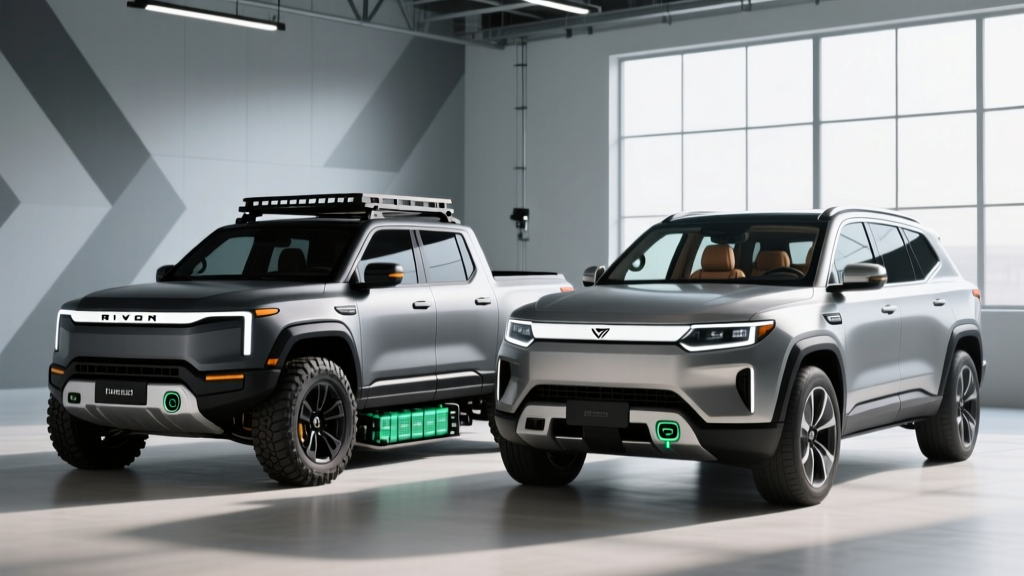
| Rivian EDV (Amazon Delivery) | 2-3 | 150 mi (est.) | ~100 kWh (NMC) | ~2,500 lbs | ~120 kW | ~50 min | Fleet-only |
| Lightning Electric Class 4 | 4-5 | 150-200 mi | 160 kWh (NMC) | ~15,000 lbs | 150 kW | ~75 min | $150,000 |
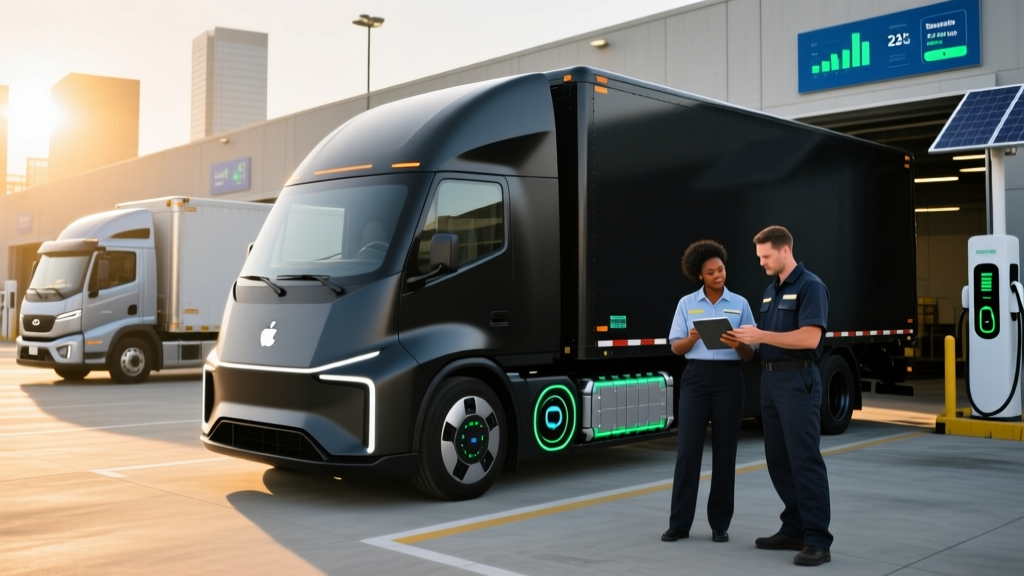
| Freightliner eCascadia | 8 | 230 mi | 438 kWh (NMC) | ~82,000 lbs GCW | 250 kW | ~90 min | $300,000+ |
| Tesla Semi (announced) | 8 | 500 mi (claimed) | ~900 kWh (est.) | ~82,000 lbs GCW | ~1 MW (Megacharger) | ~30 min (est.) | $250,000-$290,000 |
Real-world range caveat: EPA estimates assume moderate temperatures, flat terrain, and partial loads. In practice, expect 20-35% range reduction in cold weather (below 40°F), 10-20% reduction at sustained highway speeds (65+ mph), and 5-15% reduction with maximum payload. A Ford E-Transit rated at 126 miles EPA might deliver 85-100 miles in winter urban delivery with full cargo. Route planning must account for these buffers.
Cost Comparison: Electric vs. Diesel Commercial Trucks
| Cost Factor | Ford E-Transit (Electric) | Ford Transit (Gas, 3.5L V6) | Freightliner eCascadia (Electric) | Freightliner Cascadia (Diesel) |
|---|---|---|---|---|
| Purchase Price | $55,000 | $48,000 | $300,000 | $180,000 |
| Federal Tax Credit (§30D or 45W) | Up to $7,500 | $0 | Up to $40,000 (45W) | $0 |
| Fuel/Energy Cost per Mile | $0.12-$0.18 | $0.28-$0.35 | $0.20-$0.30 | $0.55-$0.75 |
| Annual Fuel (25,000 mi/yr) | $3,000-$4,500 | $7,000-$8,750 | $5,000-$7,500 | $13,750-$18,750 |
| Maintenance per Year | $1,200-$1,800 | $2,500-$3,500 | $3,000-$5,000 | $8,000-$12,000 |
| Depot Charging Install (per stall) | $15,000-$30,000 | N/A | $50,000-$80,000 | N/A |
| 5-Year Total Cost (est.) | $95,000-$115,000 | $100,000-$120,000 | $450,000-$520,000 | $350,000-$420,000 |
The numbers reveal a pattern: electric commercial trucks have higher upfront capital costs but significantly lower operating expenses. The breakeven point typically arrives between years 3-6 depending on mileage, fuel prices, and available incentives. For high-utilization fleets (30,000+ miles/year), the economics favor EVs more quickly. For low-mileage or seasonal operations, diesel may remain cheaper over a 5-7 year lifecycle.
Critical note on incentives: The IRS §45W Commercial Clean Vehicle Credit provides up to $7,500 for vehicles under 14,000 lbs GVWR and up to $40,000 for heavier trucks. Eligibility depends on battery sourcing requirements, MSRP caps, and your business's tax liability. Consult a tax professional — these credits are non-refundable and cannot exceed your tax obligation. Some states and utilities offer additional rebates (California's HVIP, for example, can cover $50,000-$120,000 for Class 8 trucks), but availability varies by jurisdiction and funding cycles.
Charging Infrastructure: The Hidden Challenge
Unlike passenger EVs, which can rely on public fast-charging networks, commercial trucks typically require depot charging infrastructure. This represents the single largest barrier to adoption and the most underestimated cost in fleet electrification planning.
| Charging Level | Power (kW) | Miles Added per Hour | Typical Use Case | Install Cost per Stall |
|---|---|---|---|---|
| Level 2 (AC) | 7.2-19.2 kW | 15-40 mi/hr | Overnight charging, light-duty vans | $3,000-$8,000 |
| DC Fast (50-150 kW) | 50-150 kW | 100-300 mi/hr | Opportunity charging, medium-duty | $25,000-$60,000 |
| DC Ultra-Fast (150-350 kW) | 150-350 kW | 300-600 mi/hr | Class 8 trucks, rapid turnaround | $80,000-$150,000 |
| Megawatt Charging (MCS) | 1,000+ kW | 1,000+ mi/hr | Future Class 8 standard (limited availability) | $200,000+ |
Real-world charging curve reality: A Freightliner eCascadia advertising "250 kW peak charging" will only sustain that rate between roughly 10-40% state of charge. Above 80%, the charge rate tapers dramatically to protect battery health — often dropping to 50-75 kW. A "90-minute 10-80% charge" claim assumes optimal battery temperature (68-86°F), preconditioning, and a functioning 250+ kW charger. In cold weather or at aging public stations, add 20-40% to that time estimate.
Depot charging considerations:
- Electrical service upgrades: Most commercial buildings need panel upgrades (400-800 amp service) to support multiple chargers. Budget $20,000-$100,000+ depending on existing infrastructure.
- Demand charges: Utilities often charge commercial customers based on peak power draw (kW), not just energy consumed (kWh). Simultaneously charging 10 trucks at 150 kW each creates a 1.5 MW peak — potentially adding $5,000-$15,000/month in demand charges unless mitigated with smart charging software or battery storage.
- Charger management software: Fleet operators need platforms like AmpUp, ChargePoint Fleet, or Enel X JuiceNet to schedule charging during off-peak hours, balance loads, and track energy costs. Budget $20-$50 per vehicle/month for software.
- Permitting and utility coordination: Expect 3-9 months for utility service upgrades, permitting, and installation. Start planning 12-18 months before vehicle delivery.
Real-World Ownership: What Fleet Operators Actually Experience
Based on data from early adopters (Amazon, FedEx, PepsiCo, various municipalities) and industry reports, here's what real-world electric commercial truck ownership looks like in 2026:
Range reliability: Most fleets report that EPA range estimates are achievable in moderate weather with partial loads, but route planners must build in 20-30% buffers for safety. One major delivery fleet reported that 8% of routes required mid-day opportunity charging in winter months, compared to 2% in summer.
Maintenance savings: The promised maintenance reductions are real. Electric trucks eliminate oil changes, diesel particulate filter replacements, transmission fluid changes, and exhaust system repairs. Brake wear is significantly reduced due to regenerative braking (one fleet reported 70% less brake replacement). However, tire wear can be 10-20% higher due to instant torque and heavier vehicle weight.
Downtime and reliability: Early-production electric trucks (2022-2024 model years) experienced higher-than-expected downtime due to software glitches, thermal management issues, and charger compatibility problems. 2025-2026 models show improved reliability, but fleets should still budget for 5-8% unplanned downtime versus 3-5% for mature diesel platforms.
Driver acceptance: Surprisingly positive in most cases. Drivers appreciate instant torque, smooth acceleration, quiet operation, and one-pedal driving in stop-and-go traffic. The main complaints center on range anxiety on unfamiliar routes and cabin heating performance in cold weather (which also impacts range).
Common Misconceptions About Electric Commercial Trucks
| Myth | Fact |
|---|---|
| "Electric trucks can't handle heavy payloads" | Class 8 electric trucks like the eCascadia can legally haul 82,000 lbs GCW (gross combination weight). However, the heavy battery (8,000+ lbs) reduces available payload capacity versus diesel, and range drops significantly at max load. |
| "Batteries won't last and replacement is prohibitively expensive" | Most commercial EV batteries carry 8-10 year / 100,000-200,000 mile warranties with 70-80% capacity retention guarantees. Real-world degradation data from early fleets shows 15-20% capacity loss after 5 years of heavy use. Replacement costs are high ($50,000-$150,000 for Class 8) but rarely needed within typical fleet lifecycle. |
| "Electric trucks are zero-emission" | Tailpipe emissions are zero, but upstream emissions depend on your local grid mix. A truck charging on coal-heavy grids (parts of the Midwest) may have higher lifecycle emissions than a modern diesel. On renewable-heavy grids (California, Pacific Northwest), EVs are dramatically cleaner. |
| "You can just use public truck-stop chargers" | Public DC fast-charging infrastructure for commercial trucks is extremely limited as of 2026. Most long-haul truck stops lack Megawatt Charging System (MCS) infrastructure. Depot charging remains essential; public charging is for emergency top-ups only. |
| "Electric trucks are cheaper overall" | Lower operating costs don't always offset higher capital costs, especially for low-mileage fleets, cold-climate operations, or routes requiring expensive infrastructure upgrades. Total cost of ownership depends heavily on duty cycle, mileage, and available incentives. |
Decision Framework: Should Your Fleet Go Electric?
Choose electric commercial trucks if:
- Your routes are predictable and return-to-base daily
- Daily mileage is under 150 miles (light-duty) or 200 miles (heavy-duty) with margin for weather/load
- You have depot space for charging infrastructure and can secure utility service upgrades
- You operate in areas with strong incentives (California, New York, utility rebates)
- Your fleet runs high annual mileage (25,000+ miles/vehicle) where fuel savings compound quickly
- You have sustainability mandates from customers, investors, or regulators
- You operate in urban areas with idling restrictions or emissions zones
Stick with diesel or hybrid if:
- Your routes are long-haul, irregular, or exceed 250 miles without reliable charging
- You operate in extreme cold climates (consistent sub-20°F temperatures) where range loss is severe
- Your payload requirements are at the legal maximum and you can't afford battery weight penalties
- Your depot lacks electrical capacity and utility upgrades are cost-prohibitive or timeline-incompatible
- Your vehicles have low annual mileage (under 15,000 miles/year) where fuel savings don't offset capital costs
- You need immediate vehicle replacement and can't wait 6-12 months for charging infrastructure buildout
- Your operation is seasonal or highly variable, making fixed infrastructure investments risky
First-Time Electric Fleet Buyer Checklist
If you're considering your first electric commercial trucks, here's what you need to know before signing purchase orders:
- Audit your duty cycles: Pull GPS and telematics data for 6-12 months. Map daily mileage, payload weights, idle time, and route topography. Identify which vehicles are EV-suitable and which aren't.
- Engage your utility early: Contact your commercial utility representative before vehicle selection. Understand service upgrade costs, timelines, demand charges, and available EV rate structures. Some utilities offer make-ready programs covering 50-100% of infrastructure costs.
- Start small, plan to scale: Order 2-5 vehicles for pilot routes before committing to fleet-wide electrification. Validate range, charging, and operational assumptions with real data.
- Budget for the full ecosystem: Vehicle cost is 40-60% of total investment. Include chargers, electrical upgrades, software, training, and contingency for route adjustments.
- Understand incentive stacking: Federal tax credits (§45W), state rebates (HVIP, NYTVIP, etc.), utility make-ready programs, and EPA Clean School Bus or DERA grants can sometimes be combined — but rules vary. Work with a consultant or legal team to maximize incentives without violating stacking restrictions.
- Plan for workforce training: Technicians need high-voltage safety certification and EV-specific diagnostic training. Budget $2,000-$5,000 per technician for certification programs. Driver training should cover range optimization, regenerative braking, and preconditioning procedures.
- Negotiate battery warranties carefully: Understand capacity retention guarantees (typically 70-80% at 8-10 years), what voids the warranty (fast-charging frequency, temperature exposure), and whether the warranty is transferable if you sell the vehicle.
- Model total cost of ownership realistically: Use conservative assumptions for electricity costs (include demand charges), maintenance (don't assume zero), battery degradation (plan for 15-20% range loss by year 5), and residual value (still uncertain for commercial EVs).
Frequently Asked Questions
What is the real-world range of electric commercial trucks versus EPA estimates?
EPA estimates assume moderate conditions. Expect 20-35% range reduction in cold weather, 10-20% reduction at highway speeds, and 5-15% reduction at maximum payload. A 150-mile EPA-rated truck might deliver 100-120 miles in winter urban delivery. Always plan routes with 20-30% range buffers.
How long does it take to charge an electric commercial truck?
Light-duty vans (Ford E-Transit): 45-60 minutes for 10-80% on DC fast charging, 8-10 hours on Level 2. Class 8 trucks (eCascadia): 90-120 minutes for 10-80% on 250+ kW chargers, 10-14 hours on Level 2. Charging slows significantly above 80% state of charge due to battery protection protocols.
Do electric commercial trucks qualify for tax credits?
Yes, under IRS §45W, businesses can claim up to $7,500 for vehicles under 14,000 lbs GVWR and up to $40,000 for heavier trucks. Eligibility depends on battery sourcing requirements, your business's tax liability (credits are non-refundable), and vehicle qualification. Consult a tax professional for your specific situation.
What happens if the battery fails or degrades significantly?
Most manufacturers warrant batteries for 8-10 years or 100,000-200,000 miles with 70-80% capacity retention guarantees. If capacity drops below the threshold, the manufacturer replaces or refurbishes the battery at no cost. Out-of-warranty replacement costs $15,000-$30,000 for light-duty vans and $50,000-$150,000 for Class 8 trucks. Real-world data shows most batteries retain 80-85% capacity after 5 years of heavy use.
Can electric commercial trucks tow or haul heavy loads?
Yes, but with trade-offs. Class 8 electric trucks can legally pull 82,000 lbs GCW, but the heavy battery reduces available payload by 3,000-8,000 lbs versus diesel. Range also drops significantly at maximum load — a 230-mile truck might deliver 120-150 miles at max weight. For consistent heavy-haul routes, diesel may still be more practical.
What are the insurance costs for electric commercial trucks?
Insurance premiums for electric commercial trucks are typically 10-25% higher than diesel equivalents due to higher vehicle values, specialized repair requirements, and limited actuarial data. However, some insurers offer discounts for fleets with telematics and driver monitoring. Budget 15-20% higher premiums in your TCO model.
How do I handle charging if my fleet operates 24/7?
Multi-shift operations require opportunity charging (topping up during breaks or shift changes) or larger battery packs to complete full shifts. DC fast chargers (150-350 kW) can add 50-150 miles in 30-45 minutes. Some fleets use a mix of vehicles — one set charging while another operates. Smart charging software can optimize schedules to minimize downtime and electricity costs.
Are there electric commercial trucks available for immediate delivery in 2026?
Ford E-Transit and BrightDrop Zevo have relatively short lead times (2-4 months for fleet orders). Class 8 trucks like the Freightliner eCascadia have 6-12 month lead times depending on configuration and incentive availability. Tesla Semi remains limited-production with long waitlists. Plan purchases 12-18 months ahead, especially if you need charging infrastructure buildout.
Electric commercial trucks in 2026 represent a viable option for specific duty cycles — particularly urban delivery, last-mile logistics, and return-to-base operations with predictable routes. The economics favor high-utilization fleets in incentive-rich regions, while long-haul, heavy-payload, and cold-climate operations face significant challenges. Success requires careful route analysis, realistic infrastructure planning, and conservative financial modeling. Start with pilot programs, gather real operational data, and scale based on proven results rather than projections.