Bottom Line: Electric Class 8 trucks in 2026 offer 150–500 miles of real-world range, peak DC fast charging from 150 kW to over 1 MW, and base prices between $180,000 and $430,000 before incentives. They deliver 60–75% lower fuel cost per mile and dramatically reduced maintenance versus diesel — but only make economic sense for fleets with predictable routes under 300 miles, depot charging access, and the ability to leverage the IRC §45W Commercial Clean Vehicle Credit (up to $40,000 for heavy-duty vehicles). Long-haul, irregular-route operators should wait for megawatt charging infrastructure to mature.
The 2026 Electric Class 8 Truck Landscape
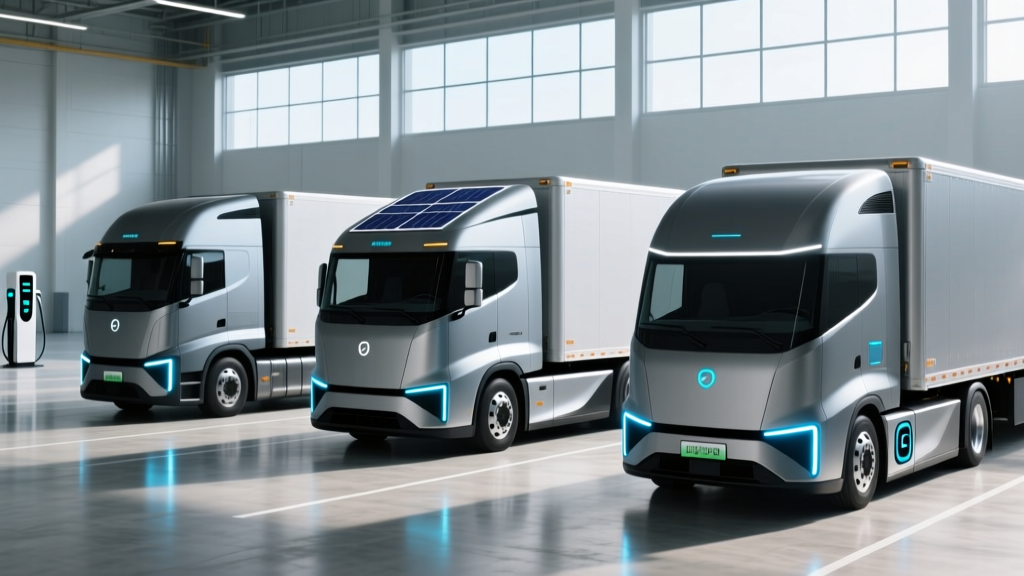
Class 8 trucks — those with a gross vehicle weight rating (GVWR) above 33,000 lbs — are the workhorses of freight: regional haulers, drayage rigs, and long-haul semis. Electrifying this segment has been slower than passenger EVs due to battery weight, charging infrastructure demands, and the sheer energy required to move 80,000 lbs down the highway. But 2026 marks a genuine inflection point. Four production-ready models are now in fleet hands, megawatt charging system (MCS) pilots are expanding along key freight corridors, and total cost of ownership (TCO) parity with diesel is achievable on specific duty cycles.
Unlike passenger EVs, where range and 0–60 times dominate the conversation, Class 8 buyers need to evaluate payload impact (battery weight eats into cargo capacity), depot electrical capacity, charger uptime, and whether the §45W commercial tax credit and state voucher programs (like California's HVIP) can bridge the upfront cost gap. Here's what you need to know.
Spec Comparison: The Four Production Electric Semis
| Spec | Tesla Semi (2026) | Freightliner eCascadia | Volvo VNR Electric | Peterbilt 579EV |
|---|---|---|---|---|
| Base MSRP | ~$250,000 (300 mi) / ~$290,000 (500 mi) | ~$290,000–$330,000 | ~$290,000–$350,000 | ~$190,000–$230,000 |
| Battery Capacity (usable) | ~500 kWh (300 mi) / ~900 kWh (500 mi) | ~291–438 kWh (NMC) | ~264–565 kWh (NMC) | ~282–396 kWh (NMC/LFP options) |
| EPA Est. Range (loaded) | 300 mi / 500 mi | 155–230 mi | 150–275 mi | 130–200 mi |
| Real-World Range (loaded, mixed) | ~250–270 mi / ~420–460 mi | ~130–200 mi | ~125–240 mi | ~110–175 mi |
| Peak DC Charge Rate | ~1.2 MW (MCS connector) | ~250 kW (CCS2) | ~250 kW (CCS2) | ~150–250 kW (CCS2) |
| 10–80% Charge Time | ~30 min (500 mi variant, 1 MW+ station) | ~90–120 min | ~70–90 min | ~60–120 min |
| Motor Power | ~1,000+ hp (tri-motor) | ~400–470 hp (eAxle) | ~450 hp (dual eAxle) | ~400–670 hp |
| GCWR (max) | 82,000 lbs | 82,000 lbs | 82,000 lbs | 82,000 lbs |
| Battery Warranty | 8 yr / 1,000,000 mi (est.) | 5 yr / 600,000 mi | 5 yr / 600,000 mi | 5 yr / 500,000 mi |
Note: Class 8 trucks are not rated by EPA MPGe on fueleconomy.gov like light-duty vehicles. Efficiency is measured in kWh/mile. Real-world consumption typically ranges from 1.5–2.5 kWh/mile depending on load, speed, and terrain.
⚡ Real-World Range Reality Check: Published range figures assume moderate loads and favorable conditions. In practice, expect 15–25% range reduction when pulling a full 80,000 lb GCWR at sustained highway speeds (65+ mph), and an additional 20–35% loss in sub-freezing temperatures due to cabin/battery heating and reduced battery efficiency. A Freightliner eCascadia rated at 230 miles may deliver only 140–155 miles on a cold, fully loaded winter run.
Electric vs. Diesel Class 8: The Cost Breakdown
The upfront price gap is stark — a new diesel Class 8 tractor runs $130,000–$180,000, while electric equivalents start at $190,000 and climb past $350,000. But fleet operators think in total cost per mile over a 5–7 year lifecycle. Here's how the numbers stack up for a regional haul operation doing 60,000 miles/year:
| Cost Category (5-Year / 300,000 mi) | Diesel Class 8 | Electric Class 8 |
|---|---|---|
| Vehicle Purchase | $155,000 | $290,000 |
| Federal Tax Credit (§45W) | $0 | –$40,000 |
| State Incentive (e.g., CA HVIP) | $0 | –$45,000–$120,000 |
| Net Vehicle Cost | $155,000 | $130,000–$205,000 |
| Fuel/Energy (300,000 mi) | $172,500 (diesel @ ~$4.60/gal, 6.5 mpg avg) | $54,000 (electricity @ ~$0.18/kWh, 2.0 kWh/mi avg) |
| Maintenance | $45,000 (oil, filters, DPF, DEF, brakes) | $12,000 (tire rotation, cabin filter, coolant) |
| Depot Charger Install (per truck) | $0 | $25,000–$75,000 |
| 5-Year Total Cost | $372,500 | $221,000–$317,000 |
| Cost Per Mile | $1.24/mi | $0.74–$1.06/mi |
The electric truck wins on operating cost — often by $0.30–$0.50 per mile — but only when the duty cycle fits and incentives are available. Without the §45W credit and state vouchers, the payback period stretches to 7–9 years, which exceeds the practical ownership window for many fleets.
Charging Infrastructure: The Make-or-Break Factor
Unlike diesel trucks that refuel in 15 minutes at any truck stop, electric Class 8 trucks require strategic charging planning. There are two primary models:
Depot Charging (Level 2 / DC Fast): Most fleet operators install DC fast chargers (50–350 kW per stall) at their home base. A 150 kW charger can add roughly 75 miles of range per hour to a loaded semi. For trucks returning to base nightly with 150–200 miles of remaining range, a 6–8 hour overnight session is sufficient. Depot installation costs vary wildly: $25,000–$75,000 per charger for electrical work alone, plus potential utility demand charges and transformer upgrades. A 20-truck fleet depot may require a dedicated 2–3 MW electrical service — a 12–18 month utility project in some regions.
Public Megawatt Charging (MCS): The Megawatt Charging System standard (up to 3.75 MW) is being deployed along major freight corridors by companies like WattEV, TeraWatt Infrastructure, and Greenlane. As of 2026, MCS stations are operational in limited numbers in California's Central Valley, the I-10 corridor, and the Texas Triangle. At 1+ MW, a Tesla Semi can recover 70% of its battery in roughly 30 minutes — approaching diesel refueling convenience. But public MCS availability remains sparse outside these corridors, and pricing is typically $0.35–$0.60/kWh (significantly higher than depot rates).
| Charging Level | Power (kW) | Miles of Range Added/Hour | Typical Use Case |
|---|---|---|---|
| AC Level 2 (depot) | 19.2–40 kW | 10–20 mi/hr | Overnight top-off, light-duty yard moves |
| DC Fast (CCS2 depot) | 50–250 kW | 25–125 mi/hr | Nightly depot charging, opportunity charging |
| Megawatt (MCS public/depot) | 600–1,200+ kW | 300–600+ mi/hr | En-route fast charging, high-utilization fleets |
Critical kW vs. kWh reminder: kW (kilowatts) measures charging power — how fast energy flows. kWh (kilowatt-hours) measures battery energy capacity — how much the tank holds. A 900 kWh battery charged at 150 kW would take 6 hours from empty; at 1 MW, roughly 54 minutes. Peak charge rates are never sustained across the full session — the charge curve tapers significantly above 80% SoC to protect battery health.
Who Should Buy Electric Class 8 — And Who Shouldn't
Choose an Electric Class 8 Truck If:
- Your routes are under 250 miles round-trip with predictable schedules (drayage, regional distribution, dedicated lanes)
- You have depot or yard space where chargers can be installed
- Your utility can provide the required electrical service (1–3 MW for multi-truck depots) within a reasonable timeline
- You operate in a state with substantial incentive programs (CA, NY, NJ, WA, CO) that bring net vehicle cost near diesel parity
- You run in areas with low commercial electricity rates (<$0.15/kWh) or can negotiate off-peak charging rates with your utility
- Environmental compliance (zero-emission drayage mandates, ESG reporting) is a business driver
Stick With Diesel (or Wait) If:
- Your routes regularly exceed 300 miles without reliable mid-route charging
- You operate long-haul, irregular-route freight where scheduling flexibility is essential
- Your depot lacks the electrical capacity for high-power charging and utility upgrades are cost-prohibitive or multi-year projects
- You operate in extreme cold climates (sustained sub-zero temperatures) where range loss and battery heating demands are severe
- Your payload is already weight-constrained — battery packs add 4,000–8,000+ lbs, reducing legal cargo capacity
Common Misconceptions About Electric Semis
| Myth | Fact |
|---|---|
| "Electric trucks can't pull heavy loads." | Electric motors deliver peak torque from zero RPM. The Tesla Semi pulled 80,000 lbs up a 5% grade faster than a comparable diesel in published demonstrations. The issue isn't capability — it's range reduction under heavy loads (up to 40% less range at max GCWR vs. bobtail). |
| "Batteries won't last the life of the truck." | Modern NMC packs are engineered for 1,000+ full charge cycles before reaching 80% state of health. At 200 miles/day, that's roughly 1,000,000 miles — matching or exceeding diesel engine overhaul intervals. Tesla warranties its Semi battery to 1 million miles. Replacement cost is estimated at $30,000–$60,000 per pack module (not the full system) if needed. |
| "Charging takes too long for freight operations." | For depot-based regional routes, trucks charge during mandatory 10-hour driver rest periods — zero operational downtime. For en-route charging, MCS at 1 MW+ delivers 300+ miles in ~30 minutes, aligning with driver break schedules. |
| "The grid can't handle electric truck fleets." | A single 20-truck depot drawing 3 MW simultaneously is a significant load — comparable to a small neighborhood. But smart charging software (staggered sessions, off-peak scheduling) and utility demand-response programs can manage this. The constraint is local distribution infrastructure, not bulk generation. |
| "Federal tax credits cover most of the cost." | The IRC §45W credit provides up to $40,000 for vehicles over 14,000 lbs — meaningful but only 12–20% of a Class 8 EV's price. State incentives (CA HVIP up to $120,000, NY Truck Voucher up to $185,000) are where the real cost bridging happens, and these programs are competitive and may have waitlists. |
Real-World Ownership Considerations
Payload Penalty: Battery packs for Class 8 trucks weigh between 4,000 and 8,500 lbs depending on capacity. Federal bridge law allows 80,000 lbs GCWR (some states permit 2,000 lbs additional for EVs). That extra battery weight comes directly out of your revenue-generating cargo. For weight-sensitive freight (liquids, aggregates, dense goods), this can mean 5–10% fewer revenue miles per load. For cube-limited freight (e-commerce, light packaging), the impact is negligible.
Insurance: Commercial EV insurance premiums currently run 15–30% higher than diesel equivalents, driven by higher vehicle values, specialized repair requirements, and limited actuarial data. Expect $12,000–$18,000/year per truck vs. $9,000–$13,000 for diesel. This gap is narrowing as fleet loss data accumulates.
Maintenance Savings — Where They Come From: Electric Class 8 trucks eliminate engine oil changes (~$500–$800 each, 3–4x/year), diesel exhaust fluid (DEF, ~$1,500–$2,500/year), diesel particulate filter (DPF) replacements ($3,000–$6,000 every 200,000–400,000 miles), transmission fluid, and most brake wear (regenerative braking handles 70–85% of deceleration). Cumulative maintenance savings of $30,000–$50,000 over 5 years are well-documented in early fleet reports from PepsiCo, Schneider, and JB Hunt.
Cold Weather Operations: Lithium-ion batteries lose efficiency below 32°F and lose significant capacity below 0°F. In sustained sub-zero operations (Minnesota, Montana, New England winters), expect 25–40% range reduction. Battery preconditioning systems and heated battery enclosures mitigate this but add energy consumption. Fleets in cold climates should spec the largest battery option available and plan routes conservatively.
The §45W Commercial Clean Vehicle Credit: What Fleets Need to Know
Unlike the §30D credit for personal vehicles, the IRC §45W credit is available to businesses and tax-exempt organizations. Key rules for 2026:
- Credit Amount: Up to $40,000 for vehicles with GVWR over 14,000 lbs (all Class 8 trucks qualify)
- Calculation: The lesser of 15% of vehicle cost (30% if not subject to depreciation limits) or the incremental cost over a comparable ICE vehicle
- Battery Sourcing: Battery components must meet domestic-content thresholds that increase annually — verify current-year requirements with your tax professional
- No MSRP Cap: Unlike §30D, there is no manufacturer's suggested retail price cap for commercial vehicles
- No Income Cap: Available to businesses of all sizes and tax-exempt organizations (including government fleets)
- Transferability: Credits can be transferred to the dealer/seller for a direct price reduction (elective pay for tax-exempt entities)
Always consult a qualified tax professional to confirm eligibility — incentive rules evolve and interact with depreciation schedules (bonus depreciation, §179) in complex ways.
Frequently Asked Questions
Can electric Class 8 trucks handle long-haul routes over 500 miles?
Not yet, practically speaking. Even the Tesla Semi's 500-mile variant would require mid-route charging at an MCS station — and public MCS infrastructure in 2026 is limited to select corridors. Long-haul operators running 600–1,000+ mile routes with irregular schedules should plan for diesel or hybrid solutions for now. The MCS network is expanding, but true coast-to-coast electric freight is likely a 2029+ reality.
How long do electric semi batteries last before replacement?
Current NMC battery packs are designed for 1,000–1,500 full charge cycles before degrading to 80% of original capacity. At typical fleet usage (one charge cycle per day), that translates to 800,000–1,200,000 miles. Most manufacturers warranty packs for 5–8 years or 500,000–1,000,000 miles. Full pack replacement is estimated at $80,000–$150,000 depending on capacity, but modular designs allow partial replacement at lower cost.
What electrical service does a fleet depot need for 10 electric semis?
Ten trucks charging simultaneously at 150 kW each requires approximately 1.5 MW of electrical capacity — equivalent to a large industrial facility. Many existing fleet depots have 400–800 amp, 480V service (~300–600 kW), requiring a utility upgrade. Smart charging software that staggers sessions can reduce peak demand to 800 kW–1 MW. Engage your utility early — transformer and feeder upgrades can take 12–24 months.
Are electric Class 8 trucks exempt from weight limits?
Federal law (23 U.S.C. §127) allows up to 2,000 lbs of additional weight allowance for EVs on interstate highways to compensate for battery mass, raising the GCWR limit from 80,000 to 82,000 lbs. Some states offer additional allowances on state highways. This helps but doesn't fully offset the 4,000–8,500 lb battery penalty for weight-critical freight.
What's the resale value outlook for electric semis?
The used electric Class 8 market is still immature — too few trucks have cycled through first ownership to establish reliable residual values. Early indicators suggest 30–45% residual value at 5 years / 400,000 miles (comparable to diesel), but battery health certification and warranty transferability will be critical factors. Fleets should model conservative 25–35% residual values until the secondary market matures.