Quick Answer: Do Electric Cars Have Transmissions?
Most electric vehicles use a single-speed reduction gearbox rather than a multi-gear transmission. Because electric motors produce maximum torque from 0 RPM and operate efficiently across a wide RPM range (often up to 15,000–20,000 RPM), there is no mechanical need for multiple gear ratios. A few exceptions exist — the Porsche Taycan and Audi e-tron GT use a two-speed rear axle — but over 95% of EVs on the road in 2026 rely on a single fixed gear ratio, typically between 8:1 and 10.5:1. This means no shift points, no transmission fluid changes on most models, and fewer moving parts to fail.
How an EV Reduction Gearbox Differs From a Gas-Car Transmission
In a conventional internal combustion engine (ICE) vehicle, the engine produces usable torque only within a narrow RPM band — roughly 1,500 to 5,000 RPM for most gasoline engines. A multi-speed transmission (6-, 8-, or 10-speed automatic, CVT, or manual) exists solely to keep the engine in that sweet spot as vehicle speed changes.
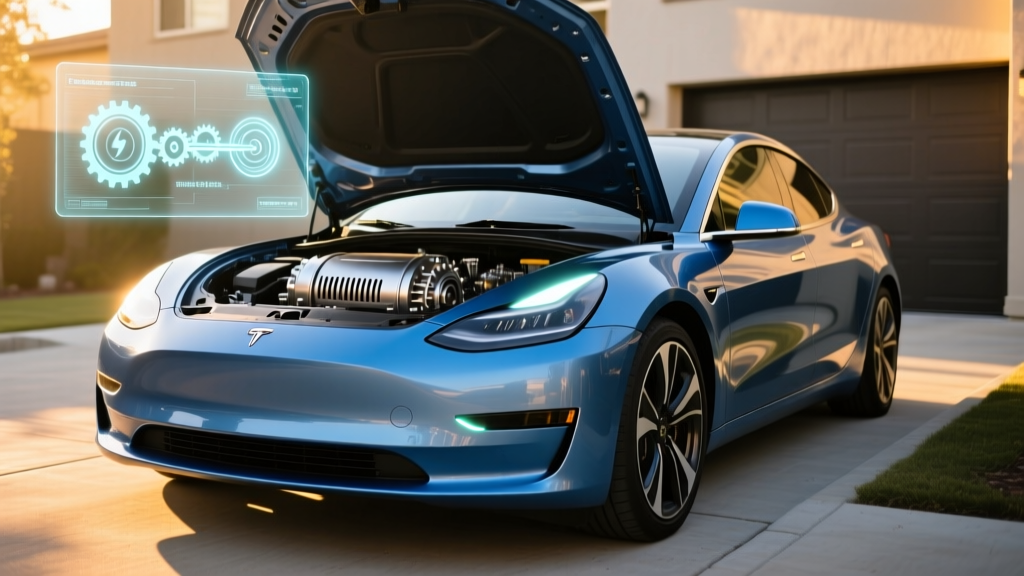
Electric motors don't have this limitation. A permanent-magnet synchronous motor (the type in most 2026 EVs, from the Tesla Model Y to the Hyundai Ioniq 5) delivers peak torque at 0 RPM and sustains a broad, flat torque curve well past 10,000 RPM. The single-speed reduction gearbox simply converts the motor's high-RPM, low-torque output into the low-RPM, high-torque rotation your wheels need.
| Attribute | Typical EV (Single-Speed) | Typical Gas Car (8-10 Speed AT) |
|---|---|---|
| Gear ratios | 1 fixed (e.g., 9.73:1) | 8–10 forward gears |
| Moving parts in gearbox | ~5–12 (helical gears, bearings) | ~80–150+ (clutches, bands, planetary sets) |
| Shift interruptions | None — seamless torque | 100–400 ms per shift |
| Transmission fluid service | Rarely required; some models every 60k–100k mi | Every 30k–60k mi ($150–$350 per service) |
| Typical replacement cost | $2,000–$5,000 (rare) | $3,500–$7,000 (more common) |
| Weight contribution | 15–40 lbs | 150–250 lbs |
Why Nearly Every EV Maker Chose a Single-Speed Design
The engineering logic is straightforward: eliminating the multi-speed transmission saves weight, reduces cost, removes a failure point, and simplifies the drivetrain. For a vehicle like the 2026 Tesla Model 3 Long Range (363 mi EPA, 82 kWh usable NMC battery, $44,130 MSRP before incentives), the single-speed unit contributes to the car's 0–60 mph time of 4.2 seconds without a single shift event.
However, there is a trade-off. A single gear ratio must serve both low-speed acceleration and high-speed cruising. Automakers choose a ratio that balances strong launch performance with acceptable top-speed efficiency. Most EVs top out electronically between 112 and 155 mph — not because the motor can't spin faster, but because the fixed ratio limits the vehicle speed at the motor's maximum safe RPM.
The Two-Speed Exception: Porsche Taycan and Audi e-tron GT
The Porsche Taycan (2026 base MSRP from $92,250) and its platform-mate, the Audi e-tron GT, use a two-speed automatic on the rear axle. First gear is a short ratio for brutal launch acceleration; second gear is a tall ratio for high-speed efficiency. The Taycan Turbo S achieves a 2.4-second 0–60 mph time partly thanks to this setup. The trade-off is added complexity, weight (~30 lbs more than a single-speed unit), and cost. Porsche has stated the two-speed gearbox was necessary to meet both the sub-2.5-second launch target and the 161 mph top speed simultaneously. For everyday driving, the difference in efficiency is marginal — roughly 1–2% improvement at sustained highway speeds above 90 mph.
Efficiency, Range, and Real-World Implications
The single-speed gearbox is highly efficient — typically 97–98% of the motor's output reaches the wheels through the reduction gear. By comparison, a conventional automatic transmission is roughly 85–92% efficient, losing energy to torque-converter slip and hydraulic pumping losses.
This drivetrain efficiency is one reason EVs convert 77–85% of grid energy to wheel motion, while gas cars convert only 12–30% of gasoline energy to wheel motion (per fueleconomy.gov well-to-wheel data).
Where the Single-Speed Design Shows Limits
At very high sustained speeds (85+ mph on long highway stretches), a single-speed EV operates at the upper end of its motor's RPM range, where efficiency drops. This is why real-world highway range at 75–80 mph is typically 10–20% below the EPA combined estimate. For example:
- Hyundai Ioniq 5 Long Range (2026): EPA 318 mi; expect ~255–275 mi at 75 mph, ~220–240 mi in 20°F weather.
- Chevrolet Equinox EV RS (2026): EPA 319 mi; expect ~260–280 mi highway, ~225–245 mi in cold conditions.
- Ford Mustang Mach-E Extended Range (2026): EPA 320 mi; expect ~260–280 mi highway.
None of this is a transmission problem per se — it's a function of aerodynamic drag, which scales with the square of speed. A multi-speed gearbox could theoretically help at the margin, but the weight, cost, and complexity penalties outweigh the gains for most buyers.
Maintenance and Long-Term Ownership Costs
One of the biggest ownership advantages of the single-speed EV gearbox is reduced maintenance. Here's how the costs stack up over five years and 75,000 miles of ownership:
| Service Item | EV (Single-Speed) | Gas Car (8-Speed AT) |
|---|---|---|
| Transmission fluid service | $0–$200 (many EVs: sealed-for-life or 100k interval) | $450–$1,050 (2–3 services) |
| Engine oil changes | $0 | $300–$700 (7–10 changes) |
| Spark plugs | $0 | $200–$400 |
| Timing belt/chain | $0 | $500–$1,200 (if belt-equipped) |
| Brake pad replacement | $150–$350 (regen braking extends life; often 80k+ mi) | $400–$800 (2–3 sets) |
| Exhaust system | $0 | $0–$600 (catalytic converter, O2 sensors) |
| Total drivetrain-related maintenance | $150–$550 | $1,850–$4,750 |
The gearbox itself rarely fails. Most EV manufacturers cover the reduction gear under the powertrain warranty — typically 5 years/60,000 miles or 8 years/100,000 miles. The battery and drive unit warranty (mandated at 8 years/100,000 miles minimum by federal emissions rules, and often matching that for the e-motor) provides additional coverage. Replacement of a single-speed reduction gear is uncommon but runs $2,000–$5,000 including labor — significantly less than a modern 8- or 10-speed automatic rebuild.
What About Regenerative Braking and the Gearbox?
During regenerative braking, the electric motor reverses role and becomes a generator. The same single-speed reduction gear transmits this braking torque to the wheels. Because regen handles 60–80% of everyday deceleration (depending on driving style and terrain), friction brakes last significantly longer on EVs. Owners in flat terrain often report original brake pads at 80,000+ miles.
Common Misconceptions About Electric Car Transmissions
| Myth | Fact |
|---|---|
| "EVs don't have any gears at all." | They have a single-speed reduction gearbox — typically a single pair of helical gears with a ratio between 8:1 and 10.5:1. It is a gear system, just not a multi-speed one. |
| "No transmission means no maintenance ever." | The reduction gear may require fluid inspection or replacement at high mileage. Some models (e.g., early Nissan Leaf) had gearbox whine issues. The EV still has coolant systems, cabin filters, brake fluid, and a 12V battery to maintain. |
| "EVs can't go fast without a multi-speed gearbox." | The Lucid Air Sapphire (1,234 hp, 0–60 in 1.89 seconds) and Tesla Model S Plaid (1,020 hp, 0–60 in 1.99 seconds) both use single-speed gearboxes and exceed 200 mph. Electric motors spin fast enough to make it work. |
| "A two-speed gearbox would double the range." | Real-world testing of two-speed EV prototypes shows 1–4% highway efficiency improvement — negligible compared to the gains from better aerodynamics, lighter weight, or a larger battery. |
| "EV gearbox repair is impossible and you must replace the whole motor." | The reduction gear is a separate, serviceable unit bolted to the motor housing. Independent EV shops and dealers can replace just the gear unit without replacing the motor. |
Should the Gearbox Type Affect Your EV Purchase Decision?
Decision Framework: What to Prioritize
- Choose a single-speed EV (nearly all models) if you want lower maintenance costs, proven reliability, seamless acceleration, and the widest selection. This is the right call for 95%+ of buyers. Models like the 2026 Tesla Model Y ($44,990), Hyundai Ioniq 5 ($42,600), Chevrolet Equinox EV ($33,400), and Ford Mustang Mach-E ($39,995) all use this design.
- Choose a two-speed EV (Porsche Taycan, Audi e-tron GT) if you prioritize extreme launch performance and high top speed simultaneously, and you're spending $90,000+. Understand that you're paying for marginal efficiency gains and a performance feature you'll rarely exploit on public roads.
- Don't worry about gearbox type when comparing EVs. Focus instead on EPA range, DC fast-charge speed (peak kW and 10–80% time), battery chemistry (LFP for longevity and daily 100% charging vs. NMC for maximum range), home charging access, and total cost of ownership.
Real-World Ownership Considerations Beyond the Gearbox
The transmission is one of the least consequential decisions in EV ownership. What actually matters:
- Home charging access: A Level 2 home charger (240V, 32–48 amps, 7.7–11.5 kW) adds 25–44 miles of range per hour and costs $500–$1,800 installed (depending on panel capacity and run length). Without home charging, public DC fast charging at $0.30–$0.60/kWh erases much of the fuel-cost advantage over gasoline.
- Climate: In sub-30°F conditions, expect 20–35% range reduction due to battery chemistry limitations and cabin heating demands. A heat pump (standard on the Ioniq 5, Model Y, and Mach-E) mitigates this by ~10% compared to resistive heating.
- Federal tax credit (§30D): Up to $7,500 for new EVs meeting battery-sourcing and critical-mineral requirements, with MSRP caps ($55,000 for sedans, $80,000 for SUVs/trucks/vans) and buyer income limits ($150k single, $300k joint). Check current eligibility on IRS.gov — rules change frequently. Point-of-sale transfer is available as of 2024 and continues in 2026.
- Insurance: EV insurance premiums run 10–25% higher than comparable gas cars on average, driven by higher repair costs for battery and structural components. Get quotes before purchasing.
Frequently Asked Questions
Do electric cars have a clutch?
No. Since there is only one gear ratio and the electric motor can come to a complete stop without stalling, there is no need for a clutch. You simply press the accelerator to go and the brake to stop — no gear engagement is required.
Can an electric car be towed with wheels on the ground?
Generally, no. Because the motor is permanently connected to the wheels through the fixed-ratio gearbox, towing with drive wheels on the ground spins the motor without proper lubrication or cooling, which can cause damage. Most manufacturers require flatbed towing. Check your owner's manual — some EVs have a specific "tow mode" or neutral disconnect.
Why don't more EVs have two-speed transmissions if Porsche uses one?
The two-speed gearbox solves a problem most EVs don't have. Porsche needed to hit both a sub-2.5-second 0–60 time and a 160+ mph top speed in the Taycan. For a Tesla Model 3 that tops out at 125 mph and does 0–60 in 5.8 seconds (base RWD), a single gear ratio handles both requirements easily. The added cost ($1,000–$2,000 per unit), weight, and complexity aren't justified for mainstream vehicles.
Will future EVs switch to multi-speed transmissions?
Unlikely for mainstream models. As electric motors improve — higher RPM limits, wider efficiency maps, and better thermal management — the case for a single-speed design only gets stronger. Multi-speed gearboxes may appear in heavy-duty electric trucks (where extreme torque multiplication helps with towing) but are not expected to proliferate in passenger EVs. Some manufacturers, like Bosch and ZF, have developed two-speed EV transmissions, but adoption remains limited to niche performance applications.
Does the single-speed gearbox limit towing capacity?
Not significantly. The Ford F-150 Lightning (single-speed, dual-motor) tows up to 10,000 lbs. The Rivian R1T (single-speed, quad-motor) tows 11,000 lbs. Towing capacity is limited more by battery thermal management, motor cooling, and structural design than by the gearbox. Expect 30–50% range reduction when towing near maximum capacity, regardless of gearbox type.
The bottom line: electric car transmissions — or more accurately, single-speed reduction gearboxes — are one of the simplest, most reliable components in an EV. They require virtually no maintenance, add minimal weight, and deliver seamless acceleration. When shopping for your next EV, spend your research energy on battery size and chemistry, DC charging speed, real-world range in your climate, and home charging setup. The gearbox will take care of itself.