The Short Answer: Do Electric Cars Have a Transmission?
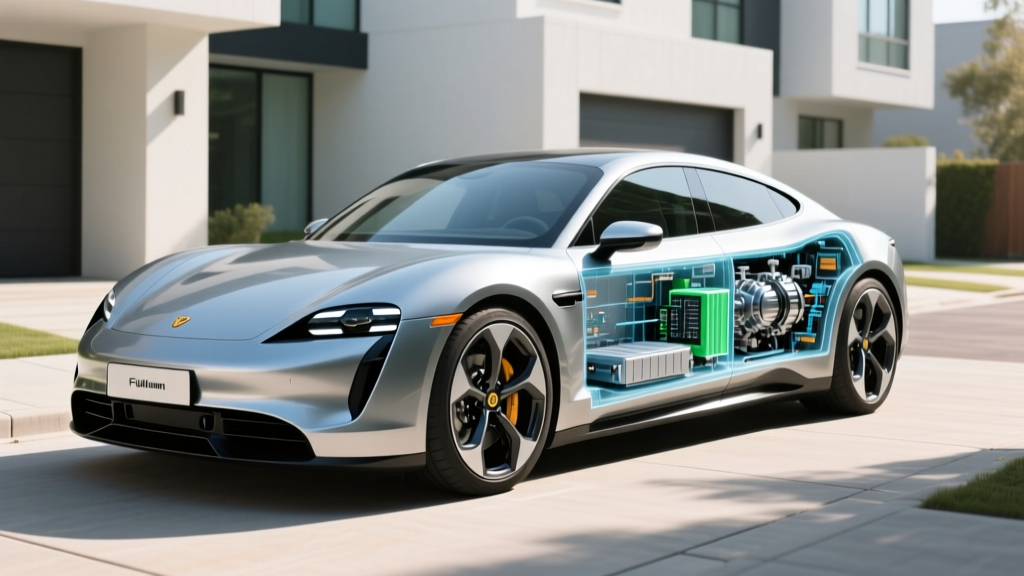
Most electric vehicles use a single-speed reduction gear — not a traditional multi-gear transmission. Because electric motors deliver maximum torque from 0 RPM and operate efficiently across a wide speed range (typically 0–12,000+ RPM), there's no need for gear shifting. A few exceptions exist: the original Porsche Taycan and Audi e-tron GT use a two-speed transmission on the rear axle to optimize both launch acceleration and high-speed efficiency. But for 95%+ of EVs on the road in 2026 — from the Tesla Model 3 to the Hyundai Ioniq 5 to the Ford F-150 Lightning — one gear is all you get, and it's all you need.
How an EV Drivetrain Actually Works (vs. a Gas Car)
To understand why most electric cars ditch the multi-speed transmission, you need to understand the fundamental difference between how electric motors and internal combustion engines (ICE) produce power.
Gas engines produce usable torque only within a narrow RPM band — typically 1,500–5,000 RPM. Below that, they stall. Above that, they over-rev and self-destruct. A 6-, 8-, or 10-speed transmission exists to keep the engine in that narrow sweet spot as vehicle speed changes. Every shift is the transmission searching for the right gear ratio.
Electric motors are fundamentally different. They deliver peak torque from 0 RPM — which is why EVs accelerate so briskly off the line — and can spin safely at 12,000–20,000+ RPM. That enormous operating range means a single fixed gear ratio (usually between 8:1 and 10:1 reduction) can handle everything from crawling in traffic to cruising at 85 mph.
| Attribute | EV (Single-Speed Reduction Gear) | Gas Car (Multi-Speed Automatic) |
|---|---|---|
| Gear ratios | 1 fixed ratio (~9:1 typical) | 6–10 forward gears |
| Moving parts in drivetrain | ~20–30 (motor + reduction gear) | 200+ (transmission alone) |
| Transmission fluid changes | Every 60,000–100,000 mi (some sealed for life) | Every 30,000–60,000 mi |
| 0 RPM torque | 100% available instantly | Minimal; requires clutch/torque converter |
| Max RPM | 12,000–20,000+ RPM | ~6,000–7,000 RPM redline |
| Drivetrain energy loss | ~5–8% | ~12–20% (torque converter, gear friction) |
| Average transmission replacement cost | $1,500–$3,500 (reduction gear) | $3,500–$7,000+ (full rebuild/replacement) |
The simplicity is the point. Fewer moving parts means fewer things to break, less parasitic drivetrain loss, and lower maintenance costs over the vehicle's life.
The Exceptions: EVs With Two-Speed Transmissions
A handful of performance-oriented EVs use a two-speed gearbox on the rear axle. The most prominent examples:
- Porsche Taycan (2020–present): First gear is short for explosive 0–60 mph launches (2.6 seconds on the Turbo S). Second gear engages around 50–60 mph for efficient highway cruising and higher top speed (161 mph).
- Audi e-tron GT / RS e-tron GT: Shares the J1 platform with the Taycan, same two-speed rear axle.
- Rimac Nevera (hypercar): Uses single-speed but with four independent motors, each with its own reduction gear — torque vectoring replaces the need for multi-speed.
Why don't more EVs use two speeds? The cost, weight, and complexity penalty rarely justifies the marginal efficiency gain. Porsche chose it for performance differentiation. For a commuter-focused EV like the Chevrolet Equity EV or Tesla Model Y, the engineering trade-off doesn't pencil out. A single-speed unit is lighter, cheaper, more reliable, and — for 99% of driving scenarios — equally efficient.
Maintenance Costs: What the Missing Transmission Saves You
The absence of a multi-speed transmission is one of the biggest ownership-cost advantages EVs hold over gas cars. Here's what a typical 5-year/75,000-mile ownership period looks like when you isolate drivetrain-related maintenance:
| Service Item | EV Cost | Gas Car Cost |
|---|---|---|
| Transmission fluid service | $0–$200 (many EVs sealed; some at 60k mi) | $450–$900 (2–3 services) |
| Engine oil changes | $0 (no engine oil) | $375–$750 (5–10 changes) |
| Spark plugs / ignition | $0 | $200–$600 |
| Timing belt / chain | $0 | $500–$1,500 |
| Exhaust / emissions system | $0 | $0–$800 (O2 sensors, catalytic converter risk) |
| Brake pad replacement | $0–$250 (regen braking extends pad life 2–3x) | $400–$900 (2–3 sets) |
| Total drivetrain-related maintenance | $0–$450 | $1,925–$5,450 |
Data from Consumer Reports and the U.S. Department of Energy consistently show EVs cost roughly $0.061 per mile to maintain versus $0.101 per mile for gas vehicles — a savings of about $3,000 over 75,000 miles. The simplified drivetrain (no multi-speed transmission, no engine) accounts for a significant portion of that gap.
One caveat: if an EV's reduction gear does fail — rare as it is — replacement runs $1,500–$3,500. But this is still cheaper than a gas-car transmission rebuild, and the failure rate is dramatically lower due to fewer moving parts and no shifting stress.
Efficiency Implications: How the Single-Speed Design Affects Range
There's a real-world trade-off to the single-speed design that buyers should understand: EVs are less efficient at sustained high speeds compared to city driving. This is the opposite of gas cars.
Here's why: a gas car's multi-speed transmission lets the engine drop to low RPM at highway speed (e.g., 1,800 RPM in 8th gear at 75 mph), where it operates relatively efficiently. An EV's single gear means the motor is spinning at a fixed ratio to wheel speed — at 75 mph, that motor might be turning 10,000+ RPM, where efficiency drops slightly due to increased windage and iron losses.
The practical impact:
- City driving: EVs shine. Stop-and-go lets regenerative braking recapture energy, and low speeds keep the motor in its peak efficiency zone. Expect to meet or even exceed EPA range estimates in city conditions.
- Highway driving (70–80 mph): Expect 10–15% range reduction below the EPA combined estimate. A vehicle rated at 310 miles EPA might deliver 265–280 miles at sustained 75 mph.
- Cold weather + highway: The compounding effect of cabin heating, battery resistance, and high-speed inefficiency can reduce range by 25–35%. That same 310-mile EV might deliver 200–230 miles at 75 mph in 20°F weather.
This is where Porsche's two-speed transmission offers a theoretical advantage: second gear reduces motor RPM at highway speed, recovering some of that high-speed efficiency loss. But the gain is small — roughly 2–4% in real-world highway efficiency — and doesn't justify the added cost and complexity for most buyers.
Common Misconceptions About EV Transmissions
| Myth | Fact |
|---|---|
| "EVs have no transmission at all." | They have a single-speed reduction gear. It's technically a transmission — just one with a single fixed ratio. It still uses gear-reduction fluid and has bearings that require lubrication. |
| "The single gear means EVs can't go fast." | Most EVs are electronically limited to 100–155 mph. The Lucid Air Sapphire hits 205 mph on a single gear. The motor's 15,000+ RPM capability provides more than enough top-end speed. |
| "EV transmissions never need service." | Most reduction gears use a sealed fluid bath that lasts 60,000–100,000+ miles, but some manufacturers (e.g., Hyundai/Kia) recommend inspection or fluid replacement at specific intervals. Always check your owner's manual. |
| "If the motor fails, it's as expensive as a gas engine replacement." | EV motor failures are extremely rare. When they do occur under warranty, replacement is covered. Out-of-warranty motor replacement runs $4,000–$8,000 — comparable to an engine swap, but the failure rate is far lower. |
| "Regenerative braking wears out the transmission." | Regen braking applies torque through the same reduction gear, but within designed load limits. There's no evidence of accelerated gear wear from regen use. In fact, one-pedal driving reduces brake pad wear dramatically. |
Hybrid Transmissions: Where Gears Still Matter
If you're cross-shopping EVs with hybrids (HEVs and PHEVs), the transmission story changes completely. Hybrids must blend power from both an electric motor and a gas engine, requiring more complex drivetrain solutions:
- Toyota's e-CVT (Hybrid Synergy Drive): Uses a planetary gearset — not a traditional belt-and-pulley CVT — to continuously vary the ratio between engine, motor, and wheels. Found in the Prius, RAV4 Hybrid, and Camry Hybrid. Extremely reliable, with millions of units on the road.
- Hyundai/Kia 6-speed automatic (PHEV): The Tucson PHEV and Sportage PHEV use a conventional 6-speed automatic with the electric motor sandwiched between the engine and transmission. Familiar shift feel, but more moving parts.
- Honda's e-CVT (i-MMD / two-motor system): In the Accord Hybrid and CR-V Hybrid, the gas engine mostly generates electricity while the electric motor drives the wheels. At highway speed, a lock-up clutch connects the engine directly. Effectively a single-speed EV most of the time, with a direct-drive overdrive gear for highway.
For buyers: if you want the simplest, lowest-maintenance drivetrain, a full BEV wins. If you need a hybrid for range flexibility or lack of home charging, know that the transmission is more complex — but proven platforms like Toyota's e-CVT have excellent long-term reliability records.
Decision Framework: What the Drivetrain Means for Your Purchase
Choose a Battery EV (Single-Speed) If:
- You have access to Level 2 home charging (240V, 32–48A circuit) — this unlocks the lowest per-mile cost and eliminates daily range concern.
- Your daily commute is under 80 miles round-trip (covers 90%+ of US drivers).
- You want the lowest long-term maintenance cost and simplest drivetrain.
- You prioritize instant torque and smooth, shift-free acceleration.
- You qualify for the federal §30D tax credit (up to $7,500, subject to MSRP caps, buyer income limits, and battery sourcing rules — verify at IRS.gov).
Choose a PHEV (Multi-Speed / e-CVT) If:
- You can't install home Level 2 charging and rely on public infrastructure that may be unreliable.
- You regularly drive 300+ miles in a day and don't want to plan around DC fast-charger locations.
- You want 25–45 miles of electric-only commuting with gas-engine backup for road trips.
- You live in a region with extreme cold (below 0°F) where EV range loss is severe.
Choose a Gas Vehicle (Multi-Speed Automatic) If:
- You have zero access to home or workplace charging and public DC fast-charging infrastructure is sparse in your area.
- You tow heavy loads frequently (above 7,500 lbs) where EV range under load becomes impractical.
- Your budget is strictly under $28,000 and you need a new vehicle — EV options below this price remain limited in 2026.
Frequently Asked Questions
Do Tesla vehicles have a transmission?
Tesla uses a single-speed reduction gear across its entire lineup — Model 3, Model Y, Model S, Model X, and Cybertruck. The original 2008 Tesla Roadster initially shipped with a two-speed transmission but switched to a single-speed unit due to reliability issues. Tesla has never returned to multi-speed since. The Model S Plaid's tri-motor setup uses three independent motors each with their own single-speed reduction gear.
Can you shift gears in an EV like you would in a manual car?
No. There is no gear lever or clutch in the traditional sense. The PRND selector in an EV simply engages or disengages the motor's direction and parking pawl. Some EVs offer selectable regen modes (e.g., Hyundai Ioniq 5's paddle-shift regen levels, Nissan Ariya's e-Pedal) that mimic engine braking, but these don't change gear ratios.
Does the single-speed design affect towing capacity?
Not significantly. EVs like the Ford F-150 Lightning (max tow: 10,000 lbs) and Rivian R1T (max tow: 11,000 lbs) tow competitively with gas trucks on a single gear. The real towing limitation is range: expect a 40–60% range reduction when towing at highway speeds, due to the massive aerodynamic and rolling-resistance load. The single-speed drivetrain handles the torque fine — it's the battery capacity that becomes the bottleneck.
How long does an EV reduction gear last?
In most cases, the reduction gear is designed to last the life of the vehicle (150,000–200,000+ miles). Failures are rare and typically related to manufacturing defects (covered under the powertrain warranty, usually 5 years/60,000 miles) or fluid contamination. The electric motor itself carries an even longer warranty — federal law mandates at least 8 years/100,000 miles on the battery and motor for EVs sold in the US.
Will future EVs switch to multi-speed transmissions?
Unlikely for mainstream vehicles. As motor technology improves (higher RPM capability, better efficiency maps), the case for a single-speed design actually strengthens. Bosch, ZF, and other tier-one suppliers have developed two-speed EV transmissions, but adoption has been limited to niche performance applications. The added cost (~$500–$1,000 per vehicle), weight (~30–50 lbs), and complexity don't justify the marginal 2–4% efficiency gain for most use cases. Solid-state batteries and improved thermal management are more likely to solve the high-speed range penalty than adding gears.