What Is an "Electric Car Pusher"?
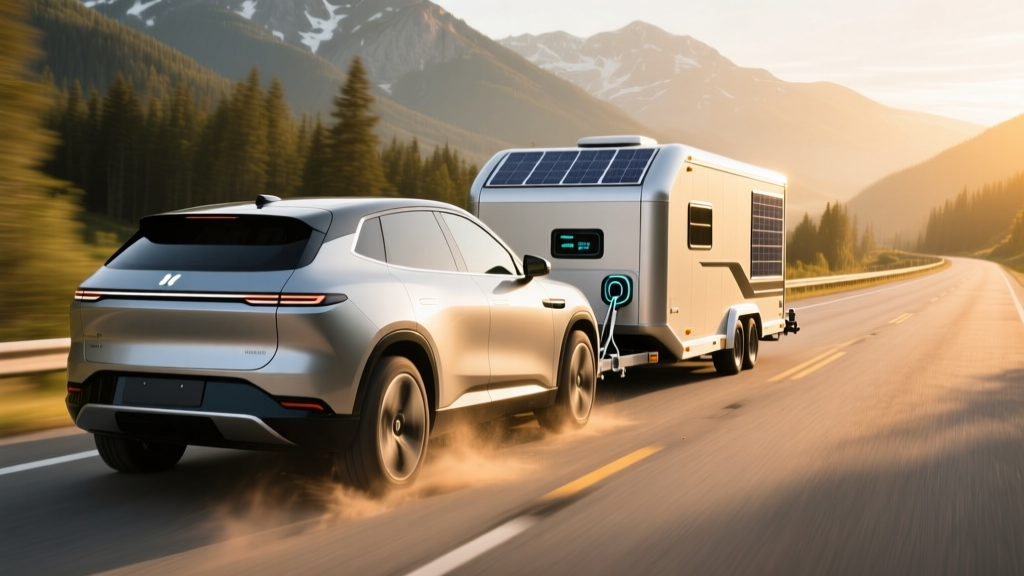
The term electric car pusher most commonly refers to a range-extender trailer — a small towed unit housing a gasoline generator or auxiliary battery pack that charges an EV's battery while driving, effectively extending its range on long road trips. A secondary meaning describes EV push-start or flatbed towing procedures for disabled electric vehicles. In 2026, purpose-built range-extender trailers remain a niche aftermarket product, while most automakers address range anxiety through larger batteries (100+ kWh), faster DC charging (250–350 kW peak), and expanded NACS Supercharger access.
Range-Extender Trailers: How They Work
A range-extender trailer connects to an EV's charge port via a standard J1772 or NACS plug and feeds electricity back into the battery while the vehicle is in motion or parked. The two main types available today:
- Gas-generator trailers: A small 3–7 kW gasoline generator mounted in a lightweight trailer (typically 300–600 lbs). It charges the EV at Level 1 or low Level 2 speeds while driving, adding roughly 15–30 miles of range per hour of operation.
- Battery-pack trailers: A trailer carrying a 10–30 kWh lithium battery pack that feeds power to the EV via a bidirectional charger. These add 40–100 miles of range depending on pack size, but weigh 500–1,200 lbs and cost $8,000–$20,000+.
The physics trade-off is significant: towing a 500-lb trailer increases an EV's energy consumption by 15–30%, partially offsetting the range the extender provides. A vehicle rated at 3.5 miles/kWh unladen might drop to 2.5–2.8 miles/kWh while towing.
EV vs Gas: The Range Reality on Road Trips
The core appeal of a range-extender trailer is eliminating charging stops on long highway drives. Let's compare real numbers:
| Metric | 2026 Tesla Model Y LR | 2026 Toyota Camry (Gas) | 2026 Toyota RAV4 Hybrid |
|---|---|---|---|
| EPA Range / Tank Range | 320 mi (EPA) | ~490 mi (13.2 gal × 37 mpg) | ~580 mi (14.5 gal × 40 mpg) |
| Real-World Highway Range | ~260–280 mi | ~440 mi | ~520 mi |
| Charging/Fueling Stops Needed | 1 DC fast charge | 0 | 0 |
| Stop Duration | ~18–22 min (10–80%) | ~5 min | ~5 min |
| Energy/Fuel Cost | ~$18–$28 (DC fast charging) | ~$32 (at $3.40/gal) | ~$28 (at $3.40/gal) |
| CO₂ Emissions (Tailpipe) | 0 g/mi | ~250 g/mi | ~220 g/mi |
For a 300-mile trip, most modern EVs with 280+ miles of real-world range need exactly one 20-minute DC fast charge. A range-extender trailer could theoretically eliminate that stop — but at the cost of $3,000–$20,000 for the hardware, reduced efficiency, and the complexity of towing.
Real Costs: Range Extenders vs. DC Fast Charging
Let's break down whether a range-extender trailer makes financial sense compared to simply using public DC fast chargers.
| Cost Category | Gas-Generator Trailer (~$4,500) | Battery-Pack Trailer (~$14,000) | DC Fast Charging Only |
|---|---|---|---|
| Hardware Purchase | $4,500 | $14,000 | $0 |
| Annual Fuel/Energy (road trips) | ~$360/yr (gasoline for generator) | ~$120/yr (home-charged battery) | ~$480/yr (avg $0.40/kWh) |
| 5-Year Fuel/Energy Total | $1,800 | $600 | $2,400 |
| Maintenance (5 years) | ~$500 (oil, spark plugs, filters) | ~$200 (minimal) | $0 |
| Trailer Registration/Insurance | ~$600 over 5 years | ~$600 over 5 years | $0 |
| 5-Year Total Cost | $7,400 | $15,400 | $2,400 |
| Cost Per Road Trip | ~$123 | ~$257 | ~$40 |
The math is clear: unless you take 30+ long road trips per year through areas with zero charging infrastructure, DC fast charging is dramatically cheaper. The national DC fast-charging network has expanded significantly, with NACS becoming the standard connector for nearly all 2026-model EVs and over 55,000 public charging stations listed by the DOE's Alternative Fuels Data Center.
EV Towing: The Other "Pusher" Meaning
If you encountered "electric car pusher" in the context of a disabled or dead-battery EV, this refers to EV towing and push-start procedures. Critical facts every EV owner should know:
- Never flat-tow an EV (all four wheels on the ground). EV motors generate electricity when the wheels spin, which can overheat and destroy the power electronics if the vehicle isn't powered on. This applies to Tesla, Hyundai, Ford, Rivian, and virtually every BEV.
- Flatbed tow trucks are mandatory for most EVs. The vehicle must be fully lifted off the ground or placed on a dolly with drive wheels raised.
- Push-starting doesn't apply to EVs. There's no engine to crank. A dead 12V auxiliary battery can prevent the car from powering on, which requires a 12V jump — but the traction battery itself cannot be "push started."
- Roadside assistance coverage is included with most new EVs for 3–5 years / 36,000–60,000 miles. Tesla, Hyundai, Ford, and BMW all include flatbed towing to the nearest charger.
Common EV Range & Towing Myths vs. Facts
| Myth | Fact |
|---|---|
| "You'll get stranded with no way to recharge" | Modern EVs provide 20–40 miles of low-charge buffer warnings. With 2026's NACS network, most highway corridors have chargers every 50–80 miles. |
| "A gas generator trailer is the best range insurance" | A $120 portable power station + a $100 J1772 adapter provides emergency Level 1 charging (3–5 mi/hr) at a fraction of the cost and weight. |
| "You can tow an EV behind an RV like a gas car" | Most EVs cannot be flat-towed. Doing so risks catastrophic inverter damage not covered by warranty. Check your owner's manual — some Rivian models allow limited flat-towing in specific modes. |
| "Cold weather cuts EV range in half" | At 20°F, expect 20–35% range loss depending on the vehicle. EVs with heat pumps (standard on most 2026 models from Hyundai, Tesla, BMW) lose significantly less than older resistive-heating models. Preconditioning while plugged in recovers most of this loss. |
| "Charging an EV on the road takes hours" | At a 250+ kW DC fast charger, most 2026 EVs charge 10–80% in 15–22 minutes. The 350 kW chargers on Electrify America and Tesla V4 Superchargers push this to 12–18 minutes for compatible vehicles. |
What First-Time EV Buyers Should Know Instead
Rather than investing in a range-extender trailer, here's where first-time EV buyers should focus their budget and research:
Home Charging Is the Real Game-Changer
Over 80% of EV charging happens at home. A Level 2 home charger (240V, 32–48 amps) adds 25–40 miles of range per hour and costs $500–$1,500 for the unit plus $800–$2,500 for professional installation (depending on panel capacity and run length). If your electrical panel needs a 200-amp upgrade, budget an additional $1,500–$3,000. Total home-charging setup: $1,300–$7,000 depending on your home's electrical infrastructure.
Choose the Right Battery Size for YOUR Driving
Not everyone needs a 330-mile battery. According to fueleconomy.gov, the average American drives 37 miles per day. If you have home charging and rarely take 200+ mile trips, a 220–250 mile EV saves you $5,000–$10,000 upfront and reduces battery weight (improving efficiency).
Understand the §30D Federal Tax Credit
The federal EV tax credit under IRS §30D offers up to $7,500 for qualifying new EVs, with these 2026 requirements:
- MSRP caps: $80,000 for SUVs/pickups/vans; $55,000 for sedans
- Income limits: $150,000 single / $225,000 head of household / $300,000 joint AGI
- Battery sourcing: Critical minerals and battery components must meet phased-in domestic/free-trade sourcing thresholds (stricter each year through 2032)
- Point-of-sale transfer: You can transfer the credit to the dealer for an instant price reduction at purchase
Always verify eligibility on the IRS website before purchasing — sourcing rules change annually and vary by model and build date.
Decision Framework: Do You Need a Range Extender?
Choose a range-extender trailer if:
- You drive 500+ miles through remote areas (rural Alaska, desert Southwest, northern Canada) more than 6 times per year
- You regularly travel corridors with confirmed charging gaps exceeding 100 miles
- You need continuous cabin heating in extreme cold (-20°F or below) on long unplugged stretches
- Budget is secondary to absolute range certainty
Choose DC fast charging + trip planning if:
- Your road trips mostly follow interstate highways (I-5, I-80, I-95, I-70, I-10)
- You take fewer than 20 road trips over 250 miles per year
- You want to minimize upfront cost, maintenance, and towing complexity
- You drive a 2026 EV with 280+ miles of real-world range and 200+ kW DC charging
Choose a PHEV instead if:
- You want EV commuting (30–50 miles electric) but gas-engine range insurance for road trips
- You lack reliable home charging and want flexibility
- Vehicles like the 2026 Toyota RAV4 Prime (42 mi EV, 38 mpg gas) or Jeep Wrangler 4xe (22 mi EV) fit your needs
The Verdict: Range Extenders Are a Solution to a Mostly-Solved Problem
In 2026, the combination of 280+ mile real-world EV range, 15–22 minute DC fast charging, and a mature NACS Supercharger network has made range-extender trailers unnecessary for over 95% of drivers. The hardware costs $4,500–$20,000, adds 300–1,200 lbs of towing weight, reduces efficiency by 15–30%, and introduces mechanical complexity — all to save one 20-minute charging stop on occasional road trips.
If range anxiety is your primary barrier to EV adoption, a plug-in hybrid (PHEV) is a more practical bridge: you get 30–50 miles of electric commuting with unlimited gas range for road trips, zero towing required, and full warranty coverage. For committed EV buyers, invest in a quality Level 2 home charger, learn to precondition your battery before DC fast charging, and use apps like A Better Routeplanner to plan charging stops — you'll spend less money, tow less weight, and arrive at the same destination only 20 minutes later.
Can I plug a portable generator into my EV's charge port?
Technically, some portable generators with 240V outlets can charge an EV using a generator-to-J1772 adapter at 1.5–3 kW (roughly 5–10 miles of range per hour). However, most EVs and generators lack the proper grounding and communication protocols for safe operation. This is not recommended by any automaker and may void your vehicle's electrical warranty. Purpose-built range-extender trailers include the necessary inverters and safety systems.
Does towing a trailer void my EV warranty?
Towing within the manufacturer's rated capacity does not void the battery or powertrain warranty. However, damage caused by an aftermarket range-extender trailer feeding power back through the charge port while in motion could be classified as unauthorized modification. Consult your warranty terms and the trailer manufacturer's liability coverage before connecting any third-party charging device while driving.
What EVs have the longest real-world range for road trips in 2026?
Based on EPA estimates and real-world highway testing: the Lucid Air Grand Touring achieves ~450 real-world highway miles (516 EPA), the Tesla Model S Long Range delivers ~340 real-world miles (402 EPA), and the Chevrolet Silverado EV 4WT reaches ~320 real-world miles (390+ EPA). For mainstream pricing, the Hyundai Ioniq 6 SE Long Range offers ~300 real-world miles (361 EPA) starting around $42,000.
Are range-extender trailers street-legal?
Range-extender trailers must meet standard trailer regulations: DOT lighting, brakes (if over a state-specific weight threshold, typically 1,500–3,000 lbs), registration, and license plates. Running a gasoline generator on a public highway may be restricted in some jurisdictions due to emissions and noise ordinances. Check your state's DMV and environmental regulations before purchasing.
What's the cheapest way to add emergency range to an EV?
The most cost-effective emergency range solution is a portable 120V/240V EVSE (charge cable) paired with access to standard outlets — a $200–$350 investment that provides 3–5 miles/hour on 120V or 15–25 miles/hour on 240V (NEMA 14-50 outlets at campgrounds, RV parks, and some rest areas). Combined with a $50 J1772-to-NACS adapter for broader charger access, this covers most emergency scenarios for under $400.