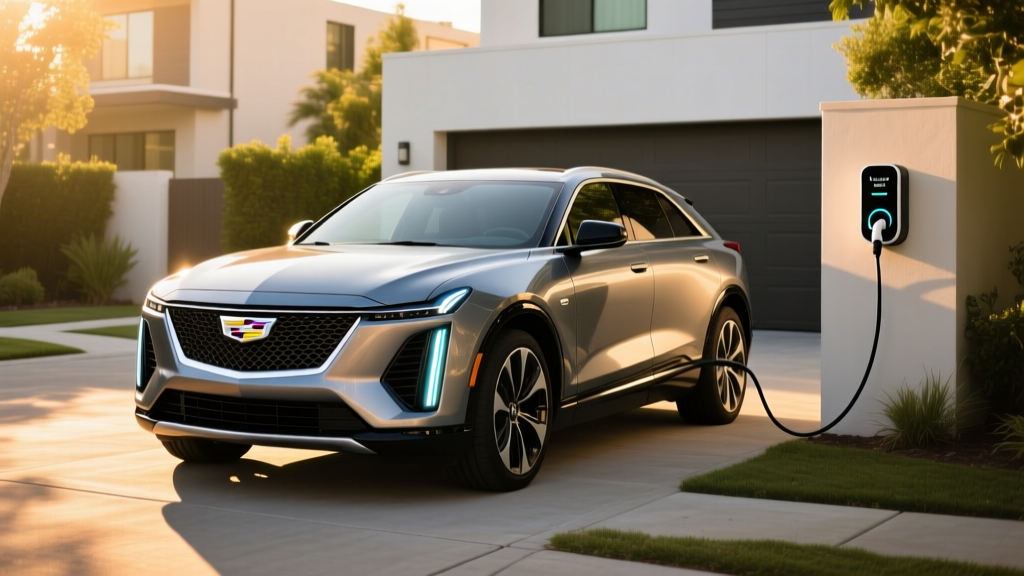
The 2024 Cadillac Lyriq Sport 3 sits at the top of the Lyriq lineup, pairing a 100.4 kWh Ultium battery with a 500-horsepower dual-motor AWD powertrain and Cadillac's most feature-rich trim. It's the version buyers choose when they want the sportier aesthetic — blacked-out trim, 22-inch wheels, and a monochromatic badge delete — without stepping into the six-figure luxury EV space occupied by the BMW iX and Mercedes EQS SUV. But does the Sport 3 deliver on range, charging speed, and value when you move past the spec sheet? We break down the numbers that matter.
Key Specs at a Glance: 2024 Cadillac Lyriq Sport 3
| Specification | Value |
|---|---|
| EPA Range | 314 miles (AWD dual-motor) |
| Usable Battery | 100.4 kWh (NMC, Ultium platform) |
| Peak DC Fast Charge | 190 kW |
| 10–80% DC Charge Time | ~34 minutes |
| Level 2 Home Charge Rate | 19.2 kW (up to 52 mi/hr) |
| Drivetrain | Dual-motor AWD |
| Horsepower / Torque | 500 hp / 450 lb-ft |
| 0–60 mph | 4.6 seconds |
| EPA Efficiency | 89 MPGe (combined) / 38 kWh/100 mi |
| Base MSRP (Sport 3) | $64,090 (incl. $1,395 destination) |
| Battery Warranty | 8 years / 100,000 miles |
Real-World Range: What the EPA Sticker Doesn't Tell You
Real-World Highway (70–80 mph): ~250–275 miles
Cold Weather (below 32°F): ~220–250 miles with heat pump active
Mixed Commute (city/suburban): ~290–310 miles
The Lyriq Sport 3's 314-mile EPA rating applies specifically to the dual-motor AWD configuration. The single-motor RWD versions of the Lyriq push past 314 miles, but the Sport 3 is exclusively AWD, so 314 is your ceiling.
In real-world highway driving at sustained speeds above 70 mph, expect a 12–18% reduction from the EPA sticker. EVs lose efficiency at high speed because aerodynamic drag scales with the square of velocity, and the Sport 3's 22-inch wheels and 5,800-pound curb weight don't help. On a 300-mile road trip with a mix of 65–80 mph segments, you'll likely arrive with roughly 10–15% remaining — workable, but tight enough that you'll want to plan one DC fast-charge stop.
Cold weather compounds the loss. The Lyriq uses a heat pump for cabin heating, which is significantly more efficient than resistive heating, but battery chemistry still slows down in sub-freezing temperatures. Expect 20–28% range reduction in sustained winter driving, especially on short trips where the cabin and battery both need to warm from cold-soaked states. According to EPA data on fueleconomy.gov, the AWD Lyriq rates at 89 MPGe combined, which translates to 38 kWh per 100 miles — respectable for a 5,800-pound luxury SUV, but not class-leading against lighter competitors.
Charging Speed: 190 kW Peak, but Read the Fine Print
| Charging Level | Power / Rate | Time / Miles Added |
|---|---|---|
| Level 1 (120V household) | ~1.4 kW | ~3–4 miles per hour |
| Level 2 (240V home, 19.2 kW capable) | Up to 19.2 kW | ~52 miles per hour |
| Level 2 (240V home, 11.5 kW typical) | 11.5 kW | ~31 miles per hour |
| DC Fast Charge (peak) | 190 kW | 10–80% in ~34 minutes |
| DC Fast Charge (sustained avg 10–80%) | ~120–130 kW | ~170 miles in 34 min |
The Lyriq Sport 3 supports up to 190 kW on DC fast chargers via its CCS1 connector (Cadillac began transitioning to NACS for 2025 models, but 2024 models use CCS1 with Supercharger adapter access). The 10–80% charge time of approximately 34 minutes is competitive, though not class-leading — the Hyundai Ioniq 5 and Kia EV6 can hit 10–80% in roughly 18 minutes thanks to their 800V architecture, while the Lyriq runs on GM's 400V Ultium platform.
The critical detail is the charge curve. The Lyriq peaks near 190 kW between roughly 10–30% state of charge, then tapers progressively. Above 60%, expect speeds closer to 80–100 kW, and above 80%, charging slows dramatically to protect the NMC battery. This is standard behavior for all lithium-ion packs, but it means that a 20–80% session will be faster than a 10–90% session. For road trips, plan to charge in the 10–80% window and skip topping off unless you need the extra miles.
At home, the Lyriq's onboard charger supports up to 19.2 kW on Level 2 — one of the highest in its class. This requires a hardwired 100-amp circuit and a compatible Level 2 station (such as the ChargePoint Home Flex configured for 80 amps). Most homes with a standard 50-amp NEMA 14-50 outlet will see 11.5 kW, which still delivers a full overnight charge in about 9 hours. A Cadillac-published charging guide confirms the 19.2 kW capability, but verify your home's electrical panel capacity with a licensed electrician before committing to a 100-amp install.
Performance and Driving Dynamics
The Sport 3's dual-motor AWD setup produces 500 horsepower and 450 lb-ft of torque, launching the Lyriq from 0–60 mph in 4.6 seconds. That's genuinely quick for a luxury SUV of this size, and the instant torque delivery makes highway merging effortless. The one-pedal driving mode with regenerative braking is well-calibrated — aggressive enough to handle most stop-and-go traffic without touching the friction brakes, but not so abrupt that passengers complain.
Ride quality benefits from GM's five-link rear suspension and available air ride adaptive damping (standard on the Sport 3). The 22-inch wheels look aggressive but transmit more road imperfections than the 20-inch options on lower trims. If you frequently drive on rough pavement, consider whether the Sport 3's wheel-and-tire package is the right trade-off for the aesthetics.
Interior Space, Tech, and the 33-Inch Display
The Lyriq Sport 3's cabin is anchored by a 33-inch advanced LED curved display that combines the instrument cluster and infotainment into a single pane of glass running Google Built-In. This means native Google Maps navigation, Google Assistant voice commands, and Play Store apps — no phone projection required, though wireless Apple CarPlay and Android Auto are both supported.
| Dimension | Measurement |
|---|---|
| Cargo Volume (rear seats up) | 28.0 cu ft |
| Cargo Volume (rear seats folded) | 60.8 cu ft |
| Front Legroom | 44.3 inches |
| Rear Legroom | 39.6 inches |
| Front Headroom | 39.8 inches |
| Rear Headroom | 38.4 inches |
Cargo space is adequate but not exceptional. The 28.0 cu ft behind the second row trails the Tesla Model X (37.1 cu ft) and is roughly on par with the BMW iX (35.5 cu ft to the window line, though measurement methodologies differ). The Lyriq does not offer a front trunk (frunk), which is a missed opportunity for an EV built on a dedicated platform — GM allocated that space to HVAC and electronics packaging.
Driver assistance comes via Super Cruise, GM's hands-free driving system for compatible divided highways. Super Cruise is SAE Level 2 — the driver must remain attentive, and a camera monitors eye gaze. It's one of the best highway-assist systems available, with smooth lane-keeping and automatic lane-change capability, but it is not autonomous driving. Coverage has expanded to over 750,000 miles of mapped roads in North America as of late 2024.
Pricing, Trims, and Federal Tax Credit Eligibility
| Trim | MSRP (incl. destination) | Est. After §30D Credit* |
|---|---|---|
| Sport 1 (AWD) | $58,590 | ~$51,090 |
| Sport 2 (AWD) | $62,090 | ~$54,590 |
| Sport 3 (AWD) | $64,090 | ~$56,590 |
*Federal tax credit eligibility is not guaranteed. The §30D credit is subject to MSRP caps (SUVs must be ≤$80,000), buyer income limits ($300K joint / $225K head of household / $150K single MAGI), and battery critical-mineral and component sourcing requirements that change annually. The Lyriq qualifies for at least partial credit in 2024; verify current-year eligibility at fueleconomy.gov and consult a tax professional. The credit can now be transferred to the dealer at point of sale as an upfront discount under IRS rules effective January 2024.
The Sport 3 commands roughly $2,000 over the Sport 2 primarily for cosmetic and convenience upgrades: 22-inch alloy wheels, a unique front grille design, illuminated exterior accents, and a few additional interior trim options. It does not add performance or range over the Sport 2 — both share the same 100.4 kWh battery and 500 hp dual-motor setup. If you don't care about the blacked-out Sport aesthetic, the Luxury 3 trim offers the same equipment level with chrome exterior accents at the same MSRP.
An as-tested Sport 3 with premium paint and no dealer markups will land near $65,000–$67,000 before incentives. After the maximum $7,500 federal credit (if eligible), the effective price drops into the high $50Ks — a competitive position against the BMW iX xDrive50 ($87,000+), Audi Q8 e-tron ($75,000+), and Genesis Electrified GV70 ($67,000+).
Battery Warranty and Longevity
GM backs the Lyriq's Ultium battery pack with an 8-year / 100,000-mile warranty covering defects and capacity loss below a specified threshold (typically 60–70% retention, though exact terms should be confirmed in your purchase agreement). The NMC chemistry in the Ultium platform has demonstrated competitive degradation in early fleet data, though long-term 10-year results are still accumulating. The Ultium platform uses a wireless battery management system (wBMS) that reduces wiring harness weight and complexity — a design choice unique to GM among mainstream EV platforms.
For owners who charge primarily at home on Level 2 and avoid frequent DC fast-charging to 100%, NMC batteries in this class typically retain 85–92% capacity after 100,000 miles based on industry-wide degradation data from similar chemistries.
Pros, Cons, and Who Should Buy the Sport 3
Pros
- 314-mile EPA range is competitive for AWD luxury SUVs
- 19.2 kW Level 2 onboard charging is among the fastest available
- Super Cruise hands-free highway driving (SAE Level 2) included
- 33-inch curved display with Google Built-In is genuinely excellent
- Strong value vs. BMW iX and Mercedes EQS SUV after tax credit
- Quiet, well-isolated cabin with premium ride quality
Cons
- 400V architecture means slower DC charging vs. 800V competitors
- No front trunk (frunk) despite dedicated EV platform
- 22-inch Sport 3 wheels hurt ride quality on rough roads
- Cargo volume (28 cu ft) trails some rivals
- CCS1 connector on 2024 models; NACS adapter required for Superchargers
- Heavy at ~5,800 lbs — efficiency suffers at sustained highway speeds
Best for: Luxury-minded commuters and families who prioritize cabin technology, ride comfort, and hands-free highway driving over maximum cargo space or the fastest road-trip charging. The Sport 3 is ideal if you can charge at home on a Level 2 circuit and your typical road trips stay within 250 miles between stops. It's also a strong pick if you want a premium EV under the $80,000 MSRP cap for the federal tax credit.
Look elsewhere if: You need the fastest possible DC charging (consider the Ioniq 5 or EV6), require maximum cargo capacity (Model X or Rivian R1S), or want a NACS-native vehicle without adapter dependency (2025+ models or Tesla).
Frequently Asked Questions
What is the real-world range of the 2024 Cadillac Lyriq Sport 3?
Expect 250–275 miles in sustained highway driving, 220–250 miles in cold weather below freezing, and close to the 314-mile EPA rating in mixed city/suburban commuting with moderate temperatures.
How fast does the Lyriq Sport 3 charge?
On DC fast chargers, it peaks at 190 kW and charges from 10–80% in approximately 34 minutes. At home on a Level 2 charger, it supports up to 19.2 kW (52 miles per hour) with the proper 100-amp circuit, or 11.5 kW (31 mi/hr) on a standard 50-amp outlet.
Does the 2024 Lyriq Sport 3 qualify for the federal EV tax credit?
The Lyriq has qualified for up to $7,500 under IRS §30D rules, but eligibility depends on your income (MAGI caps apply), the vehicle's MSRP (must be ≤$80,000 for SUVs — the Sport 3 qualifies), and battery-sourcing requirements that change yearly. Check fueleconomy.gov for current status and consult a tax professional.
Is the Lyriq Sport 3 worth buying over the BMW iX or Tesla Model X?
If your priority is value and a premium cabin experience under $65K, the Lyriq Sport 3 undercuts the BMW iX by over $20,000 and the Model X by over $30,000. You sacrifice some DC charging speed and cargo space, but gain Super Cruise and one of the best infotainment systems in the segment.
Does the 2024 Lyriq have a frunk?
No. GM used the front compartment for HVAC components and electronics, so there is no front trunk. All cargo goes in the rear, which offers 28.0 cu ft behind the second row and 60.8 cu ft with seats folded.
What connector does the 2024 Lyriq use?
The 2024 Lyriq uses a CCS1 connector for DC fast charging and a J1772 connector for Level 1 and Level 2 AC charging. Cadillac provides access to Tesla Superchargers via a GM-approved adapter, but the native port is CCS1. Starting with 2025 models, Cadillac transitioned to the NACS connector.