The Short Answer on the Electric Jeep Wrangler
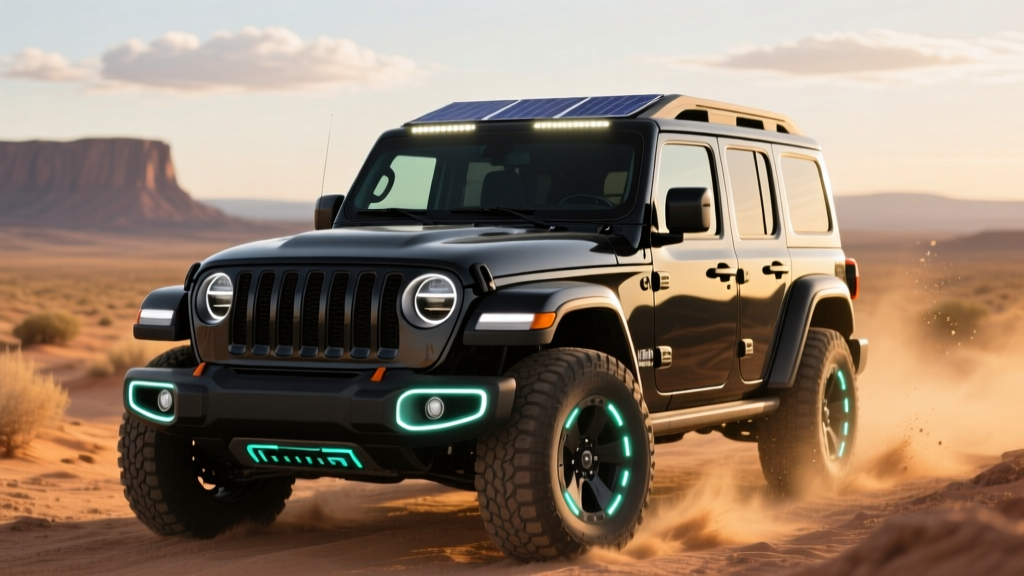
As of early 2026, Jeep does not sell a fully electric (battery-electric) Wrangler. If you are searching for an electric car Jeep Wrangler, the closest option available today is the Wrangler 4xe plug-in hybrid (PHEV), which offers 21 miles of electric-only range and 49 MPGe combined. A fully battery-electric Wrangler has been announced as part of Stellantis's EV roadmap, but no firm on-sale date or finalized specs have been published. For buyers who want electric Jeep capability right now, the 4xe PHEV or the all-electric Jeep Recon (a Wrangler-inspired SUV) are the realistic choices.
Current State of Electric Jeep Wrangler Options in 2026
Jeep's electrification strategy has centered on the Wrangler 4xe since its 2021 launch. The 2026 Wrangler 4xe continues with a 2.0L turbocharged inline-four paired with two electric motors and a 17.3 kWh (usable) lithium-ion battery pack. This PHEV setup produces 375 horsepower and 470 lb-ft of torque, routed through an 8-speed automatic and the same 4x4 systems (Selec-Trac, Rock-Trac) found in gas Wranglers.
Meanwhile, the Jeep Recon — a fully electric, body-on-frame SUV built on Stellantis's STLA Large platform — entered production in late 2025 as a 2026 model. While Jeep markets the Recon as a spiritual successor to the Wrangler's off-road ethos, it is a distinct vehicle with unibody construction and different dimensions. We cover it as a comparison point below.
Stellantis has signaled a battery-electric Wrangler is in development, potentially arriving by 2028–2029, but all details remain preliminary. Any article or listing claiming you can buy a fully electric Wrangler today is inaccurate.
Wrangler 4xe vs Gas Wrangler: Real Numbers
The decision for most buyers comes down to whether the 4xe PHEV's electric capability justifies its price premium over the gas-only Wrangler. Here is how the two stack up with concrete data from fueleconomy.gov and Jeep's official specifications.
| Spec | 2026 Wrangler 4xe (PHEV) | 2026 Wrangler Gas (2.0L Turbo) |
|---|---|---|
| Powertrain | 2.0L I4 turbo + 2 electric motors | 2.0L I4 turbo |
| Horsepower | 375 hp combined | 270 hp |
| Torque | 470 lb-ft | 295 lb-ft |
| EPA Electric-Only Range | 21 miles | N/A |
| EPA Combined MPGe | 49 MPGe | N/A |
| EPA Combined MPG (gas-only mode) | 20 MPG | 22 MPG |
| Battery Capacity (usable) | 17.3 kWh (NMC) | N/A |
| Level 2 Charge Time (0–100%) | ~2.0 hours at 7.2 kW | N/A |
| 0–60 mph | ~7.5 sec | |
| Towing Capacity | 3,500 lbs | 3,500 lbs |
| Starting MSRP (Sport S trim) | $51,790 | $37,290 |
| Federal Tax Credit Eligibility | Up to $3,750 (§30D, PHEV cap) | None |
Key takeaway: The 4xe commands a roughly $14,500 premium before incentives. After the maximum $3,750 PHEV federal credit (subject to income, MSRP, and battery-sourcing rules per IRS §30D), the effective gap narrows to approximately $10,750. Whether that gap closes through fuel savings depends entirely on your driving and charging habits.
Real-World Ownership Costs: 4xe PHEV vs Gas Wrangler
Sticker price is only part of the equation. Here is a 5-year cost projection assuming 15,000 miles per year, electricity at $0.16/kWh (national average), and gasoline at $3.50/gallon.
| Cost Category (5 Years / 75,000 Miles) | Wrangler 4xe PHEV | Gas Wrangler 2.0T |
|---|---|---|
| Purchase Price (Sport S, before credit) | $51,790 | $37,290 |
| Federal Tax Credit Applied | −$3,750 | $0 |
| Effective Purchase Price | $48,040 | $37,290 |
| Fuel / Electricity Cost | $7,800* | $11,930 |
| Maintenance (estimated) | $3,200 | $4,100 |
| Insurance (avg. $2,100/yr) | $10,500 | $9,000 |
| Total 5-Year Cost | $69,540 | $62,320 |
*Fuel cost assumes 40% of miles driven on electric (short commutes with nightly home charging) and 60% on gasoline. If you rarely charge, the 4xe's 20 MPG gas-only mode actually costs more per mile than the gas Wrangler's 22 MPG, because the 4xe carries ~700 lbs of extra battery weight.
Should You Buy the Wrangler 4xe or the Gas Model?
Choose the Wrangler 4xe if:
- Your daily commute is under 20 miles round-trip and you can charge at home nightly (Level 2 or even Level 1 will replenish 17.3 kWh overnight).
- You want the instant torque advantage off-road — the electric motors deliver full torque at 0 RPM, which matters on technical trails.
- You qualify for the §30D PHEV credit (modified AGI under $150K single / $300K joint, vehicle MSRP under $80K for SUVs).
- You value the additional 105 hp and 175 lb-ft over the gas model for towing or highway passing.
Choose the Gas Wrangler if:
- You cannot charge at home or work — without regular plug-in charging, the 4xe becomes a heavier, thirstier gas Wrangler.
- Your budget is firm below $40,000 and you do not want to finance the PHEV premium.
- You primarily drive long highway miles where the 4xe's electric range is irrelevant and its extra mass hurts fuel economy.
- You plan to heavily modify the vehicle (larger tires, lift kits), which already degrades efficiency — adding battery weight compounds the penalty.
Charging the Wrangler 4xe at Home: What You Actually Need
The Wrangler 4xe uses a J1772 connector for AC charging and does not support DC fast charging. This is a common point of confusion for first-time PHEV buyers.
| Charging Level | Power | Time (0–100%) | Setup Required |
|---|---|---|---|
| Level 1 (120V household outlet) | ~1.4 kW | ~12 hours | None — included cordset |
| Level 2 (240V, 32A) | 7.2 kW | ~2 hours | Home wall connector install ($500–$1,500) |
| DC Fast Charging | Not supported | N/A | N/A |
Because the battery is only 17.3 kWh usable, a Level 2 home charger replenishes it fully in about two hours. Many 4xe owners find that plugging into a standard 120V outlet overnight (12+ hours) is sufficient for daily top-ups, since most commutes use less than the full 21-mile electric range. However, a dedicated Level 2 circuit is recommended for convenience and to precondition the cabin while plugged in without draining the battery.
Home charging install reality check: A basic Level 2 installation (240V / 40A circuit, 20-foot run from panel) typically costs $800–$1,500 including the ChargePoint Home Flex or similar EVSE and electrician labor. If your electrical panel is at capacity (common in older homes with 100A service), a panel upgrade to 200A adds $1,500–$3,000. Always get a quote from a licensed electrician before committing.
Off-Road Capability: Does Electrification Help or Hurt?
This is where the Wrangler 4xe differentiates itself from every other PHEV on the market. The electric motors provide precise low-speed torque control that is genuinely advantageous in rock crawling and technical terrain. Jeep's Rock-Trac 4:1 low-range transfer case (standard on Rubicon 4xe) combined with electric torque delivery creates a crawl ratio of 77.2:1 — and the instant response eliminates the lag you feel modulating a gas engine at idle speed on rocks.
The trade-off is weight. The 4xe weighs approximately 5,200 lbs — roughly 700 lbs more than a comparable gas Wrangler Rubicon. That extra mass is noticeable on soft surfaces (sand, deep mud) where ground pressure matters, and it increases brake wear on sustained downhill grades. The battery pack is mounted under the rear seats and is sealed for the Wrangler's 31.5-inch water fording depth, so submersion is not a concern.
Cold-weather reality: In temperatures below 20°F, expect the 4xe's electric-only range to drop from 21 miles to approximately 14–16 miles due to battery chemistry limitations and cabin heating demand. The gas engine will engage more frequently in cold weather, reducing your electric driving percentage. If you live in a northern climate and were counting on pure-electric commuting through winter, plan for this 25–30% range loss.
What About the Jeep Recon? The All-Electric Alternative
If you want a fully battery-electric Jeep with off-road credentials, the 2026 Jeep Recon is the current option. Built on the STLA Large platform, the Recon offers:
- EPA Range: ~320 miles (estimated, AWD variant)
- Battery: ~100 kWh usable, NMC chemistry
- Peak DC Fast Charge: ~175 kW (10–80% in ~28 minutes)
- Horsepower: ~335 hp (dual-motor AWD)
- Starting MSRP: ~$52,000 (estimated)
- Selec-Terrain + Electronic Lockers: Standard on Trailhawk trim
The Recon is a unibody SUV, not a body-on-frame Wrangler. It does not have a removable roof or doors, a solid front axle, or the Wrangler's aftermarket modification ecosystem. Think of it as Jeep's answer to the Ford Bronco Sport rather than the Bronco itself. If your priority is zero-emission daily driving with moderate trail capability, the Recon is compelling. If you need the Wrangler's specific combination of removable top, solid axles, and extreme articulation, no current EV replaces it.
Tax Credit Eligibility: What the 4xe Actually Qualifies For
The Wrangler 4xe is eligible for the §30D New Clean Vehicle Credit, but as a PHEV, the maximum credit is $3,750 (half of the $7,500 maximum available to full BEVs). This is because the 4xe's battery does not meet the full critical-minerals and battery-component sourcing thresholds required for the second $3,750 half under current IRS rules.
- Income caps: Modified AGI must not exceed $150,000 (single), $225,000 (head of household), or $300,000 (married filing jointly).
- MSRP cap: The vehicle's MSRP must not exceed $80,000 (SUV classification). All current 4xe trims fall under this cap.
- Point-of-sale transfer: As of 2024, you can transfer the credit to the dealer at purchase, reducing your out-of-pocket cost immediately rather than waiting to claim it on your tax return.
- Battery sourcing: Sourcing requirements tighten annually. Confirm current-year eligibility with your dealer and a tax professional before relying on the credit in your budget.
Common Misconceptions About an Electric Jeep Wrangler
| Myth | Fact |
|---|---|
| "You can buy a fully electric Wrangler today." | False. Only the 4xe PHEV is available. A BEV Wrangler has not been released as of 2026. |
| "The 4xe charges at DC fast chargers." | False. The 4xe is AC-only (Level 1 and Level 2). No DC fast charging hardware is equipped. |
| "The battery makes it unsafe in water crossings." | False. The 4xe maintains the Wrangler's 31.5-inch fording depth. The battery is sealed and positioned above the frame rails. |
| "PHEVs are pointless — you still burn gas." | Misleading. If 40% of your miles are electric, you save ~$4,100 in fuel over 5 years. The PHEV eliminates emissions for short trips while retaining gas range for long hauls. |
| "The 4xe qualifies for the full $7,500 tax credit." | False. As a PHEV with partial battery sourcing compliance, the current maximum is $3,750. |
| "Electric motors can't handle off-road abuse." | False. Electric motors provide superior low-speed torque control. The 4xe isTrail Rated and used in competitive off-road events. |
Frequently Asked Questions
Will Jeep release a fully electric Wrangler?
Stellantis has indicated a battery-electric Wrangler is in development as part of its goal to sell 50% EVs in the US by 2030. However, no official on-sale date, pricing, or finalized specifications have been announced. The earliest realistic estimate is the 2028–2029 timeframe, and it may be a next-generation model rather than a conversion of the current JL platform.
How far can the Wrangler 4xe go on electricity alone?
The EPA rates the 2026 Wrangler 4xe at 21 miles of electric-only range. In real-world driving with moderate temperatures and flat terrain, expect 18–21 miles. In cold weather (below 20°F) or at sustained highway speeds, expect 14–16 miles. Once the battery depletes, the gas engine takes over seamlessly, and you drive it like a conventional hybrid with 20 MPG combined.
Can I take the Wrangler 4xe through deep water?
Yes. The 4xe carries the same Trail Rated badge and 31.5-inch water fording rating as the gas Wrangler Rubicon. The high-voltage battery pack is hermetically sealed, and all high-voltage connections are waterproofed. Jeep specifically engineered the 4xe for the same off-road use cases as the gas model.
Is the Wrangler 4xe more expensive to insure?
Yes, typically. PHEVs carry higher insurance premiums due to the cost of battery replacement and specialized repair requirements. Expect to pay 10–15% more than an equivalent gas Wrangler — roughly $200–$300 additional per year depending on your insurer, driving record, and state.
What happens if the 4xe battery degrades?
Jeep covers the 4xe's high-voltage battery with an 8-year / 100,000-mile warranty (10 years / 150,000 miles in CARB states). The warranty guarantees the battery will retain at least 70% of its original capacity. Given the relatively small 17.3 kWh pack and moderate cycling demands, significant degradation within the warranty period is uncommon. Out-of-warranty replacement cost is estimated at $8,000–$12,000 based on current PHEV battery pricing.