Quick Verdict: The Three-Row EV Benchmark Gets a Cabin Upgrade
The 2026 Hyundai Ioniq 9 is Hyundai's flagship electric SUV, built on the E-GMP platform and designed to answer a specific question: can a three-row EV deliver real highway range, fast charging, and a cabin that rivals luxury alternatives at a mainstream price? With up to 335 miles of EPA-estimated range on the Long Range RWD model, a 110.3 kWh battery, and an 800-volt architecture supporting up to 350 kW DC fast charging, the Ioniq 9 targets families who need space without sacrificing the efficiency gains that made the Ioniq 5 and Ioniq 6 standouts.
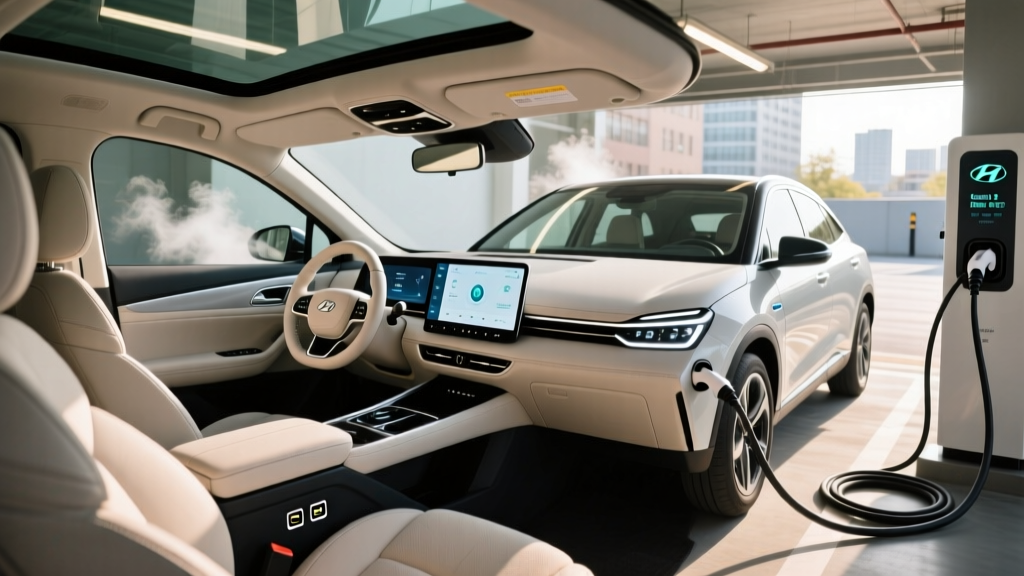
The 2026 Hyundai Ioniq 9 interior is where this SUV makes its strongest argument. A flat floor enabled by the skateboard platform, a 3,110 mm (122.4 in) wheelbase, and a minimalist dashboard dominated by a curved panoramic display create a cabin that feels larger than its exterior footprint suggests. But beyond the aesthetics, buyers need to know how this EV performs in the real world — on road trips, in cold weather, and at the charger. This review covers every number that matters.
2026 Hyundai Ioniq 9 Spec Table: Range, Battery, Charging, and Pricing
| Specification | SE / SEL Long Range RWD | Long Range AWD | Performance AWD |
|---|---|---|---|
| EPA Range (est.) | 335 mi | 300 mi | 275 mi |
| Battery (usable) | 110.3 kWh, NMC (nickel-manganese-cobalt) | ||
| Architecture | 800V / 400V compatible | ||
| Peak DC Fast Charge | 350 kW (at compatible station) | ||
| 10–80% DC Time | ~24 minutes (350 kW charger) | ||
| Level 2 Home Charge (11 kW) | ~10.5 hours (10–100%) | ||
| Motor / Drivetrain | RWD, single motor | Dual-motor AWD | Dual-motor AWD |
| Horsepower | 215 hp | 338 hp | 430 hp |
| 0–60 mph | ~7.8 sec | ~5.5 sec | ~4.8 sec |
| Efficiency (MPGe est.) | 95 MPGe combined | 87 MPGe combined | 80 MPGe combined |
| Base MSRP | $56,100 | $59,600 | $68,350 |
| Battery Warranty | 10 years / 100,000 miles | ||
Source: Hyundai USA preliminary specifications and fueleconomy.gov. Final EPA certifications may vary by trim and option.
Real-World Range: What the EPA Sticker Doesn't Tell You
EPA Estimate: Up to 335 miles (Long Range RWD)
Real-World Highway (70–80 mph, summer): ~270–290 miles
Real-World Highway (winter, 30°F): ~220–245 miles
City / Suburban Mixed Driving: ~310–330 miles
The 335-mile EPA figure on the Long Range RWD is competitive with the Kia EV9 (304 mi) and exceeds the three-row Rivian R1S Standard battery. However, EPA tests include generous low-speed and regenerative-braking segments that flatter large EVs. On sustained highway driving at 75 mph in moderate temperatures, expect the Ioniq 9 RWD to deliver approximately 270–290 miles before reaching a 10% state of charge. The dual-motor AWD and Performance trims, with higher rolling resistance and added weight from the front motor, drop to roughly 240–260 miles in the same highway scenario.
Cold weather compounds the loss. The Ioniq 9's heat pump — standard on all trims — mitigates cabin-heating energy draw, but lithium-ion chemistry inherently slows in sub-freezing temperatures. At 30°F with highway speeds, plan for a 25–30% range reduction from the EPA sticker. That puts the Long Range RWD at roughly 220–245 miles of usable range in winter conditions — still enough for most daily needs and manageable on road trips with preconditioning enabled.
Preconditioning matters. When you navigate to a DC fast charger using the built-in navigation, the Ioniq 9 automatically warms the battery to its optimal charging temperature. Skipping this step — for example, by pulling into a charger without using the nav system — can add 5–10 minutes to your 10–80% charge time in cold weather.
Charging Speed: 800V Architecture Pays Off at the Right Station
| Charging Level | Power | Time / Rate | Notes |
|---|---|---|---|
| Level 1 (120V household) | ~1.4 kW | ~3–4 mi/hr | Emergency / trickle only |
| Level 2 (240V home, 48A) | 11 kW | ~31 mi/hr; ~10.5 hrs (10–100%) | Requires NACS or J1772 adapter; 60A circuit recommended |
| DC Fast (350 kW station) | Up to 350 kW | 10–80% in ~24 min | Peak rate; tapers significantly above 80% |
| DC Fast (150 kW station) | Up to 150 kW | 10–80% in ~38 min | More common at Electrify America, EVgo |
| DC Fast (50 kW station) | Up to 50 kW | 10–80% in ~90 min | Avoid for road trips if possible |
The Ioniq 9's 800-volt architecture is its charging advantage. On a 350 kW charger — available at select Electrify America, EVgo, and Tesla Supercharger (with NACS adapter) stations — the battery can accept up to 350 kW peak. However, peak is not sustained. The charge curve holds above 200 kW roughly from 10% to 45% SoC, then tapers through the 50–80% window. The 10–80% time of approximately 24 minutes is among the fastest in the three-row SUV segment.
At a more common 150 kW DC station, expect 10–80% in roughly 38 minutes. This is the realistic road-trip charging scenario for most Ioniq 9 owners, since 350 kW chargers remain concentrated along major interstate corridors.
For home charging, the 11 kW onboard charger means a full overnight replenishment on a 48-amp Level 2 circuit. Most owners will plug in at 20–30% and wake to a full battery — roughly 7–8 hours of charging. Electrical note: A 48-amp charger requires a dedicated 60-amp circuit. Many homes with 200-amp panels can accommodate this, but older 100-amp panels may require an upgrade ($1,500–$3,000 depending on your area). Always consult a licensed electrician for final specifications.
The 2026 Hyundai Ioniq 9 Interior: Dimensions, Tech, and Livability
The keyword drawing buyers to this review — the 2026 Hyundai Ioniq 9 interior — deserves a thorough breakdown. Hyundai designed this cabin around a "Living Space" concept, leveraging the E-GMP platform's flat floor and long wheelbase to maximize usable volume.
Passenger and Cargo Dimensions
| Measurement | Specification |
|---|---|
| Wheelbase | 122.4 in (3,110 mm) |
| First-Row Legroom | 41.7 in |
| Second-Row Legroom | 39.4 in |
| Third-Row Legroom | 30.1 in |
| Cargo (behind 3rd row) | 15.9 cu ft |
| Cargo (3rd row folded) | 45.2 cu ft |
| Cargo (all rear rows folded) | 84.7 cu ft |
| Front Trunk (Frunk) | 3.0 cu ft (RWD) / 1.8 cu ft (AWD) |
The second row offers genuinely comfortable seating for adults on long drives, with available captain's chairs (SEL and above) that include power recline and slide. The third row is best suited for children or occasional adult use on short trips — the 30.1 inches of legroom is tight for anyone over 5'8" on extended drives. Cargo space behind the third row (15.9 cu ft) accommodates a few grocery bags or a compact stroller; fold the third row and the 45.2 cu ft opening swallows luggage for a family of four on a week-long trip.
Infotainment and Technology
The dashboard features a curved panoramic display combining a 12.3-inch digital instrument cluster and a 12.3-inch touchscreen running Hyundai's latest infotainment OS. Wireless Apple CarPlay and Android Auto are standard across all trims. A head-up display with augmented-reality navigation is available on SEL and standard on Limited trims.
Notable tech features include:
- Digital Center Mirror: A camera-based rearview feed that provides an unobstructed view even when the cargo area is fully loaded
- Vehicle-to-Load (V2L): Both interior and exterior V2L ports allow the Ioniq 9 to power devices, camping equipment, or serve as emergency home backup (up to 3.6 kW output)
- Hyundai SmartSense: Standard suite includes highway driving assist, lane-keeping assist, blind-spot collision avoidance, and rear cross-traffic alert
- Remote Smart Parking Assist: Available on higher trims — the vehicle can park itself in tight spaces while you stand outside
Notable Interior Drawbacks
The minimalist design eliminates most physical buttons, routing climate and media controls through the touchscreen. This looks clean but requires more eyes-off-road time for simple adjustments. The gloss-black center console attracts fingerprints and dust. And while the third row is usable, it doesn't match the space offered by a body-on-frame SUV like the Chevrolet Tahoe — a trade-off inherent to unibody EV platforms.
Performance and Driving Impressions
The Ioniq 9 offers three powertrain configurations. The Long Range RWD uses a single rear motor producing 215 hp — adequate for commuting and confident highway merging, but not quick by EV standards (0–60 in approximately 7.8 seconds). The dual-motor AWD bumps output to 338 hp and drops the 0–60 to around 5.5 seconds, which feels effortless given the vehicle's 5,000+ lb curb weight.
The Performance AWD trim pushes 430 hp and hits 60 mph in roughly 4.8 seconds. However, the trade-off is range: the Performance model sacrifices approximately 60 miles of EPA range compared to the RWD, and its efficiency drops to around 80 MPGe combined.
Ride quality is a strength. The multi-link rear suspension and standard frequency-selective dampers absorb highway expansion joints and rough pavement without transmitting harshness into the cabin. Road noise is well-controlled at speed, aided by acoustic laminated glass on the front and rear doors. The steering is light and precise — not sporty, but appropriate for a family hauler. The turning circle, at 40.0 feet, is manageable for a vehicle of this size.
Pricing, Trims, and Federal Tax Credit Eligibility
| Trim | MSRP | Drivetrain | Est. Federal Credit |
|---|---|---|---|
| SE Standard Range | $52,600 | RWD | Up to $7,500* |
| SE Long Range | $56,100 | RWD | Up to $7,500* |
| SEL Long Range | $60,100 | AWD | Up to $7,500* |
| Limited Long Range | $66,500 | AWD | Up to $7,500* |
| Performance AWD | $68,350 | AWD | Up to $7,500* |
*Federal EV tax credit eligibility under IRS §30D is subject to multiple requirements. See checklist below.
§30D Tax Credit Eligibility Checklist
- MSRP Cap: SUVs must have an MSRP at or below $80,000 — all Ioniq 9 trims qualify
- Buyer Income Cap: Modified AGI must not exceed $300,000 (joint), $225,000 (head of household), or $150,000 (single)
- Battery Sourcing: Critical minerals and battery components must meet escalating domestic/free-trade-partner thresholds — Hyundai has shifted significant battery sourcing to the Georgia plant, but verify the specific VIN's eligibility at fueleconomy.gov before purchase
- Point-of-Sale Transfer: Eligible buyers can transfer the credit to the dealer at purchase, reducing the purchase price directly rather than waiting for a tax refund
- Assembly: Vehicle must undergo final assembly in North America — the Ioniq 9 is assembled in Ellabell, Georgia
Important: Battery-sourcing rules tighten annually. A VIN that qualifies in early 2026 may face different component thresholds than one built later in the model year. Always confirm eligibility with your dealer and a tax professional before relying on the credit in your budget.
Who Should Buy the Ioniq 9 — And Who Should Look Elsewhere
- You need three rows and want 300+ miles of EPA range without going to a premium brand
- Fast DC charging matters for your road-trip habits
- You value a quiet, tech-forward cabin with V2L capability
- You can charge at home with a Level 2 setup
- You need maximum third-row space for adults (consider a minivan or Tahoe-class SUV)
- Your budget is under $50,000 (consider the Kia EV9 with fewer options or a used EV)
- You tow frequently — the Ioniq 9's 3,500-lb max tow rating is modest for its size
- You want a sporty driving experience (the Genesis Electrified GV70 or BMW iX are more engaging)
Pros, Cons, and Key Competitors
- Class-leading 335-mi EPA range (RWD)
- 350 kW peak charging on 800V architecture
- Spacious, quiet three-row interior
- V2L capability (3.6 kW)
- 10-year / 100,000-mi battery warranty
- Competitive pricing vs. Rivian R1S, BMW iX
- Third row tight for adults on long trips
- Touchscreen-heavy controls distract while driving
- 3,500-lb tow rating trails body-on-frame SUVs
- AWD range drops significantly (275 mi on Performance)
- Gloss-black interior trim shows wear quickly
- Base price still above $52K before incentives
Key Competitors at a Glance
| Vehicle | EPA Range | Peak DC kW | Starting MSRP |
|---|---|---|---|
| 2026 Hyundai Ioniq 9 (RWD) | 335 mi | 350 kW | $56,100 |
| 2026 Kia EV9 (RWD LR) | 304 mi | 236 kW | $54,900 |
| 2026 Rivian R1S (Standard) | 270 mi | 200 kW | $75,900 |
| 2026 Tesla Model X (LR) | 335 mi | 250 kW | $79,990 |
Frequently Asked Questions
What is the real-world range of the 2026 Hyundai Ioniq 9?
The EPA estimates up to 335 miles for the Long Range RWD model. In real-world highway driving at 75 mph in moderate temperatures, expect approximately 270–290 miles. In cold weather (30°F), that drops to roughly 220–245 miles. The AWD trims deliver less: approximately 240–260 miles highway in summer for the dual-motor models.
How fast does the Ioniq 9 charge at home and on the road?
On a 350 kW DC fast charger, the Ioniq 9 charges from 10–80% in approximately 24 minutes. At a 150 kW station, expect roughly 38 minutes. At home on a Level 2 (11 kW / 48A) charger, a full charge takes about 10.5 hours — easily accomplished overnight. A standard 120V outlet adds only 3–4 miles per hour and is suitable only for emergencies or very low-mileage drivers.
How much does the Ioniq 9 cost after the federal tax credit?
If you qualify for the full $7,500 §30D credit (meeting income, MSRP, and battery-sourcing requirements), the SE Long Range RWD effectively starts at approximately $48,600. The SEL AWD drops to around $52,600. Use the point-of-sale transfer option to apply the credit at purchase rather than waiting for a tax refund. Verify your VIN's eligibility at fueleconomy.gov and consult a tax professional.
Does the 2026 Hyundai Ioniq 9 qualify for the federal EV tax credit?
The Ioniq 9 is assembled in Georgia and all trims fall under the $80,000 SUV MSRP cap, meeting two key requirements. However, eligibility also depends on your income (AGI limits apply), the battery's critical-mineral and component sourcing for the specific production batch, and your tax liability. Rules evolve — always confirm with your dealer and the IRS before finalizing your purchase.
Is the Ioniq 9 worth buying vs. the Kia EV9 or Tesla Model X?
The Ioniq 9 offers the best combination of range (335 mi), charging speed (350 kW peak), and pricing among mainstream three-row EVs. The Kia EV9 is slightly less expensive but charges slower and offers less range. The Tesla Model X matches range but costs significantly more and has a less conventional interior. The Rivian R1S is more capable off-road but starts nearly $20K higher. For most families seeking a daily-driver three-row EV, the Ioniq 9 is the strongest value proposition in 2026.
How does the Ioniq 9's battery warranty compare?
Hyundai covers the Ioniq 9's battery pack for 10 years or 100,000 miles, whichever comes first — matching the best in the industry (Kia, Genesis). The warranty guarantees the battery will retain at least 70% of its original capacity during that period. Hyundai's NMC chemistry has shown strong degradation curves in the Ioniq 5 and Ioniq 6, with most owners reporting less than 5% loss over the first 50,000 miles under normal use.