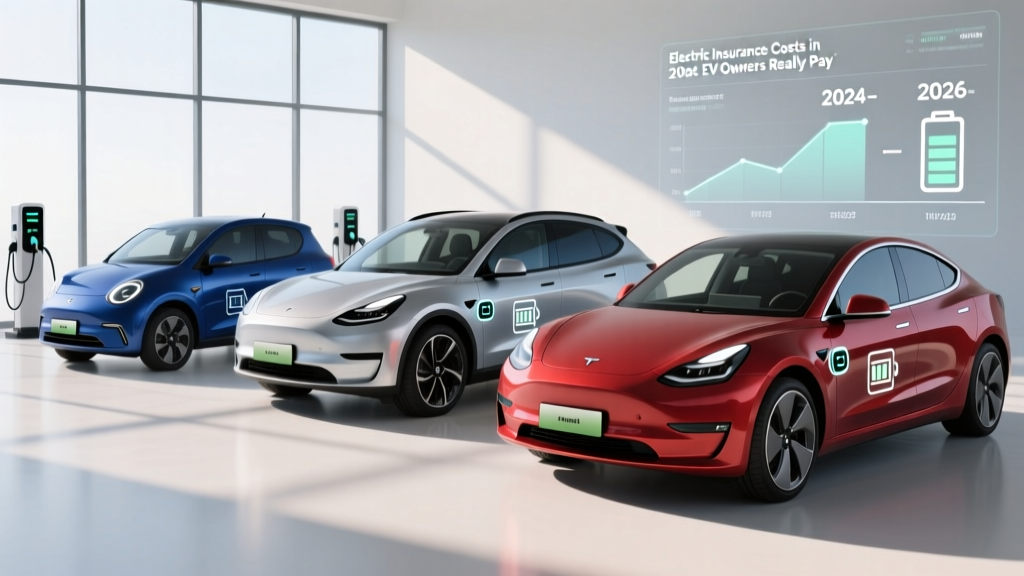
Quick Answer: The average electric vehicle insurance premium in 2026 is approximately $2,100–$2,600 per year for a mainstream EV, roughly 15–25% higher than a comparable gas-powered car. However, after accounting for fuel savings ($900–$1,400/year), reduced maintenance ($400–$700/year), and available federal tax credits, most EV owners still come out ahead on total cost of ownership within 3–5 years. Your exact electric ins rate depends on the vehicle model, your driving record, location, and whether your insurer offers dedicated EV discounts.
Insurance is one of the most overlooked costs when buyers calculate whether an electric vehicle makes financial sense. You've crunched the numbers on MSRP, the §30D federal tax credit, home charger installation, and per-kWh electricity rates — but if your annual premium jumps by $500 or more, that cuts into your projected savings faster than you might expect.
At the same time, EV insurance is not the budget-killer some headlines suggest. Premiums have stabilized since the post-2022 spike, more insurers now offer EV-specific policies, and the total-cost-of-ownership math still favors electrification for most drivers. Here's exactly what you need to know about electric ins costs, why EVs are priced differently, and how to keep your premium as low as possible.
Why EV Insurance Premiums Run Higher Than Gas Cars
Insurance companies price policies based on risk and repair cost. EVs present a different profile than internal combustion vehicles in several measurable ways:
- Higher repair costs after collisions: EV battery packs can cost $10,000–$25,000+ to replace. Even minor structural damage near the battery enclosure may trigger a full pack replacement due to safety protocols, pushing total-loss thresholds lower.
- Specialized labor: High-voltage system repairs require certified EV technicians, and the supply of qualified body shops still lags demand in many regions.
- Higher vehicle MSRP: A 2026 Tesla Model Y Long Range starts at roughly $44,990; a comparably equipped Toyota RAV4 gas model starts around $31,000. Insurers factor in replacement cost.
- Instant torque and acceleration: Some actuaries associate rapid 0–60 times (a Model 3 Performance hits 60 mph in 3.1 seconds) with higher incident risk, though this is debated.
- Parts availability: Certain EV-specific components (cast aluminum structural battery trays, integrated heat pump assemblies) can have longer lead times, increasing rental-car reimbursements and shop time.
That said, EVs also offer insurance advantages: fewer moving parts means less mechanical breakdown risk, and advanced ADAS features (automatic emergency braking, lane-keeping assist) have been shown by IIHS testing to reduce certain collision types.
EV vs Gas Insurance: Real Cost Comparison
Let's put concrete numbers on the difference. Below is a side-by-side annual cost comparison for three popular 2026 model pairings, assuming a 35-year-old driver with a clean record, 12,000 miles/year, and garaged in a suburban zip code.
| Vehicle Pairing | Annual Insurance (EV) | Annual Insurance (Gas) | Premium Gap | EV Annual Fuel Savings |
|---|---|---|---|---|
| Tesla Model Y LR ($44,990) vs Toyota RAV4 LE ($31,000) | $2,480 | $1,720 | +$760/yr | ~$1,150 |
| Hyundai Ioniq 5 SEL ($45,500) vs Honda CR-V EX ($35,000) | $2,340 | $1,680 | +$660/yr | ~$1,080 |
| Chevrolet Equinox EV LT ($36,000) vs Chevy Equinox Gas LT ($30,000) | $1,960 | $1,640 | +$320/yr | ~$980 |
Insurance estimates are illustrative composites based on published 2025–2026 industry averages. Your actual rate will vary by insurer, state, driving history, and coverage selections. Fuel savings assume 12,000 miles/year at $3.40/gal (gas) vs $0.14/kWh (home charging).
Notice the pattern: the premium gap narrows significantly when the EV and gas vehicle are closer in MSRP. The Equinox EV, one of the most affordable mainstream electric crossovers, costs only about $320 more per year to insure than its gas sibling — and the fuel savings alone more than cover that difference.
Full 5-Year Cost of Ownership: Where Insurance Fits
Insurance is just one line item. Here's how a 5-year ownership comparison shakes out for the Tesla Model Y Long Range versus the Toyota RAV4 LE, assuming 12,000 miles/year and current national averages:
| Cost Category (5 Years) | Tesla Model Y LR | Toyota RAV4 LE |
|---|---|---|
| Purchase price (after §30D credit, if eligible) | $37,490* | $31,000 |
| Insurance (5 years) | $12,400 | $8,600 |
| Fuel / electricity | $3,360 | $9,180 |
| Maintenance (oil, filters, brakes, fluids) | $1,200 | $4,500 |
| Federal tax credit applied | −$7,500* | $0 |
| 5-Year Total | $46,950 | $53,280 |
*§30D credit eligibility depends on MSRP caps ($55,000 for sedans, $80,000 for SUVs/trucks), buyer income limits ($150K single / $300K joint), and battery critical-mineral sourcing requirements. Verify current-year rules at IRS.gov or consult a tax professional.
Even with $3,800 more in insurance over five years, the Model Y owner saves roughly $6,300 net — driven primarily by the tax credit and dramatically lower fuel and maintenance costs. This is why total cost of ownership, not any single line item, should drive your decision.
EV Insurance Myths vs Facts
Misinformation about electric car insurance is rampant on forums and social media. Let's address the most common claims with data:
| Myth | Fact |
|---|---|
| "EVs cost double to insure" | The average premium gap is 15–25%, not 100%. Some budget EVs (Equinox EV, Nissan Leaf) are only 5–10% more expensive to insure than gas equivalents. |
| "If the battery gets damaged, the whole car is totaled" | While battery replacement is expensive ($10K–$25K), insurers increasingly work with EV-certified shops that can replace individual modules or sections. Full-pack replacement is not automatic. |
| "All insurance companies charge the same for EVs" | Premium variance between insurers for the same EV can be $600–$1,200/year. Shopping around is critical. Some carriers (GEICO, Progressive, Liberty Mutual) offer specific EV discounts. |
| "Home charging increases my home insurance" | A professionally installed Level 2 charger (240V, 32–48A) generally does not increase homeowner's insurance. Notify your carrier, but expect no premium change if installation was permitted and inspected. |
| "EV insurance will keep rising" | Premiums have stabilized since 2023–2024 as the EV fleet grows, parts supply improves, and more technicians earn high-voltage certifications. Competition among insurers for EV customers is increasing. |
Real-World Factors That Shape Your EV Insurance Rate
Your electric ins premium is not determined by the powertrain alone. These variables have outsized impact:
Vehicle Model and Trim
A Tesla Model 3 Performance (0–60 in 3.1 seconds, ~$53,000) will cost significantly more to insure than a base Model 3 Long Range (~$42,000, 0–60 in 5.8 seconds). Higher horsepower and higher MSRP both push premiums up. Similarly, a loaded Hyundai Ioniq 5 Limited will cost more to insure than the SE Standard Range.
Your Location
Urban drivers pay 20–40% more than rural drivers across all vehicle types. States with high litigation rates (Florida, Louisiana, Michigan) carry higher base premiums. Conversely, states with strong EV adoption (California, Washington, Colorado) now have more insurers competing for EV customers, which can suppress rates.
Home Charging vs Public Charging
Insurers don't typically surcharge you for using public chargers, but your driving pattern matters. If you lack home charging and rely on DC fast charging (which can cost $0.30–$0.48/kWh at Electrify America or EVgo stations), your per-mile cost rises — not your insurance premium directly, but your overall ownership economics change. Drivers with home Level 2 access charge at roughly $0.10–$0.16/kWh (depending on local utility rates), making the fuel-cost advantage over gas much more pronounced.
Annual Mileage and Climate
Low-mileage drivers (under 8,000 miles/year) often qualify for usage-based discounts. Cold-climate EV owners should factor in real-world range loss: a 2026 Model Y with an EPA range of 310 miles may deliver 230–260 miles in sustained sub-freezing highway driving. This doesn't affect insurance but does affect whether the EV fits your lifestyle.
How to Lower Your EV Insurance Premium
Based on current insurer practices, here are proven strategies to reduce your electric ins cost:
- Get quotes from at least 5 carriers. EV premium variance is wide. Progressive, GEICO, State Farm, USAA, and Liberty Mutual all price EVs differently. Use comparison tools and specify the exact EV trim.
- Ask about EV-specific discounts. Some insurers offer 5–10% discounts for battery-electric vehicles, recognizing their lower mechanical-failure risk and advanced safety features.
- Bundle home and auto. Multi-policy discounts of 10–20% apply to EVs just as they do for gas cars.
- Choose a higher deductible. Moving from a $500 to a $1,000 comprehensive/collision deductible can save $150–$300/year — but ensure you can cover the deductible if needed.
- Enroll in usage-based programs. Programs like Progressive's Snapshot or Allstate's Drivewise track driving behavior. Low-mileage, safe-driving EV owners often see 10–15% savings.
- Select an EV with a lower MSRP. The Chevrolet Equinox EV ($33,600–$42,000 range) and Nissan Leaf ($29,000–$37,000) cost less to insure than premium EVs simply because replacement cost is lower.
- Maintain a clean driving record. This is obvious but bears repeating: a single at-fault accident can increase EV premiums by 30–50% for 3–5 years.
Decision Framework: Should the Insurance Premium Change Your EV Choice?
Choose the EV if:
- You have access to home Level 2 charging (the single biggest ownership advantage)
- Your annual mileage is 10,000+ miles (fuel savings offset the insurance gap faster)
- You qualify for the §30D federal tax credit (up to $7,500, subject to income, MSRP, and sourcing rules)
- You plan to keep the vehicle 4+ years (TCO crossover typically occurs at year 3–5)
- The EV's EPA range exceeds your longest regular trip by 20%+ (accounting for cold-weather and highway losses)
Consider a PHEV or hybrid instead if:
- You live in an apartment or lack home charging access and your area has limited public DC fast-charging infrastructure
- You regularly drive 400+ miles in a single day through areas with sparse charging networks
- Your budget is tightly constrained and a $320–$760/year insurance premium increase meaningfully impacts your finances
- You live in an extreme cold-weather climate (sustained temps below 10°F) and your daily commute already pushes range limits
Consider a gas vehicle if:
- You drive fewer than 5,000 miles per year (fuel savings won't offset higher purchase price and insurance)
- You need a specialized vehicle (heavy towing, off-road) where EV options are limited or carry extreme premiums
First-Time EV Buyer Insurance Checklist
Before you sign the purchase agreement, work through this list:
- ☐ Run insurance quotes for the exact make, model, year, and trim from at least 3 insurers before committing
- ☐ Confirm whether your chosen EV qualifies for the §30D tax credit under current-year IRS rules — this changes your effective purchase price
- ☐ Verify your home electrical panel can support a Level 2 charger (typically a 240V/40–60A circuit); budget $500–$2,000 for installation, or more if a panel upgrade is needed
- ☐ Check whether your homeowner's or renter's insurance needs a rider for the charger installation
- ☐ Understand your EV's battery warranty: federal law mandates at minimum 8 years/100,000 miles for battery capacity retention (typically 70% threshold)
- ☐ Factor in real-world range: subtract 15–30% from the EPA sticker for highway driving and cold weather
- ☐ Research DC fast-charging infrastructure along your most common long-distance routes
Frequently Asked Questions
Is electric car insurance more expensive in 2026?
On average, yes — about 15–25% higher than a comparable gas vehicle. However, the gap has narrowed as the EV fleet has grown and repair networks have expanded. Budget-friendly EVs like the Chevy Equinox EV may only cost 5–10% more to insure than their gas counterparts.
Do all insurance companies cover electric vehicles?
Every major U.S. insurer (State Farm, GEICO, Progressive, Allstate, USAA, Liberty Mutual, Farmers) covers EVs. The difference is in pricing methodology — some carriers have more sophisticated EV actuarial models and offer better rates. Always compare at least 3–5 quotes.
Will my EV insurance go down over time?
Premiums for a given vehicle typically decline as it ages and depreciates, just like gas cars. Additionally, industry-wide EV insurance rates have stabilized as parts availability improves and more repair shops gain high-voltage certification. Expect your premium to decrease modestly year-over-year after the first 1–2 years of ownership.
Does installing a home charger affect my insurance?
A professionally installed, permitted Level 2 home charger should not increase your auto insurance premium. Some homeowner's insurance carriers may ask you to disclose it, but a properly installed 240V EVSE (electric vehicle supply equipment) is treated similarly to any other permitted electrical appliance. Unpermitted or DIY installations could create coverage issues.
What happens if my EV battery is damaged in an accident?
Your collision coverage handles battery damage the same as any other component. If the battery is damaged, the insurer will pay for repair or replacement up to your policy limits minus your deductible. Because EV battery packs cost $10,000–$25,000+, this is a key reason comprehensive and collision coverage is strongly recommended for EVs — not just state-minimum liability.
Can I get a discount on EV insurance?
Yes. Look for: EV-specific discounts (5–10% at some carriers), multi-policy bundling (10–20%), low-mileage discounts, usage-based program enrollment, good-driver discounts, and defensive-driving course credits. The single most effective savings strategy is comparing quotes across multiple insurers — variances of $600–$1,200/year for the same EV are common.