Quick Verdict: Is a Tesla Model X Lease Right for You?
The Tesla Model X remains the only all-electric three-row SUV that combines falcon-wing doors, a 5,000-pound towing capacity, and access to the Supercharger network. For 2026, the Long Range AWD model delivers an EPA-estimated 335 miles of range, while the Plaid variant sacrifices 21 miles for a staggering 1,020 horsepower and a 2.5-second 0-60 time. Leasing a Model X makes sense for families who want flagship EV tech without committing to a six-figure purchase — but the math requires careful scrutiny of residual values, mileage caps, and shifting federal incentive rules.
| Spec | Long Range AWD | Plaid |
|---|---|---|
| EPA Range | 335 miles | 314 miles |
| Battery (usable) | ~100 kWh (NMC) | ~100 kWh (NMC) |
| Peak DC Fast Charge | 250 kW | 250 kW |
| 10-80% DC Charge Time | ~30 min | ~30 min |
| Level 2 Rate (11.5 kW) | ~34 mi/hr | ~34 mi/hr |
| 0-60 mph | 3.8 sec | 2.5 sec |
| Horsepower | 670 hp | 1,020 hp |
| Drivetrain | Dual-Motor AWD | Tri-Motor AWD |
| MPGe (combined) | 98 MPGe | 96 MPGe |
| kWh/100 mi | 34 kWh | 35 kWh |
| Base MSRP | $81,630 | $96,630 |
| Battery Warranty | 8 yr / 150,000 mi | 8 yr / 150,000 mi |
Range and Efficiency: EPA vs. the Real World
The 2026 Model X Long Range carries an EPA-estimated 335 miles on a full charge, placing it near the top of the three-row electric SUV segment. The Plaid trim drops to 314 miles due to its tri-motor powertrain's higher energy consumption (35 kWh/100 mi vs. 34 kWh/100 mi for the Long Range).
EPA estimates assume a mix of city and highway driving at moderate temperatures. In our experience and consistent with independent testing, expect:
- Highway-only at 70 mph (summer): ~280-295 miles (Long Range)
- Highway-only at 70 mph (winter, 30°F): ~230-255 miles — cold weather reduces battery efficiency and increases cabin heating load
- City/suburban mixed driving: ~320-340 miles — regenerative braking recovers energy in stop-and-go traffic
The Model X's heat pump (standard since the 2022 refresh) mitigates cold-weather losses compared to older EVs using resistive heaters, but a 20-30% range reduction in freezing temperatures is still physics, not a defect.
Efficiency-wise, the Long Range's 98 MPGe combined (per fueleconomy.gov) is competitive with the Rivian R1S and superior to the Mercedes EQS SUV. The Model X's relatively low drag coefficient (0.24 Cd) for a three-row SUV helps it achieve these numbers despite its 5,185-pound curb weight.
Charging Speed: Supercharger Network Advantage
The Model X supports a peak DC fast-charge rate of 250 kW via its native NACS (North American Charging Standard) connector. On a V3 Supercharger or compatible third-party station, Tesla estimates a 10-80% charge in approximately 30 minutes. However, as with all lithium-ion batteries, the charge curve tapers significantly above 80% — expect a full 10-100% session to take closer to 50-55 minutes.
| Charge Level | Power / Voltage | Miles Added per Hour | Notes |
|---|---|---|---|
| Level 1 (120V) | ~1.4 kW | ~3-4 mi/hr | Emergency/trickle only; not practical for daily use |
| Level 2 (240V, 48A) | 11.5 kW (onboard charger) | ~34 mi/hr | Full charge in ~10 hrs; standard home setup |
| Level 2 (240V, 32A) | 7.7 kW | ~22 mi/hr | Mobile connector on a NEMA 14-50; full charge ~14 hrs |
| DC Fast (V3 Supercharger) | 250 kW peak | ~200 mi in 15 min | 10-80% in ~30 min; tapers above 80% |
| DC Fast (V4 Supercharger) | Up to 350 kW* | Model X capped at 250 kW | *V4 stations deliver higher power, but Model X architecture limits intake |
Home charging setup: The Model X's onboard charger accepts up to 11.5 kW on Level 2. To achieve the full 34 mi/hr rate, you need a Tesla Wall Connector hardwired to a 60-amp circuit (48A continuous draw). A licensed electrician will typically charge $600-$1,800 for installation depending on panel proximity and local permit costs. If your home has a 200-amp electrical panel with spare capacity, this is straightforward; older homes with 100-amp service may need a panel upgrade ($1,500-$3,000+).
Preconditioning matters: The Model X will automatically precondition its battery when you navigate to a Supercharger via the built-in navigation. This warms the battery to the optimal temperature for fast charging, shaving 5-10 minutes off your session in cold weather. Always navigate to the charger rather than just driving there — the difference is measurable.
Performance, Space, and Daily Livability
The Long Range's dual-motor AWD produces 670 horsepower and hits 60 mph in 3.8 seconds — sports-car acceleration in a 5,185-pound family hauler. The Plaid's tri-motor setup (1,020 hp, 2.5 seconds) is genuinely absurd and exists mostly as a halo. For most lessees, the Long Range's performance is more than adequate and the 21 extra miles of range is the better trade-off.
Cargo and passenger space:
- Front trunk (frunk): 6.7 cu ft — fits a carry-on or charging cables
- Cargo behind 3rd row: 15.0 cu ft — tight for a vehicle this size; a week's groceries for a family of five
- Cargo behind 2nd row (3rd row folded): 42.5 cu ft
- Max cargo (all rear seats folded): 85.1 cu ft
- 3rd-row legroom: 32.7 inches — usable for children or short-trip adults; tight for long journeys
- 2nd-row legroom: 40.9 inches
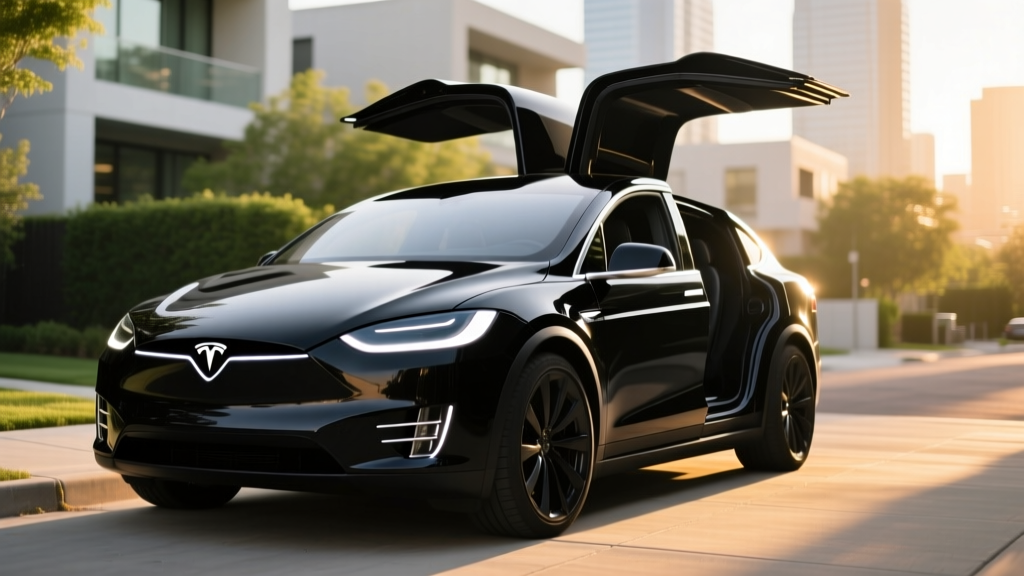
The falcon-wing rear doors are the Model X's signature feature. They open upward with a double-hinge design that requires less lateral clearance than conventional doors, making car-seat access easier in tight parking spots. However, they are mechanically complex — a known source of warranty claims in earlier model years — and they cannot accommodate aftermarket roof racks.
Towing: The Model X is rated to tow up to 5,000 pounds with the optional tow package ($1,000). This covers most boat trailers, small campers, and utility trailers, but towing at capacity will reduce range by roughly 35-45%.
Technology, Driver Assistance, and Safety
The Model X runs Tesla's latest infotainment software on a 17-inch center touchscreen (6.0 TFLOPS processor) with a 12.3-inch digital instrument cluster and an 8-inch rear-seat entertainment screen. The 22-speaker, 960-watt audio system is one of the best in any vehicle at this price point. Wireless phone charging, HEPA air filtration with Bioweapon Defense Mode, and over-the-air updates are all standard.
Driver assistance: Tesla's Autopilot comes standard and includes adaptive cruise control, lane centering, automatic emergency braking, and blind-spot monitoring. The optional Full Self-Driving (Supervised) package ($8,000 one-time or $99/month) adds automated lane changes, navigation-guided on/off-ramp transitions, and traffic-light recognition.
Despite the "Full Self-Driving" name, Tesla's FSD (Supervised) is an SAE Level 2 driver-assistance system. The driver must remain fully attentive, keep hands on the wheel (or demonstrate engagement via the cabin camera), and be prepared to take over at any moment. It does not make the Model X a self-driving car. Only Level 4 services like Waymo operate without a human driver — and only in geofenced areas.
Safety ratings: The Model X earned a 5-star overall rating from NHTSA and has historically performed well in IIHS crash testing. Standard active safety features include automatic emergency braking, lane-departure warning, and side-collision warning.
Pricing, Lease Economics, and Federal Tax Credit Eligibility
The 2026 Tesla Model X Long Range starts at $81,630 (including destination), and the Plaid starts at $96,630. Common add-ons include the $1,000 tow package, $2,000 six-seat interior (captain's chairs replacing the bench), and $1,500-$2,500 for premium paint colors. A well-equipped Long Range typically lands between $85,000-$90,000 before incentives.
| Item | Long Range AWD | Plaid |
|---|---|---|
| Base MSRP | $81,630 | $96,630 |
| Typical As-Tested | ~$86,000 | ~$101,000 |
| Federal Tax Credit (§30D) | Up to $7,500* | Up to $7,500* |
| Credit-Adjusted Price | ~$78,500 | ~$93,500 |
| Est. Monthly Lease (36 mo, 10k mi/yr)** | ~$1,100-$1,350 | ~$1,400-$1,700 |
*Subject to IRS §30D eligibility rules — see below. **Estimates vary by region, credit score, money factor, and residual value. Tesla does not publish standard lease rates; figures are approximations based on third-party leasing data.
The Model X may qualify for up to $7,500 under IRS §30D, but eligibility is not automatic. Key rules for 2026:
- MSRP cap: SUVs/vans/pickups must have an MSRP ≤ $80,000. The Model X Long Range base MSRP of $81,630 exceeds this cap — meaning the Long Range may NOT qualify unless Tesla adjusts pricing or the IRS classifies it differently. The Plaid ($96,630) is also above the cap.
- Buyer income cap: Modified AGI ≤ $300,000 (married filing jointly), $225,000 (head of household), $150,000 (single).
- Battery sourcing: Critical minerals and battery components must meet phased-in domestic/free-trade sourcing thresholds that tighten annually through 2029.
- Point-of-sale transfer: Eligible buyers can transfer the credit to the dealer at purchase, reducing the upfront cost — but the MSRP cap still applies.
Bottom line: The Model X's MSRP puts it in a gray area for §30D eligibility. Always verify current eligibility on the IRS Clean Vehicle portal and consult a tax professional before counting on the credit in your lease or purchase math.
Lease-specific note: Under §30D, the tax credit for a leased vehicle technically goes to the lessor (the financing entity), not the lessee. Some lessors pass this savings through as a capitalized-cost reduction (lowering your monthly payment); others do not. Tesla's lease terms vary by state and financing partner — always confirm whether the $7,500 credit is reflected in your quoted lease payment before signing.
Pros, Cons, and Who the Model X Suits Best
- 335-mile EPA range (Long Range) — among the longest for a three-row EV
- Access to 6,000+ Tesla Supercharger stations — the most reliable DC fast-charging network in North America
- Falcon-wing doors ease car-seat loading in tight parking spots
- 5,000-lb towing capacity with available tow package
- Class-leading acceleration (3.8s / 2.5s 0-60)
- Over-the-air updates continuously add features
- HEPA air filtration with Bioweapon Defense Mode
- Base MSRP exceeds $80,000 SUV cap for §30D federal tax credit
- Third-row legroom (32.7 in.) is tight for adults on long trips
- Cargo behind 3rd row (15.0 cu ft) is small for the vehicle's footprint
- Falcon-wing doors cannot support roof racks or crossbars
- No Apple CarPlay or Android Auto — Tesla's proprietary infotainment only
- Insurance premiums are 20-35% higher than comparable non-Tesla SUVs
- DC fast charge capped at 250 kW while competitors (Hyundai/Kia E-GMP) accept 350 kW
Who the Model X is best for:
- Families of 4-5 who use the third row occasionally for children or short trips and prioritize Supercharger access for road trips
- Tech-forward buyers who value OTA updates, the Tesla ecosystem, and performance over traditional luxury brand cachet
- Towers who need 5,000-lb capacity with an electric powertrain (limited options exist)
Who should look elsewhere:
- Families of 6-7 who need full-time adult third-row seating — the Rivian R1S or Kia EV9 offer more usable third rows
- Budget-conscious lessees — the $1,100+/month lease payment and likely §30D ineligibility make the total cost steep
- Apple CarPlay/Android Auto users — Tesla's closed infotainment system is a dealbreaker for some
Model X vs. Key Competitors: Is It Worth the Lease?
- Supercharger network access is a priority for frequent road trips
- You want the longest EPA range in a three-row electric SUV (335 mi)
- Performance (3.8s 0-60) and falcon-wing doors are meaningful to you
- You're comfortable with Tesla's proprietary infotainment and no CarPlay
- You need a more usable third row (34.4 in. legroom) and more cargo space
- Off-road capability matters (R1S offers quad-motor and 14.9 in. ground clearance)
- You want a more conventional SUV design with roof-rack compatibility
- Budget is a concern — the EV9 starts ~$27,000 lower and qualifies for §30D
- You want Apple CarPlay/Android Auto and a more traditional dealer experience
- 350 kW DC fast-charging capability (E-GMP platform) matters for public charging speed
Frequently Asked Questions
What is the real-world range of the Tesla Model X?
The EPA rates the 2026 Model X Long Range at 335 miles and the Plaid at 314 miles. In real-world highway driving at 70 mph, expect 280-295 miles (Long Range) in summer conditions and 230-255 miles in freezing weather. City driving with regenerative braking can approach or slightly exceed EPA estimates.
How fast does the Model X charge at home and on the road?
On a properly installed Level 2 home charger (48A/11.5 kW), the Model X gains about 34 miles of range per hour — a full charge takes roughly 10 hours. On a V3 Supercharger (250 kW DC), it charges from 10-80% in approximately 30 minutes. The Model X's architecture caps DC intake at 250 kW, so newer 350 kW stations won't charge it any faster.
Does the Tesla Model X qualify for the $7,500 federal EV tax credit?
Possibly, but it's uncertain. The IRS §30D credit caps SUV MSRP at $80,000, and the Model X Long Range starts at $81,630. Whether Tesla or the IRS classifies the Model X in a way that meets the cap varies — always check the IRS Clean Vehicle portal for the most current eligibility. Buyer income caps ($300K joint / $150K single) and battery-sourcing rules also apply. For leases, the credit goes to the lessor and may or may not be passed through to your monthly payment.
Is leasing a Model X better than buying?
Leasing protects you from depreciation risk (EVs have seen volatile resale values), keeps you under warranty for the full term, and lets you upgrade to newer battery/tech in 36 months. However, lease mileage caps (typically 10,000-15,000 mi/yr) can be restrictive for heavy road-trippers, and excess-mileage penalties ($0.20-$0.30/mi) add up fast. If you drive more than 15,000 miles per year, buying is usually more economical.
How long will the Model X battery last?
Tesla warranties the Model X battery for 8 years or 150,000 miles, whichever comes first, with a minimum 70% capacity retention threshold. Real-world data from high-mileage Tesla owners suggests NMC batteries in the Model X typically degrade 10-15% over the first 100,000 miles, with the rate slowing thereafter. Battery replacement (if out of warranty) costs approximately $15,000-$22,000 including labor — a figure worth considering for post-lease or high-mileage ownership.
What are the biggest drawbacks of the Model X?
The most common complaints are the tight third-row legroom (32.7 in.), limited cargo space behind the third row (15.0 cu ft), the lack of Apple CarPlay/Android Auto, higher-than-average insurance costs, and the falcon-wing doors' incompatibility with roof racks. The MSRP also places it above the §30D tax credit cap for SUVs, which affects the value proposition versus competitors like the Kia EV9.