Quick Answer: Do Electric Cars Get HOV Lane Access?
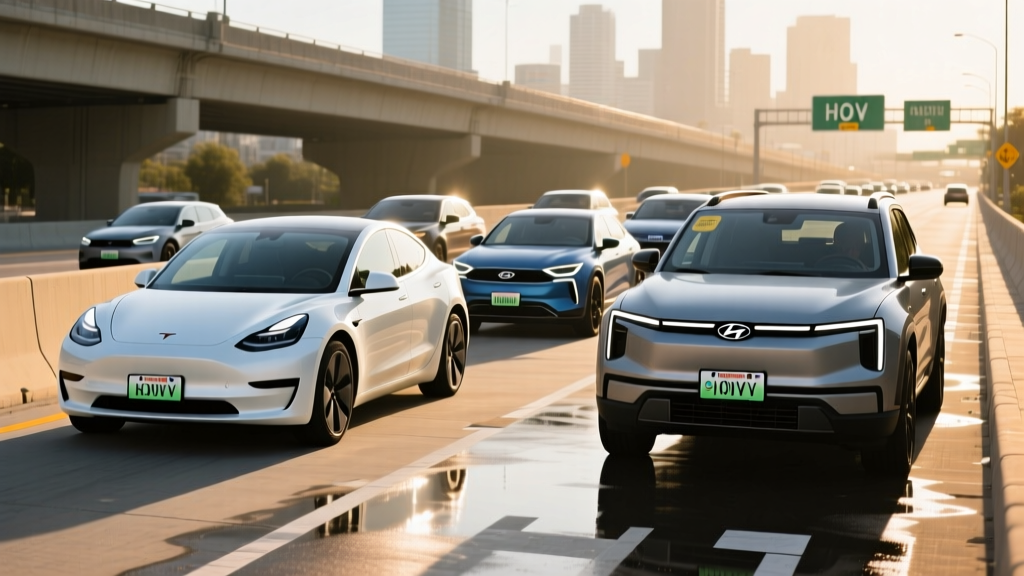
Yes — but only in certain states, only with specific EVs, and only if you apply for and display a special decal or plate. As of 2026, the states offering HOV (carpool) lane exemptions to solo-driving electric vehicles include California, Colorado, Georgia, Maryland, New York, New Jersey, and Virginia, among others. Eligibility typically requires a fully electric (BEV) or qualifying plug-in hybrid (PHEV), and many programs have income caps, vehicle price caps, or expiration dates on the decals. The perk can save commuters 10–30 minutes per trip in congested metro corridors, but it is not automatic — you must apply through your state's DMV or clean-air agency.
How Electric Car HOV Lane Programs Actually Work
The idea behind electric car HOV lane access is simple: states incentivize zero-emission vehicle adoption by letting EV drivers use carpool lanes even when driving alone. But the execution varies dramatically by jurisdiction, and the details matter enormously for your purchase decision.
In California — the state with the most robust and longest-running program — the Clean Air Vehicle (CAV) decal program has undergone multiple revisions. As of 2026, new applicants purchasing a qualifying zero-emission vehicle can apply for a CAV decal through the California DMV. However, the program has faced legislative sunsets and renewals, and decal expiration dates are tied to specific program phases. Vehicles purchased in earlier program years may have already lost access. The key takeaway: decal eligibility is not permanent and not guaranteed for future buyers.
Colorado offers HOV lane access on I-25 express lanes to qualifying EVs and PHEVs through its Clean Vehicle Pass program. Maryland allows PEV (plug-in electric vehicle) owners to apply for HOV permits for use on I-270 and US-50. Virginia has offered HOV exemptions for alternative-fuel vehicles, though program rules and eligible corridors have shifted. Georgia discontinued its free HOV access for EVs several years ago but has debated reinstating limited perks.
The critical point for buyers: check your specific state's current rules before purchasing. A vehicle that qualifies in California may not qualify in Maryland, and program sunsets can eliminate access for new applicants even within the same state.
Which EVs Qualify for HOV Lane Decals?
Generally, states require the vehicle to be a battery electric vehicle (BEV) or a plug-in hybrid (PHEV) meeting minimum electric-only range thresholds. Conventional hybrids (HEVs) like the Toyota Prius hybrid — which cannot plug in — do not qualify in most current programs.
| Vehicle | Type | EPA Electric Range | Battery | Base MSRP | HOV Eligible? |
|---|---|---|---|---|---|
| Tesla Model 3 RWD | BEV | 272 mi | 60 kWh (LFP) | $38,990 | Yes (most states) |
| Tesla Model Y Long Range | BEV | 320 mi | 75 kWh (NMC) | $44,990 | Yes (most states) |
| Chevrolet Equinox EV 3LT | BEV | 319 mi | 85 kWh (NMC) | $41,900 | Yes (most states) |
| Hyundai Ioniq 5 SE | BEV | 303 mi | 77.4 kWh (NMC) | $42,600 | Yes (most states) |
| Toyota Prius Prime XSE | PHEV | 44 mi (elec) | 13.6 kWh | $36,695 | Varies by state |
| Ford Escape PHEV | PHEV | 37 mi (elec) | 14.4 kWh | $39,500 | Varies by state |
| Toyota Prius (HEV) | HEV | N/A (no plug) | 1.0 kWh | $28,550 | No |
States like California typically require PHEVs to meet a minimum electric-only range — often 25+ miles — to qualify for the same decals as BEVs. Some states have created tiered systems where BEVs receive longer-duration decals while PHEV decals expire sooner. Always verify with your state's DMV or environmental agency before assuming eligibility.
The Real Commute-Time Value of HOV Lane Access
Let's quantify what an electric car HOV lane sticker actually buys you in daily life. Data from transportation studies in major metro areas paints a clear picture:
- Los Angeles (I-405, I-10): Solo drivers in general-purpose lanes average 35–45 minutes for a 15-mile commute during peak hours. HOV lane users cover the same distance in 15–22 minutes — a savings of 15–25 minutes each way.
- Washington, D.C. (I-270, I-66): Peak-hour savings range from 10–20 minutes per trip depending on corridor and time.
- Denver (I-25 Express Lanes): Savings of 8–15 minutes during rush hour, with express-lane tolls waived for qualifying clean-energy vehicles.
- Atlanta (I-85 HOT lanes): Georgia's previous HOV exemption was eliminated, and current HOT lane pricing applies to EVs — reducing the perk's value.
For a commuter driving 250 days per year, saving 20 minutes per round-trip translates to roughly 166 hours annually — the equivalent of four full work weeks. If your time is valued at $30/hour, that's approximately $5,000/year in recovered productivity. This is the strongest economic argument for prioritizing HOV-eligible EVs in congested corridors.
EV vs. Gas Car: Total Cost When You Factor in HOV Lane Savings
To understand whether the HOV perk justifies choosing an EV over a comparable gas car, we need to look at total ownership costs. Below is a 5-year comparison for a typical commuter driving 15,000 miles/year in California, comparing a Tesla Model 3 RWD against a Honda Accord 1.5T (a popular gas sedan in the same price bracket).
| Cost Category | Tesla Model 3 RWD (BEV) | Honda Accord 1.5T (Gas) |
|---|---|---|
| Purchase Price (MSRP) | $38,990 | $29,990 |
| Federal Tax Credit (§30D, if eligible) | -$3,750* | $0 |
| Net Purchase Cost | $35,240 | $29,990 |
| Fuel/Energy (5 yrs, 75k mi) | $4,500 (home L2 avg) | $9,375 (30 MPG, $3.75/gal) |
| Maintenance (5 yrs) | $1,200 | $3,500 |
| Insurance (5 yrs avg) | $11,500 | $8,500 |
| HOV Time Savings (valued at $30/hr) | -$25,000 (savings) | $0 |
| Net 5-Year Cost | $27,440 | $51,365 |
*§30D credit amount varies based on battery sourcing, buyer income, and MSRP caps. Verify eligibility at irs.gov. Point-of-sale transfer available at participating dealers.
Without the HOV time savings, the Model 3 costs more over five years — primarily due to higher insurance premiums and the purchase price gap. But when you monetize commute time saved through carpool-lane access, the EV becomes dramatically more economical for corridor commuters. The break-even point for the HOV perk alone is roughly 18–24 months of daily commuting in heavy congestion.
Common Misconceptions About Electric Car HOV Lane Access
| Myth | Fact |
|---|---|
| "Any electric car automatically gets HOV lane access." | No. You must apply for a decal or plate through your state DMV, display it, and the vehicle must meet specific eligibility criteria. Driving in the HOV lane without the proper decal is a traffic violation. |
| "HOV lane access is permanent once I get the decal." | Decals have expiration dates tied to program phases. California's CAV decals issued under different program years expire on different schedules. Some states have fully sunset their programs for new applicants. |
| "Hybrids like the Prius qualify for HOV lane access." | Conventional hybrids (HEVs) that cannot plug in generally do not qualify. Only BEVs and PHEVs meeting minimum electric-range thresholds are eligible in most current programs. |
| "HOV access works in every state." | Only a handful of states offer this perk. If you move from California to Texas, your HOV lane privilege does not transfer — and Texas does not offer a comparable program. |
| "I can use any HOV lane with my EV decal." | Some HOV lanes are restricted to 2+ or 3+ occupants regardless of vehicle type. Express lanes and toll lanes may have separate rules. Always check posted signage for the specific corridor. |
Real-World Ownership Considerations Before You Buy for the HOV Perk
Chasing HOV lane access as your primary EV motivation is reasonable — but only if the rest of EV ownership fits your life. Here are the practical factors that determine whether the strategy works:
Home Charging Access
The economics above assume home Level 2 charging at residential electricity rates ($0.13–$0.28/kWh depending on state and utility). If you rely exclusively on public DC fast charging, your energy cost per mile roughly doubles — from about $0.04–$0.06/mile at home to $0.10–$0.18/mile on networks like Electrify America or EVgo. Apartment dwellers without charging access should verify workplace charging availability or nearby reliable public infrastructure before committing.
Cold-Weather Range Loss
If you commute in a state with harsh winters (Colorado, Maryland, New Jersey), expect 15–30% range reduction in freezing temperatures due to battery chemistry limitations and cabin heating demands. A Tesla Model 3 with 272 miles of EPA range may deliver only 190–230 miles in sustained sub-30°F driving. For most commuters doing 30–50 miles daily, this is still ample — but it affects road-trip planning and charging frequency.
Insurance Costs
EV insurance premiums run 15–30% higher than comparable gas vehicles, driven by higher repair costs, specialized parts, and battery replacement risk. A Model 3 that costs $29,000 to insure over 5 years as a gas equivalent might cost $34,000–$38,000. Get quotes before purchasing — the HOV savings can offset this, but you need to know the number upfront.
Program Sunset Risk
Several states have already scaled back or eliminated EV HOV perks as adoption has increased. California's program has been extended multiple times but faces ongoing legislative debate. If your state's program sunsets in 2–3 years, you may only receive partial value from the HOV benefit. Factor this uncertainty into your purchase calculus.
Decision Framework: Should You Buy an EV for HOV Lane Access?
Choose a BEV for HOV access if:
- Your daily commute includes a congested corridor with an HOV/express lane (I-405, I-270, I-25, etc.)
- You have reliable home or workplace Level 2 charging
- Your state currently offers an active HOV exemption program for EVs with a decal you can obtain
- Your round-trip commute is under 80 miles (well within real-world EV range)
- You value time savings at $25+/hour and commute 200+ days/year
Choose a PHEV instead if:
- Your state's program accepts qualifying PHEVs (44+ mile electric range)
- You lack reliable home charging but want electric-mode commuting on shorter trips
- You frequently take road trips exceeding 200 miles and don't want to plan DC fast-charging stops
- You want HOV access without full BEV range-anxiety risk
Skip the EV-for-HOV strategy if:
- Your state does not offer an EV HOV exemption program
- Your commute route has no HOV or express lanes
- You live in an apartment with no charging access and no workplace charging
- Your state's program is sunsetting within 12 months and no renewal is pending
- Your daily commute is under 10 miles in uncongested traffic (time savings are negligible)
Federal Tax Credits and HOV-Eligible EV Pricing in 2026
If you're buying an EV partly for HOV access, the federal §30D clean vehicle credit can further improve the economics — but eligibility is far from universal. Key requirements for 2026:
- MSRP caps: Vans, SUVs, and pickups must be under $80,000; sedans under $55,000
- Buyer income caps: AGI must not exceed $300,000 (joint), $225,000 (head of household), or $150,000 (individual)
- Battery sourcing: Increasing percentages of critical minerals and battery components must be sourced from the U.S. or free-trade-agreement partners — this disqualifies some otherwise eligible models
- Point-of-sale transfer: Buyers can transfer the credit to the dealer at purchase, reducing the out-of-pocket price immediately rather than waiting for tax filing
The maximum credit is $7,500, but many vehicles qualify for only $3,750 (meeting one of two sourcing thresholds) or $0. Always verify the specific model year and trim's eligibility on the fueleconomy.gov tax credit page before purchasing. The IRS maintains the definitive list at irs.gov.
Frequently Asked Questions
Can I use the HOV lane immediately after buying an EV?
No. You must apply for and receive the state-issued decal or clean-air plate before using HOV lanes as a solo driver. In California, CAV decal processing can take 2–4 weeks. Driving in the carpool lane without the displayed decal is a citable offense, even if your vehicle technically qualifies.
Does HOV lane access transfer if I sell my EV?
Generally, no. In most states, the decal is tied to the vehicle and the original applicant. California allows limited transfers under specific conditions (e.g., if the decal has not yet been issued to a prior owner's vehicle), but the rules are restrictive. A used EV buyer should verify decal transferability with the DMV before purchasing.
Do Tesla vehicles still qualify for HOV lane decals?
Yes. Tesla Model 3, Model Y, Model S, and Model X are all zero-emission BEVs and qualify for HOV decals in states with active programs, subject to MSRP caps where applicable. The Model S and Model X (starting above $70,000 and $80,000 respectively) may face MSRP cap restrictions in some state programs.
Will HOV lane perks eventually disappear as EV adoption grows?
Likely yes, in many states. These programs were designed as adoption incentives, and as EV market share grows, legislators face pressure to end the perk — both to manage HOV lane congestion and because the incentive has served its purpose. Georgia, which was an early adopter, already eliminated its program. Expect gradual phase-outs rather than abrupt endings, but plan your purchase assuming the benefit has a finite lifespan.
Can I get HOV access with a used electric car?
It depends on the state and whether the vehicle previously held a decal. In California, a used EV may be eligible for a new decal if it never received one under a prior owner, or if the prior owner's decal was issued under a program phase that allows transfer. This is a complex area — verify with the DMV before assuming a used EV purchase will grant HOV access.