The Real Answer: Which Electric Car Suits Adult Drivers?
Short answer: The best electric car for adults depends on your daily mileage, charging access, and budget. For most adult buyers in 2026, the sweet spot is a crossover or sedan with 250–320 miles of EPA range, DC fast charging at 150+ kW (10–80% in under 25 minutes), and a starting MSRP between $35,000 and $50,000. Models like the Hyundai Ioniq 5 (EPA 303 mi, peak 240 kW DC, ~$42,000 base), Tesla Model Y (EPA 310 mi, peak 250 kW, ~$44,990 base), and Chevrolet Equinox EV (EPA 315 mi, peak 150 kW, ~$33,600 base) hit these marks. If you lack home charging, prioritize public charging network access and consider a plug-in hybrid as a bridge.
Adult EV buyers aren't chasing gimmicks — they want reliable daily transportation that starts every morning, charges conveniently, and costs less over time than a gas equivalent. This guide strips away the hype and gives you the exact numbers, trade-offs, and decision points you need to choose the right electric car for your life.
EV vs Gas vs Hybrid: The Numbers Side by Side
Before choosing an electric car, adult buyers need honest comparison data. Here's how a typical 2026 EV stacks up against a gas car and a plug-in hybrid across key ownership metrics, using the Hyundai Ioniq 5 SEL (AWD, 84 kWh usable battery, NMC chemistry) versus the Honda CR-V EX (2.0L turbo, AWD) and the Toyota RAV4 Prime (PHEV, AWD).
| Metric | Hyundai Ioniq 5 SEL (EV) | Honda CR-V EX (Gas) | Toyota RAV4 Prime (PHEV) |
|---|---|---|---|
| MSRP (base) | $42,750 | $33,750 | $44,590 |
| Federal tax credit (§30D) | Up to $7,500 (eligibility varies) | $0 | Up to $7,500 (eligibility varies) |
| Effective price after credit | ~$35,250 | $33,750 | ~$37,090 |
| EPA range / MPG | 290 mi (EPA) / 110 MPGe | 27 MPG combined | 42 mi EV + 38 MPG gas |
| Annual fuel cost (12k mi) | ~$540 (electricity) | ~$1,560 (gasoline) | ~$780 (mixed) |
| 5-year fuel savings vs gas | ~$5,100 | Baseline | ~$3,900 |
| Annual maintenance | ~$200 | ~$600 | ~$450 |
| 0–60 mph | 5.1 sec / 320 HP | 7.8 sec / 190 HP | 5.7 sec / 302 HP |
Source: fueleconomy.gov, manufacturer spec sheets, 2026 pricing. Fuel costs assume $3.50/gal gas and $0.15/kWh electricity. Tax credit eligibility depends on income, MSRP caps, and battery sourcing — see IRS §30D rules.
Real Costs: What You'll Actually Spend
Adult buyers care about the bottom line. Here's a realistic 5-year total cost of ownership breakdown for the Ioniq 5 SEL versus the CR-V EX, assuming 12,000 miles per year, home Level 2 charging, and no major repairs.
| Cost Category (5 years) | Hyundai Ioniq 5 SEL (EV) | Honda CR-V EX (Gas) |
|---|---|---|
| Purchase price (after credit) | $35,250 | $33,750 |
| Home charger + installation | $1,200–$2,500 | $0 |
| Fuel/electricity (5 years) | $2,700 | $7,800 |
| Maintenance (5 years) | $1,000 | $3,000 |
| Insurance (5 years) | $9,500 | $7,500 |
| Depreciation (est. 5-year) | ~$14,000 | ~$12,000 |
| Total 5-year cost | ~$63,650–$64,950 | ~$64,050 |
Key takeaways:
- With the full $7,500 federal credit, the EV breaks even or wins on 5-year cost, even with higher insurance premiums (EV insurance averages 15–25% more than gas equivalents).
- Without the credit, the EV costs roughly $8,500 more over 5 years — but delivers significantly more horsepower, lower daily operating friction, and zero tailpipe emissions.
- Home charging installation varies widely: a simple 240V/50A outlet near your panel runs $800–$1,500; a panel upgrade to 200A can add $2,000–$4,000. Always get a quote from a licensed electrician before purchasing.
Range, Charging, and the Real-World Gap
The EPA range sticker tells only part of the story. Adult buyers who commute, road-trip, or live in cold climates need to understand the real-world range gap and charging logistics.
EPA vs. Real World — Hyundai Ioniq 5 AWD:
- EPA sticker: 290 miles
- Real-world highway (70 mph, moderate temps): ~245–260 miles
- Real-world cold weather (below 30°F, highway): ~200–220 miles
- Real-world city/mixed (mild temps): ~270–285 miles
Charging speed matters more than peak kW. The Ioniq 5 peaks at 240 kW on an 800V DC fast charger, but sustained charging follows a curve:
- 10–80% in ~18 minutes on a 350 kW charger (e.g., Electrify America, Ionity)
- 10–80% in ~25–30 minutes on a 150 kW charger (common at many public stations)
- Level 2 home charging (11.5 kW onboard): 0–100% in ~7.5 hours — overnight is sufficient
Above 80% state of charge (SoC), charging slows dramatically to protect battery health. Plan road-trip stops to 80% and move on — charging from 80–100% can take as long as 10–80%.
First-Time EV Buyer Checklist: What to Know Before You Buy
| Myth | Fact |
|---|---|
| "EV batteries need replacing every few years." | Modern NMC and LFP batteries are warrantied for 8 years/100,000 miles at 70% capacity retention. Real-world degradation data shows most packs retain 85–90% capacity at 100k miles. |
| "I can't road-trip in an EV." | The US now has over 70,000 public DC fast-charging ports. Tesla Superchargers (now open to NACS-equipped non-Teslas), Electrify America, and EVgo cover most interstate corridors. Plan with apps like A Better Routeplanner. |
| "EVs are worse in cold weather." | Range drops 20–30% in sub-freezing temps due to battery chemistry and cabin heating. Heat pump-equipped EVs (Ioniq 5, Tesla Model Y) mitigate this to 15–20% loss. Preconditioning while plugged in recovers much of the loss. |
| "Home charging requires a massive electrical upgrade." | Many homes can support a 240V/40A circuit (9.6 kW Level 2) on an existing 100A panel. A licensed electrician can confirm — don't assume you need a panel upgrade until quoted. |
| "All EVs qualify for the $7,500 tax credit." | Eligibility depends on MSRP caps ($55k sedans, $80k SUVs/trucks), buyer income limits ($150k single / $300k joint AGI), and battery sourcing requirements. Many popular models qualify for partial or no credit. Check fueleconomy.gov for current eligibility. |
Federal Tax Credit (§30D) — 2026 Rules at a Glance
- MSRP caps: $55,000 for sedans/wagons; $80,000 for SUVs, trucks, vans
- Buyer income caps: Modified AGI ≤ $150,000 (single), $225,000 (head of household), $300,000 (married filing jointly)
- Battery sourcing: Increasingly strict critical-mineral and battery-component requirements phase in through 2026–2027 — some models lose partial credit eligibility year over year
- Point-of-sale transfer: You can transfer the credit to the dealer at purchase for an immediate price reduction (requires dealer registration and IRS reporting)
- Used EVs: Separate §25E credit offers up to $4,000 for qualifying used EVs priced under $25,000
Decision Framework: Which Electric Car Is Right for You?
Choose a battery electric vehicle (BEV) if:
- You have home charging access (garage, driveway, or workplace Level 2)
- Your daily driving is under 80 miles (covers 90%+ of US commutes)
- You qualify for the federal or state EV tax credit
- You want minimal maintenance and the lowest per-mile fuel cost
- Recommended models: Hyundai Ioniq 5, Tesla Model Y, Chevrolet Equinox EV, Ford Mustang Mach-E
Choose a plug-in hybrid (PHEV) if:
- You lack reliable home or workplace charging
- You frequently drive 300+ miles in areas with sparse public charging
- You want electric-only commuting (25–45 mi range) with gas flexibility for road trips
- You live in extreme cold where EV range loss is a concern
- Recommended models: Toyota RAV4 Prime, Jeep Wrangler 4xe, Hyundai Tucson PHEV
Choose a hybrid (HEV) or wait on EVs if:
- You rent or have no charging access of any kind
- Your budget is strictly under $30,000 and you need a new vehicle
- You drive over 200 miles daily in rural areas with no DC fast-charging infrastructure
- Recommended models: Toyota RAV4 Hybrid, Honda CR-V Hybrid
Ownership Realities: What Life With an EV Actually Looks Like
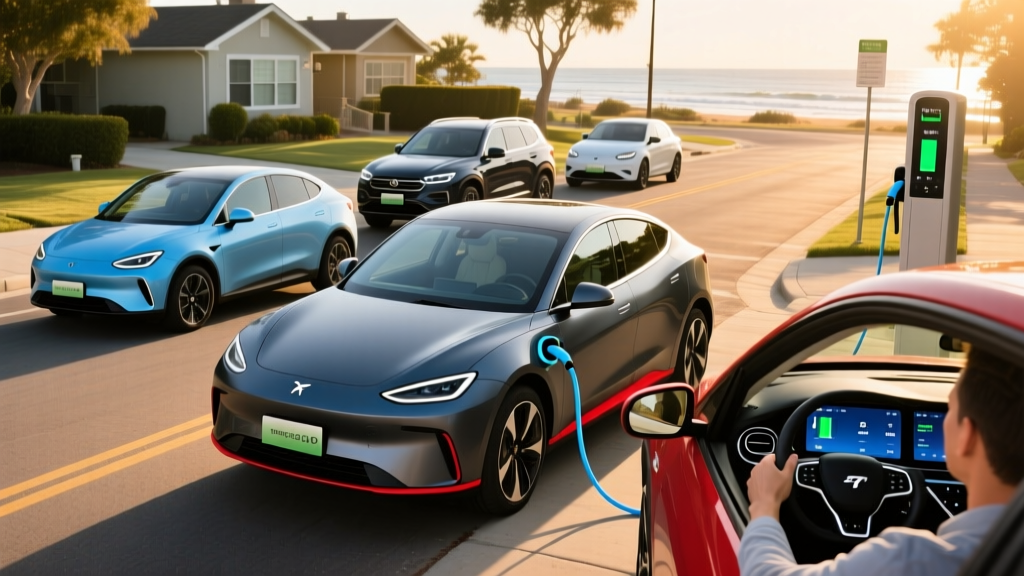
Home charging is the foundation. Over 80% of EV charging happens at home. A Level 2 charger (240V, 32–48A) adds 25–35 miles of range per hour of charging — more than enough to replenish a full day's driving overnight. Equipment costs $400–$800 for a quality unit (ChargePoint Home Flex, Emporia Vue, Wallbox Pulsar Plus); professional installation runs $600–$2,000 depending on circuit distance from your panel.
Public charging is improving but uneven. Urban and suburban areas along major corridors have strong coverage. Rural stretches of I-70, I-10, and parts of the Mountain West remain sparse. Before buying, map your most common road trips against charging networks using PlugShare or the DOE's Alternative Fuels Data Center.
Insurance costs more — plan for it. EV insurance premiums run 15–25% higher than gas equivalents due to higher repair costs, specialized parts, and battery replacement risk. Shop quotes from EV-friendly insurers (GEICO, Progressive, State Farm) before purchasing.
Maintenance is genuinely lower. No oil changes, no spark plugs, no transmission fluid. Brake pads last 100,000+ miles thanks to regenerative braking. Cabin air filter replacement and tire rotation are your primary service items. Budget ~$200/year versus $500–$700 for a gas car.
Tire wear is higher. EVs are 10–20% heavier than gas equivalents and deliver instant torque. Expect tire replacement at 30,000–40,000 miles rather than 50,000–60,000. Budget $800–$1,200 for a set of EV-rated tires (Michelin e.Primacy, Hankook iON).
Frequently Asked Questions
Is an electric car worth it for an adult commuter in 2026?
Yes, if you have home charging and your commute is under 80 miles round-trip. The fuel savings ($1,000+/year), reduced maintenance, and available tax credits make the math work for most commuters. If you lack home charging and rely solely on public stations, a PHEV may be a more practical choice until infrastructure improves in your area.
How long do EV batteries last, and what does replacement cost?
Modern EV batteries (NMC and LFP chemistries) are warrantied for 8 years or 100,000 miles at 70% minimum capacity. Real-world data from Tesla, Hyundai, and GM shows most packs retain 85–90% capacity at 100,000 miles. Full battery replacement costs $8,000–$18,000 depending on pack size, but catastrophic failure before 150,000 miles is rare. Most buyers will sell or trade the vehicle before replacement becomes necessary.
Can I charge an EV if I live in an apartment or don't have a garage?
It's challenging but increasingly possible. Some apartment complexes now offer shared Level 2 chargers. Workplace charging is another option. If neither is available, you can use a standard 120V outlet (Level 1) to add 3–5 miles of range per hour — sufficient for low-mileage drivers who can plug in overnight. Otherwise, a PHEV eliminates the home-charging requirement entirely.
Do electric cars hold their resale value?
EV depreciation has been steeper than gas cars in recent years, driven by rapid price cuts (especially Tesla), improving newer models, and battery health uncertainty. Expect 40–55% depreciation over 5 years versus 35–45% for comparable gas vehicles. However, the fuel and maintenance savings during ownership often offset the resale gap. Certified pre-owned EV programs from Hyundai, Tesla, and Ford are improving used-EV confidence.
What's the cheapest electric car for adults in 2026?
The Chevrolet Equinox EV LT starts at ~$33,600 and qualifies for up to $7,500 in federal tax credits, bringing the effective price to ~$26,100 for eligible buyers. It offers 315 miles of EPA range and 150 kW DC fast charging. The Nissan Leaf S starts at ~$29,000 but uses the aging CHAdeMO connector and has limited DC fast-charge capability — it's best for city-only drivers with home charging.