The Quick Answer: EV Charge Times at a Glance
How long does an electric car take to charge? It depends entirely on the charging level and your battery size:
- Level 1 (120V household outlet): 40–80+ hours for a full charge. Adds 3–5 miles of range per hour.
- Level 2 (240V home/public): 6–12 hours for a full charge. Adds 20–45 miles of range per hour.
- DC Fast Charging (50–350 kW): 15–45 minutes for a 10–80% charge. Adds 100–250+ miles in 20 minutes on capable vehicles.
For daily driving, most EV owners plug in at home overnight on Level 2 and wake up to a full battery every morning. DC fast chargers are reserved for road trips. The exact time depends on your battery capacity (measured in kWh—kilowatt-hours, the energy stored) and the charger's power output (measured in kW—kilowatts, the rate of delivery).
To calculate a rough charge time: divide your battery's usable kWh by the charger's kW output. A 75 kWh battery on an 11.5 kW Level 2 charger takes roughly 6.5 hours from empty to full. But real-world charging isn't linear—especially on DC fast chargers, where speeds taper significantly above 80% state of charge (SoC) to protect battery health. Let's break down each level with exact numbers from current 2026 models.
Level 1 Charging: The Emergency Backup
Level 1 charging uses a standard 120V household outlet and the portable cord that comes with most EVs. It delivers between 1.0 and 1.9 kW of power—enough to add roughly 3 to 5 miles of range per hour of charging. For a vehicle with a 300-mile EPA range and an 80 kWh battery, a full 0–100% charge takes 45 to 80 hours.
That sounds impractical, and for most drivers, it is. But Level 1 still has real use cases:
- PHEV owners: A plug-in hybrid like the 2026 Toyota RAV4 Prime has an 18.1 kWh battery and only needs about 5.5 hours on Level 1 to fully recharge its ~42 miles of electric range. Many PHEV owners use Level 1 exclusively.
- Low-mileage drivers: If you drive 20–30 miles per day and can plug in for 10–12 hours overnight, Level 1 recovers enough range to cover a short commute.
- Travel emergencies: Any standard outlet becomes a trickle-charge lifeline if you're stranded with low SoC.
Level 1 is not a practical primary charging strategy for battery-electric vehicles (BEVs) with large packs. If your only option is a 120V outlet, a PHEV or hybrid may be a more realistic electrified choice.
Level 2 Charging: The Daily Workhorse
Level 2 charging operates at 240V—the same voltage as your electric dryer—and delivers between 3.3 kW and 19.2 kW, with most home installations falling at 7.7 kW (32-amp circuit) or 11.5 kW (48-amp circuit). This is the charging method that makes EV ownership effortless for anyone with garage or driveway access.
| Vehicle | Battery (kWh usable) | Onboard Charger | At 7.7 kW (32A) | At 11.5 kW (48A) |
|---|---|---|---|---|
| 2026 Tesla Model Y Long Range | 75 kWh | 11.5 kW | ~9.7 hours | ~6.5 hours |
| 2026 Hyundai Ioniq 5 (Std Range) | 58 kWh | 10.9 kW | ~7.5 hours | ~5.3 hours |
| 2026 Chevrolet Equinox EV 3RS | 85 kWh | 11.5 kW | ~11 hours | ~7.4 hours |
| 2026 Ford F-150 Lightning Ext. Range | 131 kWh | 19.2 kW | ~17 hours | ~6.8 hours |
A few practical observations from real-world ownership:
- You rarely charge from 0%. Most drivers plug in at 20–30% SoC and top off to 80–90%, cutting charge times by a third or more.
- Your vehicle's onboard charger is the bottleneck. Even if you install an 11.5 kW (48-amp) wall connector, a car with a 7.7 kW onboard charger will only accept 7.7 kW. Check your vehicle's spec before overpaying for a higher-amperage unit.
- Overnight is the sweet spot. A 6–10 hour charge window covers virtually any daily driving need. According to fueleconomy.gov, the average American drives about 37 miles per day—easily recovered in under 2 hours on Level 2.
Home Level 2 Installation: What It Actually Costs
Installing a Level 2 charger at home requires a 240V circuit run by a licensed electrician. Costs vary widely based on your electrical panel's capacity and the distance from the panel to your parking spot.
| Component | Low Estimate | High Estimate |
|---|---|---|
| Level 2 EVSE hardware (wall connector) | $350 | $750 |
| Electrician labor + materials (simple install, panel nearby) | $400 | $1,200 |
| Electrical panel upgrade (if needed, 100A → 200A) | $1,500 | $3,500 |
| Permit and inspection | $50 | $250 |
| Total (no panel upgrade) | $800 | $2,200 |
| Total (with panel upgrade) | $2,300 | $5,700 |
Some utilities and states offer rebates of $200–$1,000 for home charger installation, and the federal Alternative Fuel Vehicle Refueling Property Credit covers 30% of equipment and installation costs up to $1,000 (subject to income and census-tract eligibility). Always consult a tax professional for your specific situation.
DC Fast Charging: Road-Trip Reality
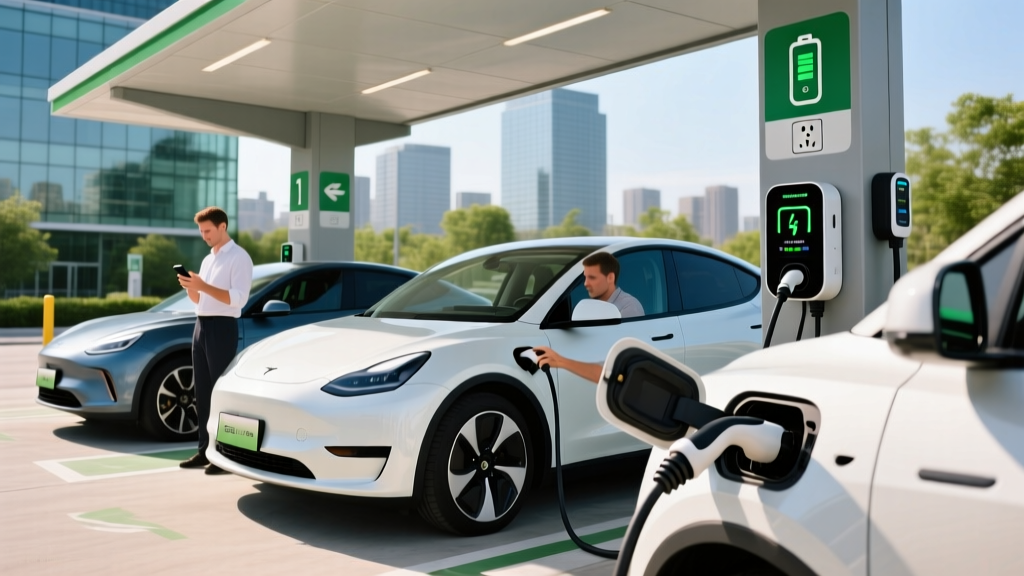
DC fast chargers (DCFC) bypass your vehicle's onboard charger and deliver direct current straight to the battery at power levels from 50 kW up to 350 kW. These are the chargers you'll find at Electrify America, EVgo, Tesla Supercharger, and other highway-adjacent networks.
Here's where most marketing claims fall apart. A vehicle advertised as capable of "250 kW charging" does not sustain 250 kW for the entire session. The charge curve peaks early (typically between 10–30% SoC) and tapers progressively, dropping sharply above 80%. This taper protects the battery from heat damage and lithium plating.
| Vehicle | Peak DC Rate | 10–80% Time | Miles Added in 15 Min |
|---|---|---|---|
| 2026 Hyundai Ioniq 5 (84 kWh) | 240 kW | ~18 minutes | ~150 miles |
| 2026 Tesla Model 3 Long Range | 250 kW | ~25 minutes | ~175 miles |
| 2026 Chevrolet Silverado EV 4WT | 350 kW | ~20 minutes | ~200 miles |
| 2026 Nissan Leaf (62 kWh, CHAdeMO) | 50 kW | ~60 minutes | ~55 miles |
Preconditioning matters. Many modern EVs (Tesla, Hyundai/Kia, GM Ultium-based vehicles) will warm or cool the battery to its optimal charging temperature when you navigate to a DC fast charger. If you arrive at a charger without preconditioning—especially in cold weather—your peak charge rate may be cut by 30–50% for the first several minutes. Always use the vehicle's built-in navigation to route to a fast charger when possible.
Common Charging Myths vs. Facts
| Myth | Fact |
|---|---|
| "EVs take all day to charge" | On Level 2 at home, most EVs fully recharge in 6–10 hours—overnight, while you sleep. You never wait for it. |
| "Fast charging ruins the battery" | Modern thermal management systems limit degradation. Most manufacturers warranty 70% capacity retention at 100,000–150,000 miles. Occasional DCFC use is fine; daily use shows marginally higher degradation over years. |
| "I need a 350 kW charger" | Most EVs can't accept 350 kW. Even those that can only sustain peak rate briefly. A 150 kW charger is sufficient for most vehicles and widely available. |
| "Charging to 100% every time is best" | For NMC/NCA batteries, daily charging to 80% extends longevity. LFP batteries (some Tesla Model 3/Y Standard Range, Ford Mustang Mach-E Select) tolerate and even benefit from regular 100% charges. Check your owner's manual. |
| "All public chargers are broken" | Reliability varies by network. Tesla Superchargers consistently report 98%+ uptime. Non-Tesla networks have improved but still show 10–20% failure rates at some locations per J.D. Power studies. Plan with backup chargers on long trips. |
EV Charging Cost vs. Gas: The Real Numbers
One of the strongest ownership arguments for an EV is lower fueling costs—but the savings depend heavily on where you charge.
| Scenario | Cost per kWh / Gallon | Annual Cost | Cost per Mile |
|---|---|---|---|
| EV, home charging (Level 2, $0.14/kWh avg, 3.5 mi/kWh) | $0.14/kWh | $600 | $0.04 |
| EV, public DCFC ($0.40/kWh avg, 3.2 mi/kWh) | $0.40/kWh | $1,875 | $0.125 |
| EV, mixed (70% home / 30% DCFC) | Blended $0.22/kWh | $943 | $0.063 |
| Gas car (28 MPG combined, $3.50/gal) | $3.50/gal | $1,875 | $0.125 |
| Hybrid (50 MPG combined, $3.50/gal) | $3.50/gal | $1,050 | $0.07 |
Key takeaway: Home charging is where the economics work best. An EV charged primarily at home saves $900–$1,275 per year versus a comparable gas car. But if you rely exclusively on public DC fast charging at current rates, your "fueling" cost can equal or exceed a gas car. This is a critical factor for apartment dwellers or street-parkers without home charging access.
Electricity rates also vary enormously by region. In Louisiana, residential rates hover around $0.10/kWh; in California, they can exceed $0.30/kWh on standard tiers. Time-of-use (TOU) plans can cut charging costs by 40–60% if you schedule sessions during off-peak hours (typically midnight to 6 AM). Check your utility's EV-specific rate plans before purchasing.
Bigger Picture: Total Ownership Cost for First-Time Buyers
Charging time and cost are just one piece of the EV ownership equation. First-time buyers should weigh the full financial picture before committing.
Where EVs Save Money
- Fueling: $600–$1,200/year savings with home charging versus gas.
- Maintenance: No oil changes, no spark plugs, no transmission fluid, fewer brake replacements (regenerative braking extends pad life 2–3x). Expect $0.061/mile maintenance cost vs. $0.101/mile for gas cars per AAA data.
- Federal tax credit: Under IRS §30D Clean Vehicle Credit, qualifying new EVs can receive up to $7,500, transferable at point of sale as an instant rebate. Eligibility depends on MSRP caps ($55,000 for cars, $80,000 for SUVs/trucks/vans), buyer income limits ($150K single / $300K joint), and battery critical-mineral and component sourcing requirements that tighten annually. Always verify current-year eligibility on the IRS website or with your tax professional.
Where EVs Cost More
- Upfront purchase price: Though narrowing, EVs still carry a premium over comparable gas vehicles in many segments. The 2026 Equinox EV 2LT starts around $33,000 before credits—a competitive price, but the gas Equinox starts roughly $5,000 lower.
- Insurance: EV insurance premiums average 15–25% higher than equivalent gas cars due to higher repair costs and battery replacement exposure. Get quotes before buying.
- Home charger installation: $800–$5,700 as detailed above, a one-time cost that gas car buyers don't face.
- Depreciation: EV depreciation has been volatile. Some models lose value faster than gas counterparts due to rapid tech advancement and Tesla price cuts. Lease if depreciation concerns you.
Decision Framework: Which Charging Setup Fits Your Life?
If X, Then Y: Your EV Charging Decision Guide
- If you have a garage/driveway with 240V access → Install a Level 2 home charger. This is the ideal EV ownership experience. Charge overnight, wake up full, rarely visit a public charger. Choose a BEV with confidence.
- If you have garage access but only 120V → Consider a PHEV (like the RAV4 Prime or Jeep Wrangler 4xe) that can fully recharge its small battery on Level 1 overnight. Or budget $1,000–$2,500 for a 240V circuit installation for a BEV.
- If you live in an apartment or park on the street → Map your nearby public Level 2 and DCFC options first. If reliable chargers are within 5 minutes of your home or workplace, a BEV can still work. If charging infrastructure is sparse, a hybrid or PHEV is the lower-risk choice.
- If you drive more than 250 miles per week on highways → Prioritize an EV with fast DC charging (sub-20-minute 10–80%) and a large battery (80+ kWh). Vehicles on 800V architectures (Hyundai Ioniq 5/6, Kia EV6/EV9, Porsche Taycan) charge significantly faster than 400V competitors.
- If you live in a cold climate (below 20°F regularly) → Expect 20–35% range loss in winter. Choose an EV with a heat pump (standard on most 2026 Teslas, Hyundais, and GM Ultium vehicles) and add 25% to the battery capacity you think you need. Precondition the battery before every fast-charge stop.
- If you tow frequently → Towing cuts EV range by 40–55%. An F-150 Lightning with a 320-mile EPA range drops to ~160–180 miles while towing. Plan charging stops accordingly or consider a diesel for heavy towing duty.
Frequently Asked Questions
Can I charge an EV from a regular wall outlet?
Yes, but slowly. A standard 120V outlet (Level 1) delivers about 1.4 kW, adding 3–5 miles of range per hour. It's adequate for PHEVs with small batteries or as a backup for BEVs, but not practical as a daily strategy for a battery-electric vehicle with 250+ miles of range.
Why does charging slow down above 80%?
Lithium-ion batteries accept charge fastest at low states of charge. Above 80% SoC, the battery management system (BMS) reduces current to prevent lithium plating and excessive heat. This is why DC fast charge times are quoted as 10–80%, not 0–100%. Charging from 80–100% on a DCFC can take as long as the 10–80% portion. For road trips, charge to 80% and go—you'll save time.
Does fast charging damage my EV battery?
Modern EVs have sophisticated thermal management that keeps batteries in a safe temperature window during DCFC sessions. Studies show that vehicles that fast-charge frequently exhibit slightly higher degradation over 100,000+ miles—perhaps 2–5% more capacity loss than those that charge exclusively on Level 2. But all current EVs are warranted for at least 8 years/100,000 miles at 70% capacity retention (per federal mandate). Occasional fast charging is not a concern; daily exclusive fast charging may accelerate wear modestly.
How much does it cost to charge an EV at home?
At the U.S. residential average of ~$0.14/kWh and an efficiency of 3.5 miles per kWh, home charging costs roughly $0.04 per mile—about $600 per year for 15,000 miles of driving. Compare that to a 28 MPG gas car at $3.50/gallon: $0.125 per mile, or $1,875 per year. Your savings depend on your local electricity rate and whether you use a time-of-use plan for off-peak charging.
What's the difference between kW and kWh?
This is the most common point of confusion. kW (kilowatts) is power—the rate at which energy flows, like water pressure from a hose. kWh (kilowatt-hours) is energy—the total amount stored or delivered, like gallons in a bucket. A 75 kWh battery charged at 7.5 kW takes roughly 10 hours. A charger's kW rating tells you how fast it delivers energy; a battery's kWh rating tells you how much it holds.
Do I need a Tesla to use a Supercharger?
No. As of 2025–2026, Tesla has opened many Supercharger stations to non-Tesla EVs equipped with the NACS (North American Charging Standard) connector. Most major automakers—Ford, GM, Rivian, Volvo, Polestar, and others—have adopted NACS on their 2025–2026 models. CCS-equipped vehicles can access select Tesla Superchargers using a Tesla-approved adapter. Check Tesla's website or your vehicle's app for compatible stations.
What if I can't charge at home?
Public charging-only EV ownership is feasible but more expensive and less convenient. You'll pay $0.30–$0.50/kWh at public DCFC stations (roughly double or triple home rates), spend 20–40 minutes per session instead of 0 minutes (since home charging is passive), and need to plan your week around charger availability. If this describes your situation, seriously consider whether a hybrid or PHEV better fits your lifestyle—or advocate for workplace charging, which is expanding rapidly.
Charge time isn't a single number—it's a spectrum from overnight convenience at home to 18-minute pit stops on road trips. The right question isn't "how long does charging take?" but rather "how long does charging take in my specific situation?" Map your parking, your commute, your road-trip frequency, and your local electricity rates. For the majority of drivers with home charging access, the answer is simple: you plug in when you get home, and the car is ready every morning. The gas station stops being part of your routine.