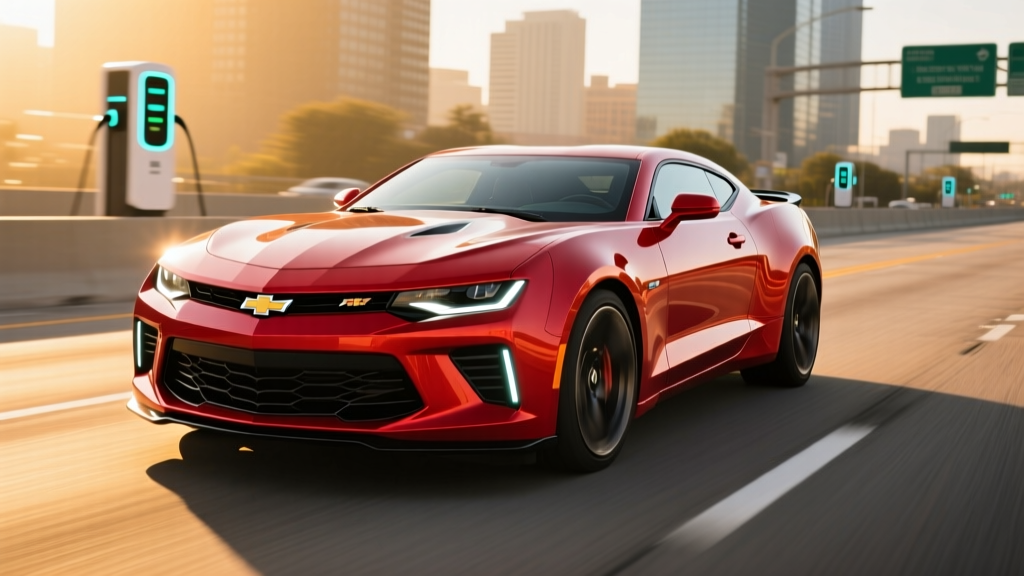
Chevrolet retired the sixth-generation Camaro in 2024, and as of early 2026, there is no production electric Camaro on sale. However, GM has confirmed an electric performance coupe built on the Ultium platform is in development, and the industry widely expects it to wear the Camaro nameplate. If you're searching for an "electric Camaro," here's the practical truth: you cannot buy one today, but you can plan for one — and you can cross-shop the EVs that already fill that muscle-car-shaped hole in the market.
Quick Answer: What Is the Electric Camaro?
As of 2026, Chevrolet has not released a production electric Camaro. GM's Ultium-based EV performance coupe is in development and may arrive for the 2027 or 2028 model year. In the meantime, the closest EV alternatives delivering muscle-car performance include the Ford Mustang Mach-E GT, Dodge Charger Daytona EV, and Tesla Model 3 Performance. Below, we break down what to expect from an eventual electric Camaro, how it compares to the gas Camaro that left the market, and what the real ownership math looks like for an EV in this segment.
What We Know About the Electric Camaro So Far
When Chevrolet ended Camaro production in January 2024, GM executives signaled that the nameplate would return — likely as an electric vehicle. The brand has since invested heavily in its Ultium battery platform, which underpins the Blazer EV, Silverado EV, and Cadillac Lyriq. An electric Camaro would likely share architecture with these vehicles but be tuned for performance.
Here is what we can reasonably project based on GM's existing Ultium EVs and announced battery roadmap:
| Spec | Projected Estimate | Basis |
|---|---|---|
| Platform | GM Ultium (BEV3) | Shared with Blazer EV, Silverado EV |
| Battery Chemistry | NMC (Nickel Manganese Cobalt) | GM's standard Ultium chemistry for performance trims |
| Usable Battery Capacity | 85–102 kWh | Blazer EV SS uses ~102 kWh pack |
| EPA Range (est.) | 280–340 miles | Blazer EV AWD rated at 279 mi; coupe aero advantage possible |
| Peak DC Fast Charge | 190–220 kW | Blazer EV peaks at ~190 kW |
| 10–80% Charge Time | ~22–28 minutes | Based on Ultium charge-curve data |
| Horsepower | 500–700+ HP (SS variant) | Blazer EV SS: 615 HP; Silverado EV RST: 754 HP |
| 0–60 mph | 3.0–4.0 seconds | Blazer EV SS: 3.4 sec |
| Starting MSRP (est.) | $55,000–$75,000+ | Based on Blazer EV and competitive segment pricing |
Important caveat: These figures are estimates based on existing GM Ultium vehicles. Chevrolet has not published official specs for an electric Camaro. Treat all numbers as preliminary until GM makes a formal announcement.
Electric Camaro vs. Gas Camaro: The Cost Comparison That Matters
The last gas-powered Camaro (2024 model year) started at $26,495 for the 1LS coupe with a 275-hp turbo four-cylinder and climbed to $72,000+ for the ZL1. The electric Camaro will almost certainly carry a higher starting price, but total cost of ownership tells a different story. Here's how a projected electric Camaro SS stacks up against the gas Camaro SS (6.2L V8, 455 HP) over five years and 75,000 miles:
| Cost Category | Electric Camaro SS (Projected) | Gas Camaro SS (2024) |
|---|---|---|
| Purchase Price (MSRP) | $65,000 | $48,000 |
| Federal Tax Credit (§30D) | –$7,500 (if eligible) | $0 |
| Effective Purchase Price | $57,500 | $48,000 |
| Fuel / Energy (75,000 mi) | $4,500 (home charging avg.) | $12,750 (16 MPG combined, $3.40/gal) |
| Maintenance (5 yr) | $1,800 | $4,200 |
| Insurance (5 yr avg.) | $14,500 | $12,000 |
| Depreciation (est.) | $22,000 | $18,500 |
| Total 5-Year Cost | $100,300 | $95,450 |
Key takeaways from the numbers:
- Energy savings are massive. At the national average electricity rate of ~$0.16/kWh and an efficiency of ~3.0 mi/kWh, charging an electric Camaro at home costs roughly $0.06/mile. The gas Camaro SS, rated at 16 MPG combined by fueleconomy.gov, costs ~$0.17/mile at $3.40/gallon. That's an $8,250 gap over 75,000 miles.
- Maintenance favors EVs heavily. No oil changes, no spark plugs, no transmission fluid, and regenerative braking extends pad life dramatically. Expect to spend on cabin air filters, wiper fluid, tire rotations, and eventually tires (EVs wear tires faster due to weight and instant torque).
- Insurance is the EV penalty. Performance EVs carry higher premiums due to repair costs, battery replacement risk, and specialized labor. Budget $200–$400 more per year versus a gas equivalent, according to industry data.
- The tax credit narrows the gap — if you qualify. Under current IRS §30D rules, the full $7,500 credit requires meeting critical-mineral and battery-component sourcing thresholds, buyer income caps ($150K single / $300K joint), and an MSRP cap of $55,000 for sedans/coupes. A $65,000 electric Camaro SS would likely exceed the MSRP cap, meaning the credit may not apply to performance trims. Lower trims could qualify.
Real-World Range, Charging, and What the EPA Sticker Won't Tell You
If the electric Camaro follows the Blazer EV's architecture, expect an EPA range in the 280–340 mile window. But the EPA number is a laboratory estimate — real-world results depend heavily on how and where you drive.
Real-World Range Expectations (Projected)
EPA Estimate: ~310 miles (mid-range projection)
Highway driving at 75 mph: ~240–270 miles (aerodynamic drag reduces efficiency 15–20%)
Cold weather (below 30°F): ~200–250 miles (battery resistance and cabin heating draw)
City / moderate driving: ~290–320 miles (regen braking recovers energy)
Charging speed is where Ultium vehicles have drawn some criticism. The Blazer EV peaks at approximately 190 kW on a DC fast charger — respectable, but not class-leading. Here's what that means in practice:
| Charging Level | Power (kW) | Miles Added Per Hour | Typical Use Case |
|---|---|---|---|
| Level 1 (120V outlet) | 1.4 kW | ~4 mi/hr | Emergency / overnight trickle |
| Level 2 (240V home) | 11.5 kW | ~34 mi/hr | Daily home charging (full overnight) |
| DC Fast Charge | ~190 kW peak | ~200+ mi in 20 min | Road trips (10–80% in ~25 min) |
The charge-curve reality: That 190 kW peak only holds between roughly 10% and 40% State of Charge. Above 60%, the rate tapers significantly — often dropping below 80 kW by 80% SoC. This is normal for NMC lithium-ion chemistry and is managed by the battery thermal system to protect long-term health. On a road trip, plan your stops around 10–80% charges rather than trying to fill to 100%.
Who Should Wait for the Electric Camaro — and Who Should Buy Now?
Not every muscle-car buyer is ready for an EV, and that's fine. The right decision depends on your driving patterns, home setup, and patience.
Decision Framework: Should You Wait or Cross-Shop Now?
Wait for the electric Camaro if:
- You have Level 2 home charging (or can install it — budget $800–$2,500 for a 240V/48A circuit and hardwired charger)
- Your daily commute is under 80 miles round-trip (covers the vast majority of US drivers)
- You want GM's Ultium ecosystem and Super Cruise hands-free driving on highways
- You can wait until late 2027 or 2028 for availability and early-production quirks
- You're not in a region with extreme cold (below 10°F for extended periods) or a charging desert
Cross-shop an EV now if:
- You want muscle-car EV performance today: Ford Mustang Mach-E GT (312 mi EPA, 480 HP, ~$55,000), Dodge Charger Daytona Scat Pack (260 mi EPA, 670 HP, ~$72,000), or Tesla Model 3 Performance (315 mi EPA, 510 HP, ~$53,000)
- You're spending over $3,000/year on gas for a performance coupe and want to cut that to under $800
- You can take delivery now and start saving on fuel immediately
Stick with gas or hybrid if:
- You lack home charging access and your area has sparse public DC fast-charging infrastructure
- You regularly tow, track-drive, or take 500+ mile road trips through rural areas
- Upfront budget is under $40,000 — the EV premium is real, even with incentives
Common Electric Camaro Myths — Addressed With Facts
| Myth | Fact |
|---|---|
| "The electric Camaro won't feel like a real muscle car." | EVs deliver instant torque from 0 RPM. The Blazer EV SS hits 60 mph in 3.4 seconds with 615 HP — faster than the last gas Camaro SS (4.0 sec, 455 HP). An electric Camaro SS would likely exceed this. |
| "EV batteries need replacing every 5 years." | GM's Ultium battery warranty covers 8 years / 100,000 miles with a capacity-retention threshold (typically 70% of original capacity). Real-world degradation data from GM's fleet shows most packs retain 90%+ capacity after 100,000 miles. |
| "You can't road-trip an EV." | The US now has over 200,000 public charging ports including 40,000+ DC fast chargers. Tesla's Supercharger network (now open to NACS-equipped GM vehicles) adds major route coverage. With 25-minute charge stops every 200 miles, a 600-mile trip adds about 50 minutes total. |
| "The $7,500 tax credit applies to every EV." | Under IRS §30D, the credit requires meeting battery-sourcing rules, buyer income caps, and MSRP caps ($55,000 for coupes/sedans). Many performance EVs exceed the MSRP cap. Always verify eligibility on the IRS website or with a tax professional before purchasing. |
| "Home charging installation is prohibitively expensive." | A basic Level 2 install (240V/48A hardwired charger on an existing 200A panel) typically costs $800–$1,500 including equipment, electrician labor, and permits. If your home needs a panel upgrade to 200A, add $1,500–$3,500. Many utilities offer rebates of $250–$750 for charger installation. |
First-Time EV Buyer Checklist: What to Know Before You Commit
Whether you wait for the electric Camaro or buy a different performance EV today, these are the non-negotiable items to sort out before signing:
- Audit your home electrical panel. A Level 2 charger drawing 48 amps requires a dedicated 60A circuit. If your panel is already near capacity (common in older homes with 100A service), you'll need a panel upgrade — get a quote from a licensed electrician before budgeting.
- Map your charging options. Use apps like PlugShare and the DOE Alternative Fuels Station Locator to check DC fast-charger density along your regular routes. If the nearest 150+ kW charger is more than 30 minutes away, factor that into your ownership experience.
- Understand the connector situation. GM has adopted the NACS (Tesla) connector for its 2025+ EVs. This means an electric Camaro would use NACS natively, granting access to Tesla Superchargers without an adapter — a significant infrastructure advantage over CCS-equipped competitors.
- Budget for higher insurance. Get quotes before purchasing. Performance EVs routinely cost 15–30% more to insure than their gas equivalents. Shop multiple carriers — some specialize in EV coverage.
- Check your tax credit eligibility. The §30D credit has income limits ($150K single / $225K head of household / $300K joint for 2026), MSRP caps, and battery-sourcing requirements that change annually. The credit can now be transferred to the dealer as a point-of-sale discount, which reduces your out-of-pocket cost at purchase. Verify current-year rules at irs.gov.
- Plan for tire costs. Performance EVs are heavy (5,000+ lbs) and produce instant torque. Expect to replace tires every 25,000–35,000 miles — roughly half the life of tires on a comparable gas car. Budget $1,200–$2,000 per set for performance rubber.
Bottom Line: The Electric Camaro Is Coming — But Patience Has a Price
Chevrolet's electric Camaro is one of the most anticipated EVs in the performance segment, and GM's Ultium platform gives it the bones to deliver genuine muscle-car thrills with 300+ miles of range and sub-4-second 0–60 times. But "coming soon" doesn't pay your commute today.
If you can wait 18–30 months, have home charging sorted, and want to stay in the GM ecosystem with Super Cruise and NACS Supercharger access, the electric Camaro could be worth the patience. If you want to cut your fuel bill now and put 500+ HP to the ground on electrons today, the Mustang Mach-E GT, Charger Daytona, and Model 3 Performance are proven, purchasable alternatives with real-world data behind them.
Either way, do the math on your specific situation — your commute, your electricity rate, your panel capacity, and your road-trip habits — before letting nostalgia or hype make the decision for you.
Will the electric Camaro be a coupe or a sedan?
GM has not confirmed body style details, but the Camaro nameplate is historically a two-door coupe. Industry reports suggest the electric successor will retain a coupe silhouette, possibly with a fastback roofline similar to the Dodge Charger Daytona EV.
How much will the electric Camaro cost?
Based on GM's Ultium pricing strategy (Blazer EV starts at ~$50,000; SS trim ~$65,000), expect a base electric Camaro around $50,000–$55,000 and a performance SS variant at $65,000–$75,000+. These are estimates — official pricing has not been announced.
Will the electric Camaro qualify for the $7,500 federal tax credit?
Possibly, but not guaranteed. The §30D credit has an MSRP cap of $55,000 for coupes and sedans. A base electric Camaro might fall under that cap and qualify (assuming it meets battery-sourcing and buyer-income requirements), but an SS performance variant priced above $55,000 would not. Check current rules at irs.gov.
Can I charge an electric Camaro at a Tesla Supercharger?
Yes — GM has adopted the NACS connector for its EVs starting in 2025. An electric Camaro would use NACS natively and have full access to the Tesla Supercharger network without an adapter.
What's the closest EV I can buy right now to an electric Camaro?
The Dodge Charger Daytona Scat Pack (670 HP, 260 mi EPA, ~$72,000) is the closest analog — a two-door electric muscle car with serious performance. The Ford Mustang Mach-E GT (480 HP, 312 mi EPA, ~$55,000) offers a more practical four-door SUV shape with comparable thrills and better range.