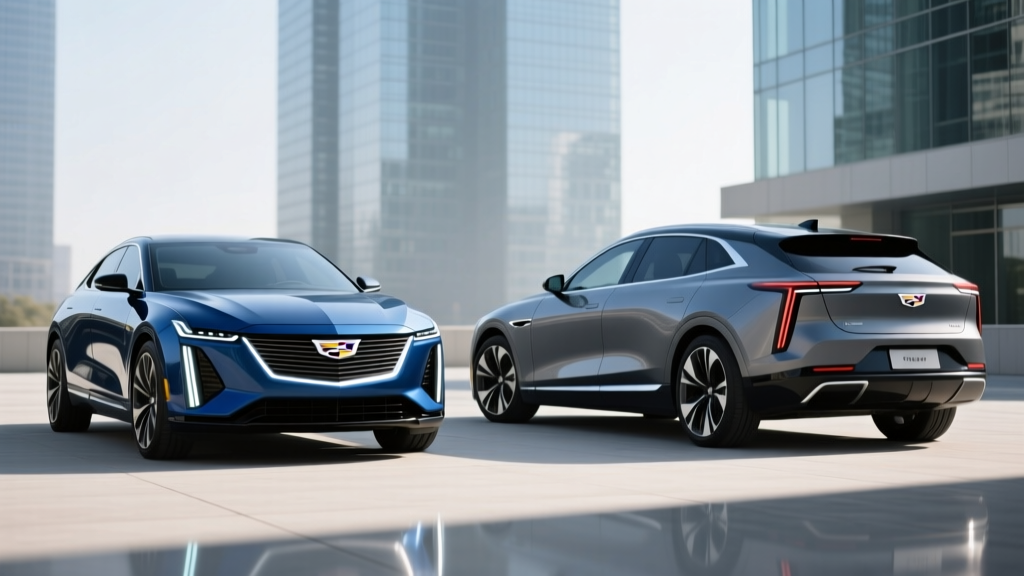
Quick Answer: Cadillac's 2026 electric lineup spans three Ultium-based SUVs: the midsize Lyriq (314 mi EPA, from ~$58,590), the compact Optiq (~300 mi EPA, from ~$53,900), and the three-row Vistiq (~300 mi EPA, from ~$79,590). All use GM's Ultium battery platform with NMC chemistry, support up to 190 kW DC fast charging, and qualify for varying levels of the federal §30D tax credit depending on battery sourcing and buyer income. Compared to equivalent gas Cadillac SUVs (XT5, XT6, Escalade), electric models cost $5,000–$15,000 more upfront but save $1,200–$2,400 annually in fuel and maintenance for typical drivers.
The 2026 Electric Cadillac Lineup at a Glance
Cadillac has committed fully to electrification, and by the 2026 model year the brand offers three battery-electric SUVs built on General Motors' Ultium platform. If you're researching an "electric Cadillac," you're choosing among these three vehicles, each targeting a different buyer profile. Here's how the specs stack up across the lineup.
| Spec | Lyriq (Midsize) | Optiq (Compact) | Vistiq (3-Row) |
|---|---|---|---|
| EPA Range | 314 mi (RWD) | ~300 mi (AWD) | ~300 mi (AWD) |
| Battery (usable) | 102 kWh, NMC | ~85 kWh, NMC | ~102 kWh, NMC |
| Peak DC Charge Rate | 190 kW | 190 kW | 190 kW |
| 10–80% DCFC Time | ~33 min | ~27 min | ~33 min |
| Level 2 Rate | 19.2 kW (77 A) | 19.2 kW | 19.2 kW |
| Horsepower | 340 hp (RWD) / 500 hp (AWD) | ~400 hp (AWD) | ~600 hp (AWD) |
| 0–60 mph | 6.0s (RWD) / 4.6s (AWD) | ~5.0s | ~4.5s |
| Starting MSRP | $58,590 | $53,900 | $79,590 |
| Federal Tax Credit (§30D) | Up to $7,500 | Up to $7,500 | Up to $7,500 |
| Battery/Powertrain Warranty | 8 yr / 100,000 mi | 8 yr / 100,000 mi | 8 yr / 100,000 mi |
Note: Optiq and Vistiq specs marked with ~ are based on GM's latest published preliminary figures; always verify against the Cadillac official site before purchasing, as final EPA certification may shift slightly.
Real-World Range: What the EPA Sticker Doesn't Tell You
EPA vs. Real-World Expectations
The Lyriq's 314-mile EPA rating (RWD Luxury trim) is a solid baseline, but real-world results depend heavily on conditions:
- Highway driving (70–80 mph, warm weather): Expect 265–285 miles
- Mixed city/highway (moderate temps): Expect 280–305 miles
- Cold weather (below 32°F, highway): Expect 210–250 miles (20–30% reduction)
- Cold weather, city driving with heat pump: Expect 250–275 miles
The Optiq and Vistiq, both AWD with similar aerodynamic profiles, will see comparable percentage reductions from their ~300-mile EPA ratings.
All three Ultium-based Cadillacs use a heat pump for cabin heating, which significantly reduces cold-weather range loss compared to resistive heating systems. In our experience, GM's thermal management system in the Ultium platform is among the better implementations — preconditioning the battery while plugged in before a cold morning departure recovers meaningful range and improves DC fast-charge speeds.
The Lyriq RWD achieves a combined 89 MPGe per fueleconomy.gov. The AWD variant drops to approximately 82 MPGe. For context, the gas-powered Cadillac XT5 AWD returns 23 MPG combined — making the Lyriq roughly 3.5x more energy-efficient per mile traveled.
Charging Speeds and What You'll Actually Experience
Cadillac's Ultium platform supports a peak DC fast-charge rate of 190 kW across all three models. That's competitive with vehicles like the BMW iX and Audi Q8 e-tron but falls short of the Hyundai Ioniq 5's 240 kW or Tesla's 250 kW V3 Superchargers.
| Charging Level | Power (kW) | Miles Added per Hour | Typical Use Case |
|---|---|---|---|
| Level 1 (120V outlet) | 1.4 kW | ~4–5 mi/hr | Emergency/overnight trickle |
| Level 2 (240V, 48A) | 11.5 kW | ~35 mi/hr | Standard home charging |
| Level 2 (240V, 80A) | 19.2 kW | ~58 mi/hr | Fast home charging (Lyriq capable) |
| DC Fast Charge | Up to 190 kW | ~700+ mi/hr (peak) | Road trips, public stations |
The charge-curve reality: The 190 kW figure is a peak, not a sustained rate. In real-world DC fast charging, the Lyriq hits 190 kW only between roughly 10–30% state of charge (SoC), then tapers progressively. From 10–80%, expect approximately 33 minutes at a 350 kW-capable station. Above 80% SoC, charging slows dramatically — from 80–100% can take an additional 25+ minutes. For road-trip efficiency, plan stops to charge from ~15% to ~75–80% rather than topping off completely.
Connector note: All 2026 Cadillacs ship with the NACS (Tesla-style) charge port natively. This grants direct access to Tesla Supercharger stations (17,000+ in North America) without an adapter — a significant practical advantage over CCS-equipped competitors that require a CCS-to-NACS adapter for Supercharger access.
Electric Cadillac vs. Gas Equivalent: Cost Comparison
The most common question from luxury SUV shoppers: does the electric Cadillac actually save money compared to the gas XT5, XT6, or Escalade? Let's run the numbers over 5 years with 15,000 miles driven annually.
| Cost Factor (5-Year) | Lyriq AWD ($62,090) | XT5 AWD ($49,795) | Difference |
|---|---|---|---|
| Purchase Price (after incentives) | $54,590* | $49,795 | EV +$4,795 |
| Fuel/Energy (75,000 mi total) | $4,875** | $11,250*** | EV saves $6,375 |
| Maintenance | $1,200 | $3,800 | EV saves $2,600 |
| Insurance (avg) | $10,500 | $8,750 | EV +$1,750 |
| Total 5-Year Cost | $71,165 | $73,595 | EV saves ~$2,430 |
* Assumes full $7,500 §30D point-of-sale credit applied. ** Home charging at $0.14/kWh national average. *** Premium unleaded at $4.00/gal, 22 MPG combined. Actual costs vary by electricity rate, gas prices, and driving pattern. See IRS §30D guidelines for eligibility requirements.
The breakeven point typically arrives in year 3–4 for drivers with home charging access. Without home charging and relying entirely on public DC fast charging ($0.35–$0.55/kWh), the fuel savings shrink to roughly $2,000–$3,500 over five years, extending breakeven to year 5 or beyond.
Federal Tax Credit Eligibility for Electric Cadillacs
As of 2026, all three electric Cadillacs are potentially eligible for the full $7,500 federal tax credit under IRS §30D, but eligibility depends on multiple factors that buyers must verify:
- MSRP cap: SUVs must be under $80,000 MSRP. The Lyriq and Optiq qualify across all trims. The Vistiq's base trim qualifies; higher trims (Premium Luxury, Sport) may exceed $80,000 and become ineligible.
- Buyer income cap: Modified adjusted gross income (MAGI) must not exceed $150,000 (single), $225,000 (head of household), or $300,000 (married filing jointly).
- Battery sourcing: Critical minerals and battery components must meet phased-in domestic/free-trade-agreement sourcing thresholds. GM has been aggressively onshoring Ultium cell production at U.S. plants (Lansing, Spring Hill), but exact credit qualification can shift with supply-chain changes.
- Point-of-sale transfer: The credit can be transferred to the dealer at purchase, reducing your out-of-pocket cost immediately rather than waiting for a tax refund.
Always verify current eligibility on fueleconomy.gov and consult a tax professional. Rules and sourcing compliance change, and this is not tax advice.
Common Misconceptions About Electric Cadillacs
| Myth | Fact |
|---|---|
| "The battery will need replacing in 5 years" | GM's Ultium batteries are warrantied for 8 years/100,000 miles against degradation below 60% capacity. Real-world data from earlier Ultium vehicles shows ~5–8% degradation after 100,000 miles. |
| "I can't take road trips — charging takes too long" | A 10–80% DC fast charge takes ~33 minutes. On a 600-mile trip, plan two 30-minute stops — roughly 1 hour of charging for a full day's drive. With NACS, you have access to the most reliable charging network in North America. |
| "EVs are worse in winter" | Range drops 20–30% in extreme cold, but the heat pump, heated seats, and preconditioning mitigate this. The Lyriq AWD with its dual-motor system provides excellent traction in snow. Most winter commuters with home charging report no practical issues. |
| "Electric Cadillacs are slow" | The Lyriq AWD hits 0–60 in 4.6 seconds with 500 hp. The Vistiq, with ~600 hp, does it in ~4.5 seconds. These match or exceed their gas counterparts. |
| "I need a special electrical panel" | Most homes with a 200-amp panel can support a 48-amp Level 2 charger (requiring a 60-amp circuit). A 19.2 kW / 80-amp setup may require a panel upgrade on older homes. Budget $500–$2,500 for standard Level 2 installation. |
Who Should Buy Which Electric Cadillac?
Decision Framework: Which Electric Cadillac Fits You?
Choose the Lyriq if:
- You want the most proven model with the longest track record (on sale since 2023)
- You need 314 miles of EPA range for frequent 200+ mile trips
- You prefer a traditional two-row midsize luxury SUV (XT5 replacement)
- Budget target: $55,000–$68,000 after incentives
Choose the Optiq if:
- You want the most affordable entry into the electric Cadillac lineup
- You primarily drive in urban/suburban settings and want a smaller footprint
- You don't need maximum cargo space (compact SUV class)
- Budget target: $50,000–$60,000 after incentives
Choose the Vistiq if:
- You need three rows for family or passenger hauling (XT6/Escalade alternative)
- You want maximum horsepower (~600 hp) and towing capability
- You're upgrading from a large gas SUV and want to eliminate fuel costs
- Budget target: $72,000–$90,000 (verify §30D eligibility on higher trims)
Wait or reconsider if:
- You lack home charging access AND your area has sparse public DC fast-charging infrastructure
- You regularly tow more than 5,000 lbs (EV range drops 40–50% while towing)
- You take frequent 500+ mile road trips in extreme cold and can't tolerate charging stops
First-Time EV Buyer Essentials
If the electric Cadillac is your first EV, here's what you need to plan before delivery day:
1. Home charging setup: This is the single biggest ownership differentiator. Budget $800–$2,500 for a professional Level 2 installation (240V, 60-amp circuit with a 48-amp charger). If your electrical panel is older or at capacity, add $1,500–$3,500 for a panel upgrade. Get a quote from a licensed electrician before ordering the car. The Lyriq, Optiq, and Vistiq all accept up to 19.2 kW on Level 2, but a standard 11.5 kW / 48-amp setup is sufficient for overnight charging — fully replenishing a depleted Lyriq battery in about 9 hours.
2. Electricity rate check: Contact your utility about EV-specific time-of-use (TOU) rates. Charging overnight at off-peak rates ($0.08–$0.12/kWh in many regions) cuts your "fuel" cost to roughly $0.03–$0.04 per mile — about one-quarter the cost of premium gasoline in a Cadillac XT5.
3. Insurance quotes: EV insurance premiums typically run 15–25% higher than equivalent gas vehicles due to higher repair costs and battery replacement risk. Get quotes from multiple carriers before finalizing your purchase. Expect $1,800–$2,400/year for the Lyriq depending on your profile.
4. Download the myCadillac app: This handles charge scheduling, preconditioning, remote start, and locating NACS-compatible charging stations. You can set departure times so the car preconditions the battery and cabin while still plugged in — maximizing range and comfort.
5. Plan your first road trip: Use the built-in navigation's EV routing (which factors in elevation, temperature, and charger availability) or apps like PlugShare and A Better Routeplanner. With native NACS, you'll have seamless access to Tesla Superchargers — simply plug in and charging begins automatically.
Frequently Asked Questions
Do electric Cadillacs qualify for the $7,500 federal tax credit?
As of 2026, the Lyriq and Optiq are expected to qualify for the full $7,500 §30D credit across all trims, and the Vistiq qualifies on base trims under the $80,000 SUV MSRP cap. However, eligibility depends on your income (MAGI caps apply), battery component and critical-mineral sourcing compliance, and whether you've already transferred a credit on another vehicle purchase. Verify on fueleconomy.gov and with your tax professional before relying on the credit.
How long does it take to charge an electric Cadillac at home?
On a standard 48-amp Level 2 home charger (11.5 kW), a fully depleted Lyriq (102 kWh battery) charges in approximately 9 hours. On an 80-amp circuit (19.2 kW), that drops to roughly 5.5 hours. Most owners charge overnight and never deplete the battery fully — topping up from 30% to 80% takes about 4 hours on a standard Level 2 setup.
Can I use Tesla Superchargers with an electric Cadillac?
Yes. All 2026 electric Cadillacs come with the native NACS charge port, meaning you can plug directly into any Tesla Supercharger without an adapter. This is one of the strongest practical advantages of the GM Ultium platform's switch to NACS — you get access to the most extensive and reliable fast-charging network in North America.
How does the electric Cadillac compare to a Tesla Model X or Model Y?
The Lyriq competes most directly with the Tesla Model Y in size but targets a more traditional luxury buyer with a quieter ride, premium materials, and a less minimalist interior. The Vistiq targets Model X territory but at a lower price point. Where Tesla leads is charging speed (Model Y can hit 250 kW) and software/Autopilot features. Where Cadillac leads is ride comfort, dealership service, and build quality consistency. Range is competitive across both brands.
What happens if the Ultium battery degrades significantly?
GM warranties the Ultium battery for 8 years or 100,000 miles, covering capacity loss below 60% of original. Based on data from earlier Ultium-platform vehicles, typical degradation is 5–8% over 100,000 miles — meaning a 314-mile Lyriq would still deliver approximately 289–298 miles of range at that point. Out-of-warranty battery replacement costs are estimated at $12,000–$18,000, though prices continue to decline as cell manufacturing scales.
Is the electric Cadillac a good choice in cold climates?
Yes, with caveats. All three models feature a heat pump (more efficient than resistive heating), heated seats, and battery preconditioning. Expect 20–30% range reduction in sustained sub-freezing temperatures, particularly on highway drives. The AWD system on the Optiq and Vistiq provides confident winter traction. If you have home charging and can precondition while plugged in, winter ownership is very manageable. If you lack home charging and live in extreme cold, the range penalty and reduced DC fast-charge speeds in cold weather are legitimate concerns worth considering.