The Short Answer: Why Electric Bus Venture Capital Matters to Passenger EV Buyers
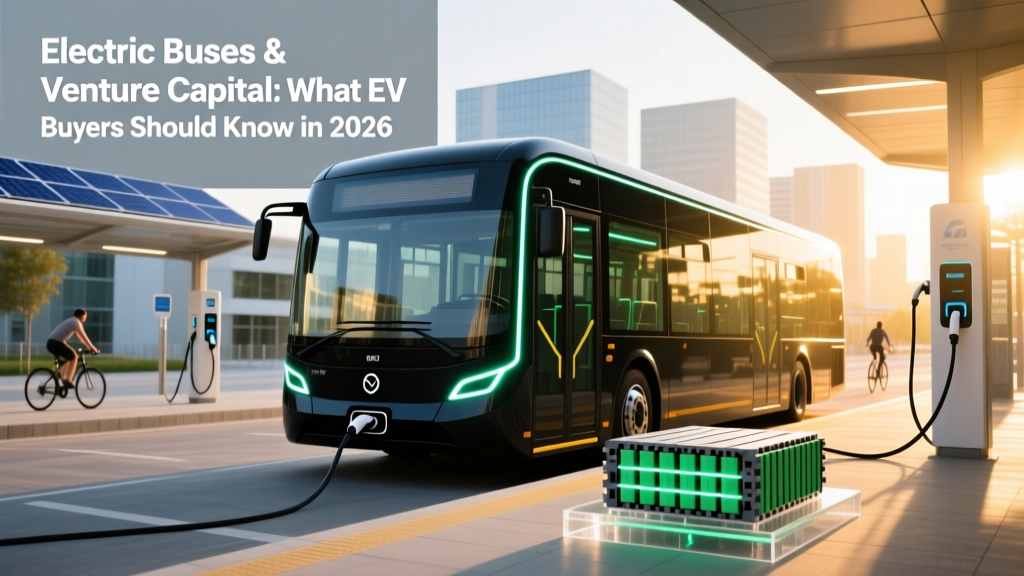
Venture capital flowing into electric buses is accelerating battery, charging, and thermal-management breakthroughs that trickle down to the passenger EVs you actually buy. In 2025–2026, VC-backed transit companies like Proterra (now Phoenix Motorcars after restructuring), Blue Bird, and Lion Electric have helped validate heavy-duty LFP battery packs exceeding 400 kWh, megawatt-class DC fast charging, and route-optimized fleet software. For passenger EV shoppers, this means cheaper LFP packs (now appearing in Tesla Model 3 RWD and Ford Mustang Mach-E Select), faster 350+ kW charging architectures, and more robust battery warranties — all technologies proven first on city buses logging 60,000+ miles per year.
But VC investment is not a guarantee of consumer savings. Transit-grade battery durability does not erase real buyer concerns: upfront EV premiums of $5,000–$12,000 over comparable gas cars, Level 2 home charging installation costs of $800–$2,500, and cold-weather range losses of 20–35%. This guide connects the electric buses venture capital trend to the practical numbers you need before signing a purchase order.
Where the Venture Capital Is Going in Electric Transit
Between 2020 and 2025, venture capital and private equity firms poured an estimated $12 billion+ into electric commercial vehicle startups globally, with transit buses receiving a disproportionate share because municipal contracts provide predictable revenue. Key funding milestones include:
- Proterra — raised over $750M in VC and SPAC funding before its 2023 bankruptcy and subsequent acquisition, validating 440–660 kWh LFP packs with 10-year/500,000-mile warranties.
- Lion Electric — Canadian school bus maker backed by $350M+ in equity; its LionC school bus delivers 130–260 miles of range on a 133–252 kWh LFP pack.
- Blue Bird — the legacy school bus manufacturer secured $100M+ in DOE grants and private capital to retool for its Vision and All American electric platforms.
- Lightning eMotors, ElectraMeccanica, Arrival — several VC-backed entrants failed or pivoted, underscoring that capital alone does not guarantee execution.
According to BloombergNEF, electric bus battery pack prices fell from $350/kWh in 2018 to approximately $115/kWh at the cell level by late 2025, driven partly by fleet-scale LFP procurement. That price drop directly benefits passenger EVs using the same chemistry.
How Transit EV Tech Translates to Your Passenger Car
Electric buses operate in conditions far harsher than personal vehicles: 16-hour daily cycles, extreme stop-and-go regen loads, and exposure to every climate zone. When a battery chemistry survives 500,000 miles on a city bus, automakers gain confidence to use it in consumer vehicles with aggressive warranties.
| Technology | Proven On | Now Available In | Buyer Benefit |
|---|---|---|---|
| LFP (lithium iron phosphate) cells | Proterra ZX5, BYD K-series buses | Tesla Model 3 RWD, Ford Mach-E Select, Hyundai Ioniq 5 Standard Range | Lower cost, longer cycle life (~3,000+ cycles), no cobalt |
| Megawatt-class DC charging (MCS) | Transit depot chargers (1 MW+) | Passenger 800V architectures (Hyundai Ioniq 5, Kia EV6, Porsche Taycan) | 350 kW peak, 10–80% in ~18 min |
| Active thermal management | Blue Bird Vision electric | GM Ultium platform, Rivian R1S/R1T Gen 2 | Reduced cold-weather range loss, sustained fast charging |
| Fleet telematics & preconditioning | Lion Electric school buses | Tesla app preconditioning, FordPass charge scheduling | Optimized charge curves, battery longevity |
The trade-off is real: LFP packs sacrifice roughly 10–15% energy density compared to NMC (nickel manganese cobalt) chemistry. A Tesla Model 3 RWD with LFP delivers an EPA-estimated 272 miles from a ~60 kWh pack, while the NMC-based Model 3 Long Range AWD reaches 363 miles from ~82 kWh. If you drive more than 250 miles daily or regularly tow, NMC remains the better choice. If you commute under 60 miles and want a lower purchase price with a battery that degrades slower, LFP — the chemistry VC-funded transit fleets validated — is the smarter pick.
Real Costs: Electric Bus vs. Gas Bus vs. Your Passenger EV Decision
Understanding fleet economics clarifies why venture capital chased electric buses — and why the same math may or may not apply to your driveway.
| Vehicle Type | Fuel/Energy Cost | Maintenance | Total Per Mile |
|---|---|---|---|
| Diesel transit bus (40-ft) | $0.82/mi | $0.45/mi | $1.27/mi |
| Electric transit bus (40-ft, depot-charged at $0.12/kWh) | $0.28/mi | $0.18/mi | $0.46/mi |
| Gas sedan (30 MPG combined, $3.40/gal) | $0.11/mi | $0.09/mi | $0.20/mi |
| Passenger EV (3.5 mi/kWh, $0.14/kWh home) | $0.04/mi | $0.06/mi | $0.10/mi |
| Passenger EV (DC fast charging at $0.40/kWh) | $0.11/mi | $0.06/mi | $0.17/mi |
The takeaway for buyers: if you charge primarily at home on Level 2 (240V, 7–11 kW), a passenger EV costs roughly half as much per mile as a gas sedan. If you rely entirely on public DC fast charging at $0.35–$0.50/kWh, the cost advantage narrows to near parity with a 30-MPG gas car. This is the same dynamic that made electric buses venture capital-worthy — fleets charge at depots at controlled rates, capturing maximum savings.
What First-Time EV Buyers Must Know Before Purchasing
Whether you are eyeing a $29,990 Chevrolet Equus EV, a $42,000 Tesla Model Y, or a $58,000 Ford F-150 Lightning, these realities apply regardless of how much venture capital flows into the sector:
1. EPA Range Is Not Real-World Range
The EPA test cycle includes low-speed city driving and moderate temperatures. In real-world highway driving at 70–75 mph, expect 15–25% less range than the sticker. In sub-freezing weather (below 32°F), losses reach 20–35% due to cabin heating and reduced battery chemistry efficiency. A 310-mile EPA-rated EV may deliver 230 miles on a cold January highway trip. Always plan road trips around 70% of the EPA figure in winter.
2. Home Charging Is the Make-or-Break Factor
Public charging remains unreliable in many regions. A J.D. Power 2025 EV Experience Index survey found that 20% of public charging sessions encounter errors. If you cannot install a Level 2 home charger (requiring a 240V/40–60A circuit, typically $800–$2,500 including electrician labor and permit), EV ownership becomes significantly less convenient. Apartment dwellers should confirm workplace or building charging access before purchasing.
3. The §30D Federal Tax Credit Is Not Automatic
Under current IRS rules, the up-to-$7,500 new EV credit requires meeting all of these criteria simultaneously:
- MSRP caps: $80,000 for SUVs/pickups/vans; $55,000 for sedans
- Buyer income limits: AGI ≤ $150,000 single / $300,000 married filing jointly
- Battery sourcing: Critical minerals and battery components must meet escalating North American/free-trade-agreement thresholds (check IRS.gov §30D guidance for the current-year list)
- Point-of-sale transfer: You can apply the credit as a dealer discount at purchase rather than waiting for tax filing
Many popular models — including certain Tesla Model Y trims and Ford F-150 Lightning configurations — qualify for the full $7,500, while others qualify for $3,750 or $0 depending on battery component sourcing that shifts quarterly. Always verify eligibility on the IRS qualified vehicles list at the time of purchase.
4. Insurance Costs 15–25% More
EV insurance premiums run higher due to expensive battery replacements and specialized repair networks. Budget an additional $200–$500/year compared to an equivalent gas vehicle. Some insurers (Geico, Progressive, State Farm) now offer EV-specific policies with battery coverage riders.
5. Battery Degradation Is Slower Than You Think
Thanks partly to transit-fleet durability data, modern EV batteries degrade approximately 1.5–2.5% per year under normal use. An NMC pack should retain 85–90% capacity after 8 years; LFP packs often retain 90%+. All major automakers warrant the battery for 8 years/100,000 miles with a minimum 70% capacity retention threshold. Replacement costs remain high — $12,000–$22,000 out of warranty — but are rarely needed within typical ownership periods.
| Myth | Fact |
|---|---|
| "EV batteries need replacing every 5 years" | Median degradation is ~2% per year; most packs outlast 15 years before hitting 70% capacity |
| "EVs are worse in cold weather" | Range drops 20–35%, but EVs start instantly and heat cabins using heat pumps without idling emissions |
| "Charging takes too long" | At home (Level 2, 11 kW): ~8 hours for a full charge overnight. DC fast (250 kW): 10–80% in 18–25 min |
| "The grid can't support EVs" | The U.S. DOE estimates most charging occurs off-peak; smart charging and V2G actually stabilize grids |
| "EVs cost more long-term" | Consumer Reports data shows EVs save $6,000–$10,000 over their lifetime in fuel and maintenance |
Decision Framework: Should You Buy an EV, PHEV, or Stick with Gas?
Choose a Battery EV (BEV) If:
- You have Level 2 home or workplace charging access
- Your daily driving is under 100 miles (covers 95% of U.S. commutes)
- You take road trips fewer than 6 times per year
- You qualify for the §30D credit, bringing effective purchase price below a comparable gas car
- Example: 2026 Hyundai Ioniq 5 SEL — 318 miles EPA, 225 kW peak DC charging (10–80% in ~20 min), ~$46,500 MSRP before credit
Choose a Plug-In Hybrid (PHEV) If:
- You lack reliable home charging but want some electric driving
- You frequently drive 200+ miles between fuel stops
- You live in a charging desert region (rural Plains, parts of the Mountain West)
- Example: 2026 Toyota RAV4 Prime — 42 miles electric-only, 38 MPG combined after battery depletion, ~$45,000 MSRP
Stick with a Gas/HEV Vehicle If:
- You live in an apartment with zero charging access and no workplace option
- You regularly tow heavy loads (boats, horse trailers) over long distances
- Your budget is under $28,000 and you need a new vehicle (EV options remain limited at this price)
- Example: 2026 Toyota Camry Hybrid — 51 MPG combined, ~$30,000 MSRP, zero charging infrastructure required
The Bottom Line: VC Dollars Build the Road You Drive On
Electric buses venture capital investment has accelerated LFP adoption, megawatt charging standards, and thermal management systems that directly benefit passenger EV buyers in 2026. But investment trends do not eliminate the fundamental ownership calculus: your charging access, driving patterns, climate, and budget determine whether an EV saves or costs you money. Use the decision framework above, verify tax credit eligibility at the point of sale, and budget realistically for insurance and home charging installation. The technology is ready — the question is whether your situation is.
Does venture capital investment in electric buses lower the price of passenger EVs?
Indirectly, yes. VC-funded transit fleets create volume demand for LFP cells and high-power charging hardware, driving down per-unit costs. Battery cell prices fell from $350/kWh in 2018 to ~$115/kWh by late 2025, partly due to fleet-scale procurement. This translates to lower MSRP on consumer EVs using the same supply chains.
Are LFP batteries in passenger cars the same as those in electric buses?
The chemistry is identical — lithium iron phosphate — but pack configurations differ. Bus packs run 200–660 kWh; passenger car LFP packs are typically 50–77 kWh. The cycle-life durability (3,000+ full cycles to 80% capacity) proven on buses applies to both.
Should I wait for more VC-funded charging infrastructure before buying an EV?
If you can install Level 2 home charging, do not wait. Home charging covers 80–90% of most owners' needs. Public infrastructure will continue expanding through 2028 via NEVI federal funding and private networks (Tesla Supercharger, Electrify America, EVgo), but home access is the primary convenience factor.
What is the real-world range of popular 2026 EVs?
EPA estimates with real-world highway/cold-weather expectations: Tesla Model 3 Long Range (363 mi EPA → ~290 mi highway, ~250 mi cold), Hyundai Ioniq 5 (318 mi EPA → ~260 mi highway, ~220 mi cold), Ford Mustang Mach-E Extended Range (320 mi EPA → ~265 mi highway, ~225 mi cold).
How much does home Level 2 charger installation cost?
Expect $800–$2,500 total: $300–$700 for the charger unit (e.g., ChargePoint Home Flex, Tesla Wall Connector) plus $500–$1,800 for licensed electrician labor, permit, and potential panel upgrade if your home has a 100A or older service. Homes with 200A panels and nearby garage outlets are at the low end.