Quick Answer: Choosing the Right Electric Bus Company
The best electric bus company for your fleet depends on route length, depot charging infrastructure, and total cost of ownership targets. For transit agencies running 150+ mile daily routes, New Flyer's Xcelsior CHARGE NG (up to 220-mile EPA range, 440 kWh LFP battery) leads on range. For school bus fleets with predictable short routes, Blue Bird's Vision Electric (120-mile range, ~$200,000 after incentives) offers the lowest entry cost. For paratransit and shuttle operators, BYD's K-series and Proterra's ZX5 balance range (180-250 miles) with proven depot-charging reliability. The decision hinges on three numbers: your longest daily route mileage, your depot's electrical panel capacity (kW), and your per-mile fuel/maintenance savings target versus diesel.
The Electric Bus Market in 2026: Who Makes What
The zero-emission bus market has consolidated around a handful of manufacturers that can deliver at scale, honor long-term battery warranties, and support depot charging infrastructure. Federal and state mandates — including the EPA's Clean School Bus Program and FTA Low-No grant funding — have accelerated adoption, but fleet buyers still face real trade-offs between range, charging speed, cold-weather performance, and acquisition cost.
Here are the primary electric bus companies serving the U.S. market in 2026:
- New Flyer (NFI Group) — Xcelsior CHARGE NG (40-ft transit), Xcelsior CHARGE H2 (hydrogen fuel cell variant)
- BYD — K7M (30-ft), K8M (35-ft), K9M (40-ft), K11M (60-ft articulated)
- Proterra (now part of Amprius/GreenPower ecosystem) — ZX5 (40-ft transit), ZX5 Max (extended range)
- Blue Bird — Vision Electric (Type C school bus), All American RE Electric (Type D)
- Thomas Built Buses (Freightliner/Daimler) — Saf-T-Liner C2 Jouley (Type C school bus)
- GreenPower Motor Company — EV Star (cutaway/shuttle), BEAST Type D school bus
- Lion Electric — LionC (Type C school bus), Lion8 (Class 8 step van/truck)
Each company targets different duty cycles. A 40-foot transit bus carrying 60+ passengers through stop-and-go urban routes has fundamentally different energy demands than a Type C school bus running two 25-mile routes per day with long midday layovers.
Spec Comparison: Range, Battery, and Charging by Manufacturer
| Manufacturer / Model | Battery (kWh usable) | Chemistry | EPA / CARB Range (mi) | DC Fast Charge (peak kW) | 10–80% Time | Base MSRP (approx.) |
|---|---|---|---|---|---|---|
| New Flyer Xcelsior CHARGE NG (40-ft) | 440 kWh | LFP | ~220 mi | 350 kW (CCS) | ~75 min | $1.0–1.2M |
| BYD K9M (40-ft) | 390 kWh | LFP (Blade) | ~200 mi | 200 kW (CCS) | ~90 min | $900K–1.1M |
| Proterra ZX5 (40-ft) | 440 kWh (Max: 660 kWh) | NMC/LFP options | ~250 mi (Max: ~329 mi) | 350 kW (CCS) | ~70 min | $1.1–1.3M |
| Blue Bird Vision Electric (Type C) | 155 kWh | LFP | ~120 mi | 60 kW (CCS) | ~90 min | $200–250K |
| Thomas Jouley (Type C) | 226 kWh | NMC | ~135 mi | 60 kW (CCS) | ~120 min | $220–270K |
| GreenPower BEAST (Type D) | 240 kWh | LFP | ~150 mi | 80 kW (CCS) | ~100 min | $280–330K |
| Lion LionC (Type C) | 155–210 kWh | NMC | ~100–130 mi | 50 kW (CCS) | ~110 min | $190–240K |
Range figures based on CARB/EPA standardized transit duty cycles or manufacturer-reported estimates under ideal conditions. Real-world range drops 15–30% in cold weather (below 32°F), on hilly routes, and with full passenger loads. Always spec your battery for your worst-case route day, not your average day.
Total Cost of Ownership: Electric Bus vs. Diesel Bus
The purchase price of an electric bus is 2–4x that of an equivalent diesel bus, but the operating cost gap flips dramatically within 3–5 years. Here is a realistic 12-year TCO comparison for a 40-foot transit bus running 45,000 miles per year:
| Cost Category | Electric Bus (40-ft) | Diesel Bus (40-ft) | CNG Bus (40-ft) |
|---|---|---|---|
| Purchase Price (before incentives) | $1,100,000 | $525,000 | $575,000 |
| Federal/State Incentives (FTA Low-No, EPA, state vouchers) | –$350,000 (varies) | $0 | –$50,000 |
| Fuel/Energy (12 years, 540K miles) | $162,000 ($0.30/mi at $0.12/kWh) | $594,000 ($1.10/mi at $4.00/gal, 5 MPG) | $432,000 ($0.80/mi) |
| Maintenance (12 years) | $108,000 ($0.20/mi) | $270,000 ($0.50/mi) | $243,000 ($0.45/mi) |
| Battery Replacement (year 8–10, if needed) | $80,000–$150,000 | N/A (engine rebuild ~$30K) | N/A |
| Charging Infrastructure (depot) | $80,000–$200,000 per bus | $0 | $0 (station shared) |
| Estimated 12-Year TCO | $1.18–1.45M | $1.39M | $1.20M |
Energy costs assume depot charging at commercial/industrial electricity rates ($0.10–$0.15/kWh). Diesel and CNG prices reflect 2025–2026 national fleet averages. Incentive amounts vary by program year and jurisdiction — consult EPA Clean School Bus Program and your state's clean transportation office for current availability.
The crossover point — where electric TCO drops below diesel — typically occurs between year 5 and year 8 depending on local electricity rates, annual mileage, and incentive stacking. Fleets in California, New York, and other states with aggressive voucher programs (HVIP, NYTVIP) can reach parity as early as year 3.
Real-World Ownership: What Fleet Managers Actually Face
Depot Charging Infrastructure Is the Bottleneck
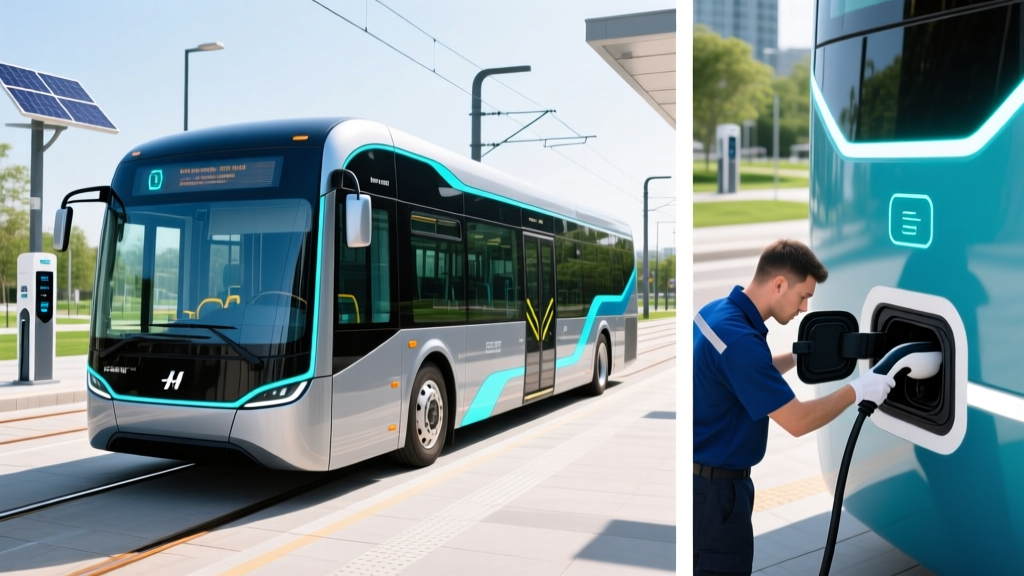
The single biggest barrier to electric bus adoption isn't the bus — it's the electrical infrastructure. A depot with 20 electric buses charging simultaneously at 60 kW each needs 1.2 MW of electrical capacity. That often requires a utility service upgrade, new transformers, switchgear, and potentially a dedicated feeder line. Budget $80,000–$200,000 per charge point for the full installation, and plan for 12–18 months of lead time with your utility.
Smart depot charging software (e.g., ChargePoint Fleet, EvoCharge, Nuvve) can reduce peak demand by staggering charge sessions and leveraging off-peak electricity rates. Some utilities offer demand-response programs that pay fleets to shift charging away from peak hours, further reducing energy costs.
Cold-Weather Range Loss Is Real and Significant
Electric buses in northern climates (Chicago, Minneapolis, Boston) lose 20–35% of their rated range in winter. A 220-mile rated bus may deliver only 145–175 miles in sub-freezing temperatures due to cabin heating loads and reduced battery efficiency. Fleets in these regions must either spec larger battery packs, install opportunity chargers along routes, or accept shorter winter routes.
Heat pump HVAC systems (now standard on most 2025+ models from New Flyer and Proterra) recover 15–20% of that loss compared to resistive electric heaters. If you operate below 20°F regularly, confirm your bus spec includes a heat pump and battery thermal preconditioning.
Maintenance Savings Are Immediate
Electric buses eliminate engine oil changes, diesel particulate filter (DPF) cleaning/replacement, transmission fluid service, exhaust aftertreatment, and fuel system maintenance. Brake wear drops 50–70% thanks to regenerative braking. Fleet operators consistently report maintenance cost reductions of 40–60% versus diesel — typically saving $0.25–$0.35 per mile.
Common Misconceptions About Electric Buses
| Myth | Fact |
|---|---|
| "Electric buses don't have enough range for real routes." | Modern 40-ft transit buses deliver 180–250 real-world miles — sufficient for 85%+ of U.S. transit agency daily block schedules (National Renewable Energy Laboratory fleet data). School buses with 100–135 mile range cover virtually all standard AM/PM routes. |
| "Battery replacement will bankrupt the fleet." | LFP batteries (now standard on most transit and school bus models) are rated for 4,000–6,000+ cycles with less than 20% degradation. Most manufacturers warranty 8–12 years / 350,000+ miles at ≥70% capacity retention. Many buses will reach retirement before needing a pack swap. |
| "The grid can't handle depot charging." | Managed charging software and utility partnership programs allow fleets to charge within existing grid capacity. Off-peak overnight charging at 20–40 buses typically draws 1–3 MW — manageable with utility coordination and, in some cases, on-site battery storage. |
| "Electric buses cost more over their lifetime." | When incentives, fuel savings, and maintenance reductions are factored in, 12-year TCO is typically equal to or lower than diesel — often $100K–$300K less per bus. See cost table above. |
| "Hydrogen fuel cell buses are a better zero-emission option." | Hydrogen buses (e.g., New Flyer CHARGE H2) offer longer range and faster refueling but face hydrogen fuel costs 2–4x higher per mile than electricity, limited fueling infrastructure, and higher operating costs. Battery-electric is the default for most urban/suburban routes; hydrogen may suit long-haul or extreme-cold applications. |
Federal and State Incentives: What's Available Now
Electric bus purchases in 2026 can stack multiple incentive layers:
- EPA Clean School Bus Program — Up to $345,000 per zero-emission school bus plus $20,000 for charging infrastructure (2025–2026 funding rounds). Check current status at epa.gov/clean-school-bus-program.
- FTA Low-No Program — Competitive grants covering up to 80% of capital cost for transit agency zero-emission bus purchases and depot infrastructure.
- IRA §30C Alternative Fuel Vehicle Refueling Property Credit — Up to $100,000 per charging item installed in eligible census tracts (check IRS §30C for eligibility).
- State voucher programs — California HVIP ($120K–$300K per bus), New York NYTVIP, New Jersey, Colorado, and others offer point-of-sale vouchers. Amounts and availability change annually.
- Utility make-ready programs — Many investor-owned utilities cover the cost of electrical infrastructure upgrades from the utility pole to the depot meter.
Incentive eligibility depends on fleet type, location, vehicle class, and program funding cycles. Always verify current program rules with your state energy office and a qualified grant consultant before committing to a purchase order.
Decision Framework: Which Electric Bus Company Is Right for Your Fleet?
If/Then Fleet Selection Guide
- IF you operate a transit agency with 150+ mile daily blocks and need maximum range → THEN evaluate the Proterra ZX5 Max (660 kWh, ~329 mi rated) or New Flyer Xcelsior CHARGE NG (440 kWh, ~220 mi rated) with depot opportunity charging.
- IF you run a school bus fleet with AM/PM routes under 60 miles each → THEN the Blue Bird Vision Electric ($200K–$250K, 120 mi range) or Thomas Jouley ($220K–$270K, 135 mi range) is the lowest-risk entry point. Stack EPA Clean School Bus funding to reduce net cost below $50K per unit.
- IF you operate paratransit, airport shuttles, or university transit with 80–150 mile daily needs → THEN consider GreenPower EV Star (cutaway, 150 mi) or BYD K7M/K8M for mid-size routes with moderate passenger loads.
- IF your depot lacks utility capacity for a full upgrade within 18 months → THEN phase your electric bus rollout in cohorts of 5–10 buses, pair with on-site battery storage (e.g., 500 kWh BESS), and negotiate a managed charging agreement with your utility before ordering more.
- IF you operate in sub-zero winter climates and cannot accept range loss → THEN spec buses with heat pump HVAC, battery preconditioning, and consider 20% larger battery packs than your summer route calculations suggest. Alternatively, evaluate hydrogen fuel cell buses for routes exceeding 200 miles in extreme cold.
Frequently Asked Questions
How long do electric bus batteries last before replacement?
Most LFP battery packs in 2025–2026 electric buses are rated for 4,000–6,000 full charge cycles with ≤20% capacity loss. At one cycle per day, that translates to 11–16 years of service. Manufacturer warranties typically cover 8–12 years at ≥70% state of health. Many transit agencies plan 12-year bus lifecycles and expect the original battery to last the entire service life.
Can electric buses handle hilly or mountainous routes?
Yes, but with significant range penalties. Climbing grades consume 2–3x the energy per mile versus flat terrain. Regenerative braking recovers some energy on descents, but net efficiency still drops 20–40% on steep routes. Fleet operators in cities like San Francisco and Seattle spec larger battery packs (440+ kWh) and use opportunity charging at route endpoints to maintain schedule reliability.
What is the charging time for a typical electric transit bus?
At a 150 kW CCS depot charger, a 440 kWh battery charges from 10–80% in roughly 2.5–3 hours. At 350 kW (the current CCS peak for heavy-duty), the same pack reaches 80% in about 70–75 minutes, though sustained charge rates taper significantly above 60% state of charge. Most fleets charge overnight during off-peak hours (8–10 hour dwell time), making even 50 kW chargers sufficient for daily top-ups.
Do electric buses qualify for the federal §30D EV tax credit?
No — the §30D credit applies to light-duty vehicles under 14,000 lbs GVWR. Electric buses qualify under different programs: the §30C charging infrastructure credit, EPA Clean School Bus grants, FTA Low-No grants, and state voucher programs. Always consult a transportation grant specialist to identify the optimal incentive stack for your fleet class.
What's the biggest risk when switching to electric buses?
Underestimating depot charging infrastructure timelines. Utility service upgrades can take 12–24 months from application to energization. Fleet operators who order buses before securing charging infrastructure often face months of idle vehicles. Start with your utility interconnection study 18+ months before your planned bus delivery date.
How does an electric school bus compare to a diesel school bus on cost per mile?
Electric school buses operate at approximately $0.25–$0.35 per mile (electricity + maintenance) versus $0.85–$1.10 per mile for diesel (fuel + maintenance). Over a 12-year lifecycle at 12,000 miles/year, that's a savings of $72,000–$108,000 per bus in operating costs alone — enough to offset the higher purchase price when combined with EPA Clean School Bus funding.