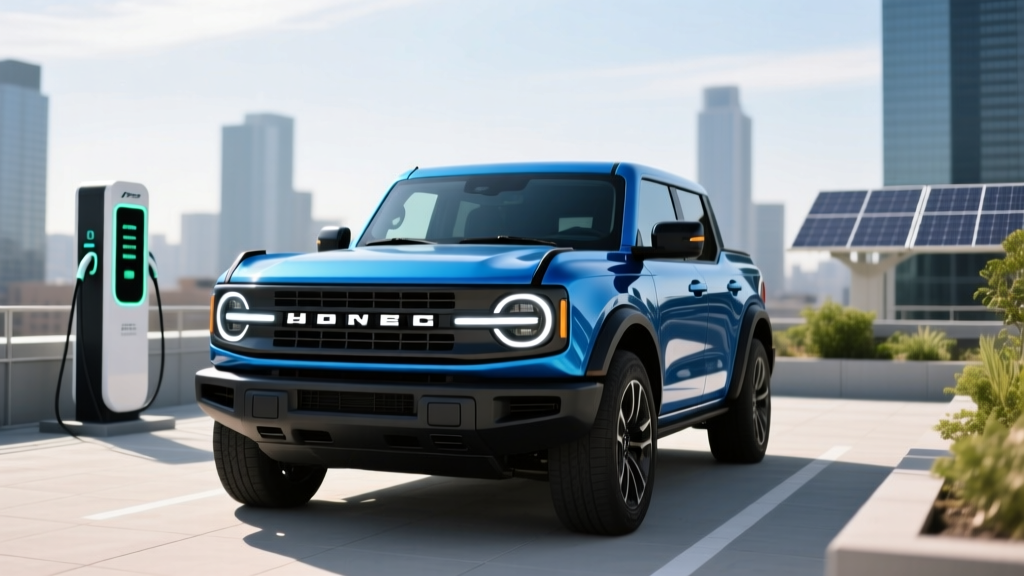
The Short Answer: There Is No Electric Bronco (2022 or Otherwise)
If you've been searching for an electric Bronco 2022 model, here's the direct truth: Ford never produced an electric Bronco for the 2022 model year, nor for any subsequent year through 2026. The current sixth-generation Bronco (reintroduced for 2021) is offered exclusively with gasoline powertrains — a 2.3L EcoBoost I4 (300 hp), a 2.7L EcoBoost V6 (330 hp), and the high-output 3.0L V6 in the Raptor (418 hp). Ford has not announced a production date for a battery-electric Bronco.
What Ford has done is file trademark applications and make vague references to an electrified Bronco in investor presentations, and the 2004 Bronco concept was a fuel-cell vehicle — but none of this translates to a buyable electric Bronco today. If you want an electric SUV with genuine off-road capability in 2026, you'll need to look at alternatives. This guide breaks down exactly what's available, what it costs, and how these EVs compare to the gas Bronco you may have been considering.
Why the Electric Bronco Doesn't Exist Yet
Ford's electrification strategy has prioritized its highest-volume nameplates first. The Mustang Mach-E launched for 2021, the F-150 Lightning for 2022, and the E-Transit van for commercial fleets. The Bronco, while popular, sells roughly 100,000–130,000 units annually — a fraction of F-Series volume — and its body-on-frame architecture (shared with the Ranger) was not designed with a skateboard battery platform in mind.
Converting a body-on-frame off-roader to electric power introduces engineering challenges that Ford is still working through:
- Battery placement vs. ground clearance: A Bronco needs 11.5+ inches of ground clearance for serious trail use. Mounting a 100+ kWh battery pack underneath without sacrificing breakover angle or adding vulnerable underbody exposure is a genuine packaging problem.
- Weight and suspension: The gas Bronco already weighs 4,500–5,200 lbs depending on trim. An electric version with adequate range (300+ miles) would likely push past 6,000 lbs, requiring entirely re-engineered suspension, brakes, and axles.
- Off-road range reality: Low-speed rock crawling is actually efficient for EVs (high torque, low speed), but high-speed desert running and highway travel to trailheads drain batteries fast. Ford would need to deliver at least 300 miles of EPA range to be competitive, which means a large, heavy pack.
Ford's next-generation EV platform (a universal skateboard architecture) is expected to underpin future models, and industry analysts widely expect an electric Bronco to eventually arrive — likely for the 2028 or 2029 model year at the earliest. Until then, every Bronco rolling off the Wayne, Michigan assembly line burns gasoline.
The Gas Bronco's Real Cost of Ownership (2026 Model Year)
Before we evaluate electric alternatives, let's establish the baseline. Here's what owning a 2026 Ford Bronco actually costs, based on the 4-door Big Bend trim with the 2.3L EcoBoost — the most popular configuration.
| Category | Annual Cost | 5-Year Total | Notes |
|---|---|---|---|
| Purchase price (MSRP) | — | $42,300 | Base MSRP before destination; typical transaction ~$45,000 with options |
| Fuel (gasoline) | $2,640 | $13,200 | 20 MPG combined (EPA), 12,000 mi/yr, $3.67/gal avg |
| Insurance | $1,860 | $9,300 | National avg for midsize SUV; varies by state/driver |
| Maintenance | $650 | $3,250 | Oil changes, filters, brakes, fluids |
| Federal tax credit | — | $0 | Gas vehicle — no §30D credit |
| Estimated depreciation | — | $18,500 | ~44% over 5 years (Bronco holds value well) |
| Total 5-Year Cost | ~$44,250 | Purchase + fuel + insurance + maintenance + depreciation |
The Bronco's 20 MPG combined EPA rating (per fueleconomy.gov) is one of the worst in the midsize SUV segment. That's the trade-off for its off-road capability, removable roof/doors, and boxy aerodynamics. For comparison, a Toyota RAV4 Hybrid achieves 39 MPG combined — nearly double — but offers nothing close to the Bronco's trail capability.
Electric Alternatives: What You Can Actually Buy in 2026
If the electric Bronco search brought you here because you want an electric SUV that can handle light-to-moderate off-road use, here are the real options available now. None of them match the Bronco's hardcore rock-crawling chops (solid axles, sway-bar disconnect, 35-inch tire clearance), but they cover the overlanding and trail-driving needs of most buyers.
| Spec | Ford Bronco 2.3L | Rivian R1S (Dual-Motor) | Jeep Wrangler 4xe | Toyota Land Cruiser (2024+) |
|---|---|---|---|---|
| Powertrain | Gas (2.3L Turbo I4) | Battery Electric (Dual Motor AWD) | Plug-in Hybrid (2.0L Turbo + electric) | Hybrid (2.4L Turbo i-FORCE MAX) |
| Horsepower | 300 hp | 533 hp (Standard) | 375 hp combined | 326 hp combined |
| 0–60 mph | 6.5 sec | 4.5 sec | 6.0 sec | 6.0 sec |
| EPA Range / Efficiency | 20 MPG combined (~370 mi/tank) | 352 mi (EPA, Max Pack); 270 mi (Standard) | 22 mi electric-only; 49 MPGe; 20 MPG gas-only | 27 MPG combined (~486 mi/tank) |
| Ground Clearance | 8.3–11.5 in (trim-dependent) | 7.9–14.9 in (adjustable air suspension) | 10.8 in | 8.7 in |
| Towing Capacity | 3,500 lbs | 7,700 lbs | 3,500 lbs | 6,000 lbs |
| Starting MSRP (2026) | ~$39,695 | ~$75,900 | ~$51,795 | ~$57,345 |
| Federal Tax Credit (§30D) | $0 | Up to $7,500 (check IRS sourcing rules) | Up to $7,500 (PHEV, income/MSRP caps apply) | Up to $7,500 (check sourcing eligibility) |
| Battery Warranty | N/A | 8 yr / 120,000 mi | 8 yr / 100,000 mi (hybrid components) | 10 yr / 150,000 mi (hybrid battery) |
Rivian R1S: The Closest Thing to an Electric Bronco
The Rivian R1S is the only purpose-built electric SUV in 2026 with serious off-road credentials. Its quad-motor variant (850 hp, 0–60 in ~3.0 seconds) is absurdly quick, but the dual-motor with the Max Pack battery is the practical choice for range and trail use. Key strengths:
- Adjustable air suspension: Raises ground clearance to 14.9 inches in Off-Road mode — exceeding even the Bronco Raptor's 13.1 inches.
- Tank turns: The quad-motor version can rotate the vehicle nearly 360° in place by spinning left and right wheels in opposite directions — useful on tight trails.
- Real-world range caveat: The EPA-rated 352 miles (Max Pack) drops to roughly 260–290 miles at sustained highway speeds of 75+ mph, and cold weather (below 32°F) can knock off another 15–25%. Plan for ~220–250 miles of usable range on a winter road trip to the trailhead.
- Charging: Peaks at ~220 kW on DC fast chargers, achieving a 10–80% charge in approximately 30 minutes. Rivian has also opened access to Tesla Superchargers via an adapter, significantly expanding the charging network.
The catch: the R1S starts at roughly $75,900 for the dual-motor Standard battery — nearly double the Bronco's base price. It's a premium vehicle competing with the BMW X5 and Mercedes GLE, not the Bronco's mainstream bracket.
Jeep Wrangler 4xe: The Plug-in Hybrid Compromise
If you want something closer to the Bronco's spirit (removable doors, solid axles, trail-rated) with some electric capability, the Wrangler 4xe is the pragmatic bridge. Its 22 miles of EPA electric-only range covers most daily commutes, and the combined 375 hp provides strong acceleration. However, once the battery depletes, you're driving a heavy gas vehicle rated at just 20 MPG — essentially the same as the Bronco.
Toyota Land Cruiser (2024+): Hybrid Efficiency, Real Trail Capability
Not electric, but worth mentioning: the new Land Cruiser's i-FORCE MAX hybrid powertrain delivers 326 hp and 465 lb-ft of torque with a 27 MPG combined rating. It's a genuine body-on-frame off-roader with locking differentials, and its hybrid system provides instant electric torque at low speeds — ideal for crawling. At ~$57,345, it sits between the Bronco and the R1S in price.
Real Costs: Electric SUV vs. Gas Bronco Over 5 Years
Let's compare the total cost of ownership between the gas Bronco Big Bend and the Rivian R1S Dual-Motor (Standard battery, ~270 mi EPA), assuming 12,000 miles per year and home Level 2 charging for the R1S.
| Cost Factor | Ford Bronco Big Bend | Rivian R1S (Dual-Motor Std) |
|---|---|---|
| MSRP (before incentives) | $42,300 | $75,900 |
| Federal §30D Tax Credit | $0 | Up to $7,500* |
| Effective Purchase Price | $42,300 | ~$68,400 |
| Fuel / Energy (5 years) | $13,200 (gas at $3.67/gal, 20 MPG) | $4,200 (electricity at $0.14/kWh, ~2.0 mi/kWh) |
| Maintenance (5 years) | $3,250 | $1,200 (no oil, fewer brake replacements due to regen) |
| Insurance (5 years) | $9,300 | $12,500 (Rivian premiums run 25–35% higher) |
| Depreciation (estimated) | $18,500 | $32,000 |
| Total 5-Year Cost | ~$44,250 | ~$69,900 |
*Federal §30D credit eligibility depends on your modified adjusted gross income, the vehicle's MSRP cap ($80,000 for SUVs), battery critical-mineral sourcing, and final assembly requirements. Check the latest rules at IRS.gov before purchasing. Credits may be transferred to the dealer at point of sale as of 2024+.
The takeaway: The R1S saves roughly $9,000 in fuel and maintenance over five years, but its higher purchase price, insurance, and depreciation result in a ~$25,650 higher total cost. You're paying a premium for performance, technology, and zero tailpipe emissions — not for economic savings. If your primary goal is saving money, the Bronco (or a hybrid like the Land Cruiser) wins on pure economics. The EV math improves if you drive more miles annually, have cheap electricity (under $0.10/kWh), or qualify for state incentives on top of the federal credit.
Common Misconceptions About an Electric Bronco
| Myth | Fact |
|---|---|
| "Ford released an electric Bronco in 2022" | No. Ford released the F-150 Lightning in 2022. The Bronco has been gas-only since its 2021 reintroduction. |
| "The Bronco EV is coming next year" | Ford has not confirmed a production date. Industry estimates place it at 2028–2029 at the earliest, on a next-gen EV platform. |
| "An electric Bronco would be terrible off-road" | EVs actually excel at low-speed crawling (instant torque, precise motor control). The Rivian R1S and GMC Hummer EV prove electric off-roaders work. The challenge is range and underbody battery protection, not capability. |
| "I can convert my gas Bronco to electric" | Aftermarket EV conversions exist but cost $30,000–$60,000+, void all factory warranties, and require custom engineering. Not practical for most owners. |
| "The Wrangler 4xe is basically an electric Bronco" | It's a plug-in hybrid with just 22 miles of electric range — enough for a commute, not a trail day. Once the battery depletes, it's a gas vehicle. |
First-Time EV Buyer Considerations: What the Bronco Search Misses
If the electric Bronco search is your entry point into EVs, there are practical realities that spec sheets don't capture:
Home Charging Is Non-Negotiable for Most Owners
Over 80% of EV charging happens at home. If you don't have access to a garage or driveway where a Level 2 charger (240V, 32–48 amps, 7.7–11.5 kW) can be installed, EV ownership becomes significantly more inconvenient. A professional Level 2 installation typically costs $800–$2,500 (charger + electrician + permit), but can climb to $4,000+ if your electrical panel needs an upgrade from 100A to 200A service.
Cold Weather Cuts Range — Plan for It
If you live where winters drop below freezing, expect 15–30% range loss in an EV. A Rivian R1S rated at 270 miles EPA might deliver only 190–210 miles in 20°F weather with the heater running. Heat pumps (standard on most 2025+ EVs) help, but physics is physics. Gas vehicles also lose efficiency in cold weather, but the impact on range is far less dramatic because a gas tank holds vastly more energy than a battery pack.
Charging Speed Matters More Than Peak Numbers
Manufacturers advertise peak DC fast-charge rates (e.g., "220 kW"), but that peak is sustained only briefly, typically between 10–40% state of charge. The charge curve tapers significantly above 80% to protect battery health. A "30-minute 10–80% charge" is the realistic metric to evaluate. Charging from 80–100% can take as long as the 10–80% session — which is why most EV road-trippers charge to 80% and move on.
Insurance Costs More for EVs (Currently)
EV insurance premiums run 15–35% higher than comparable gas vehicles, driven by higher repair costs (specialized parts, battery replacement risk, trained technicians). Get quotes before purchasing — the difference can be $300–$600+ per year.
Decision Framework: What Should You Actually Buy?
Choose the Gas Ford Bronco If:
- You regularly tackle moderate-to-hard off-road trails (rock crawling, deep mud, water crossings)
- Your budget is under $50,000
- You don't have reliable home charging access
- You want the removable roof/doors experience and the Bronco community culture
- You drive fewer than 10,000 miles per year (fuel cost impact is lower)
Choose the Rivian R1S If:
- Your budget is $75,000+ and you want a premium electric SUV
- You have home Level 2 charging and want minimal daily fuel cost
- Your off-road use is light-to-moderate (fire roads, snow, overlanding — not hardcore rock crawling)
- You value acceleration (4.5 sec 0–60) and technology over removable doors
- You tow boats or trailers (7,700 lb capacity beats the Bronco's 3,500 lbs)
Choose the Jeep Wrangler 4xe If:
- You want a bridge between gas and electric — daily electric commuting with gas-powered trail freedom
- You want the removable doors/roof and solid-axle off-road capability the R1S doesn't offer
- Your budget is $50,000–$60,000
- You can charge at home to actually use the 22 miles of electric range daily
Wait for an Electric Bronco If:
- You're not in a rush to buy (realistic arrival: 2028–2029 model year)
- You're willing to gamble on pricing and specs that haven't been announced
- The Bronco's specific combination of removable body panels, trail capability, and Ford dealer network is essential to you
Frequently Asked Questions
Will Ford ever make an electric Bronco?
Almost certainly, yes — but not before 2028 based on Ford's announced EV platform timeline. Ford has invested billions in EV development and has publicly stated that its iconic nameplates will eventually go electric. The Bronco and Bronco Sport are strong candidates for electrification on Ford's next-generation universal EV skateboard platform. However, no concept, prototype, or production timeline has been officially revealed as of early 2026.
Is there an electric SUV that can truly off-road?
Yes. The Rivian R1S and GMC Hummer EV SUV are both production electric vehicles with legitimate off-road capability — adjustable air suspension, skid plates, and sophisticated traction control. The R1S has completed the Rubicon Trail, and the Hummer EV offers CrabWalk (diagonal movement) and Extract Mode (15.9 inches of ground clearance). However, neither matches the Bronco or Wrangler's aftermarket ecosystem, body-on-frame durability, or ease of repair in remote areas.
How much would an electric Bronco cost if it existed?
Based on current EV pricing trends and the Bronco's market position, a production electric Bronco would likely start in the $55,000–$65,000 range for a base model, with well-equipped trims reaching $80,000+. This assumes Ford targets a price point above the gas Bronco but below the Rivian R1S. The §30D federal tax credit could bring the effective price down by up to $7,500, subject to income limits ($150,000 single / $300,000 joint MAGI), MSRP caps ($80,000 for SUVs), and battery sourcing requirements current at time of purchase.
Does the Ford Mustang Mach-E count as an electric Bronco alternative?
Only if you don't need off-road capability. The Mach-E is a car-based crossover with up to 320 miles of EPA range (Extended Range RWD) and a starting price around $43,000. It's an excellent daily driver and road-trip EV, but its 5.9 inches of ground clearance and lack of off-road hardware make it unsuitable for anything beyond gravel roads and light snow. If your Bronco interest was aesthetic rather than functional, the Mach-E is worth a look.
What's the most fuel-efficient alternative to the Bronco?
If off-road capability matters, the Toyota Land Cruiser (27 MPG combined, hybrid) or the Ford Bronco Sport with the 1.5L EcoBoost (26 MPG combined) are the most efficient options in the segment. The Bronco Sport is a unibody crossover (not the same vehicle as the Bronco) and offers significantly less trail capability, but it's far more efficient for daily driving. For a true plug-in hybrid off-roader, the Wrangler 4xe delivers 49 MPGe when using its electric range.