Quick Answer: Is the Electric Boat Market Ready for Mainstream Buyers?
The electric boat market in 2026 remains a niche but rapidly evolving segment. While electric boats offer near-silent operation, zero on-water emissions, and dramatically lower maintenance costs, they face significant limitations: typical ranges of 20–60 nautical miles, charging infrastructure that lags far behind EV road networks, and purchase prices that often exceed comparable gas-powered boats by 40–70%. For EV owners already comfortable with charging logistics and battery management, the transition to electric boating is more intuitive — but it's not yet a drop-in replacement for gas boats used for long-range cruising or watersports.
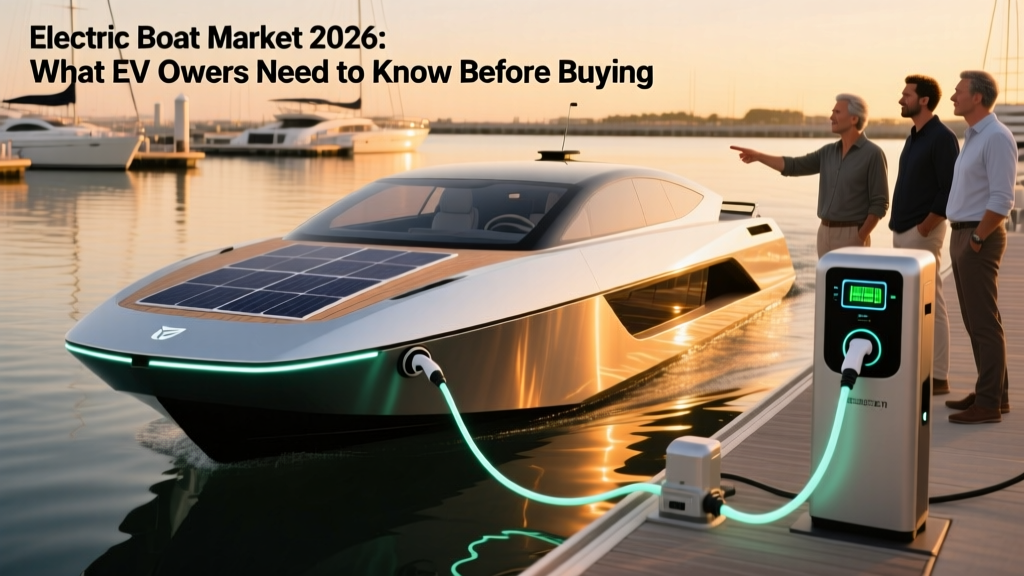
If you've spent the last few years optimizing your EV ownership — timing charges around off-peak electricity rates, planning road trips around DC fast-charger locations, and monitoring battery state of health — you might be wondering whether that same electrified lifestyle extends to the water. The electric boat market has attracted significant investment and media attention, with companies like Candela, X Shore, Navier, and Arc Boats pushing battery-electric and hydrofoiling designs into production. But the reality of electric boating in 2026 is more nuanced than the headlines suggest.
This guide applies the same data-driven, ownership-focused lens we use for EVs to the electric boat market — covering real range expectations, charging logistics, cost comparisons, and a practical decision framework so you can determine whether an electric boat fits your use case.
Electric Boat Market Overview: Where Things Stand in 2026
The global electric boat market is projected to reach approximately $20–25 billion by the late 2020s, driven by commercial ferry electrification, luxury day-boat demand, and tightening emissions regulations on inland waterways. But consumer adoption remains early-stage. Here's what the market looks like right now:
- Available consumer models: Roughly 15–25 production electric boats are available for purchase in the U.S. and European markets, spanning 18-foot day boats to 40-foot cruisers.
- Price range: $50,000 for basic electric runabouts up to $500,000+ for foiling luxury models like the Candela C-8.
- Primary use cases: Day cruising, lake boating, short harbor commutes, and commercial water taxis.
- Key limitation: Energy density. Marine battery packs face a physics challenge — water creates roughly 4× the drag resistance of road surfaces, meaning boats consume energy at rates that make even large EV batteries look modest.
Electric Boat vs. Gas Boat: The Numbers Compared
The most common question from EV owners exploring boats is straightforward: how does an electric boat stack up against a gas-powered equivalent? Below is a comparison based on typical 22-foot day cruiser configurations available in 2026.
| Attribute | Electric Boat (Typical) | Gas Boat (Typical) |
|---|---|---|
| Purchase Price | $85,000 – $150,000 | $50,000 – $85,000 |
| Battery / Fuel Capacity | 40–80 kWh (LFP or NMC) | 40–60 gallon tank |
| Range (cruising speed) | 25–50 nautical miles | 150–250 nautical miles |
| Top Speed | 20–30 knots | 35–50 knots |
| "Refueling" Time | 3–8 hours (Level 2 equivalent dock charging) | 5–10 minutes |
| Annual Maintenance | $300–$800 | $1,500–$3,500 |
| Energy/Fuel Cost per Hour | $5–$15 (electricity) | $30–$60 (gasoline) |
| Noise Level at Cruise | Near-silent (~50 dB) | 75–90 dB |
| On-Water Emissions | Zero | CO₂, NOₓ, unburned hydrocarbons |
Sources: Manufacturer specifications from Candela, X Shore, and Arc Boats; EPA marine emissions data.
Range Reality: What the Sticker Doesn't Tell You
Just as with EVs, electric boat range figures require a critical eye. Manufacturers typically quote range at optimal cruising speed (often 5–8 knots for displacement hulls, or specific foiling speeds for hydrofoiling designs like the Candela C-8). Real-world range varies dramatically based on conditions:
Real-World Electric Boat Range Expectations
- Sticker range (optimal): 50 nautical miles at 22 knots (Candela C-8, 44 kWh battery, hydrofoiling)
- Calm lake, moderate speed: ~35–45 nautical miles achievable
- Choppy water / headwinds: Range can drop 30–50% — expect 20–30 nautical miles
- High-speed operation (planing): Range collapses to 10–15 nautical miles — just as flooring an EV at 85 mph destroys its EPA range
- Cold water (below 50°F): Battery performance loss of 10–20%, similar to cold-weather EV range reduction
Key insight: Hydrofoiling boats (Candela, Navier) achieve dramatically better efficiency by lifting the hull above water, reducing drag by ~80%. This is the marine equivalent of an EV's regenerative braking and heat pump — a technology advantage that translates directly to range.
Charging Infrastructure: The Electric Boat Market's Biggest Gap
This is where the electric boat market diverges most sharply from EVs. While the U.S. now has over 70,000 public EV charging ports, marine charging infrastructure is extremely limited:
| Charging Level | Power (kW) | Charge Time (40 kWh Battery) | Availability |
|---|---|---|---|
| Standard Dock Outlet (120V / 20A) | ~1.9 kW | ~21 hours (0–100%) | Most marinas |
| Marine Level 2 (240V / 50A) | ~9.6 kW | ~4.5 hours (0–100%) | Growing — select marinas in CA, FL, Pacific Northwest |
| DC Fast Marine Charger | 40–150 kW | ~25–45 min (10–80%) | Very rare — a handful of pilot installations |
Practical reality for 2026: Most electric boat owners charge overnight at their dock or slip using a 240V marine-rated outlet. If your marina doesn't offer 240V shore power, you're looking at 20+ hour charge times on a standard 120V outlet — which makes daily use impractical for larger battery packs.
Unlike EV road trips where you can plan around Electrify America or Tesla Supercharger stops, there is no reliable network of marine fast chargers for extending range on the water. This makes electric boats fundamentally a home-base activity — ideal if you boat on a single lake or within a defined harbor area, problematic if you want to cruise between ports.
Total Cost of Ownership: Where Electric Boats Save (and Don't)
The economics of electric boats follow a pattern familiar to EV owners: higher upfront cost, lower operating costs. Here's a 5-year ownership projection for a typical electric vs. gas day boat used 100 hours per year:
| Cost Category | Electric Boat | Gas Boat |
|---|---|---|
| Purchase Price | $110,000 | $65,000 |
| Fuel / Electricity (5 years) | $3,500 | $22,500 |
| Maintenance (5 years) | $2,500 | $12,500 |
| Winterization / Engine Service | $500 | $3,500 |
| Insurance (5 years) | $9,000 | $7,500 |
| Dock / Slip Fees (5 years) | $15,000 | $15,000 |
| Total 5-Year Cost | $140,500 | $126,000 |
| Estimated Resale Value (Year 5) | $66,000 (60%) | $32,500 (50%) |
| Net 5-Year Cost (after resale) | $74,500 | $93,500 |
Takeaway: Electric boats still carry a purchase-price premium, but the net cost of ownership can be lower over 5 years when you factor in dramatically reduced maintenance (no engine oil, impellers, exhaust manifolds, winterization of cooling systems) and fuel savings. Higher projected resale values for electric boats also help — though this market is young and depreciation curves are still being established.
Common Misconceptions About the Electric Boat Market
| Myth | Fact |
|---|---|
| "Electric boats can't go fast." | Several models exceed 30 knots. The Arc One hits 40+ mph. But high speed destroys range — the same trade-off as EVs. |
| "Saltwater destroys electric boat batteries." | Modern marine battery enclosures are IP67/IP68-rated and sealed against saltwater intrusion. Tesla and other EV battery packs use similar protection. |
| "There are no federal incentives for electric boats." | The §30D federal tax credit applies to vehicles, not boats. However, some state and local clean-marine grants exist, and commercial electric vessel incentives are available under the Inflation Reduction Act for ferry operators. |
| "Electric boats are maintenance-free." | They eliminate engine maintenance, but you still need hull cleaning, propeller inspection, battery management system updates, and marine electronics upkeep. |
| "You can charge an electric boat from any dock outlet." | Standard 120V/15A marina outlets deliver ~1.4 kW — enough to trickle-charge but impractical for a 60+ kWh pack. You typically need a dedicated 240V circuit installed at your slip. |
Decision Framework: Should You Buy an Electric Boat?
Choose an Electric Boat If:
- You boat primarily on a single lake, calm bay, or defined harbor area within 20–30 nautical miles of your dock.
- Your marina offers (or will install) 240V shore power at your slip for overnight charging.
- You value silent operation — for wildlife observation, conversation-quality cruising, or noise-restricted waterways.
- You want to eliminate gasoline handling, engine winterization, and exhaust fumes.
- You already own an EV and are comfortable managing battery state of charge, charge scheduling, and range planning.
- You boat 50–150 hours per year and can capture the operating-cost savings.
Stick With a Gas Boat If:
- You regularly cruise more than 40 nautical miles from your home port.
- You need high-speed performance for watersports (wakeboarding, waterskiing) sustained over long sessions.
- Your marina lacks 240V power and upgrading isn't feasible.
- You boat in open ocean or large bodies of water where conditions can change rapidly and range reserves matter for safety.
- Your budget is under $60,000 — the electric boat market has very few options below this threshold.
Notable Electric Boats Available or Announced for 2026
| Model | Battery (kWh) | Range (nm) | Top Speed | Base Price | Notes |
|---|---|---|---|---|---|
| Candela C-8 | 69 kWh (NMC) | ~50 nm (foiling at 22 kn) | 27 knots | ~$390,000 | Hydrofoiling; best efficiency in class |
| X Shore Eelex 8000 | 125 kWh (NMC) | ~40–50 nm (cruising) | 35 knots | ~$320,000 | Swedish design; premium build |
| Arc One | 200 kWh (NMC) | ~45–60 nm (cruising) | 40+ mph | ~$300,000 | Performance aluminum hull |
| Navier N30 | ~48 kWh | ~30–40 nm (foiling) | 30 knots | ~$250,000 (announced) | Autonomous-capable hydrofoil |
| Alva Yachts Ocean Eco 60 | ~286 kWh | ~70–100 nm (displacement) | 15 knots | ~$2.5M+ | Luxury electric yacht segment |
Specifications from manufacturer announcements and press materials. Prices are approximate MSRP and may vary by configuration. Ranges are manufacturer-estimated under optimal conditions — expect 25–40% less in real-world use.
What First-Time Electric Boat Buyers Should Know
If you're coming from the EV world, many concepts transfer directly — but marine environments add complexity:
- Battery chemistry matters. Most production electric boats use NMC (nickel manganese cobalt) cells for energy density, since weight is critical on water. Some newer entrants are exploring LFP (lithium iron phosphate) for longer cycle life and thermal stability, but the energy-density penalty makes LFP better suited to larger hulls where weight is less constraining.
- Marine-rated charging equipment is non-negotiable. Standard EV chargers (J1772/NACS) are not designed for dock environments. You need GFCI-protected, marine-rated shore-power connections. Consult a licensed marine electrician — not just any electrician — for dock-side charging installation.
- There's no marine equivalent of the §30D tax credit for consumers. Federal EV incentives do not extend to boats. Some states offer clean-marine rebates, and commercial operators may qualify under separate programs. Check your state's environmental agency for current offerings.
- Insurance costs more — for now. Electric boat insurance premiums run 15–25% higher than gas equivalents due to limited actuarial data and higher replacement values. This should normalize as the fleet grows.
- Resale data is thin. Unlike EVs, where we have years of depreciation data, the electric boat resale market is too new for reliable projections. Early adopters accept this uncertainty.
Frequently Asked Questions
Can I use my EV home charger to charge an electric boat?
Not directly. While the power delivery concept is similar (240V AC), marine charging requires marine-rated, weatherproof connectors with GFCI protection and proper shore-power isolation. You cannot simply run a J1772 or NACS cable down a dock. A marine electrician should install dedicated shore-power charging infrastructure.
How long do electric boat batteries last?
Most manufacturers quote 2,000–3,000 charge cycles before the battery degrades to 80% of original capacity — similar to EV batteries. At 100 cycles per year, that's 20–30 years of service. Warranty coverage varies: Candela offers 5 years on the battery pack, while others provide 3–8 years. Replacement costs for a 60–80 kWh marine battery pack currently range from $15,000 to $30,000.
Are electric boats safe in saltwater?
Yes, when properly engineered. Marine-grade battery enclosures are sealed to IP67 or IP68 standards, and all high-voltage systems are isolated from the hull. Saltwater corrosion is managed through material selection (stainless steel, marine aluminum, sealed composites) rather than being fundamentally incompatible with electric propulsion.
What happens if I run out of charge on the water?
This is the marine equivalent of running out of gas — and it's equally undesirable. Unlike a gas boat where you can carry a spare fuel can, you can't easily bring extra electrons. Responsible electric boat operation means planning routes within your range envelope, monitoring state of charge, and maintaining a 20% reserve — the same discipline EV owners apply to road trips. Some models offer a small range-extender generator as a backup.
Is the electric boat market worth investing in now, or should I wait?
If your use case fits (short-range, home-dock charging, calm waters), current models are viable and enjoyable. If you need long range, open-water capability, or a budget under $60,000, waiting 2–3 years will likely bring more options, better charging infrastructure, and lower prices as the market matures. The technology trajectory is clear; the infrastructure isn't there yet for everyone.
For the latest on marine electrification standards and safety regulations, see the National Marine Manufacturers Association (NMMA) and U.S. Coast Guard guidance on electric vessel compliance. Federal tax credit information references current IRS §30D rules, which apply to road vehicles — not marine craft.