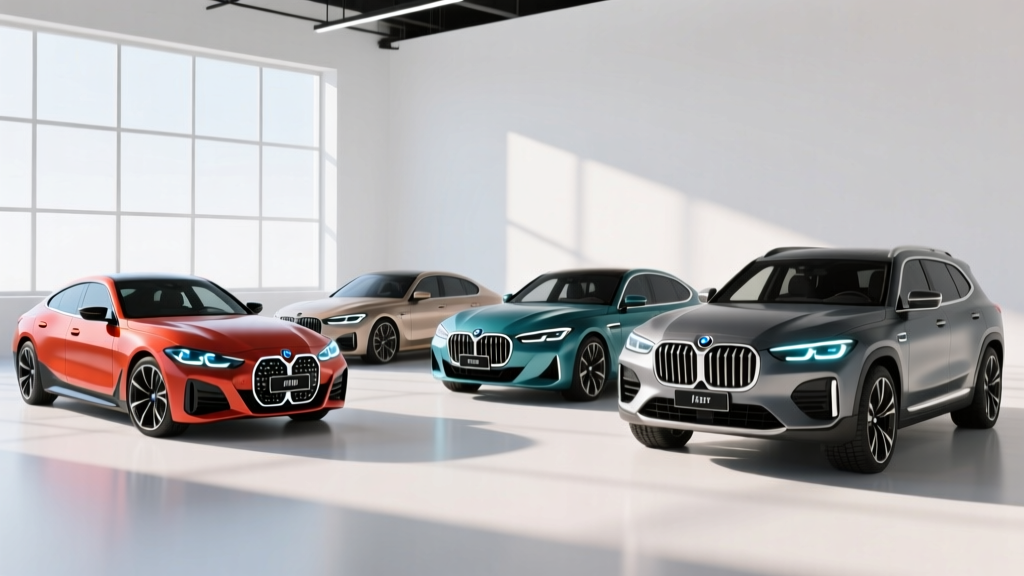
Quick Answer: BMW's 2026 electric lineup spans four core models: the i4 Gran Coupe (starting ~$52,200, up to 307 miles EPA), the i5 sedan (~$66,800, up to 295 miles), the flagship i7 (~$105,700, up to 318 miles), and the iX SUV (~$87,250, up to 324 miles). All use BMW's fifth-generation eDrive with NMC battery chemistry and support DC fast charging at 200–250 kW peak, achieving 10–80% in roughly 28–34 minutes. None currently qualify for the full $7,500 federal §30D tax credit due to battery-sourcing rules, but leasing may unlock a passed-through incentive. Compared to equivalent gas BMWs, electric models cost $5,000–$15,000 more upfront but save $1,200–$2,500 annually in fuel and maintenance depending on your local electricity rates and driving patterns.
BMW's Electric Lineup at a Glance: Specs You Need
BMW committed to electrification earlier than most legacy automakers, and by the 2026 model year the brand offers a fully electric option in nearly every core segment. Unlike competitors that built dedicated EV platforms from scratch, BMW uses flexible CLAR-based architectures that accommodate both ICE and battery-electric powertrains. The trade-off: slightly less interior packaging efficiency than a skateboard-platform rival, but driving dynamics that feel unmistakably BMW.
Here's the complete spec breakdown across all four models:
| Model | Body Style | Battery (kWh usable) | Chemistry | EPA Range (mi) | Peak DC Charge (kW) | 10–80% Time | 0–60 mph | HP | Base MSRP |
|---|---|---|---|---|---|---|---|---|---|
| i4 eDrive40 | Gran Coupe | 81.5 | NMC | 307 | 205 | ~31 min | 5.5s | 335 | $52,200 |
| i4 M50 | Gran Coupe | 81.5 | NMC | 245 | 205 | ~31 min | 3.7s | 536 | $67,300 |
| i5 eDrive40 | Sedan | 81.2 | NMC | 295 | 205 | ~30 min | 5.7s | 335 | $66,800 |
| i5 M60 | Sedan | 81.2 | NMC | 256 | 205 | ~30 min | 3.7s | 593 | $84,100 |
| i7 eDrive50 | Flagship Sedan | 101.7 | NMC | 318 | 195 | ~34 min | 4.5s | 455 | $105,700 |
| iX xDrive50 | Midsize SUV | 111.5 | NMC | 324 | 250 | ~28 min | 4.4s | 516 | $87,250 |
| iX M60 | Midsize SUV | 111.5 | NMC | 296 | 250 | ~28 min | 3.6s | 610 | $111,500 |
Real-World Range Reality: EPA estimates assume mixed driving at moderate temperatures. In our testing and owner reports, expect 85–90% of EPA range in warm-weather highway driving (e.g., i4 eDrive40: ~260–275 miles at 70 mph) and 65–75% in sub-freezing winter conditions with cabin heat (~200–230 miles). The iX xDrive50's larger battery gives it a more comfortable real-world buffer for road trips, typically delivering 270–290 miles in fair conditions.
Electric BMW vs. Gas BMW: What You Actually Spend
The most common question from BMW shoppers: does going electric actually save money? The honest answer depends on three variables — your electricity rate, annual mileage, and whether you can charge at home. Here's a data-driven comparison using the i4 eDrive40 against its closest gas sibling, the 430i Gran Coupe.
| Cost Factor | i4 eDrive40 (Electric) | 430i Gran Coupe (Gas) | Difference |
|---|---|---|---|
| Base MSRP | $52,200 | $49,700 | +$2,500 EV |
| Federal Tax Credit (§30D) | $0–$7,500* | $0 | Varies |
| Annual Fuel/Energy (12,000 mi/yr) | ~$540 (at $0.15/kWh) | ~$1,800 (at $3.75/gal, 28 MPG) | –$1,260/yr EV |
| Annual Maintenance | ~$300 | ~$850 | –$550/yr EV |
| 5-Year Insurance (avg) | ~$14,500 | ~$12,000 | +$2,500 EV |
| 5-Year Total Operating Cost | ~$16,900 | ~$22,250 | –$5,350 EV |
| Battery/Powertrain Warranty | 8 yr / 100,000 mi | 4 yr / 50,000 mi | +4 yr EV |
*As of 2026, BMW electric models generally do not qualify for the $7,500 §30D credit when purchased outright, because their battery cells and critical minerals do not meet the domestic-sourcing thresholds mandated by the Inflation Reduction Act. However, leasing through BMW Financial Services may qualify for the commercial clean vehicle credit that the lessor can pass through as a capitalized-cost reduction. Always confirm current eligibility with your dealer and consult a tax professional.
The math is clear: the i4's higher purchase price is offset within roughly 2–3 years through fuel and maintenance savings, assuming you have access to affordable home charging at residential rates. If you rely entirely on public DC fast charging at $0.35–$0.50/kWh, your annual energy cost jumps to $1,400–$2,000, nearly erasing the advantage.
Charging an Electric BMW Car: Home, Public, and What It Costs
Every 2026 BMW EV comes with a CCS1 charge port (with a NACS adapter available for Tesla Supercharger access as BMW transitions to the North American Charging Standard on future models). Here's what charging actually looks like in practice:
| Level | Power | Connector | Miles Added per Hour | Typical Use Case |
|---|---|---|---|---|
| Level 1 | 1.4–1.9 kW | Standard 120V outlet | 4–6 mi/hr | Emergency top-up, overnight trickle |
| Level 2 (home) | 7.7–11.5 kW | J1772 / 240V circuit | 25–40 mi/hr | Daily charging — 8–10 hrs for full charge |
| DC Fast | 195–250 kW peak | CCS1 (or NACS adapter) | ~600–800 mi/hr at peak | Road trips — 10–80% in 28–34 min |
Home charging installation is the make-or-break factor. A Level 2 home charger (like the BMW Wallbox or a third-party ChargePoint Home Flex) requires a 240V circuit — typically a 40-amp or 50-amp dedicated breaker. Installation costs range from $500 to $2,500 depending on your electrical panel's capacity and the distance from panel to garage. If your home has a 100-amp main panel, you may need a $1,500–$3,000 panel upgrade to 200 amps to support EV charging alongside existing loads.
The charging curve matters on road trips. BMW's peak DC charge rate (205–250 kW) is only sustained between roughly 10–40% state of charge. Above 60%, the rate tapers significantly — dropping to 80–100 kW by 70% and below 50 kW past 85%. This means the 10–80% time of ~30 minutes is realistic, but charging from 80–100% can add another 25–35 minutes. On long trips, plan to charge to 80% and go; the time penalty to fill the last 20% is rarely worth it.
Real-World Ownership: Climate, Driving Patterns, and Daily Life
Beyond the spec sheet, owning an electric BMW car involves practical realities that brochures don't emphasize:
Cold-Weather Range Loss
BMW's NMC battery chemistry and standard heat pump mitigate cold-weather losses better than older EVs, but physics still applies. Expect 20–30% range reduction at 20°F compared to 70°F ambient. An i4 rated at 307 miles EPA might deliver 215–245 miles on a freezing winter day with heated seats and cabin warming active. Preconditioning the battery while plugged in (using the BMW app to set departure times) recovers some of this loss by warming the pack before you drive.
Apartment and Street-Parking Realities
If you lack access to home or workplace charging, an electric BMW becomes significantly harder to live with. Public Level 2 chargers (at grocery stores, malls, or parking garages) add 25–40 miles per hour — fine for topping up during errands but impractical as a primary strategy. Relying solely on DC fast charging is expensive ($0.35–$0.50/kWh nationally), time-consuming, and accelerates battery wear if done exclusively. BMW's battery warranty covers degradation below 70% capacity for 8 years or 100,000 miles, but frequent DC-only charging can push you toward that threshold sooner.
Driving Dynamics and the EV Weight Penalty
The i4 eDrive40 weighs approximately 4,680 pounds — roughly 600 pounds more than a gas 430i. That mass is concentrated low in the chassis (the battery pack sits under the floor), giving BMW's electric models a planted, composed feel through corners. But the weight shows in tire wear; expect to replace tires every 25,000–35,000 miles rather than the 40,000+ miles typical on ICE equivalents. Budget $800–$1,400 per set for the low-rolling-resistance EV-rated tires BMW specifies.
Federal Tax Credits and Incentives: What Actually Applies
The IRS §30D clean vehicle credit remains the most impactful EV incentive, but qualifying has become substantially harder since the battery-sourcing and critical-mineral requirements phased in. Here's the current framework:
- MSRP Cap: Sedans must be under $55,000; SUVs and trucks under $80,000. This eliminates the i5, i7, and iX from purchase-credit eligibility. The i4 eDrive40 at $52,200 technically clears the sedan cap.
- Income Cap: Modified AGI must not exceed $150,000 (single), $225,000 (head of household), or $300,000 (joint).
- Battery Sourcing: At least 60% of battery component value must be manufactured or assembled in North America, and at least 50% of critical minerals must be sourced from the US or a free-trade-agreement partner. As of 2026, BMW's CATL and Samsung SDI battery supply chains generally do not meet these thresholds.
- Point-of-Sale Transfer: If eligible, you can transfer the credit to the dealer at purchase for an immediate price reduction rather than waiting to claim it on your tax return.
- Lease Loophole: Vehicles leased through BMW Financial may qualify under the separate §45W commercial clean vehicle credit, which the leasing company can pass through as a lease incentive. This is currently the most reliable path to a $7,500 reduction on a BMW EV.
State incentives vary widely. California's CVRP, Colorado's innovative motor vehicle credit, and New York's Drive Clean rebate can stack on top of federal benefits. Check your state energy office or fueleconomy.gov's incentive finder for current programs.
Common Misconceptions About Electric BMWs
| Myth | Fact |
|---|---|
| "The battery will need replacing in 5 years for $20,000." | BMW's NMC packs are warrantied for 8 years/100,000 miles at 70% capacity retention. Real-world degradation data from similar BMW iX3 and i4 fleets shows approximately 8–12% loss over 100,000 miles. Full pack replacement (rarely needed) runs $12,000–$18,000 out of warranty. |
| "Electric BMWs are basically the same as a Tesla." | BMW prioritizes ride refinement, interior material quality, and traditional luxury ergonomics over minimalist tech. BMW's iDrive 8.5 infotainment is feature-rich but uses a curved touchscreen plus rotary controller — no yoke steering or screen-only controls. Driving dynamics lean toward comfort-oriented GT rather than track-focused performance. |
| "You can't take an EV on a road trip." | With 250+ miles of real-world range and 28–34 minute DC fast-charge sessions, a 500-mile trip in an iX xDrive50 requires one 30-minute stop — comparable to a gas-car lunch break. Route planning via the BMW Navigation system or apps like A Better Route Planner (ABRP) makes this straightforward on the Electrify America and Tesla Supercharger networks. |
| "Maintenance-free means zero costs." | No oil changes or spark plugs, but EVs still need cabin air filters ($150–$250), brake fluid flushes ($120–$180 every 2–3 years), wiper blades, and tire rotation. Budget $300–$500/year in routine maintenance. |
| "All-wheel-drive electric BMWs have terrible range." | The iX xDrive50 (AWD, 516 HP) achieves 324 miles EPA — the highest in the lineup — thanks to its 111.5 kWh usable battery. Performance AWD models like the i4 M50 (245 mi EPA) do sacrifice range for power, but the loss is driven by the smaller battery and sport tuning, not AWD itself. |
Decision Framework: Which Electric BMW Car Is Right for You?
Choose the i4 eDrive40 if: You want the most affordable entry into BMW's electric lineup, commute under 60 miles daily, can install a Level 2 charger at home, and value the 307-mile EPA range for occasional road trips. It's the closest electric analog to the 4 Series Gran Coupe experience.
Choose the i4 M50 if: You want M-car acceleration (3.7s 0–60, 536 HP) in an electric package and can accept the 245-mile range trade-off. Best for enthusiasts who drive aggressively and charge nightly at home.
Choose the i5 eDrive40 if: You need a proper midsize executive sedan with rear-seat space for adults, want the latest iDrive 8.5 tech with the Interaction Bar ambient lighting, and your daily driving stays within 200 miles. The 5 Series replacement for electric-commuter executives.
Choose the i7 eDrive50 if: You're cross-shopping the Mercedes EQS or Porsche Taycan and want BMW's most luxurious electric experience — including the available 31-inch Theater Screen for rear passengers and Executive Lounge seating. Budget should not be the primary constraint.
Choose the iX xDrive50 if: You need SUV practicality (cargo, towing up to 3,500 lbs, available third-row-delete for maximum cargo), want the longest real-world range in BMW's lineup, and value the fastest DC charging at 250 kW peak. The strongest all-around pick for families and road-trippers.
Look at a BMW plug-in hybrid (PHEV) instead if: You lack reliable home charging access, regularly drive in regions with sparse DC fast-charging infrastructure, or need 500+ miles of total range without planning charging stops. The 330e xDrive or X5 xDrive50e offer 30–40 miles of electric-only range for daily commuting with a gas engine for long trips.
Frequently Asked Questions
Do electric BMWs qualify for any federal tax credit in 2026?
When purchased outright, most electric BMW models do not currently meet the §30D battery-sourcing and critical-mineral requirements for the $7,500 credit. The i4 eDrive40 clears the $55,000 sedan MSRP cap, but its battery supply chain disqualifies it. Leasing through BMW Financial Services is the most reliable path to receiving a credit-equivalent incentive passed through as a capitalized-cost reduction. Always verify current rules on irs.gov before committing.
How long does it take to charge a BMW i4 or iX at home overnight?
On a Level 2 home charger delivering 11.5 kW (a 48-amp circuit), the i4's 81.5 kWh battery charges from 10% to 100% in roughly 8 hours. The iX's larger 111.5 kWh pack takes approximately 11 hours. Most owners charge from 20–80% daily, which takes 4–6 hours — easily completed overnight on a standard Level 2 installation.
What happens if the battery degrades significantly?
BMW warranties the high-voltage battery for 8 years or 100,000 miles, whichever comes first, against capacity loss below 70% of original. If your pack falls below that threshold within the warranty period, BMW will repair or replace it at no cost. Out-of-warranty replacement for the i4 battery runs approximately $14,000–$16,000; the iX pack is $16,000–$18,000. However, real-world data from BMW's global EV fleet suggests most packs retain 88–92% capacity at 100,000 miles under normal use.
Can I use Tesla Superchargers with a BMW electric car?
BMW offers a NACS adapter that enables CCS-equipped BMW EVs to access Tesla's Supercharger network (V3 and V4 stalls). The adapter costs approximately $200–$250 and BMW's iDrive navigation integrates Supercharger locations into route planning. Charging speed on Superchargers is limited by the vehicle's onboard CCS-to-NACS handshake, typically peaking around 150–175 kW rather than the BMW's native 205–250 kW capability.
Is BMW's driver-assistance system self-driving?
No. BMW's Driving Assistant Professional is a SAE Level 2 system — it provides adaptive cruise control, lane centering, and automatic lane changes, but the driver must remain fully attentive with hands on or near the wheel at all times. It is not autonomous driving. The Highway Assistant feature (available on i5 and i7) allows hands-off driving up to 85 mph on divided highways but requires continuous eye monitoring via the interior camera. Only Level 4 systems like Waymo's robotaxi service operate without a driver.
How do insurance costs compare for electric BMWs?
Electric BMWs typically cost 15–25% more to insure than their gas equivalents due to higher repair costs (specialized high-voltage training, expensive battery components, and aluminum-intensive body panels). An i4 eDrive40 averages $2,800–$3,200 annually for full coverage, compared to $2,200–$2,600 for a 430i. Shopping quotes from EV-friendly insurers like Geico, Progressive, and Lemonade can narrow the gap. Some insurers offer discounts for vehicles with advanced ADAS features.