Quick Answer: Do Electric Bikes Made in the USA Make Sense for EV Owners?
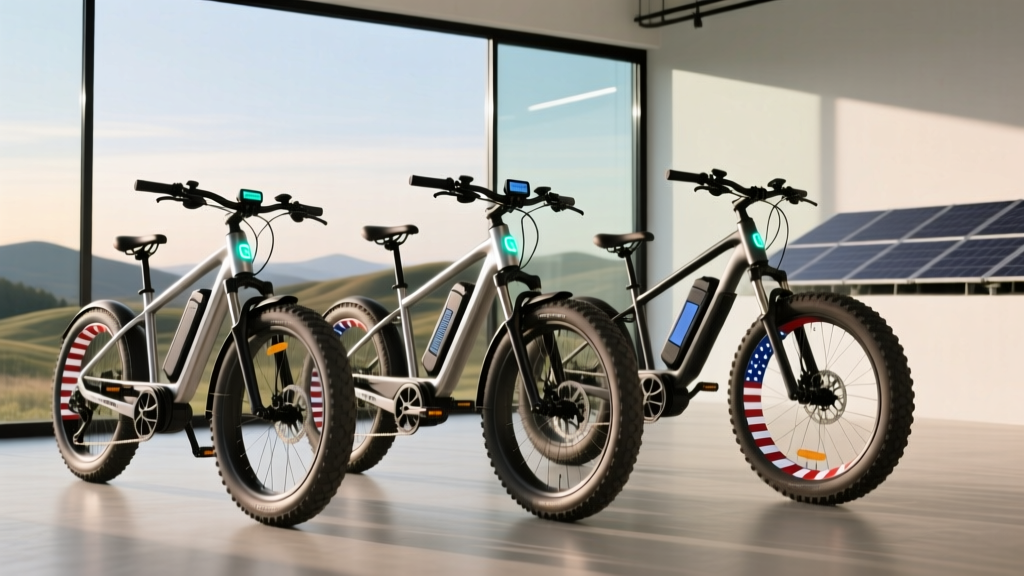
For US-based EV buyers in 2026, American-made electric bikes from brands like Rad Power Bikes, Lectric, Juiced Bikes, and Blix offer a practical complement to a four-wheel EV. Expect to pay $1,200–$3,500 for a quality US-assembled e-bike with 20–60 miles of range per charge, zero fuel costs, and minimal maintenance. While e-bikes do not qualify for the federal §30D EV tax credit, they may be eligible for local utility rebates and some state-level e-mobility incentives. For short commutes under 15 miles, an American-made e-bike can replace 30–50% of car trips, saving $400–$900 annually versus driving even an efficient EV.
At AutoEdgeView, our core focus is electric cars, trucks, SUVs, and the charging infrastructure that supports them. But we hear a recurring question from readers deep in the EV-buying process: "I'm going electric for my car — should I also look at electric bikes made in the USA for local trips?" It's a fair question, and one that touches on the same ownership calculus we apply to four-wheel EVs: upfront cost, energy expense, range reality, and long-term value.
This guide applies our EV-analyst lens to the American e-bike market, focusing on the data points that matter to someone already committed to electrified transportation. We'll note clearly where e-bikes fall outside our usual coverage scope, and where they intersect with the EV ownership experience.
The American E-Bike Landscape in 2026: Who Actually Manufactures Here?
The phrase "electric bikes made in the USA" requires precision. Very few e-bikes are 100% domestically manufactured from frame to motor to battery cell. What you'll find instead is a spectrum:
- US-assembled with global components: Brands like Rad Power Bikes (headquartered in Seattle) design and assemble bikes domestically using motors from Bafang (China) and battery cells from Samsung or LG (Korea). This is the most common "American-made" model.
- US-designed, overseas-manufactured: Companies like Lectric eBikes (Austin, TX) design in the US but manufacture frames and assemble abroad, then warehouse and ship domestically.
- Higher domestic content: A small number of boutique brands — Wyld Gear (Montana), Biktrix (some US assembly options) — offer higher US-content builds, often at $4,000+ price points.
For the EV-minded buyer, the relevant question isn't pure origin — it's whether the brand supports US-based warranty service, parts availability, and reliable customer support. A $1,800 Rad Power RadRunner assembled in the US with a 1-year warranty and domestic service network is more practical than a $900 direct-from-China import with no recourse if the battery controller fails at month six.
| Brand | HQ Location | Price Range | Typical Range | Motor Power |
|---|---|---|---|---|
| Rad Power Bikes | Seattle, WA | $1,499–$2,999 | 25–45 mi | 500–750W hub |
| Lectric eBikes | Austin, TX | $999–$1,999 | 20–40 mi | 500W hub |
| Juiced Bikes | San Diego, CA | $1,799–$3,499 | 30–60 mi | 750–1000W hub |
| Blix Bikes | San Diego, CA | $1,599–$2,499 | 25–45 mi | 500W hub |
| Priority Bicycles | New York, NY | $1,899–$2,999 | 20–40 mi | 500W mid-drive |
Cost Comparison: E-Bike vs. EV vs. Gas Car for Short Commutes
Here's where our EV-ownership lens adds value. Most EV buyers already understand cost-per-mile analysis. Let's apply it to the e-bike decision.
| Vehicle Type | Energy/Fuel Cost | Maintenance | Insurance | Annual Total |
|---|---|---|---|---|
| E-Bike (Class 2, 500Wh battery) | $18–$30 | $80–$150 | $0–$120 (optional) | $98–$300 |
| EV (2026 Hyundai Ioniq 6, 140 MPGe) | $185–$275 | $300–$450 | $1,200–$1,600 | $1,685–$2,325 |
| Gas Car (30 MPG combined, $3.40/gal) | $567 | $500–$800 | $1,100–$1,500 | $2,167–$2,867 |
Electricity rate assumed at $0.14/kWh (national avg); EV home charging at Level 2. E-bike battery charged from standard 120V outlet. Sources: fueleconomy.gov, AAA Your Driving Costs 2025.
The math is clear: for dedicated short-commute use, an e-bike costs roughly 85–90% less per year than even an efficient EV. The e-bike's energy cost is almost negligible — charging a 500Wh battery from empty costs about $0.07 at the national average electricity rate. The real savings come from eliminated insurance premiums and drastically reduced maintenance (no tires to rotate, no cabin air filters, no brake fluid flushes).
But here's the honest limitation: an e-bike replaces a car trip only when weather, cargo, distance, and safety conditions allow. In our experience, realistic e-bike substitution for a car-commuter in a temperate climate is 30–50% of work trips, not 100%.
Range Reality: E-Bike Batteries vs. EV Batteries
If you've spent time researching EV battery degradation and kWh capacity, e-bike batteries will feel familiar — just scaled down dramatically.
A typical American-market e-bike carries a 400–700 Wh (watt-hour) lithium-ion battery pack, usually built with 18650 or 21700 cells from Samsung, LG, or Panasonic. Compare that to a 2026 Tesla Model 3's ~60 kWh (kilowatt-hour) usable pack — the EV battery holds roughly 100x more energy.
Here's what that means in practice:
- Claimed range: A 500Wh e-bike battery will deliver 25–45 miles depending on assist level, rider weight, terrain, and wind.
- Real-world range: Expect to lose 20–35% of claimed range when using maximum throttle (Class 2) or riding in cold weather below 40°F. A bike rated for 40 miles may deliver 26–32 miles at full assist in winter conditions.
- Degradation: Quality e-bike batteries retain roughly 70–80% of original capacity after 500–800 full charge cycles. At one charge per day, that's 2–3 years before noticeable range reduction.
- Replacement cost: $400–$800 for a name-brand replacement battery, compared to $5,000–$15,000+ for an EV traction battery.
The same principles that govern EV battery health apply here: avoid storing at 100% state of charge for extended periods, don't charge in extreme heat, and don't routinely drain to 0%. The chemistry (typically NMC — nickel manganese cobalt) is identical to what's in many EVs.
Charging an E-Bike: What EV Owners Already Know
Here's a genuine advantage for EV owners: you already understand charging logistics. An e-bike charges from any standard 120V household outlet using an included charger rated at 2–4 amps (roughly 240–480 watts of draw).
| Battery Capacity | Charger Rating | 0–100% Time | Cost per Full Charge |
|---|---|---|---|
| 400 Wh | 2A (240W) | ~2.5 hours | $0.06 |
| 500 Wh | 2A (240W) | ~3 hours | $0.07 |
| 672 Wh | 3A (360W) | ~3.5 hours | $0.09 |
| 720 Wh | 4A (480W) | ~3 hours | $0.10 |
Unlike an EV, there's no Level 2 home installation required, no kW vs kWh confusion at public chargers, and no concern about charging-curve taper. You plug in, it charges at a steady rate, and it stops when full. The simplicity is genuinely refreshing after navigating DC fast-charging logistics on a road trip.
One practical note for EV owners: If you've installed a Level 2 home charger on a dedicated 240V/50A circuit, your electrical panel may already be near capacity. Adding an e-bike doesn't require panel upgrades — it draws less power than a laptop charger — but if you're considering e-bikes for multiple household members, the cumulative draw is still trivial compared to your EV's 7–11 kW Level 2 draw.
Tax Credits, Incentives, and the Regulatory Gap
This is where e-bikes diverge sharply from EVs. The federal §30D Clean Vehicle Credit — which provides up to $7,500 for qualifying new EVs — does not apply to electric bicycles. The IRS defines eligible vehicles as four-wheeled vehicles with a gross vehicle weight rating under 14,000 lbs. E-bikes, as two- or three-wheeled vehicles, fall outside this definition entirely.
However, some incentive pathways exist:
| Claim | Reality |
|---|---|
| "E-bikes qualify for the $7,500 federal EV tax credit" | False. §30D applies only to four-wheeled vehicles. No federal tax credit currently covers e-bikes for most buyers. |
| "My utility company offers e-bike rebates" | Sometimes true. Utilities in CO, CA, VT, and MA have offered $100–$400 e-bike rebates. Check your local utility's efficiency programs. |
| "Some cities offer e-bike purchase incentives" | True. Denver, Boulder, and several California air districts have offered $300–$1,700 income-qualified e-bike rebates. Programs open and close with funding cycles. |
| "E-bikes are eligible for the used-EV credit" | False. The §25E previously-owned clean vehicle credit also requires four wheels. |
| "I can write off an e-bike for business use" | Partially true. If used for business deliveries or commuting to a job site, partial deduction may apply. Consult a tax professional. |
The IRS and your state revenue department are the definitive sources. Incentive programs change annually, and we recommend checking current availability before budgeting around a rebate that may have exhausted its funding.
E-Bike Classes and Legal Considerations: What EV Buyers Need to Know
Unlike EVs, which face uniform federal safety standards via NHTSA, e-bike regulation is primarily state-level. The three-class system is adopted in most states:
- Class 1: Pedal-assist only, motor cuts off at 20 mph. Allowed on most bike paths.
- Class 2: Throttle-assisted, motor cuts off at 20 mph. Some path restrictions apply locally.
- Class 3: Pedal-assist only, motor cuts off at 28 mph. Often restricted from sidewalks and some multi-use paths; helmet typically required.
Most American-market commuter e-bikes are Class 2, offering throttle convenience for stoplight starts. For EV buyers accustomed to the instant torque of an electric car, the throttle response will feel intuitive — just dramatically scaled down in power.
Insurance note: Standard homeowner's or renter's insurance may cover e-bike theft up to a limit (often $500–$1,500), but may not cover crash damage or liability. Dedicated e-bike insurance from providers like Velosurance or Sunday Insurance runs $100–$300/year for a $2,000 bike — a cost that should be factored into your ownership calculation.
Decision Framework: Should You Add an American-Made E-Bike to Your EV Household?
Choose an American-made e-bike if:
- Your commute is under 15 miles round-trip with safe bike infrastructure
- You want to eliminate 30–50% of car trips and save $400–$900/year vs. driving your EV
- You value domestic warranty support and US-based customer service
- You have secure storage (garage, locked shed) to protect a $1,500–$3,000 investment from theft
- You live in a climate with 6+ months of rideable weather per year
Stick with your EV exclusively if:
- Your commute exceeds 20 miles or involves high-speed roads without bike lanes
- You live in an area with extreme winters (consistent sub-20°F temps, heavy snow/ice) where 6+ months of riding isn't realistic
- You lack any secure, dry storage — apartment hallway or street parking makes theft and weather damage near-certain
- Your typical trips involve passengers, significant cargo, or towing — an e-bike's utility ceiling is roughly one rider plus 20–40 lbs of cargo
Frequently Asked Questions
Are electric bikes made in the USA actually manufactured domestically?
Most "American-made" e-bikes are US-assembled with globally sourced components. Motors typically come from Bafang (China) or Bosch (Germany), battery cells from Samsung or LG (Korea), and frames from overseas factories. Brands like Rad Power Bikes and Juiced Bikes perform final assembly, quality control, and warranty service in the US. Truly 100% domestic manufacturing is rare and commands premium pricing above $4,000.
How does e-bike range compare to EPA-rated EV range?
Both are subject to real-world reduction. An e-bike rated for 40 miles may deliver 26–32 miles at maximum throttle in cold weather — a 20–35% loss similar to what EVs experience in freezing temperatures. The difference: an e-bike's small battery means range loss is measured in single-digit miles, while an EV's 300-mile EPA range dropping to 220 miles on a cold highway drive is a more consequential reduction.
Can I charge an e-bike from my EV's home charging setup?
Not directly. E-bikes charge from standard 120V outlets using proprietary chargers, not J1772 or NACS connectors. However, your e-bike's electricity cost is negligible — roughly $2–$4 per month of daily commuting — so it won't meaningfully impact your home electricity bill or your EV charging budget.
Do e-bike batteries degrade like EV batteries?
Yes, using the same NMC chemistry found in many EVs. Expect 70–80% capacity retention after 500–800 full charge cycles (roughly 2–3 years of daily use). Replacement batteries cost $400–$800, far less than EV battery replacement. Following the same best practices — avoid 100% storage, avoid extreme-heat charging — extends life in both cases.
Is an e-bike a good complement to an EV, or should I just drive the EV everywhere?
For short solo commutes under 15 miles with safe infrastructure, an e-bike saves $400–$900/year versus driving even an efficient EV. It also eliminates parking stress, provides exercise, and reduces wear on your EV's tires and brakes. For longer trips, passenger transport, cargo, or inclement weather, your EV remains the practical choice. Most EV-owning e-bike riders use the bike for 30–50% of trips and the car for the rest.