The Quick Answer: Yes, But It Depends on the Class
Are electric bikes legal in New York? Yes — as of 2026, New York State permits three classes of electric bicycles on public roads and bike lanes, but with important restrictions. Class 1 and Class 2 e-bikes (up to 20 mph motor-assisted) are broadly legal statewide. Class 3 e-bikes (up to 25 mph) are legal in most areas but restricted in New York City parks and certain bike paths. E-bikes do not require registration, insurance, or a driver's license under state law. However, throttle-only operation above 20 mph without pedaling is prohibited, and local municipalities can impose additional rules.
If you've been searching for clarity on e-bike legality in New York, you're not alone. The legal landscape shifted significantly after New York State formally legalized e-bikes in 2020, with subsequent amendments refining where and how each class can operate. But beyond the legal question, many buyers are also weighing whether an e-bike or a full electric vehicle (EV) better fits their daily transportation needs and budget. This guide covers the legal framework, real costs, and a practical decision framework to help you choose.
New York E-Bike Classifications Explained
New York follows the three-class e-bike system used by most U.S. states. Understanding these classes is essential because legality, access, and enforcement all hinge on which class your e-bike falls into.
| Class | Motor Type | Max Assisted Speed | Max Motor Power | NY Legal Status |
|---|---|---|---|---|
| Class 1 | Pedal-assist only (no throttle) | 20 mph | 750W | Legal statewide; allowed on most bike paths |
| Class 2 | Throttle-assisted + pedal-assist | 20 mph | 750W | Legal statewide; some local restrictions apply |
| Class 3 | Pedal-assist only (no throttle) | 25 mph | 750W | Legal on roads; restricted in NYC parks and some paths |
Key detail: New York law prohibits e-bikes with motors exceeding 750 watts from being classified as bicycles. Anything above that threshold — or any e-bike capable of exceeding 25 mph under motor power alone — is reclassified as a limited-use motorcycle, requiring registration, insurance, and a valid driver's license. This is a common point of confusion for buyers ordering high-power e-bikes online.
For authoritative details, refer to the New York State DMV e-bike guidance, which outlines classification and enforcement.
Where Can You Actually Ride? NYC vs. Upstate Rules
New York City has its own layered regulations on top of state law. As of 2026, the following rules apply within the five boroughs:
- Class 1 and 2: Permitted on bike lanes, streets, and most greenways. Prohibited on sidewalks.
- Class 3: Allowed on streets and bike lanes, but banned from the Hudson River Park bike path, Central Park loop, and several other designated recreational paths.
- Throttle use: Class 2 throttles are legal but must not propel the bike above 20 mph without pedaling.
- Helmet requirement: Mandatory for all Class 3 riders. Recommended (but not legally required for adults) on Class 1 and 2.
- Age restriction: Riders must be at least 16 years old to operate a Class 3 e-bike.
Outside NYC, upstate municipalities generally follow state law without additional restrictions, but cities like Buffalo, Rochester, and Albany have debated local ordinances around shared e-bike parking and commercial delivery e-bike storage. Always check your local municipal code before purchasing.
E-Bike vs. Electric Car: A Real Cost Comparison
Many New Yorkers considering an e-bike are also weighing whether to buy a full electric vehicle. The economics look very different depending on your commute, parking situation, and whether you have access to home charging. Below is a concrete comparison using 2026 pricing and real ownership data.
| Cost Factor | Mid-Range E-Bike (Class 2) | 2026 Chevrolet Equinox EV (2LT) |
|---|---|---|
| Purchase Price | $1,800–$3,500 | $43,900 MSRP (~$36,400 after §30D credit if eligible) |
| Federal Tax Credit | None (not eligible under §30D) | Up to $7,500 (subject to income, MSRP, and battery-sourcing rules) |
| Annual "Fuel" Cost | $25–$50 (electricity for ~2,500 mi/yr) | $550–$750 (electricity for ~12,000 mi/yr at $0.17/kWh avg) |
| Insurance (Annual) | $0–$150 (optional rider policy) | $1,800–$2,400 (NY average for EVs) |
| Maintenance (Annual) | $100–$200 (tires, brakes, chain) | $400–$600 (tires, cabin filter, fluid top-offs) |
| Parking (NYC Annual) | $0 (store indoors or lock outside) | $3,000–$6,000 (garage) or street permit ($215/yr + search time) |
| Registration | $0 | ~$180/yr (NY State) |
| 5-Year Total Cost | $3,000–$5,500 | $49,000–$58,000 (before credit) / $41,500–$50,500 (after credit) |
The takeaway: An e-bike costs roughly 10% of what an EV costs over five years in New York. But they solve different problems. An e-bike replaces transit, walking, or short car trips (under 15 miles). An EV replaces a gas car for all-weather, long-distance, and family transportation. They're often complementary, not competing purchases.
What First-Time E-Bike Buyers in NY Should Know
If you've decided an e-bike fits your needs, here are the practical realities that don't show up in product listings:
Battery Range Is Not What the Box Says
Most e-bike manufacturers advertise 40–60 miles of range on a 500Wh battery. In real-world New York conditions — hilly terrain, cold winters (lithium-ion batteries lose 20–30% capacity below 32°F), stop-and-go traffic, and heavier riders — expect 25–40 miles from a 500Wh pack. If your round-trip commute exceeds 20 miles, look for a 600–700Wh battery or plan to charge at work.
Charging Is Simple but Slow
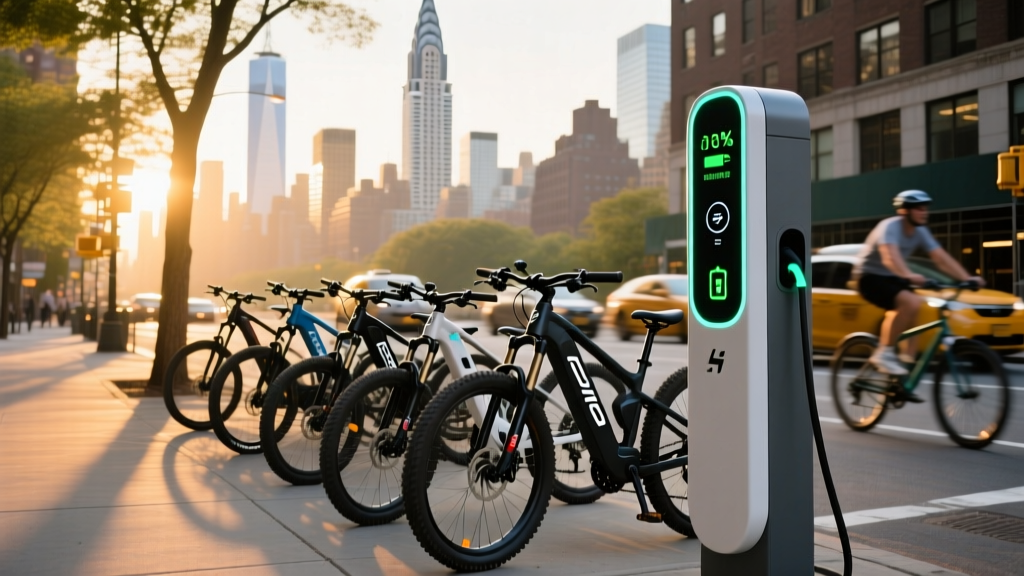
E-bike batteries charge on standard 120V household outlets using the included charger. A 500Wh battery typically takes 3.5–5 hours from empty to full at a 2A charge rate (~100W draw). Unlike EVs, there's no DC fast-charging infrastructure for e-bikes. Plan your charging around your schedule, not the other way around.
Theft Is a Serious Problem in NYC
E-bike theft in New York City remains rampant. Budget $150–$300 for a high-security U-lock (Abloy or Kryptonite New York Fahgettaboudit series) and consider a GPS tracker ($50–$100). Store the battery indoors when possible — most thefts target bikes left outside overnight, and a removed battery makes the frame less valuable to resellers.
Cold Weather Demands Preparation
New York winters are the single biggest ownership challenge. Battery performance drops significantly below freezing. Store your battery indoors and only attach it to the bike before riding. Consider neoprene battery covers ($20–$40) to insulate the pack during rides. Charging a frozen battery can cause permanent cell damage — always let the battery warm to room temperature before plugging in.
Common E-Bike Misconceptions — Fact vs. Fiction
| Myth | Fact |
|---|---|
| "E-bikes don't need to follow traffic laws" | E-bikes must obey all traffic signals, stop signs, and lane rules — same as bicycles. NYC issues summonses for e-bike traffic violations. |
| "Any e-bike with a throttle is illegal" | Class 2 e-bikes with throttles (up to 20 mph) are fully legal in New York State. Throttle-only operation is permitted as long as it doesn't exceed 20 mph. |
| "I need a driver's license to ride an e-bike" | No license, registration, or insurance is required for Class 1, 2, or 3 e-bikes under 750W in New York. This is confirmed by the NYS DMV. |
| "E-bikes can go on any sidewalk" | Illegal on sidewalks statewide. Riding on sidewalks can result in a summons and bike confiscation. |
| "E-bike batteries are a fire hazard" | Certified batteries (UL 2849 standard) are very safe. The fire risk in NYC has been linked overwhelmingly to uncertified, cheap lithium-ion packs used in converted e-bikes and aftermarket batteries. Always buy UL-certified systems. |
| "E-bikes are too expensive to maintain" | Annual maintenance averages $100–$200. Brake pads, chains, and tires are standard bicycle components available at any bike shop. Battery replacement ($400–$700) may be needed after 3–5 years or 500–800 charge cycles. |
When an E-Bike Isn't Enough: EV Ownership in New York
If your needs extend beyond a 15-mile urban commute — regular highway driving, family hauling, winter reliability in upstate New York, or trips exceeding 50 miles — a full battery electric vehicle (BEV) may be the right primary vehicle, with an e-bike as a last-mile complement.
Consider the 2026 Hyundai Ioniq 5 (Standard Range, $42,600 MSRP) as a benchmark EV for New York buyers:
- EPA Range: 290 miles (RWD); expect ~240–260 miles in real-world highway driving, ~210–230 miles in sub-30°F winter conditions
- Battery: 63.0 kWh usable, NMC chemistry
- DC Fast Charging: Up to 180 kW peak, 10–80% in approximately 22 minutes (with battery preconditioning)
- Level 2 Home Charging: 10.9 kW onboard charger, 0–100% in ~6 hours on a 48A Level 2 unit
- Federal §30D Credit: Potentially up to $7,500 at point of sale — but eligibility depends on your AGI (≤$150K single / ≤$300K joint), battery critical-mineral sourcing, and the vehicle's MSRP (must be ≤$55,000 for sedans). Verify current rules at IRS.gov.
- Home Charging Reality: If you live in a NYC apartment without garage access, installing a Level 2 charger may be impossible. In that case, rely on public DC fast chargers (Electrify America, Tesla Superchargers with NACS adapter) at $0.35–$0.55/kWh — adding roughly $700–$1,000/yr in charging costs vs. $550 at home.
The EV-versus-gas comparison in New York strongly favors EVs for owners with home charging. At $0.17/kWh (Con Edison residential average), the Ioniq 5 costs roughly $0.045/mile to fuel. A comparable 28 MPG gas car at $3.50/gallon costs $0.125/mile — nearly 3× more per mile. Over 12,000 miles/year, that's $540 vs. $1,500 in fuel alone.
Decision Framework: E-Bike, EV, or Both?
Choose an E-Bike If:
- Your daily round-trip commute is under 20 miles
- You live in NYC and lack reliable home EV charging access
- Your transportation budget is under $5,000 total
- You primarily travel solo with light cargo (groceries, laptop bag)
- You want zero registration, zero insurance requirements, and minimal maintenance
Choose a Full EV If:
- You regularly drive more than 30 miles per day or take highway trips
- You need all-weather reliability (snow, ice, sub-zero upstate winters)
- You carry passengers or significant cargo regularly
- You have access to Level 2 home charging (garage, driveway, or employer-installed charger)
- You qualify for the §30D federal tax credit (check income caps and MSRP limits)
Choose Both If:
- You own or rent a home with a garage (EV charging + secure e-bike storage)
- You want the EV for weekend/long trips and the e-bike for daily urban errands
- You want to minimize total household transportation costs below $8,000/year
Frequently Asked Questions
Do I need to register my e-bike in New York?
No. Class 1, 2, and 3 e-bikes (750W or less, meeting the speed limits described above) do not require registration, license plates, or insurance in New York State. E-bikes exceeding these specifications are reclassified as limited-use motorcycles and require full DMV registration.
Can I ride a Class 3 e-bike in Central Park?
No. As of 2026, Class 3 e-bikes (up to 25 mph) are prohibited on the Central Park loop drive and most NYC park paths. Class 1 and 2 e-bikes are permitted on the park's designated bike lanes.
Are e-bike batteries covered by any warranty or recall protections?
Reputable manufacturers offer 1–2 year warranties on batteries. In New York City, Local Law 39 of 2023 requires that all e-bikes sold or rented commercially use UL 2849-certified battery systems. If you're buying online, confirm the UL certification before purchase — uncertified batteries are the primary cause of e-bike-related fires.
How does e-bike range compare to an EV's EPA range?
E-bike range isn't EPA-rated, but the math is straightforward: a 500Wh battery at 15 Wh/mile average consumption yields roughly 33 miles of real-world range. An EV like the Ioniq 5 with a 63 kWh (63,000 Wh) battery at 250 Wh/mile yields about 252 real-world miles. Both lose 20–30% range in freezing temperatures due to lithium-ion chemistry limitations.
What's the cheapest legal e-bike I can buy in New York?
Reliable UL-certified Class 1 or 2 e-bikes start around $1,200–$1,500 (Lectric ONE, Aventon Soltera). Avoid sub-$800 e-bikes from unknown brands — they frequently use uncertified battery cells that pose fire risks and may not meet the 750W/20 mph legal thresholds, putting you in a regulatory gray area.
Is an e-bike a good substitute for a second car?
For households where the second car is used primarily for short errands under 10 miles, an e-bike can eliminate that vehicle's insurance ($1,200–$1,800/yr), registration, fuel, and parking costs. In NYC, where parking alone can cost $300–$500/month, the savings from replacing a second car with an e-bike can exceed $7,000 per year.