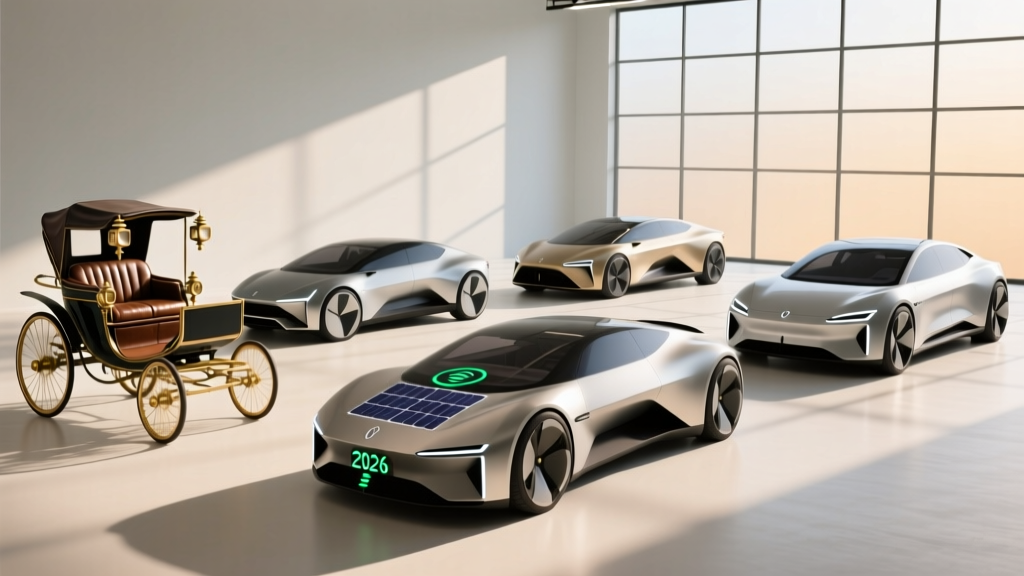
Quick Answer: Electric automobiles trace back to the 1830s, when inventors like Robert Anderson built the first crude electric carriages. EVs dominated the early 1900s before cheap gasoline and the electric starter killed them off. They resurfaced in the 1990s (GM EV1), gained real traction with the 2010 Nissan Leaf (73-mile EPA range) and Tesla Model S (265 miles), and by 2026, mainstream EVs deliver 250–400 miles of EPA range, 150–350 kW DC fast charging, and pricing from roughly $29,000 to $90,000+ before incentives. The technology that once couldn't compete with a Model T now outperforms most gas cars on efficiency, acceleration, and per-mile fuel cost.
The Arc of Electric Automobiles History: Key Milestones
Understanding where EVs came from sharpens your buying decision today — because the limitations that killed past EVs (range, charging infrastructure, battery cost) are precisely the metrics you should scrutinize in 2026.
- 1832–1839: Robert Anderson (Scotland) builds a crude electric carriage — widely cited as the first electric automobile prototype.
- 1890s: William Morrison builds the first practical US electric vehicle, a six-passenger wagon reaching ~14 mph.
- 1900: Electric cars outsell gasoline and steam vehicles combined in the US. They're quiet, clean, and don't require hand-cranking.
- 1908–1915: Ford's Model T ($850 vs. ~$1,750 for an electric) plus the electric starter (1912) and cheap Texas oil crater EV sales.
- 1966–1970s: Congress recommends EVs to fight pollution; the 1973 oil crisis sparks short-lived interest. Sebring-Vanguard produces the CitiCar (~40-mile range, 38 mph top speed).
- 1996: GM launches the EV1 lease-only program — 80–140 miles of range (lead-acid, later NiMH). Famously recalled and crushed, documented in Who Killed the Electric Car?
- 2008: Tesla Roadster ships — 244-mile EPA range using lithium-ion laptop cells, proving Li-ion viability.
- 2010: Nissan Leaf (73-mile range, ~$33,000) and Chevy Volt (35-mile electric + gas range extender) launch the modern mass-market era.
- 2012: Tesla Model S (265-mile range) establishes the long-range premium sedan template.
- 2020s: Battery costs drop below $100/kWh at the cell level. LFP chemistry enters mainstream US models. NACS connector standardization begins.
- 2026: Average new EV battery pack: ~$120–$140/kWh. Median EPA range across new EVs: ~280–310 miles. Peak DC fast-charge rates reach 350 kW on 800V architectures.
Then vs. Now: How Today's EVs Compare to Gas and Hybrids
History only matters if it informs what you buy today. Here's how a representative 2026 battery-electric vehicle (BEV) stacks up against a comparable gasoline sedan and a hybrid — using real EPA data and average US energy prices.
| Metric | 2026 BEV (e.g., Hyundai Ioniq 6 SE Long Range) | 2026 Hybrid (e.g., Toyota Camry Hybrid LE) | 2026 Gas Sedan (e.g., Honda Accord 1.5T) |
|---|---|---|---|
| EPA Range / Tank Range | ~360 miles (77.4 kWh battery) | ~580 miles (13.2-gal tank) | ~460 miles (14.8-gal tank) |
| Efficiency | 140 MPGe / 24 kWh/100 mi | 52 MPG combined | 33 MPG combined |
| Fuel Cost per Mile | ~$0.045 (home charging @ $0.16/kWh) | ~$0.060 ($3.10/gal) | ~$0.094 ($3.10/gal) |
| "Fuel" Cost for 12,000 mi/yr | ~$540 | ~$720 | ~$1,128 |
| 0–60 mph | ~5.1 sec (RWD) | ~7.2 sec | ~7.0 sec |
| Annual Maintenance (est.) | ~$300–$400 | ~$550–$700 | ~$650–$850 |
| Base MSRP (approx.) | ~$38,000 | ~$29,500 | ~$29,000 |
Sources: fueleconomy.gov, manufacturer spec sheets. Fuel cost assumes US average electricity ($0.16/kWh) and gas ($3.10/gal) as of early 2026. Your rates vary by state and utility.
The historical EV disadvantage — fuel/energy cost — has fully inverted. The remaining gap is upfront price and refueling time on road trips.
Real Ownership Costs in 2026: The 5-Year Picture
Purchase price alone misleads. A proper ownership analysis folds in fuel, maintenance, insurance, depreciation, and incentives. Here's a realistic 5-year / 60,000-mile breakdown comparing a ~$38,000 BEV against a ~$29,500 hybrid.
| Cost Category (5 yr / 60k mi) | BEV | Hybrid |
|---|---|---|
| Purchase Price (MSRP) | $38,000 | $29,500 |
| Federal Tax Credit (§30D, if eligible) | −$3,750 to −$7,500* | $0 (most hybrids don't qualify) |
| Fuel / Electricity | $2,700 | $3,600 |
| Maintenance | $1,800 | $3,200 |
| Insurance (avg. premium is ~15–20% higher on EVs) | $9,600 | $8,200 |
| Estimated Depreciation | $17,000 | $11,500 |
| Net 5-Year Cost (before credit) | $71,100 | $56,000 |
| Net 5-Year Cost (with full $7,500 credit) | $63,600 | $56,000 |
*§30D credit reality check: As of 2026, the federal credit tops out at $7,500 for new EVs, but eligibility depends on MSRP caps ($55,000 for sedans, $80,000 for SUVs/trucks/vans), buyer AGI limits ($150k single / $300k joint), and battery critical-mineral + component sourcing rules that shift annually. Many trims qualify for a partial credit ($3,750) or none at all. Check the current list at fueleconomy.gov and confirm with a tax professional. Credits can now transfer to the dealer at point of sale.
Even with the full credit, the BEV costs roughly $7,600 more over five years — driven mostly by steeper depreciation and higher insurance. The breakeven flips if you keep the car 8–10 years, drive 15,000+ miles per year, or have cheap home solar charging.
Common EV Myths vs. 2026 Facts
Many objections to EVs are stuck in 2012. Here's what the data actually says today.
| Myth | 2026 Fact |
|---|---|
| "EV batteries don't last and cost a fortune to replace." | Federal law mandates 8 years / 100,000 miles of battery warranty (capacity retention typically ≥70%). Real-world data from Tesla, Hyundai, and Nissan shows ~10–15% degradation at 150k miles. Out-of-warranty pack replacement runs $8,000–$18,000 depending on kWh and chemistry — rare before 200k miles. |
| "You'll get stranded — charging infrastructure isn't there." | The US had over 70,000 public charging stations and ~200,000 Level 2 + DC fast ports as of late 2025. Tesla's Supercharger network (now open to NACS-equipped non-Teslas) adds 6,000+ stalls. Rural corridors and apartment-dweller access remain genuine gaps. |
| "EVs are worse for the environment because of the grid." | Even on the dirtiest US regional grids (e.g., parts of the Midwest), a 2026 BEV produces lower lifetime CO₂ than a comparable gas car after ~15,000–25,000 miles, per Argonne National Laboratory lifecycle analyses. On cleaner grids (California, Pacific Northwest), the breakeven is under 10,000 miles. |
| "Cold weather makes EVs useless." | Cold reduces range — expect 15–30% loss at 20°F, worse below 0°F. Modern heat pumps (standard on Hyundai/Kia, Tesla, many 2026 models) cut that penalty roughly in half vs. resistive heaters. Preconditioning while plugged in recovers most of the loss. |
| "EVs are slow and boring to drive." | Instant torque makes even a 200-hp EV feel punchy. A 2026 Tesla Model 3 Performance does 0–60 in ~2.9 seconds; a $38,000 Ioniq 6 does it in ~5.1 sec — quicker than most V6 gas sedans. |
What a First-Time EV Buyer Must Know in 2026
Electric automobiles history is full of vehicles that failed because the supporting ecosystem — batteries, charging, cost — wasn't ready. In 2026, the ecosystem is finally mature enough for most drivers, but you still need to audit your specific situation.
Charging access is the make-or-break factor
If you can install a Level 2 home charger (240V, 32–48 amps, ~$500–$1,800 installed including a NEMA 14-50 outlet or hardwired unit), daily EV ownership is effortless — you wake up "full" every morning. If you live in an apartment, rely on street parking, or your home panel needs a 200-amp upgrade ($1,500–$3,500), weigh that friction carefully. Public-only charging is viable but adds 30–60 minutes per week and costs 2–4× more per kWh than home rates.
kW vs. kWh — the single most confused EV spec
kWh (kilowatt-hours) is battery capacity — your "tank size." A 77 kWh battery holds 77 kWh of energy. kW (kilowatts) is power — how fast you can charge or discharge. A 250 kW DC fast charger can theoretically add 250 kWh in one hour (in practice, charge curves taper above ~80% state of charge, so you never sustain peak rate). Don't let a marketing headline of "350 kW charging!" fool you — look for the 10–80% time, which on a good 2026 EV is 18–25 minutes.
Real-world range ≠ EPA range
EPA figures assume mixed driving at moderate temperatures. Expect 85–95% of EPA on highway-only trips at 70 mph, 70–85% in freezing weather, and 60–75% when towing. A 320-mile EPA SUV may deliver ~220 miles on a 75-mph winter road trip. Plan charging stops around that number, not the sticker.
Tax credits are not guaranteed money
The §30D new-EV credit has MSRP caps, AGI caps, and battery-sourcing requirements that disqualify many 2026 models — especially sedans over $55,000 and vehicles with non-compliant critical-mineral supply chains. Always verify eligibility the month you buy; the list changes quarterly. The used-EV credit (§25E) offers up to $4,000 on vehicles under $25,000, subject to similar income caps.
Decision Framework: Should You Buy an EV, Hybrid, or Gas Car?
Buy a BEV if:
- You can install Level 2 home charging (or have reliable workplace charging)
- Your daily driving is under ~80 miles round-trip
- You take road trips ≤4× per year and can plan 20–30 minute DC fast-charge stops
- You want the lowest per-mile fuel cost and minimal maintenance
- You qualify for at least a partial §30D credit, or your state offers rebates
Buy a plug-in hybrid (PHEV) if:
- You have home charging but also take frequent long road trips
- You want 25–45 miles of electric-only commuting with gas-engine backup
- Your household has one vehicle and needs maximum flexibility
- You want to hedge against charging-desert gaps in your region
Buy a conventional hybrid (HEV) if:
- You can't charge at home or work
- You drive high annual miles (15,000+) and want strong MPG without plug-in hassle
- You want the lowest upfront cost with meaningful fuel savings (50+ MPG)
Stick with gas (for now) if:
- You regularly tow heavy loads (boats, campers) over long distances
- You live in an area with very sparse DC fast-charging infrastructure AND drive long distances frequently
- Your budget is under ~$25,000 and you can't find a qualifying used EV
Frequently Asked Questions
Why did electric cars disappear in the early 1900s?
Three converging factors: the electric starter (1912) eliminated gas cars' biggest usability drawback, Texas oil discoveries made gasoline cheap, and Ford's assembly-line Model T undercut EV prices by roughly 50%. Electric cars went from the majority to a niche in under 15 years.
What was the first modern electric car most people could buy?
The 2010 Nissan Leaf is widely considered the first mass-market modern EV — 73 miles of EPA range, ~$33,000 before incentives, available nationwide. The Tesla Roadster (2008) came earlier but cost $109,000 and was low-volume.
How much does home Level 2 charger installation cost in 2026?
For a straightforward install with an existing 200-amp panel and short conduit runs: $500–$1,200 (charger hardware $350–$700 + electrician labor $200–$500). If your panel needs upgrading to 200 amps, add $1,500–$3,500. Always get a quote from a licensed electrician — final cost depends on local code, wire run length, and permit fees.
Do EVs really save money long-term?
Yes, on a per-mile basis — typically $0.04–$0.06/mile for electricity vs. $0.09–$0.12/mile for gas. Maintenance savings (no oil changes, fewer brake replacements due to regen) add ~$200–$400/year. However, higher insurance premiums (~15–20%) and steeper depreciation on some models can erase the savings over 5 years. The longer you keep the EV and the more miles you drive, the stronger the economic case.
What's the biggest lesson from electric automobiles history for today's buyer?
Infrastructure and battery cost determine whether an EV succeeds — not the car itself. In 1900, EVs lost because gas infrastructure scaled and batteries didn't improve. In 2026, the reverse is true: DC fast-charging networks are expanding, battery pack costs have dropped ~90% since 2010, and home charging is accessible to roughly 60–70% of US drivers. Audit your personal infrastructure (home charging, route corridors, climate) before choosing — that's still the deciding factor, just as it was 125 years ago.