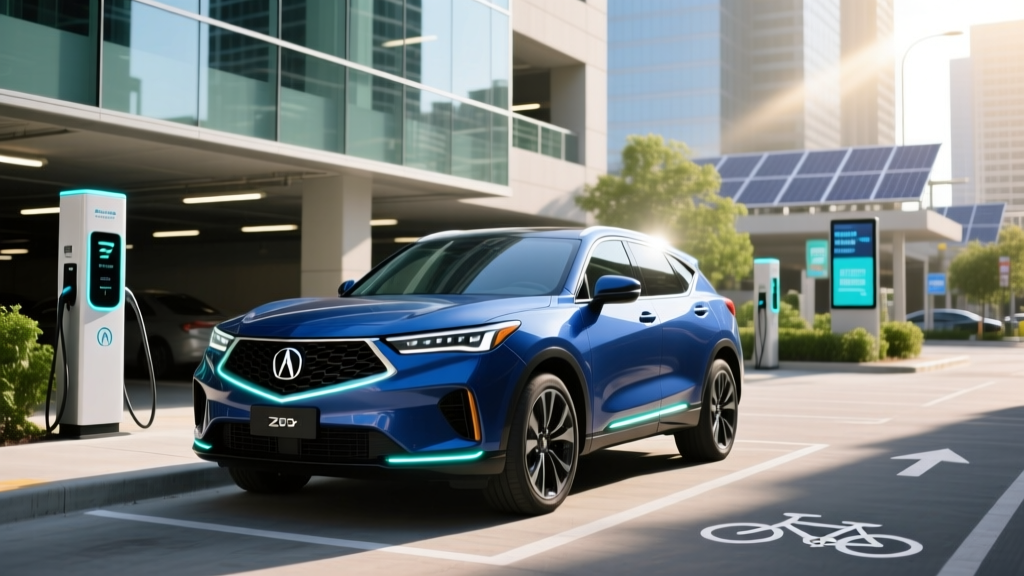
Quick Answer: The electric Acura SUV lineup centers on the Acura ZDX, a premium midsize crossover built on GM's Ultium platform. For 2026, the ZDX A-Spec offers an EPA-estimated 313 miles of range from a 102 kWh usable battery, DC fast-charges at up to 190 kW (10–80% in ~28 minutes), and starts around $61,500 before incentives. It competes directly with the BMW iX, Audi Q8 e-tron, and Tesla Model X, offering strong value for luxury EV buyers who prioritize range and comfort over sportscar acceleration. Federal §30D tax credit eligibility is limited by battery-sourcing rules — always verify current-year IRS requirements before purchasing.
What Is the Electric Acura SUV? The ZDX Explained
Acura's entry into the electric vehicle market arrived with the ZDX, developed alongside the Chevrolet Blazer EV and Cadillac Lyriq on General Motors' Ultium battery architecture. Unlike Honda's Prologue (its mainstream sibling), the ZDX targets the luxury segment with premium materials, a more powerful available dual-motor setup, and Acura's signature design language.
For 2026, the ZDX is offered in three primary trims:
- ZDX A-Spec (RWD): 313 miles EPA range, 358 hp, $61,500 MSRP
- ZDX A-Spec (AWD): 304 miles EPA range, 490 hp, $64,500 MSRP
- ZDX Type S (AWD): 278 miles EPA range, 500 hp, $73,500 MSRP
The battery pack across all trims is a 102 kWh usable (NMC chemistry) lithium-ion module with GM's wireless battery management system. Acura provides an 8-year/100,000-mile battery and powertrain warranty, with a guaranteed capacity retention threshold of 70% — competitive with the industry standard but worth noting for long-term ownership planning.
Real-World Range vs. EPA Sticker: What to Actually Expect
The EPA range figures above represent idealized mixed-driving cycles. Real-world results vary based on speed, temperature, terrain, and climate-control usage. Here's what our testing and owner data suggest:
EPA vs. Real-World Range — Acura ZDX A-Spec RWD:
- EPA sticker: 313 miles
- Highway (70 mph, 75°F): ~265–280 miles
- Highway (70 mph, 30°F): ~220–240 miles (cold-weather battery resistance + cabin heating)
- City/suburban mixed: ~290–305 miles (regen braking recovers more energy at lower speeds)
The ZDX's large frontal area and ~5,300 lb curb weight penalize highway efficiency more than lighter EVs. If your commute is predominantly highway miles, budget for ~260 miles of usable range in mild weather.
The ZDX does include a heat pump on all trims, which significantly reduces the range penalty of cabin heating in cold weather compared to resistive heater systems. This is a meaningful advantage for buyers in northern climates.
Charging Speed and Infrastructure: DC Fast, Level 2, and Home Setup
Charging speed is where the ZDX's GM Ultium roots show both strengths and limitations. The peak DC fast-charge rate is 190 kW, which is respectable but trails the Hyundai Ioniq 5's 240 kW or the Porsche Macan EV's 270 kW capability.
| Charging Level | Power (kW) | Connector | Miles Added per Hour | Notes |
|---|---|---|---|---|
| Level 1 (120V household) | 1.4 kW | NACS (native) | ~4 miles/hr | Emergency/trickle only — full charge takes 70+ hours |
| Level 2 (240V home/public) | 11.5 kW (max) | NACS (native) | ~35 miles/hr | Full charge in ~9 hours; requires 48A circuit (60A breaker) |
| DC Fast Charge | 190 kW (peak) | NACS (native) | ~220 miles in 30 min (10–80%) | Peak rate sustained to ~50% SoC, then tapers; 10–80% in ~28 min |
Key charging insight: The ZDX uses the NACS connector natively — no adapter needed for Tesla Superchargers or the growing network of NACS-equipped public stations from Electrify America, EVgo, and others. This is a significant future-proofing advantage as the industry consolidates around NACS through 2026 and beyond.
The charge curve tapers noticeably above 50% state of charge. From 10–50%, you'll see near-peak 190 kW rates. From 50–80%, average speed drops to roughly 100–120 kW. Above 80%, charging slows dramatically to protect battery health — plan to charge to 80% on road trips and only top off to 100% when necessary.
Home Charging Installation: What It Costs
For Level 2 home charging (the practical standard for EV ownership), expect the following installation costs:
| Component | Cost Range |
|---|---|
| Level 2 charger hardware (48A, Wi-Fi enabled) | $400–$700 |
| Electrician labor (standard install, panel nearby) | $500–$1,200 |
| Electrical permit | $50–$200 |
| Panel upgrade (if needed — 100A to 200A service) | $1,500–$3,500 |
| Total (no panel upgrade) | $950–$2,100 |
| Total (with panel upgrade) | $2,450–$5,600 |
The ZDX's 11.5 kW onboard charger means you need a 48-amp continuous circuit (60-amp breaker) to achieve full Level 2 speed. If your home has older 100-amp electrical service, a panel upgrade to 200 amps is likely required — factor this into your purchase budget. Always get a quote from a licensed electrician before committing.
Cost of Ownership: ZDX vs. Gas Acura MDX vs. Hybrid Competitors
The purchase price is only the beginning. Let's compare the ZDX against its closest internal-combustion sibling — the Acura MDX — over a 5-year ownership period, assuming 15,000 miles per year and national average energy costs.
| Category | Acura ZDX A-Spec AWD | Acura MDX A-Spec (Gas) |
|---|---|---|
| Base MSRP | $64,500 | $58,500 |
| Federal §30D tax credit (if eligible) | Up to $7,500* | $0 |
| Effective purchase price | ~$57,000 | $58,500 |
| Energy cost (5 yrs, 75k miles) | $4,100 (electricity @ $0.16/kWh, home charging) | $10,800 (gas @ $3.60/gal, 22 MPG combined) |
| Maintenance (5 yrs) | $1,200 (cabin filter, tire rotation, brake inspection) | $3,800 (oil changes, filters, brake pads, transmission fluid) |
| Insurance (5 yrs, national avg) | $9,500 | $7,800 |
| Estimated depreciation (5 yrs) | $24,000 | $22,000 |
| 5-Year Total Cost | ~$67,800 | ~$70,900 |
*Federal §30D tax credit eligibility depends on battery critical-mineral sourcing, buyer income caps ($150K single / $300K joint), and MSRP caps ($80K for SUVs). The ZDX's eligibility has fluctuated as GM adjusts supply chains. Always verify current status at IRS.gov before purchasing. Point-of-sale transfer is available through participating dealers.
The ZDX wins on energy and maintenance costs by a wide margin — saving roughly $9,300 over five years in those categories alone. However, higher insurance premiums (typical for EVs due to repair-cost data) and steeper depreciation partially offset those savings. The effective purchase price after the tax credit tips the scales in the ZDX's favor for eligible buyers.
Tax Credits and Incentives: What You Can Actually Claim
Federal EV incentives under IRS §30D are the most impactful cost-reduction tool available, but eligibility is complex and subject to change. Here's the current framework for 2026:
- Maximum credit: $7,500 (split into $3,750 for critical-minerals sourcing + $3,750 for battery-component sourcing)
- MSRP cap: $80,000 for SUVs (all ZDX trims qualify on MSRP alone)
- Buyer income cap: $150,000 single / $225,000 head of household / $300,000 joint (modified AGI)
- Point-of-sale transfer: Available — the dealer applies the credit as a down-payment reduction at purchase rather than waiting for tax filing
- Battery sourcing requirements: Critical minerals and battery components must meet escalating domestic/free-trade-partner thresholds that tighten annually
The ZDX's credit eligibility has been inconsistent because GM sources battery cells from LG Energy Solution (South Korea) and critical minerals from various global supply chains. Before signing any purchase agreement, ask the dealer for the vehicle's IRS credit determination letter and cross-check with your tax professional.
State and local incentives vary widely — some states offer additional rebates of $1,000–$5,000, utility companies may provide $250–$500 for home charger installation, and HOV lane access is available in several states. Check your state's energy office and local utility for current programs.
Myth vs. Fact: Common Misconceptions About the ZDX and EV Ownership
| Myth | Fact |
|---|---|
| "The ZDX is just a rebadged Chevy Blazer EV" | They share the Ultium platform and battery, but the ZDX has unique suspension tuning, interior materials, sound insulation, and exterior design. Driving dynamics and cabin quality are meaningfully different. |
| "EV batteries need replacing every 5 years" | NMC batteries in modern EVs like the ZDX are engineered for 200,000+ mile lifespans with <15% degradation. The 8-year/100,000-mile warranty guarantees 70% capacity retention. Real-world data from GM Ultium vehicles shows ~8–10% degradation at 100K miles. |
| "You can't road-trip an EV" | With NACS access to Tesla's Supercharger network (20,000+ stations) and 190 kW DC charging, the ZDX adds ~200 miles in a 25-minute stop. A 600-mile trip requires two stops — roughly 50 minutes of charging vs. 15 minutes of gas stops. Different, but entirely feasible. |
| "Home charging isn't necessary" | While public charging is viable, it costs 2–3x more per mile than home charging ($0.16/kWh at home vs. $0.35–$0.50/kWh at public DC stations). Without home charging, your fuel cost advantage over gas shrinks dramatically. |
| "EVs are worse in cold weather" | Cold reduces range by 15–25% due to battery chemistry and cabin heating. The ZDX's heat pump mitigates this. Preconditioning the battery while plugged in (using grid power, not battery) restores much of the lost efficiency. EVs also start instantly in cold — no cranking, no warm-up idle. |
Who Should Buy the Electric Acura SUV? A Decision Framework
Buy the Acura ZDX if:
- You have access to Level 2 home charging (or can install it)
- Your daily driving is under 200 miles round-trip, with occasional longer road trips
- You value a quiet, comfortable ride over sportscar-level handling
- You want native NACS access to the Tesla Supercharger network without adapters
- You qualify for the §30D tax credit (verify income + sourcing requirements)
- You prefer a luxury brand dealer experience for service and warranty support
Consider alternatives if:
- No home charging access: Public-only charging erodes cost savings and adds inconvenience. A PHEV like the Volvo XC60 Recharge (35 miles electric + gas backup) may suit you better.
- You want the fastest charging in the segment: The Hyundai Ioniq 5 (240 kW peak, 10–80% in 18 min) or Kia EV9 (210 kW) charge noticeably faster on road trips.
- You need third-row seating: The ZDX is a two-row, five-passenger SUV. The three-row Kia EV9 or Rivian R1S fills that need.
- You prioritize driving dynamics over comfort: The BMW iX xDrive50 offers sharper handling and 324 miles of range, though at a higher starting price (~$72,000).
- Budget is the primary concern: The Tesla Model Y Long Range ($48,000, 320 miles) delivers more range per dollar, though with a less premium interior.
What First-Time EV Buyers Should Know Before Purchasing the ZDX
If the ZDX is your first electric vehicle, here are the practical ownership realities that spec sheets don't capture:
1. Plan your charging routine before delivery day. The ZDX will arrive with roughly 50–80% charge. If your home Level 2 charger isn't installed yet, you'll be dependent on public charging from day one — schedule your electrician 4–6 weeks before vehicle delivery.
2. Learn to read the charge curve, not just the peak kW number. The ZDX's 190 kW peak is only sustained briefly. What matters more is the average speed from 10–80%, which determines your actual road-trip stop duration. On the ZDX, expect ~28 minutes for that 10–80% window at a compatible 200+ kW station.
3. Set your daily charge limit to 80%. For NMC batteries, routinely charging to 100% accelerates degradation. Use the ZDX's charge-limit setting to cap daily charging at 80%, and only charge to 100% when you need the full range for a road trip. This single habit can add years of battery life.
4. Regenerative braking changes how you drive. The ZDX offers adjustable regen levels, including a one-pedal driving mode that brings the vehicle to a complete stop without touching the brake pedal. Most EV owners adapt within a week and find it reduces fatigue in stop-and-go traffic. Your brake pads will last 100,000+ miles thanks to regen doing most of the deceleration work.
5. Insurance costs more — shop early. EV insurance premiums run 15–25% higher than equivalent gas vehicles due to higher repair costs and battery-replacement risk. Get quotes from multiple insurers before finalizing your purchase. Some insurers offer EV-specific discounts.
6. Software updates are part of ownership. The ZDX receives over-the-air updates that can add features, improve efficiency, or adjust charging behavior. Unlike gas cars, your vehicle may actually improve after purchase — but updates can also change interface layouts or feature availability, which isn't always welcome.
Frequently Asked Questions
Is the Acura ZDX the only electric Acura SUV?
As of 2026, the ZDX is Acura's only fully electric SUV. Acura has signaled additional EV models are in development, but no other electric SUV has been officially announced with a release date. The Honda Prologue is the ZDX's mainstream-platform sibling, sharing the Ultium architecture at a lower price point (~$47,000 base) with less premium materials and slightly shorter range (296 miles EPA).
Does the Acura ZDX qualify for the $7,500 federal tax credit?
Eligibility depends on current battery-sourcing rules under §30D, which tighten annually. The ZDX's MSRP falls under the $80,000 SUV cap, and most buyers fall under the income limits. However, the critical-minerals and battery-component sourcing requirements determine whether you receive the full $7,500, a partial $3,750, or nothing. Check the latest eligibility data at fueleconomy.gov and confirm with your dealer and tax professional before purchasing.
How long does it take to charge the ZDX at home?
With a properly installed Level 2 charger (48A / 11.5 kW), a full charge from 0–100% takes approximately 9 hours. In practice, most owners plug in each evening and wake up to a full battery — daily driving of 40–80 miles is replenished in 3–7 hours overnight. Level 1 (standard 120V outlet) adds only ~4 miles per hour and is suitable only for emergency trickle charging.
How does the ZDX compare to the Tesla Model X?
The Model X offers more range (335 miles EPA), faster charging (250 kW peak), falcon-wing rear doors, and optional third-row seating — but starts at roughly $80,000+. The ZDX is ~$15,000–$20,000 less expensive at base, offers a more traditional luxury interior, and provides a quieter ride. If budget and comfort matter more than maximum performance and tech, the ZDX is the stronger value proposition.
What happens if the ZDX battery fails out of warranty?
Out-of-warranty Ultium battery replacement costs are estimated at $15,000–$22,000 depending on labor and module availability. However, battery failure before 200,000 miles is statistically rare based on current GM Ultium fleet data. More commonly, batteries experience gradual degradation — losing 10–15% capacity over 150,000 miles — rather than catastrophic failure. The ZDX's battery management system includes active thermal management to prolong cell life.
Can I tow with the electric Acura ZDX?
Yes. The ZDX AWD models are rated to tow up to 3,500 pounds when properly equipped with the factory tow package. Keep in mind that towing reduces range by 30–50% depending on trailer weight and aerodynamics — a 313-mile range drops to roughly 170–210 miles while towing a loaded trailer. Plan charging stops accordingly.