The Short Answer on Electric 3-Wheel Vehicles
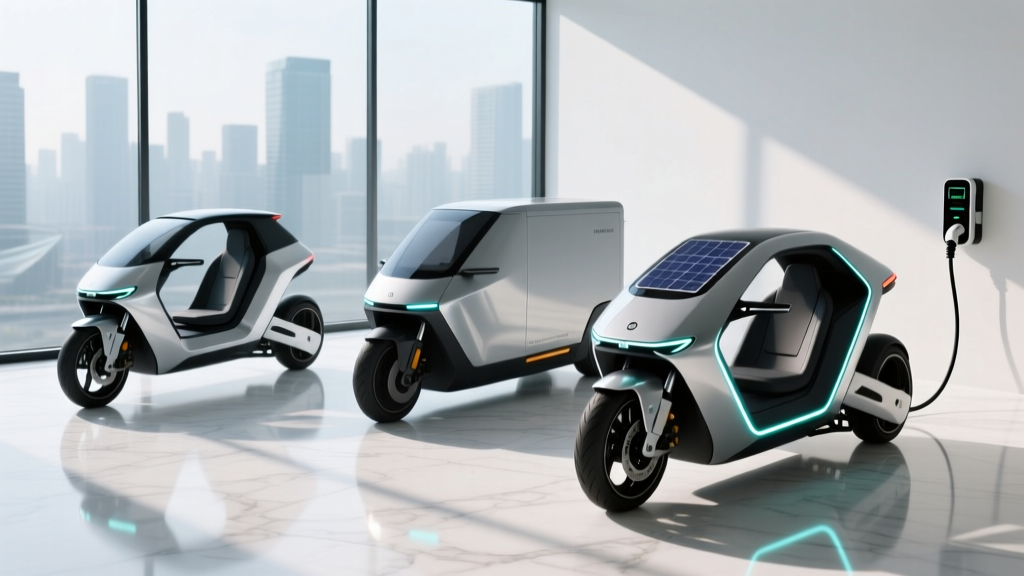
Electric 3-wheel vehicles (technically classified as "autocycles" or three-wheeled motorcycles by the NHTSA) fill a niche between e-bikes and full-size EVs. As of 2026, the most prominent options include the Aptera (announced, ~$34,000 base) with a targeted 400+ mile range, the Arcimoto FUV (~$22,000–$29,000) with an EPA-estimated 102-mile range, and smaller urban commuters like the ElectraMeccanica Solo Cargo. They offer exceptional efficiency (typically 4–6× the MPGe of a Tesla Model 3), dramatically lower purchase prices, and minimal operating costs — but come with real trade-offs: limited cargo space, minimal crash protection compared to enclosed cars, limited highway comfort, sparse dealer/service networks, and no eligibility for the federal §30D EV tax credit (which applies to four-wheeled vehicles only). They make sense as secondary commuter vehicles for solo drivers with short, fair-weather routes and home charging access.
What Exactly Are Electric 3-Wheel Vehicles?
Electric 3-wheel vehicles — sometimes called "reverse trikes" (two wheels front, one rear) or "tadpole trikes" — sit in a regulatory gray zone. The U.S. NHTSA generally classifies three-wheeled motor vehicles as motorcycles, which means:
- Licensing: Most states require a motorcycle endorsement (M-class license), not a standard driver's license.
- Safety standards: They must meet motorcycle FMVSS standards, not passenger-car crash-test requirements. You won't find IIHS or NHTSA 5-star crash ratings for them.
- Tax credits: The IRS §30D Clean Vehicle Credit explicitly requires four wheels, so none of these qualify for the up-to-$7,500 federal credit. Some may qualify for state or utility rebates, and previously the §30D two-wheeler credit existed — but it expired.
- Insurance: Typically written as motorcycle policies, which are often cheaper than auto policies but offer less coverage.
The upside: lighter weight (often 1,200–1,800 lbs vs 4,000+ lbs for a typical BEV) translates to extraordinary efficiency — often 250–400 MPGe equivalent — and smaller, cheaper battery packs.
Current Electric 3-Wheel Vehicle Options (2026)
Here's how the main contenders stack up on the specs that matter. Note: the Aptera remains in pre-production/limited delivery as of early 2026; specs are manufacturer-announced and subject to change.
| Model | Status | Battery (kWh) | Est. Range (mi) | Efficiency | Top Speed | Base MSRP |
|---|---|---|---|---|---|---|
| Aptera (400-mile config) | Announced / Limited delivery | ~60 kWh | ~400 (mfr.) | ~400 MPGe | 110 mph | ~$34,000 |
| Aptera (250-mile config) | Announced | ~42 kWh | ~250 (mfr.) | ~400 MPGe | 110 mph | ~$27,000 |
| Arcimoto FUV (Standard) | Available (limited) | 12.0 kWh usable | ~66 EPA | ~200 MPGe | 75 mph | ~$22,000 |
| Arcimoto FUV (Extended) | Available (limited) | 20.0 kWh usable | ~102 EPA | ~200 MPGe | 75 mph | ~$29,000 |
| ElectraMeccanica Solo Cargo | Available (limited) | 17.3 kWh | ~100 (mfr.) | ~150 MPGe | 80 mph | ~$19,500 |
| Vanderhall Brawley (off-road) | Announced | 60 kWh | ~200 (mfr.) | N/A | 140 mph | ~$35,000+ |
Real-World Range Reality Check
Arcimoto FUV Extended (EPA 102 mi): Expect ~75–85 miles on mixed highway driving at 65+ mph, and ~55–65 miles in cold weather (below 40°F) with the heater running. The FUV's open-air design and small battery make it particularly vulnerable to temperature-related range loss.
Aptera (announced 400 mi): Independent real-world validation is pending. Aerodynamic efficiency claims are plausible given the 0.13 Cd drag coefficient, but solar-panel contribution (~40 miles/day in ideal sun) varies dramatically by latitude, season, and parking habits.
Charging: Speed, Connectors & Home Setup
Because 3-wheel EVs have small batteries, charging is generally fast and simple — but there are caveats.
| Level | Power | Connector | Typical Miles/Hour | Notes |
|---|---|---|---|---|
| Level 1 (120V) | 1.4–1.9 kW | Standard outlet | 6–10 mi/hr | Sufficient overnight for most 3-wheelers |
| Level 2 (240V) | 3.3–7.2 kW | J1772 (most) / NACS (Aptera) | 15–40 mi/hr | Full charge in 2–5 hours |
| DC Fast Charging | Up to 50 kW (rare) | CCS1 (limited models) | ~100–150 mi in 30 min | Most 3-wheelers lack DCFC entirely |
Critical limitation: The Arcimoto FUV and most current 3-wheelers do not support DC fast charging. That rules them out for road trips or drivers without reliable home/workplace Level 2 access. Aptera has announced CCS capability on higher trims, which would be a significant differentiator.
Home charging cost: A basic Level 1 setup costs nothing (use a standard 120V outlet). A Level 2 home install (240V, 32A) typically runs $800–$2,200 including a $400–$700 charger and $400–$1,500 electrician labor, assuming your panel has capacity. Panel upgrades (to 200A) can add $1,500–$4,000.
Cost of Ownership: Electric 3-Wheel vs Gas Car vs Full EV
Here's where 3-wheelers shine — and where they don't. The following compares a 5-year ownership scenario at 10,000 miles/year.
| Category | Arcimoto FUV Ext. | Used Gas Sedan (Civic) | Tesla Model 3 RWD |
|---|---|---|---|
| Purchase price (MSRP/avg used) | $29,000 | $18,000 | $38,990 |
| Federal tax credit | $0 (ineligible) | $0 | Up to $7,500 (if eligible) |
| Effective purchase | $29,000 | $18,000 | ~$31,490 |
| Fuel/Energy (5 yr, 50k mi) | ~$1,100 (electricity) | ~$6,500 (gas @ $3.50/gal, 32 mpg) | ~$2,200 (electricity) |
| Maintenance (5 yr) | ~$500 | ~$3,500 | ~$1,500 |
| Insurance (5 yr avg) | ~$4,500 (motorcycle policy) | ~$7,500 | ~$9,000 |
| 5-year total outlay | ~$35,100 | ~$35,500 | ~$44,190 |
| Resale value (est.) | Low / uncertain | ~$10,000 | ~$18,000 |
Takeaway: Over 5 years, the FUV roughly matches a used gas Civic in total cost — but offers a new-vehicle warranty, far less maintenance, and zero tailpipe emissions. The Tesla costs more upfront but offers vastly more utility, safety, and resale value. The 3-wheeler wins on pure operating cost; it loses on versatility and depreciation certainty.
Safety, Weather & Practical Limitations
This is where honesty matters. Three-wheel EVs are not substitutes for a primary vehicle for most buyers.
What 3-Wheel EVs Do NOT Offer
- Crash protection: No IIHS ratings. Motorcycle-class FMVSS standards. You are more exposed than in any enclosed car.
- Weather protection: Most are open-air or have minimal enclosures. Rain, snow, extreme heat, and cold are real usability barriers.
- Cargo/passenger capacity: Typically 1–2 seats, minimal cargo. Not a family vehicle.
- Highway comfort: Lighter weight = more buffeting from semis, crosswinds, and road imperfections at 70+ mph.
- Service network: No widespread dealer network. Repairs may require shipping to the manufacturer.
- Winter range: Small batteries mean cold-weather range loss (20–40%) is proportionally devastating. A 102-mile FUV becomes a 65-mile FUV at 20°F.
Common Misconceptions About Electric 3-Wheelers
| Myth | Fact |
|---|---|
| "They qualify for the $7,500 federal EV tax credit." | False. IRS §30D requires 4 wheels. No current 3-wheeler qualifies. |
| "They're as safe as a small car." | False. They meet motorcycle standards, not passenger-car standards. No airbags in most models. |
| "Solar panels on the Aptera mean free driving." | Misleading. Solar adds ~20–40 miles/day in ideal conditions — helpful but not a replacement for plugging in. |
| "I don't need a motorcycle license." | Depends on your state. Most states require an M endorsement for 3-wheeled motor vehicles. |
| "They charge at Tesla Superchargers." | Generally no. Most use J1772 Level 2. Aptera plans NACS compatibility, but Supercharger access requires specific OEM agreements. |
Decision Framework: Is an Electric 3-Wheel Vehicle Right for You?
Choose a 3-Wheel Electric Vehicle IF:
- You have reliable home or workplace Level 1/Level 2 charging access.
- Your daily commute is under 50 miles round-trip, mostly on surface streets.
- You live in a mild climate (rarely below 35°F or above 95°F).
- This is a secondary vehicle — you have a primary car for trips, bad weather, and passengers.
- You're comfortable with motorcycle-style licensing, insurance, and exposure.
- You prioritize lowest possible operating cost and maximum efficiency over utility.
Choose a conventional 4-wheel EV (or PHEV) IF:
- You need year-round, all-weather usability.
- You carry passengers or significant cargo regularly.
- You want federal tax credit eligibility ($7,500 potential under §30D).
- You need highway-range DC fast charging for road trips.
- You want verified crash-test ratings (IIHS Top Safety Pick, NHTSA 5-star).
- You value strong resale value and an established service network.
FAQ: Electric 3-Wheel Vehicles
Are electric 3-wheel vehicles street-legal in all 50 states?
Generally yes, but registration and licensing requirements vary by state. Most classify them as motorcycles or autocycles, requiring a motorcycle endorsement. Some states (like California) have specific "autocycle" classifications with different rules. Check your state DMV before purchasing.
Why don't 3-wheelers qualify for the federal EV tax credit?
The IRS §30D Clean Vehicle Credit defines an eligible vehicle as having four wheels. The previous §30D two-wheeled plug-in credit expired and was not renewed. Some states offer their own rebates that may apply — check AFDC's state incentive database.
How long does the battery last, and what does replacement cost?
Most use NMC lithium-ion cells similar to larger EVs. Expect 8–15 year usable life with 70–80% capacity retention. Arcimoto offers a 3-year/36,000-mile battery warranty. Replacement costs are not widely published but would likely run $5,000–$12,000 depending on pack size — a significant percentage of the vehicle's value.
Can I drive an electric 3-wheeler on the highway?
Technically yes — most are rated for 70–110 mph. But lighter weight, narrower track, and motorcycle-class stability make them less comfortable and more vulnerable in high-speed traffic alongside semis. They're best suited for surface streets and roads under 55 mph.
What's the real-world efficiency advantage over a Tesla or Chevy Bolt?
Substantial. A Tesla Model 3 RWD achieves ~132 MPGe combined (per fueleconomy.gov). The Arcimoto FUV achieves roughly 200 MPGe, and the Aptera targets 400+ MPGe. That translates to electricity costs of roughly $0.01–0.02 per mile vs $0.04–0.05 per mile for a full-size EV — though the absolute dollar savings are small because the total energy use is already low.
Should I wait for the Aptera or buy an Arcimoto now?
If you need a vehicle in 2026 and can accept limited range and no DCFC, the Arcimoto FUV is available (with long lead times). If you want longer range, potential DC fast charging, and better weather protection — and are willing to wait on an uncertain delivery timeline — the Aptera is worth a refundable reservation. Neither is a risk-free purchase given the small manufacturer scale.