Why Tesla Lease Deals Are Drawing Attention Again in 2025
After a turbulent 2024 that saw aggressive price cuts and refreshed hardware, Tesla's lease offers for the 2025 model year have quietly become one of the more compelling entry points into the brand. The math is straightforward: lower monthly payments than financing, the ability to sidestep long-term battery degradation concerns, and — for the right buyer — a way to capture federal incentive value that might otherwise be out of reach.
But Tesla leasing has quirks that trip up first-time EV lessees. There's no purchase option at lease-end on most Tesla contracts, mileage penalties are steep, and the interplay between the §30D tax credit and lease structures (technically classified as commercial credits under §45W when the lessor passes savings through) requires careful attention. This guide breaks down exactly what 2025 Tesla lease deals look like for the two highest-volume models — the Model Y and Model 3 — with the numbers that matter.
2025 Tesla Model Y: Lease Specs, Range, and Charging Reality
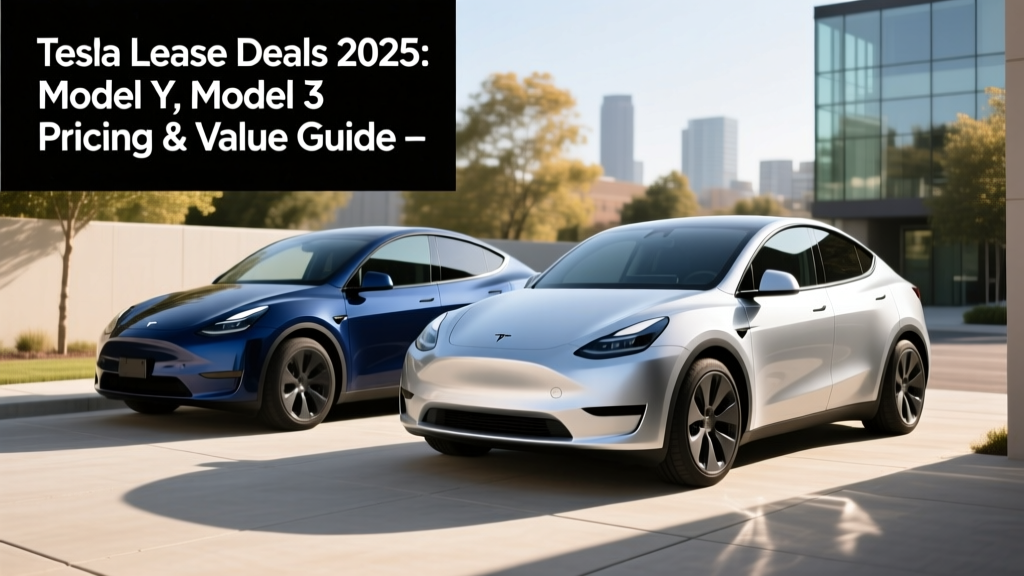
The refreshed Model Y (sometimes called "Juniper" in enthusiast circles, though Tesla doesn't use that name officially) remains the brand's volume leader and the best-selling EV in the U.S. by a wide margin. Here's what the 2025 lineup delivers on paper and in practice.
| Spec | Long Range AWD | Performance |
|---|---|---|
| EPA Range | 320 miles | 295 miles |
| Battery (usable) | ~78 kWh (NMC) | ~78 kWh (NMC) |
| Drivetrain | Dual-Motor AWD | Dual-Motor AWD |
| Horsepower | 384 hp | 456 hp |
| 0–60 mph | 4.8 sec | 3.5 sec |
| MPGe (combined) | 122 MPGe | 111 MPGe |
| Max DC Fast Charge | 250 kW | 250 kW |
| 10–80% DC Time | ~27 min | ~27 min |
| Level 2 Home Rate | 11.5 kW (~44 mi/hr) | 11.5 kW (~44 mi/hr) |
| Cargo Volume | 76 cu ft (rear seats folded) | 76 cu ft (rear seats folded) |
| Rear Legroom | 41.6 in | 41.6 in |
| Base MSRP | $44,990 | $48,990 |
| Battery Warranty | 8 yr / 120,000 mi | 8 yr / 120,000 mi |
Charging in Practice
Tesla's Supercharger network remains the gold standard for reliability, and the Model Y's 250 kW peak charge rate is competitive — though it's worth noting that peak rate only holds between roughly 10–30% State of Charge. The charging curve tapers progressively: you'll see ~150 kW around 50% SoC and ~60 kW near 80%. That's why the 10–80% time of ~27 minutes is a more honest metric than peak kW alone.
At home on a Level 2 wall connector (11.5 kW), a full overnight session adds roughly 44 miles of range per hour of charging — enough to replenish a daily commute in under two hours. If your home electrical panel only supports a 40-amp circuit (common in older homes), you'll be limited to ~9.6 kW, adding about 37 miles per hour. Budget $800–$2,000 for professional installation depending on panel capacity and run length.
2025 Tesla Model 3: The Efficiency Champion
The refreshed Model 3 (internally called "Highland") brought meaningful improvements in ride quality, cabin noise, and interior materials. For lease shoppers prioritizing range-per-dollar and commuting efficiency, it's arguably the stronger value play in 2025.
| Spec | Long Range RWD | Long Range AWD | Performance |
|---|---|---|---|
| EPA Range | 363 miles | 346 miles | 315 miles |
| Battery (usable) | ~75 kWh (NMC) | ~75 kWh (NMC) | ~75 kWh (NMC) |
| Drivetrain | Rear-Wheel Drive | Dual-Motor AWD | Dual-Motor AWD |
| Horsepower | 271 hp | 346 hp | 441 hp |
| 0–60 mph | 5.8 sec | 4.2 sec | 2.9 sec |
| MPGe (combined) | 132 MPGe | 125 MPGe | 113 MPGe |
| Max DC Fast Charge | 250 kW | 250 kW | 250 kW |
| 10–80% DC Time | ~25 min | ~25 min | ~25 min |
| Level 2 Home Rate | 11.5 kW (~48 mi/hr) | 11.5 kW (~48 mi/hr) | 11.5 kW (~48 mi/hr) |
| Cargo Volume | 23 cu ft (trunk + frunk) | 23 cu ft | 23 cu ft |
| Rear Legroom | 35.3 in | 35.3 in | 35.3 in |
| Base MSRP | $38,990 | $42,490 | $47,740 |
| Battery Warranty | 8 yr / 100,000 mi | 8 yr / 120,000 mi | 8 yr / 120,000 mi |
Breaking Down 2025 Tesla Lease Pricing and Tax Credits
Tesla's lease offers fluctuate month to month based on residual values, money factors, and promotional incentives. As of early 2025, typical advertised lease structures look approximately like this (exact terms vary by region and credit tier):
| Model & Trim | MSRP | Est. Monthly Payment | Due at Signing | Lease-End Purchase Option |
|---|---|---|---|---|
| Model 3 Long Range RWD | $38,990 | $349–$399 | $3,500–$4,500 | Typically No |
| Model 3 Long Range AWD | $42,490 | $399–$459 | $3,500–$4,500 | Typically No |
| Model Y Long Range AWD | $44,990 | $399–$479 | $4,000–$5,000 | Typically No |
| Model Y Performance | $48,990 | $479–$559 | $4,000–$5,000 | Typically No |
The Tax Credit Wrinkle: §30D vs. Commercial (§45W)
Here's where Tesla leasing gets nuanced. When you purchase an EV, you claim the §30D Clean Vehicle Credit (up to $7,500) on your personal tax return — subject to MSRP caps ($55,000 for sedans, $80,000 for SUVs/trucks), buyer income limits ($150K single / $300K joint AGI), and critical-mineral/battery-component sourcing requirements. (Source: IRS.gov)
When you lease, the vehicle is technically owned by the leasing company (Tesla's finance arm or a partner). The $7,500 credit goes to the lessor under §45W (commercial clean vehicle credit). Whether that savings gets passed to you — as a capitalized-cost reduction lowering your monthly payment — depends entirely on the lease offer. Tesla has, at various points in 2024–2025, applied the full $7,500 as a lease incentive, but this is not guaranteed and can change without notice.
Tech, Autopilot, and the FSD Question for Lessees
Both the Model Y and Model 3 come standard with Tesla's Basic Autopilot — adaptive cruise control, lane-keeping assist, and automatic emergency braking. Enhanced Autopilot ($6,000) adds auto lane-change, navigate-on-autopilot, and auto-park. Full Self-Driving (Supervised) is priced at $8,000 as a one-time purchase or $99/month.
For lessees, the FSD question is financial as much as technical: you're paying for a capability you may not fully recoup at lease-end since you don't own the vehicle. The $99/month subscription option makes more sense for lease holders who want to test FSD without committing $8,000 to a car they'll return in three years.
Other notable tech on the 2025 models:
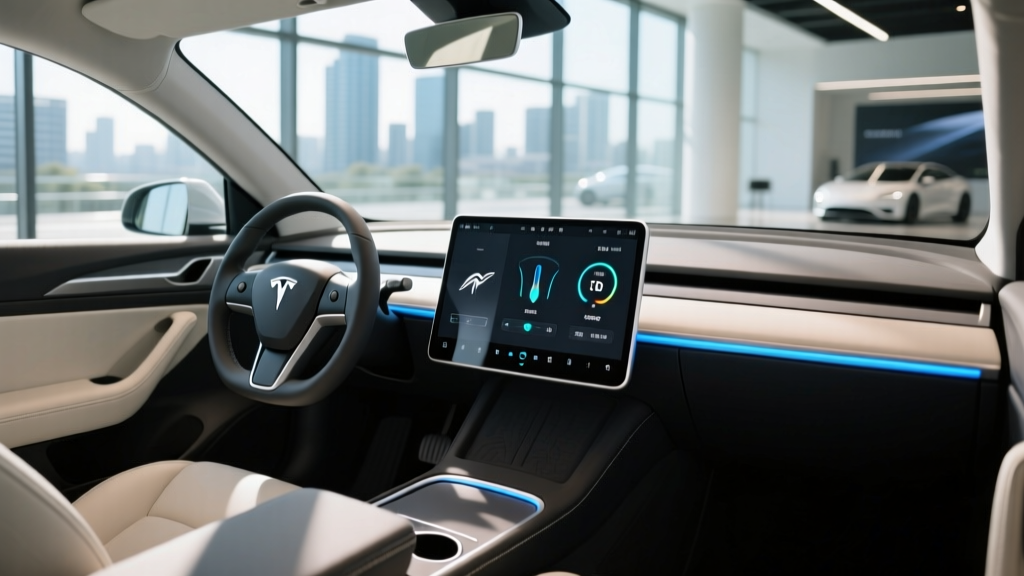
- 15.4-inch center touchscreen (Model 3 Highland) with ventilated front seats
- Rear 8-inch touchscreen for climate and entertainment (Model 3)
- Ambient lighting, acoustic glass, and significantly improved suspension tuning over pre-refresh models
- Sentry Mode, Dashcam, and over-the-air updates throughout the lease term
- NACS (native Tesla connector) — no adapter needed at Superchargers; CCS adapter included for non-Tesla DC fast chargers
Model Y vs. Model 3: Which Lease Makes More Sense?
Choose the Model Y Lease If:
- You need cargo space (76 cu ft with seats folded — handles Costco runs, strollers, camping gear)
- You regularly carry rear-seat passengers (41.6 inches of legroom vs. 35.3 in the 3)
- You want the higher seating position and crossover styling
- You value optional 7-seat configuration (though third row is child-only)
Choose the Model 3 Lease If:
- Maximum range-per-dollar matters (363 mi EPA on LR RWD vs. 320 mi on Model Y LR)
- You primarily commute solo or with one passenger
- You want the lower monthly payment (~$50–$80/month less than equivalent Model Y)
- You prefer a sedan's driving dynamics and efficiency (132 MPGe combined)
Competitor Context
Against the Hyundai Ioniq 5 (EPA 303 mi, $42,900 base, 800V architecture enabling 10–80% in ~18 min at 350 kW chargers), the Model Y trades slightly slower peak charging for superior real-world Supercharger network access. The Ford Mustang Mach-E (EPA 320 mi, $42,995 base) offers a more traditional driving feel but can't match Tesla's efficiency or software ecosystem. The Chevrolet Equinox EV (EPA 315 mi, ~$34,900 base) undercuts on price but delivers less performance and slower charging.
Pros and Cons: Honest Assessment for Lease Shoppers
Pros
- Class-leading efficiency (Model 3 LR RWD: 132 MPGe / 363 mi EPA)
- Supercharger network access — still the most reliable DC fast-charging ecosystem in North America
- OTA updates add features throughout the lease term
- Strong residual values protect lease economics
- Minimal maintenance — no oil changes, brake fluid lasts years with regen braking
- Leasing avoids long-term battery degradation risk
Cons
- No lease-end purchase option on most Tesla leases — you return the car, period
- Mileage penalties: typically $0.20–$0.25/mile over the limit (10K or 12K plans)
- FSD is a questionable investment on a leased vehicle
- Tesla service center availability varies widely by metro area
- Model 3 rear seat is tight for taller adults on long trips
- No Apple CarPlay / Android Auto — Tesla's native UI is the only option
- Insurance premiums run 15–30% higher than comparable ICE vehicles in most states
Frequently Asked Questions
What is the real-world range of the 2025 Tesla Model Y and Model 3?
The Model Y Long Range AWD delivers roughly 260–285 miles at highway speeds in mild weather and 240–270 miles in freezing temperatures. The Model 3 Long Range RWD achieves 310–330 miles in mixed driving, dropping to 275–295 highway-only and 270–290 in deep cold. These numbers assume moderate climate-control use and no aggressive acceleration habits.
How fast does a 2025 Tesla charge at home and on the road?
On a Tesla Supercharger (V3, 250 kW capable), both models charge from 10–80% in approximately 25–27 minutes, with the charge curve tapering significantly above 60% SoC. At home on a Level 2 Wall Connector (11.5 kW), the Model Y adds ~44 miles per hour and the Model 3 adds ~48 miles per hour. A full overnight charge (8 hours) replenishes 350+ miles — more than enough for any daily routine.
Does a 2025 Tesla lease qualify for the $7,500 federal tax credit?
Not directly to you as the lessee. Under IRS rules, the leasing company (the legal owner) claims the commercial clean vehicle credit (§45W). Tesla may pass this savings to you as a capitalized-cost reduction, lowering your monthly payment — but this is at Tesla's discretion and should be confirmed in writing before signing. Your personal income and the vehicle's MSRP still matter for purchase scenarios, but the lease structure bypasses some §30D personal-credit restrictions. (Source: IRS.gov)
Is leasing a Tesla worth it vs. buying or choosing a competitor?
Leasing makes sense if you want lower monthly payments, plan to stay under 10,000–12,000 miles per year, and prefer swapping for new hardware every 36 months rather than holding a depreciating asset. It's less ideal if you drive high annual miles, want to customize the vehicle, or want a purchase option at lease-end. Versus competitors, Tesla's Supercharger network and software ecosystem remain differentiators, but the Ioniq 5 charges faster on compatible infrastructure and the Equinox EV costs significantly less upfront.
What happens at the end of a Tesla lease?
Unlike many traditional automaker leases, Tesla typically does not offer a purchase option at lease-end. You return the vehicle, pay any excess mileage or wear charges, and walk away — or start a new lease. This is a deliberate Tesla strategy to control used-vehicle supply and retain battery assets. Confirm this detail with your lease agreement before signing, as policies have shifted in prior years.
How much does insurance cost on a leased Tesla?
Expect $180–$300/month depending on your state, driving record, and coverage level. Tesla offers its own insurance product in many states (priced using real-time driving data from the vehicle), which can be competitive — sometimes 10–20% below traditional carriers. Always get quotes from both Tesla Insurance and at least two external providers before taking delivery.