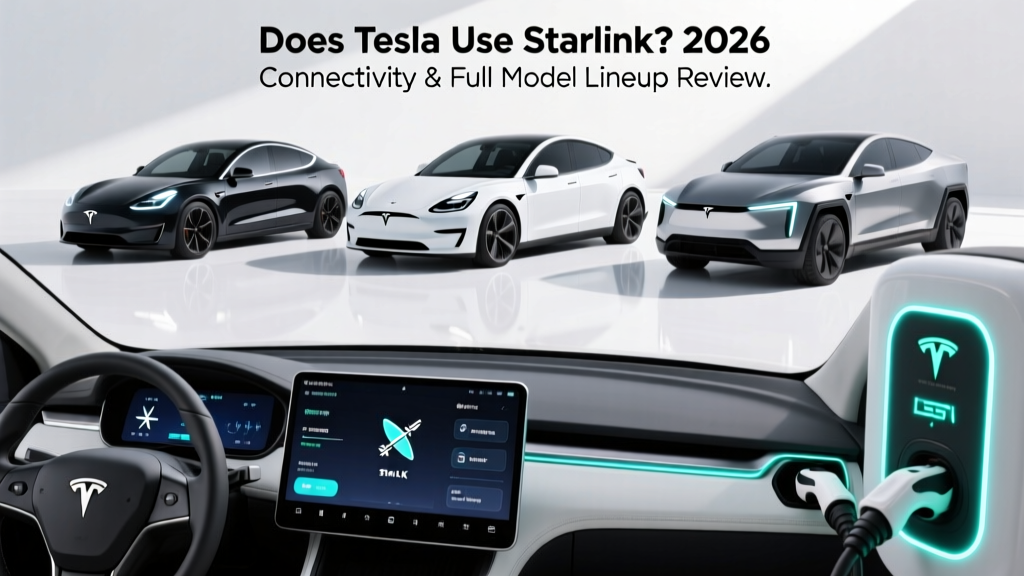
If you've seen SpaceX rockets landing on drone ships and Starlink satellites blanketing the sky, you've probably wondered: does Tesla use Starlink for its vehicle connectivity? The short answer is no — not directly. Tesla vehicles rely on cellular networks (AT&T and regional partners) for over-the-air updates, navigation, streaming, and remote features. Starlink is a separate SpaceX product designed for broadband internet in homes, RVs, and maritime use. However, Elon Musk has repeatedly hinted at future integration, and the two ecosystems share more DNA than most automakers can claim.
But connectivity is just one piece of the ownership puzzle. Below, we break down the full 2026 Tesla lineup — Model 3, Model Y, Model S, Model X, and Cybertruck — with the exact numbers that matter: EPA range, battery chemistry, DC fast-charge curves, real-world efficiency, and current federal tax credit eligibility under IRS §30D rules.
How Tesla Connectivity Actually Works in 2026
Every Tesla vehicle ships with a built-in LTE/5G modem that connects to terrestrial cellular towers. This connection powers:
- Over-the-air (OTA) software updates
- Live traffic visualization and navigation routing
- Music and podcast streaming (Spotify, Tidal, Apple Music)
- Sentry Mode clip uploads and remote camera access
- Phone-as-a-key and remote climate control via the Tesla app
Tesla offers two connectivity tiers. Standard Connectivity (included) covers basic navigation, OTA updates, and phone-as-a-key. Premium Connectivity ($9.99/month or $99/year) adds satellite maps with live traffic, video streaming (Netflix, YouTube, Disney+), Caraoke, and an internet browser — all over the cellular link.
Starlink, meanwhile, operates a constellation of over 7,000 low-Earth-orbit satellites delivering broadband to fixed and mobile receivers. While Tesla's infotainment doesn't route through Starlink today, the satellite network could theoretically serve as a fallback in cellular dead zones — something Musk has acknowledged as a long-term possibility. For now, if you're driving through rural Montana or Death Valley, your Tesla's navigation and streaming will behave like any other cellular-dependent device: it may buffer or drop offline entirely.
2026 Tesla Lineup: Range, Battery, and Efficiency at a Glance
Tesla's 2026 lineup spans five models, each targeting a distinct buyer. Here's the spec sheet that matters — EPA range, usable battery capacity, chemistry, and efficiency.
| Model | EPA Range | Battery (Usable) | Chemistry | Efficiency | Drivetrain |
|---|---|---|---|---|---|
| Model 3 RWD | 272 mi | 57.5 kWh | LFP | 132 MPGe / 25 kWh/100mi | RWD |
| Model 3 Long Range AWD | 363 mi | 78.1 kWh | NMC | 134 MPGe / 25 kWh/100mi | Dual-Motor AWD |
| Model Y Long Range AWD | 320 mi | 78.1 kWh | NMC | 122 MPGe / 28 kWh/100mi | Dual-Motor AWD |
| Model S Long Range | 402 mi | 95 kWh | NMC | 124 MPGe / 27 kWh/100mi | Dual-Motor AWD |
| Model X Long Range | 335 mi | 95 kWh | NMC | 111 MPGe / 30 kWh/100mi | Dual-Motor AWD |
| Cybertruck AWD | 340 mi | 123 kWh | NMC (4680 cells) | 76 MPGe / 44 kWh/100mi | Dual-Motor AWD |
Source: fueleconomy.gov (EPA) and Tesla specification sheets. Figures reflect 2026 model year data.
Charging Speeds: DC Fast Charging and Home Level 2
Charging speed is often more important than total range for road-trip usability. Tesla's Supercharger network remains the gold standard for DC fast charging reliability, with V4 stalls now delivering up to 350 kW at select locations. Here's what each model can actually accept:
| Model | Max DC Fast Charge | 10–80% Time | Level 2 Home (kW) | Level 2 Miles/Hr |
|---|---|---|---|---|
| Model 3 RWD | 170 kW | ~30 min | 11.5 kW | ~37 mi/hr |
| Model 3 Long Range | 250 kW | ~25 min | 11.5 kW | ~44 mi/hr |
| Model Y Long Range | 250 kW | ~27 min | 11.5 kW | ~40 mi/hr |
| Model S Long Range | 250 kW | ~30 min | 11.5 kW | ~41 mi/hr |
| Model X Long Range | 250 kW | ~32 min | 11.5 kW | ~36 mi/hr |
| Cybertruck AWD | 250 kW | ~35 min | 11.5 kW (17 kW optional) | ~37 mi/hr (52 mi/hr w/ 17kW) |
Charging curve reality: The peak kW number is just that — a peak. Tesla's charge curve typically ramps quickly to maximum rate between 10–30% SoC, sustains near-peak through ~50%, then tapers significantly. Above 80%, charging slows dramatically to protect battery longevity. If you're road-tripping, plan stops around 10–80% rather than topping to 100% unless it's your final destination.
All 2026 Teslas use the NACS (North American Charging Standard) connector natively. This is the same connector Tesla has used since 2012, now adopted by Ford, GM, Rivian, Hyundai, and most major automakers. At non-Tesla DC fast chargers that have added NACS cables (Electrify America, EVgo, ChargePoint), Teslas plug in directly — no adapter needed.
For home charging, Tesla's Wall Connector ($420) on a 60-amp circuit delivers up to 11.5 kW (48 amps continuous), which is sufficient for overnight replenishment of any Tesla model. The Cybertruck's optional 17 kW AC charger requires an 80-amp circuit and a Tesla Wall Connector with higher-capacity wiring — consult a licensed electrician before committing to this setup, as many homes need a panel upgrade.
Performance: 0–60, Horsepower, and Drivetrain
Tesla's electric powertrains deliver instant torque with no gear shifts, making even base models feel quicker than their gas counterparts. Here's the performance breakdown:
| Model | 0–60 mph | Horsepower | Top Speed |
|---|---|---|---|
| Model 3 RWD | 5.8 sec | 271 hp | 125 mph |
| Model 3 Long Range AWD | 4.2 sec | 366 hp | 125 mph |
| Model Y Long Range AWD | 4.8 sec | 384 hp | 135 mph |
| Model S Long Range | 3.1 sec | 670 hp | 155 mph |
| Model X Long Range | 3.8 sec | 670 hp | 155 mph |
| Cybertruck AWD | 4.1 sec | 600 hp | 112 mph |
The dual-motor AWD models use independent front and rear motors with torque vectoring. Tesla's traction control software adjusts torque distribution hundreds of times per second, which gives these vehicles exceptional grip in rain and snow despite their weight.
Pricing, Trims, and Federal Tax Credit Eligibility
Tesla's pricing has stabilized after years of frequent adjustments. Here's where the 2026 lineup stands before and after the federal EV tax credit:
| Model / Trim | Base MSRP | §30D Credit Eligible? | Effective Price* |
|---|---|---|---|
| Model 3 RWD | $38,990 | Yes — up to $7,500 | ~$31,490 |
| Model 3 Long Range AWD | $44,990 | Yes — up to $7,500 | ~$37,490 |
| Model Y Long Range AWD | $44,990 | Yes — up to $7,500 | ~$37,490 |
| Model S Long Range | $79,990 | No (exceeds MSRP cap) | $79,990 |
| Model X Long Range | $79,990 | No (exceeds MSRP cap) | $79,990 |
| Cybertruck AWD | $79,990 | No (exceeds MSRP cap) | $79,990 |
*Effective price assumes full $7,500 credit. Actual credit amount depends on battery sourcing compliance. Consult a tax professional for your specific situation.
- MSRP Cap: Sedans (Model 3) must be ≤$55,000. SUVs, vans, and trucks (Model Y, Cybertruck) must be ≤$80,000. Model S, Model X, and Cybertruck trims above $80K are ineligible.
- Buyer Income Cap: Modified AGI ≤$150,000 (single), ≤$225,000 (head of household), ≤$300,000 (joint).
- Battery Sourcing: The credit splits into two halves ($3,750 each) — one for critical minerals and one for battery component manufacturing. Sourcing requirements tighten annually. Verify current compliance on IRS.gov.
- Point-of-Sale Transfer: Since 2024, buyers can transfer the credit to the dealer at purchase, reducing the upfront cost immediately rather than waiting for tax filing.
Cargo Space, Interior, and Daily Livability
Tesla's minimalist interiors maximize cabin space through skateboard-platform packaging (battery under the floor, no transmission tunnel). Here's what you get:
| Model | Cargo (rear seats up) | Cargo (rear seats down) | Frunk | Rear Legroom |
|---|---|---|---|---|
| Model 3 | 23 cu ft | 65 cu ft | 3.1 cu ft | 35.2 in |
| Model Y | 30 cu ft | 76 cu ft | 4.1 cu ft | 41.6 in |
| Model S | 28 cu ft | 79 cu ft | 3.1 cu ft | 35.4 in |
| Model X | 15 cu ft (6-seat) | 85 cu ft | 6.6 cu ft | 37.1 in |
| Cybertruck | — (bed: 6.5 ft × 4 ft) | 67 cu ft (vault + bed) | 7.1 cu ft (frunk) | 36.0 in |
The Model Y remains the volume leader for good reason: its hatchback design offers crossover-level cargo capacity that swallows strollers, camping gear, and Costco runs with ease. The Model 3's trunk is more traditional and less flexible for bulky items. The Model X's falcon-wing doors are dramatic but add complexity — worth considering if you frequently park in tight garages.
Standout Tech, Driver Assistance, and Drawbacks
Tech highlights across the 2026 lineup:
- 15.4-inch center touchscreen (Model 3/Y) or 17-inch (Model S/X/Cybertruck) with AMD Ryzen processor
- Tesla Vision ADAS — camera-only Autopilot with lane centering, adaptive cruise, and auto lane change
- Full Self-Driving (Supervised) — $8,000 option or $99/month subscription; adds city-street navigation, traffic light/stop sign recognition, and autosteer on local roads
- Sentry Mode with live camera access via app
- Gaming (Steam integration), Netflix, and Disney+ streaming while parked
- Bioweapon Defense Mode (HEPA filtration) on Model S/X/Y
Notable drawbacks:
- No Apple CarPlay or Android Auto. Tesla's proprietary infotainment is excellent but closed. If you rely on CarPlay for your preferred apps, this is a dealbreaker.
- Phantom braking. Tesla Vision's camera-only approach (no radar or lidar) has drawn NHTSA scrutiny for occasional false-positive emergency braking, particularly in high-contrast lighting.
- Minimalist interior isn't for everyone. The Model 3's lack of physical buttons, instrument cluster, and traditional stalks (turn signals are on the steering wheel in the 2026 Highland/Highland II refresh) requires an adjustment period.
- Service center wait times. Tesla's direct-to-consumer model means fewer service locations than legacy brands. Body repair and collision work can involve multi-week waits in some metro areas.
- Build quality variability. Panel gap inconsistency, particularly on early-production vehicles, remains a documented concern though it has improved significantly since the Fremont factory's 2024 retooling.
Warranty Coverage and Battery Longevity
Tesla's warranty structure is straightforward and competitive with the broader EV market:
| Coverage | Model 3 / Model Y | Model S / Model X / Cybertruck |
|---|---|---|
| Basic Vehicle | 4 yr / 50,000 mi | 4 yr / 50,000 mi |
| Battery & Drive Unit | 8 yr / 120,000 mi (RWD) 8 yr / 120,000 mi (LR/AWD) | 8 yr / 150,000 mi |
| Capacity Retention Threshold | 70% | 70% |
The 70% capacity retention threshold means Tesla will replace or refurbish the battery if it degrades below 70% of original capacity within the warranty period. In practice, Tesla's batteries have shown strong longevity — data aggregated from fleet telemetry suggests typical degradation of roughly 10–12% over 150,000 miles for NMC packs. LFP packs (Model 3 RWD) tolerate regular 100% charging without accelerated degradation, which is a practical advantage for daily commuters who need every mile of range.
Tesla recommends charging LFP batteries to 100% daily, while NMC owners should set daily charge limits to 80% and charge to 100% only for long trips. This distinction matters for your daily routine.
✓ Pros
- Best-in-class Supercharger network (20,000+ stalls in North America)
- OTA updates continuously add features post-purchase
- Industry-leading efficiency (kWh/100mi) in Model 3 and Model Y
- NACS connector now the North American standard
- Strong resale value relative to most EVs
- LFP option on Model 3 RWD offers daily 100% charging without guilt
✗ Cons
- No Apple CarPlay or Android Auto
- Camera-only ADAS draws phantom-braking complaints
- FSD (Supervised) is expensive and still requires full driver attention
- Service center availability lags behind legacy brands
- Model S/X/Cybertruck ineligible for federal tax credit (MSRP cap)
- Turn-signal buttons on steering wheel (Model 3 refresh) frustrate some drivers
Who Should Buy a Tesla in 2026?
Choose the Model 3 RWD if: You're a commuter who drives under 50 miles daily, want the lowest entry price (~$31,490 after credit), and value LFP's 100% daily charging tolerance. Best for single drivers or couples without heavy cargo needs.
Choose the Model 3 Long Range or Model Y Long Range if: You take regular road trips, need AWD for snow-belt winters, or want the ~320–363 mile EPA range for peace of mind. The Model Y is the default pick for families needing hatchback cargo space and easy car-seat installation.
Choose the Model S or Model X if: Budget is flexible, you want flagship performance (670 hp, sub-4-second 0–60), and you value the larger cabin, air suspension, and HEPA filtration. Just know you're paying full MSRP with no federal credit.
Choose the Cybertruck if: You need a truck bed for work or recreation, want the stainless-steel aesthetic, and can accept the polarizing design. Towing capacity is 11,000 lbs, though expect range to drop 30–40% when towing near max capacity.
Frequently Asked Questions
Does Tesla use Starlink for navigation or streaming?
No. Tesla vehicles use terrestrial cellular networks (primarily AT&T in the US) for all connected features including navigation, OTA updates, and media streaming. Starlink is a separate SpaceX product for home and mobile broadband. While both are Musk-affiliated companies, there is no direct integration between Starlink satellites and Tesla vehicle modems as of the 2026 model year.
What is the real-world range of a Tesla?
Real-world range depends heavily on speed, temperature, and terrain. Expect roughly 85–90% of EPA range in mixed driving, 75–85% at sustained 75 mph highway speeds, and 65–80% in sub-freezing temperatures. A Model Y Long Range rated at 320 miles EPA typically delivers 260–280 miles on a summer highway trip and 220–250 miles in winter conditions.
How fast does a Tesla charge at home and on the road?
At home on a Level 2 Tesla Wall Connector (11.5 kW), most models add 37–44 miles of range per hour — enough for a full overnight charge. On DC fast chargers, most Tesla models peak at 250 kW and charge from 10–80% in 25–35 minutes depending on battery size and temperature. Preconditioning the battery (automatic when navigating to a Supercharger) is essential for achieving peak charge rates.
Does a Tesla qualify for the federal EV tax credit?
The Model 3 (RWD and Long Range) and Model Y Long Range qualify for up to $7,500 under IRS §30D, provided the buyer meets income caps ($150K single / $300K joint) and the vehicle's battery meets critical-mineral and component-sourcing requirements. The Model S, Model X, and Cybertruck exceed the MSRP cap for the credit and are not eligible. Always verify current eligibility at IRS.gov before purchasing.
Is a Tesla worth buying vs. competitors like the Hyundai Ioniq 5 or Ford Mustang Mach-E?
Tesla's advantages are the Supercharger network, OTA update cadence, efficiency, and NACS ecosystem dominance. Competitors like the Hyundai Ioniq 5 offer faster 800V charging architectures (10–80% in ~18 minutes), Apple CarPlay, and more conventional interiors. The Ford Mustang Mach-E offers a familiar crossover feel with BlueCruise hands-free driving on approved highways. If Supercharger access and software are your top priorities, Tesla wins. If you prefer CarPlay, physical buttons, or 800V charging speed, cross-shop the Ioniq 5 or Mach-E seriously.
Can I use a Tesla on non-Tesla charging networks?
Yes. With the NACS connector now standard across the industry, Teslas can use Electrify America, EVgo, ChargePoint, and other networks that have added NACS cables. For older CCS-equipped stations, Tesla sells a CCS adapter (~$250). The Tesla app and in-car navigation can route through third-party chargers, though the Supercharger experience (plug-and-charge billing, real-time stall availability) remains the most seamless.