The Short Answer: No, Tesla Doesn't Use Traditional Keys
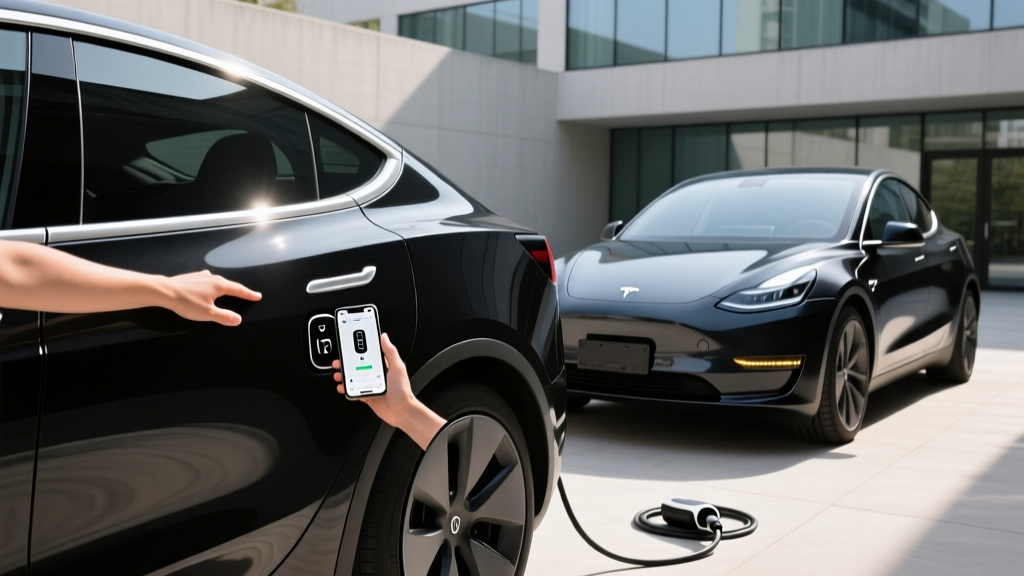
If you're coming from a gas car and wondering "does Tesla have keys?" — the answer is both no and yes. Tesla vehicles don't ship with a traditional metal ignition key or a standard push-button fob as the primary entry method. Instead, every Tesla uses a phone-as-key system via Bluetooth, backed up by a credit-card-sized RFID key card. An optional key fob is available for purchase, but it's not included in the box.
This keyless philosophy aligns with Tesla's minimalist approach to vehicle design, but it raises practical questions for new owners: What happens if your phone dies? How reliable is Bluetooth unlock in a parking garage? Can you still start the car without your phone? We'll break down every access method Tesla offers, then dive into a full profile of the Model 3 Long Range AWD — the most popular Tesla sedan — so you have the complete ownership picture.
Tesla's Three Access Methods Explained
1. Phone as Key (Primary Method)
Tesla's default access system uses your smartphone's Bluetooth Low Energy (BLE) connection. Once you pair your phone through the Tesla app, the car detects your approach and automatically unlocks the doors when you're within a few feet. Walk away, and it locks. No tapping, no button pressing — it's entirely proximity-based.
Real-world reliability: In our experience across multiple model years, phone-as-key works about 95% of the time flawlessly. The occasional hiccup happens in areas with heavy Bluetooth interference (crowded parking structures, near large metal structures) or if your phone's battery optimization aggressively kills the Tesla app in the background. On iOS, enabling Background App Refresh for Tesla largely solves this. On Android, you may need to exclude the Tesla app from battery optimization settings.
2. Key Card (Included Backup)
Every Tesla ships with two RFID key cards. You tap the card on the B-pillar (the vertical post between the front and rear doors) to unlock, and tap it on the center console card reader to start driving. It's a passive RFID system — no battery required, so it works indefinitely as a backup.
The key card is your failsafe. If your phone dies, you lose signal, or Bluetooth acts up, the card gets you in and driving. Keep one in your wallet permanently. It's thin enough to live alongside your credit cards.
3. Optional Key Fob ($175 Add-On)
For buyers who prefer a physical fob, Tesla sells a key fob accessory for approximately $175. It works via Bluetooth (not RFID like the card) and supports passive entry just like phone-as-key, plus physical buttons for lock, unlock, and trunk release. The fob uses a CR2032 coin battery that lasts roughly a year. Note: this is an aftermarket purchase — it does not come standard with any Tesla model.
| Method | Included? | Battery Required | Passive Entry | Cost |
|---|---|---|---|---|
| Phone as Key | Yes (free) | Phone battery | Yes (BLE proximity) | $0 |
| Key Card (×2) | Yes (2 included) | No (passive RFID) | No (tap required) | $0 (replacement ~$35) |
| Key Fob | No (optional) | CR2032 (~1 yr) | Yes (BLE proximity) | ~$175 |
2025 Tesla Model 3 Long Range AWD: Full Profile
Since most shoppers researching Tesla keyless entry are evaluating their first Tesla purchase, here's a comprehensive look at the 2025 Model 3 Long Range All-Wheel Drive — the variant that balances range, performance, and price for the broadest set of buyers.
| Spec | Value |
|---|---|
| EPA Range | 363 miles |
| Battery (usable) | ~79 kWh, NMC chemistry |
| Drivetrain | Dual-motor AWD |
| Horsepower | ~346 hp (combined) |
| 0-60 mph | 4.2 seconds |
| MPGe (combined) | 121 MPGe |
| Efficiency | 28 kWh/100 mi |
| Max DC Fast Charge | 250 kW (peak) |
| 10-80% DC Charge | ~25 minutes |
| Level 2 Home Charge | 11.5 kW (~44 mi/hr) |
| Cargo (rear trunk + frunk) | 23 cu ft (trunk) + ~3 cu ft (frunk) |
| Rear Legroom | 35.3 inches |
| Base MSRP | $47,740 (incl. destination) |
| Battery Warranty | 8 years / 120,000 miles |
Range and Efficiency: What to Expect in the Real World
EPA sticker: 363 miles
Real-world highway (70 mph, 72°F): ~300-320 miles
Real-world highway in cold (30°F): ~250-280 miles
City/commuter driving: ~340-360 miles (regen braking helps)
The Model 3 Long Range's 363-mile EPA rating is among the best in the midsize EV sedan segment, and Tesla's powertrain efficiency is genuinely class-leading. At 28 kWh per 100 miles, it sips electrons more carefully than the Hyundai Ioniq 6 (30 kWh/100mi) or the BMW i4 eDrive40 (31 kWh/100mi).
But EPA estimates assume a mix of city and highway driving at moderate temperatures. On a sustained 70-mph highway run in warm weather, expect about 300-320 miles before you're hunting for a charger. Drop the thermometer to 30°F and highway range falls to roughly 250-280 miles — a 25-30% reduction that's consistent with NMC battery chemistry in cold conditions. The Model 3's standard heat pump helps mitigate cabin energy draw in winter, but battery internal resistance still increases in the cold.
For city commuters doing stop-and-go driving, regenerative braking recovers significant energy, and you'll see numbers close to the EPA sticker — sometimes even exceeding it on flat terrain at moderate speeds. According to fueleconomy.gov, the combined 121 MPGe translates to roughly $550 in annual electricity costs at 15,000 miles/year and $0.16/kWh — compared to $2,100+ for a comparable gas sedan.
Charging Speed: DC Fast and Home Level 2
Charging speed is where Tesla ownership still holds a meaningful advantage, primarily due to the Supercharger network's reliability and the car's thermal preconditioning system.
| Charging Level | Power | Speed (mi/hr) | Notes |
|---|---|---|---|
| Level 1 (120V household) | ~1.4 kW | ~5 mi/hr | Emergency/trickle only; ~65 hrs for full charge |
| Level 2 (240V, 48A Wall Connector) | 11.5 kW | ~44 mi/hr | Full charge in ~7-8 hours; ideal for daily home use |
| Level 2 (240V, 32A mobile connector) | 7.7 kW | ~30 mi/hr | Included Mobile Connector with NEMA 14-50 adapter |
| DC Fast (Supercharger V3) | 250 kW peak | ~1,000 mi/hr (peak) | 10-80% in ~25 min; tapers significantly above 80% |
| DC Fast (CCS adapter + third-party) | Up to 250 kW | Varies by station | Works with Electrify America, EVgo via CCS adapter |
Charging curve reality check: The 250 kW peak rate only sustains from roughly 10% to 30% state of charge. By 50%, you're seeing ~150 kW, and above 80%, the rate drops sharply to protect battery longevity — typically 50 kW or less. This is why Tesla (and every other automaker) quotes 10-80% times rather than 0-100%. Plan your road-trip stops around the 10-80% window for the fastest experience.
Home charging setup: Most Model 3 owners install a Tesla Wall Connector on a 60-amp circuit, delivering the full 11.5 kW (48 amps continuous). This adds roughly 44 miles of range per hour of charging — more than enough to replenish a day's driving overnight. Installation costs typically run $500-$1,500 for the electrician work if your panel has capacity, or $2,000-$4,000+ if you need a panel upgrade. The included Mobile Connector with a NEMA 14-50 plug is a viable temporary solution at 7.7 kW.
One Tesla-specific advantage: navigating to a Supercharger automatically preconditioning the battery, warming it to the optimal temperature for maximum charge acceptance. This is a meaningful real-world benefit, especially in cold weather, where non-preconditioned DC fast charging can be 30-50% slower.
Pricing, Trims, and Federal Tax Credit Eligibility
| Trim | MSRP | Est. After §30D Credit | Drivetrain | EPA Range |
|---|---|---|---|---|
| Long Range RWD | $44,130 | ~$36,630* | Rear-wheel drive | 363 mi |
| Long Range AWD | $47,740 | ~$40,240* | Dual-motor AWD | 346 mi |
| Performance | $54,990 | ~$47,490* | Dual-motor AWD | 315 mi |
*Estimated price assumes full $7,500 federal tax credit eligibility. Actual credit depends on IRS §30D requirements — see checklist below.
The Model 3 pricing landscape in 2025 reflects Tesla's aggressive repositioning. The Long Range RWD is the value sweet spot at $44,130, offering the full 363-mile EPA range with a single motor. The AWD variant adds $3,610 for dual-motor traction and slightly quicker acceleration at the cost of 17 miles of range.
Does the Model 3 Qualify for the Federal EV Tax Credit?
As of the current IRS rules under §30D Clean Vehicle Credit, the Tesla Model 3 Long Range (both RWD and AWD) is eligible for up to $7,500 in federal tax credits — but only if you meet all of the following requirements:
- Income caps: Modified adjusted gross income (MAGI) must not exceed $150,000 (single), $225,000 (head of household), or $300,000 (joint filing)
- MSRP cap: The vehicle's MSRP must not exceed $55,000 for sedans (all Model 3 trims qualify)
- Battery sourcing: A percentage of critical minerals and battery components must be sourced from the U.S. or free-trade-agreement countries — Tesla's U.S.-built Model 3 with the Panasonic-sourced NMC battery has consistently met these thresholds, but verify at the point of sale as supply chains shift
- Point-of-sale transfer: You can apply the credit as a point-of-sale discount (reducing the purchase price directly) or claim it on your tax return — the dealer/manufacturer must be registered with the IRS Energy Credits Online portal
Important caveat: Tax credit rules change, and battery-sourcing requirements tighten annually. Always verify current eligibility on fueleconomy.gov and consult a tax professional before relying on the credit for your purchase math.
Performance, Interior, and Tech
The Model 3 Long Range AWD delivers a 4.2-second 0-60 mph time from its dual-motor setup producing approximately 346 combined horsepower. That's quick enough to merge onto any highway with authority and entertaining on back roads, though the Performance trim's 2.9-second sprint is the choice for track-day enthusiasts.
The refreshed Model 3 (internally called "Highland") brought meaningful improvements over the pre-2024 version: ventilated front seats, ambient lighting, a rear touchscreen for passengers, significantly improved cabin noise isolation, and revised suspension tuning that softens the ride without sacrificing handling precision.
Infotainment: The 15.4-inch center touchscreen handles everything — navigation, media, climate, vehicle settings. There is no instrument cluster; all driving information appears on the center screen. This is the most polarizing aspect of Tesla ownership: some buyers find it intuitive within a week, others never adjust. Apple CarPlay and Android Auto are not supported — Tesla's native system is the only option, though it includes Spotify, Netflix, YouTube (while parked), and a surprisingly capable navigation system with real-time Supercharger routing.
Driver assistance: Basic Autopilot (traffic-aware cruise control and lane centering) comes standard and is a competent SAE Level 2 system. Full Self-Driving (Supervised) is an $8,000 option or $99/month subscription that adds automatic lane changes, traffic light/stop sign recognition, and navigation-on-autopilot. Despite the name, FSD is still SAE Level 2 — you must remain attentive and ready to take over at all times. It is not autonomous driving.
Cargo and space: The trunk offers 23 cubic feet — competitive with midsize sedans — and the front trunk (frunk) adds about 3 cubic feet for charging cables or a small bag. Rear legroom at 35.3 inches is adequate for adults on shorter trips but tighter than a Toyota Camry or Hyundai Ioniq 6 for long-haul comfort. The glass roof creates an airy cabin but does reduce headroom slightly for taller passengers.
Pros, Cons, and Who Should Buy
- Class-leading efficiency at 28 kWh/100 mi — translates to lower charging costs and more real-world range per kWh
- Supercharger network access — still the most reliable DC fast-charging ecosystem in the U.S.
- 363-mile EPA range (Long Range RWD) eliminates range anxiety for most use cases
- Over-the-air updates continuously add features — your car improves after purchase
- Minimalist interior with premium materials post-Highland refresh
- Strong resale value relative to most EV competitors
- No Apple CarPlay or Android Auto — you're locked into Tesla's ecosystem
- No traditional instrument cluster — all info on center screen requires adjustment
- Rear seat comfort is adequate, not generous — tall passengers will notice on road trips
- Turn signal buttons on steering wheel (no stalk) take time to build muscle memory
- Key fob is a $175 add-on, not included — phone dependency may concern some buyers
- Insurance premiums run 15-30% higher than comparable gas sedans in most states
Who the Model 3 Suits Best
Ideal for: Daily commuters covering 30-80 miles round-trip with home charging access; tech-forward buyers who value OTA updates and minimalism; couples or small families who don't need expansive rear-seat space; road-trippers who prioritize Supercharger network reliability.
Look elsewhere if: You regularly carry three adults in the back seat (consider Model Y or Ioniq 5); you need Apple CarPlay for your workflow; you want a traditional driving interface with physical gauges and stalks; you live in an apartment without charging access and public infrastructure is sparse in your area.
How It Stacks Up Against Competitors
| Spec | Tesla Model 3 LR | Hyundai Ioniq 6 SEL | BMW i4 eDrive40 |
|---|---|---|---|
| EPA Range | 363 mi | 361 mi | 307 mi |
| Battery | ~79 kWh NMC | 77.4 kWh NMC | 81.5 kWh NMC |
| Peak DC Charge | 250 kW | 235 kW | 205 kW |
| 10-80% Time | ~25 min | ~18 min | ~31 min |
| Efficiency | 121 MPGe | 117 MPGe | 109 MPGe |
| Base MSRP | $44,130 | $42,600 | $57,900 |
| Apple CarPlay | No | Yes | Yes |
| Charging Network | Supercharger (NACS) | CCS (adapters available) | CCS (adapters available) |
The Ioniq 6 charges faster (18 vs 25 minutes, 10-80%) and offers CarPlay at a slightly lower price. The BMW i4 delivers premium badge cachet and CarPlay but costs significantly more with less range. The Model 3 wins on efficiency, Supercharger access, and long-term software support. Your priority ranking among these factors determines the right choice.
Frequently Asked Questions
What happens if my phone dies — can I still drive my Tesla?
Yes. Keep one of the included RFID key cards in your wallet as a permanent backup. Tap it on the B-pillar to unlock and on the center console to start driving. You won't be stranded, but you will need to tap the card each time rather than enjoying passive entry. If you've also set up a PIN-to-drive, you'll enter that on the touchscreen.
Is Tesla's phone-as-key secure against relay attacks?
Tesla uses Bluetooth Low Energy with encrypted communication, which is significantly more resistant to relay attacks than the traditional RF-based key fobs used by most automakers. BLE requires proximity and active communication rather than a passive signal that can be amplified. Tesla also supports PIN-to-drive as an additional security layer — the car won't shift into drive without the correct PIN, even if someone gains entry.
Can I use an Apple Watch as a Tesla key?
Yes. Tesla offers an Apple Watch companion app that functions as a phone-as-key alternative. If your iPhone is dead but your Apple Watch has battery, the Watch can unlock and start the car via BLE. This is a useful redundancy layer, though the Watch's smaller BLE antenna can occasionally be less reliable than the phone at detection range.
Does the Model 3 come with a key fob in the box?
No. The box includes two RFID key cards and the Mobile Connector (charging cable). The key fob is a separate $175 purchase from the Tesla Shop. Many owners find phone-as-key sufficient and never buy the fob, but it's a popular add-on for households where multiple drivers share the car or for those who prefer a physical object.
How much does a replacement Tesla key card cost?
Replacement key cards cost approximately $35 each through Tesla. You can pair up to 19 key cards and 19 phones to a single vehicle, which is useful for families or fleet operators. Pairing is done through the car's touchscreen under Locks settings.
Is the Tesla Model 3 a good first EV?
For buyers with home charging access, the Model 3 Long Range is one of the strongest first-EV choices available. The 363-mile EPA range eliminates most range anxiety, Supercharger access simplifies road trips, and the 11.5 kW Level 2 charging rate means easy overnight replenishment. The main adjustment is the screen-centric interface — test-drive one for at least 30 minutes to confirm you're comfortable with it before committing.