The Short Answer: No Multi-Speed Transmission
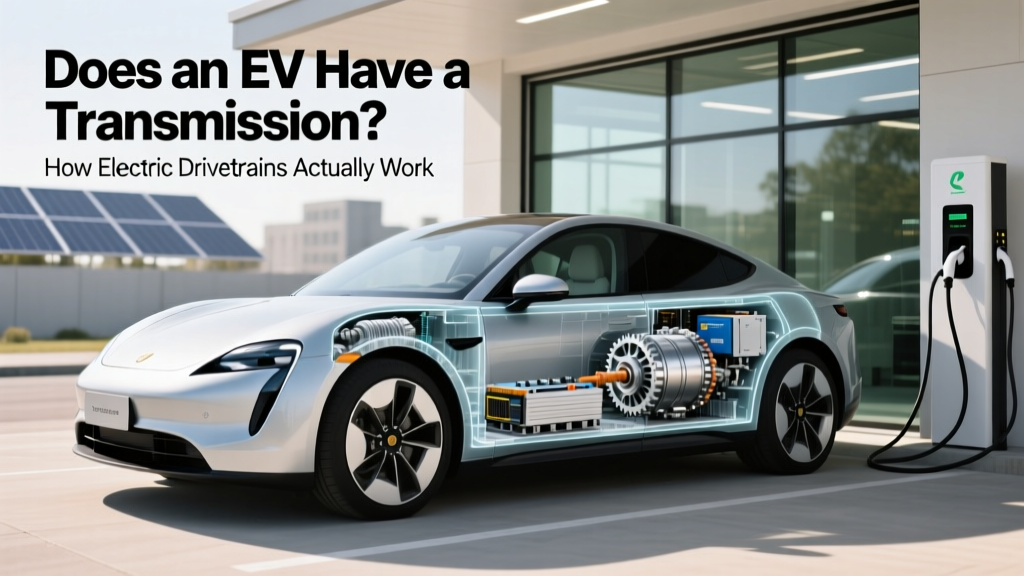
Most battery-electric vehicles (BEVs) do not have a traditional multi-speed transmission. Instead, they use a single-speed reduction gear — typically a fixed-ratio gearbox with a ratio around 9:1 to 10:1 — that transfers torque from the electric motor to the wheels. Because electric motors produce maximum torque from 0 RPM and can rev to 15,000–20,000 RPM, there's no need for gear changes to stay in a narrow power band the way an internal combustion engine (ICE) requires.
A handful of EVs — notably the Porsche Taycan and Audi e-tron GT — use a two-speed rear axle gearbox for optimized launch acceleration and high-speed efficiency. But these are exceptions, not the rule.
If you're shopping for an EV and wondering whether you'll deal with shift points, transmission fluid changes, or the sluggish downshifts common in some automatics, the answer is almost certainly no. The simplicity of the EV drivetrain is one of the technology's most underappreciated advantages — and it has real implications for performance, maintenance cost, and long-term reliability.
How an EV Drivetrain Works Without Gears
A gasoline engine produces usable torque in a narrow RPM window — typically between 1,500 and 5,000 RPM — and redlines around 6,000–7,000 RPM. A multi-speed transmission (6, 8, or even 10 speeds in modern ICE vehicles) is required to keep the engine in that sweet spot as vehicle speed increases. Shift too early and the engine lugs; shift too late and you waste fuel and stress components.
An electric motor operates on fundamentally different physics:
- Instant torque: Maximum torque is available from 0 RPM. This is why even modest EVs feel punchy off the line — a base Tesla Model 3 RWD hits 0–60 mph in 5.8 seconds with just 271 hp, because all 317 lb-ft of torque is available the moment you touch the pedal.
- Wide RPM range: EV motors spin to 15,000–20,000 RPM. A single fixed gear ratio can multiply that motor speed down to a practical wheel speed while covering 0 to 120+ mph without ever needing to shift.
- Regenerative braking: When you lift off the accelerator, the motor reverses role and becomes a generator, slowing the car and recapturing energy. No transmission is needed to manage this — it's handled entirely by the motor controller and power electronics.
The single-speed reduction gear sits between the motor and the differential (or is integrated into a combined drive unit). It has far fewer moving parts than a conventional automatic or dual-clutch transmission — no torque converter, no clutch packs, no bands, no valve body, no planetary gear sets.
EV Drivetrain vs. Gas Car: A Mechanical Comparison
The table below shows the stark difference in moving parts and maintenance needs between a typical BEV drivetrain and a conventional ICE powertrain:
| Component | Battery Electric Vehicle | Gasoline Car (ICE) |
|---|---|---|
| Transmission type | Single-speed reduction gear | 6–10 speed automatic / CVT / DCT |
| Moving parts in drivetrain | ~20–30 (motor, gear set, bearings) | ~200+ (gears, clutches, torque converter, etc.) |
| Transmission fluid changes | Every 60,000–100,000 mi (some "lifetime fill") | Every 30,000–60,000 mi ($150–$300 per service) |
| Engine oil changes | None | Every 5,000–10,000 mi ($40–$80 each) |
| Exhaust system | None | Catalytic converter, muffler, O2 sensors |
| Spark plugs / ignition | None | Replace every 30,000–100,000 mi |
| Brake pad wear | Reduced (regen handles most deceleration) | Normal wear, replace every 30,000–70,000 mi |
| Typical powertrain warranty | 8 yr / 100,000 mi (battery + drive unit) | 5 yr / 60,000 mi (powertrain) |
The U.S. Department of Energy notes that EVs have significantly fewer drivetrain components, which translates directly into lower scheduled maintenance costs over the vehicle's life.
Exceptions: EVs That Do Use Multi-Speed Gearboxes
A small number of performance EVs use a two-speed transmission on the rear axle:
- Porsche Taycan / Audi e-tron GT: A two-speed rear gearbox uses a short first gear for explosive launches (0–60 in 2.6 seconds for the Taycan Turbo S) and a tall second gear for efficient highway cruising. The shift occurs around 50–60 mph and is nearly imperceptible.
- Rimac Nevera (hypercar): Uses single-speed front and two-speed rear, but this is a $2M+ limited-production vehicle.
Why don't more EVs do this? The efficiency gain from a second gear is marginal — typically 1–3% improvement in highway energy consumption — and it adds weight, cost, and complexity. For most manufacturers, the tradeoff isn't worth it. Tesla explored a two-speed gearbox in early Roadster prototypes but abandoned it in favor of a larger, more powerful motor with a single gear.
What This Means for Maintenance Costs
The absence of a multi-speed transmission is a major reason EVs cost less to maintain. According to Consumer Reports, EV owners spend roughly 50% less on maintenance and repair over the vehicle's lifetime compared to gas-car owners. Here's a realistic 5-year cost comparison for a mid-size sedan driven 12,000 miles per year:
| Cost Category (5 Years / 60,000 mi) | EV (e.g., Tesla Model 3) | Gas Sedan (e.g., Toyota Camry) |
|---|---|---|
| Transmission fluid service | $0–$150 (if required) | $300–$600 |
| Engine oil changes | $0 | $400–$800 |
| Brake pad replacement | $0–$250 (regen extends life) | $400–$700 |
| Spark plugs / ignition | $0 | $200–$400 |
| Air filter / cabin filter | $50–$100 (cabin only) | $100–$200 |
| Coolant service | $100–$150 | $150–$250 |
| Total estimated maintenance | $150–$650 | $1,550–$2,950 |
The drivetrain simplicity also means fewer catastrophic failures. Automatic transmission replacements on gas cars run $3,000–$7,000 out of warranty. EV drive units rarely fail in normal ownership, and when they do, they're covered under the federally mandated 8-year/100,000-mile powertrain warranty.
Myths vs. Facts About EV Transmissions
| Myth | Fact |
|---|---|
| "EVs have no gears at all." | EVs have a single-speed reduction gear (fixed ratio ~9:1). It's a gear — just not a shifting one. |
| "No transmission means EVs can't go fast." | The Lucid Air Sapphire hits 0–60 in 1.89 seconds and a top speed of 205 mph — with a single-speed gearbox. |
| "EVs need transmission fluid changes like gas cars." | Some EVs use gear oil in the reduction gear, but intervals are 60,000–100,000+ miles and the quantity is small (~1–2 quarts). |
| "Without gears, EVs are inefficient on the highway." | Electric motors are 85–95% efficient across their RPM range. Gas engines peak at ~35–40% efficiency and need gears to stay near that peak. |
| "EV drivetrains wear out faster." | Electric motors have one moving part (the rotor). Drive units routinely last 200,000+ miles with minimal degradation. |
Real-World Ownership: What a First-Time EV Buyer Should Know
The transmission question connects to bigger ownership considerations. Here's what actually matters when you're deciding between an EV, a hybrid, or a gas car:
Home Charging Access
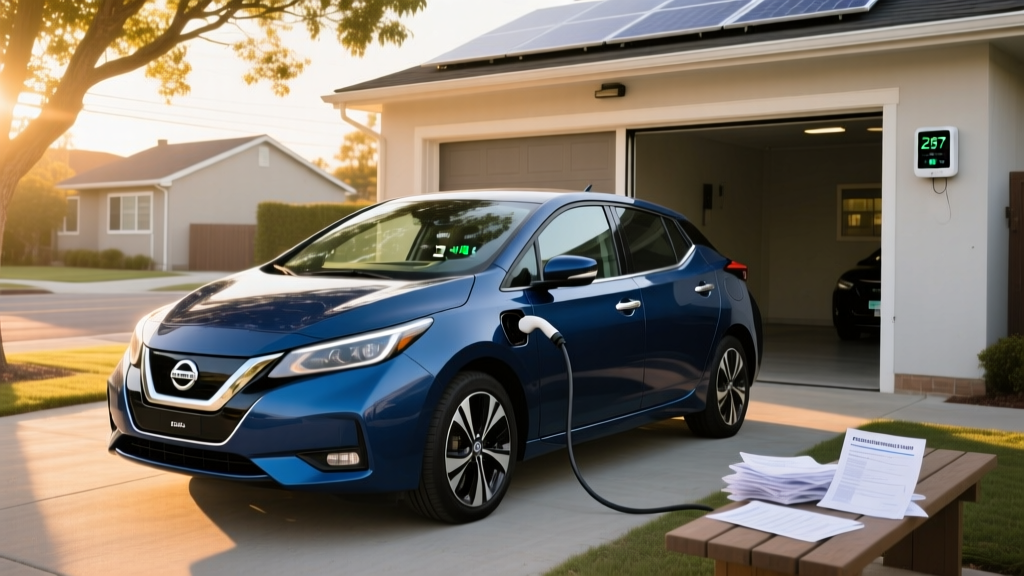
EV ownership is dramatically better with Level 2 home charging. A 240V / 48-amp home charger (like a ChargePoint Home Flex or Tesla Wall Connector) adds roughly 30–44 miles of range per hour of charging and costs $500–$1,200 for equipment plus $500–$2,000 for electrician installation depending on your panel capacity. Without home charging, you'll rely on public DC fast charging, which costs $0.30–$0.60/kWh — roughly double home rates — and requires time you wouldn't spend at a gas pump.
Climate and Range
Cold weather reduces EV range by 15–30% because the battery must be heated and cabin heating draws from the traction battery. A vehicle rated at 310 miles EPA may deliver 220–260 miles in sustained sub-freezing driving. If you live in a cold climate, oversize your range target by 25–30%.
Federal Tax Credit (IRS §30D)
For 2026, the federal EV tax credit offers up to $7,500 for qualifying new BEVs — but eligibility depends on MSRP caps ($55,000 for sedans, $80,000 for SUVs/trucks), buyer income limits ($150,000 single / $300,000 joint AGI), and strict battery-component and critical-mineral sourcing requirements. The credit can now be transferred to the dealer at point of sale as an instant discount. Always verify current eligibility on IRS.gov before purchasing, as sourcing rules tighten annually.
Fuel Cost Savings
At the U.S. average electricity rate of ~$0.17/kWh and an EV efficiency of 3.5 miles/kWh, fuel cost is roughly $0.049/mile. A gas car averaging 28 MPG at $3.30/gallon costs $0.118/mile. Over 60,000 miles, that's a savings of approximately $4,140 in fuel alone — and in states with cheaper electricity or expensive gasoline, the gap widens further.
Decision Framework: Should You Buy an EV, Hybrid, or Stick With Gas?
- Choose a BEV if: You have reliable home or workplace Level 2 charging, your daily driving is under 200 miles, and you want the lowest per-mile operating cost and minimal maintenance. The single-speed drivetrain means fewer things to break.
- Choose a PHEV if: You want electric-only commuting (typically 25–45 miles) but lack reliable charging on road trips, or you live in an apartment without charging access and need gas flexibility.
- Choose a gas car / HEV if: You regularly drive 400+ miles between charging options, live in an extreme cold climate with limited charging infrastructure, or need the lowest possible purchase price without waiting for tax-credit savings to offset the premium.
Frequently Asked Questions
Do Teslas have a transmission?
No Tesla model uses a multi-speed transmission. All Tesla vehicles (Model 3, Model Y, Model S, Model X, Cybertruck) use a single-speed reduction gear. The Model S Plaid, which produces 1,020 hp and hits 0–60 in 1.99 seconds, accomplishes this with a single gear ratio.
Does an EV have a clutch?
No. Because there's no multi-speed gearbox to engage and disengage, EVs have no clutch. Acceleration is managed entirely by the inverter controlling how much current flows to the motor. This is why EVs deliver perfectly smooth, uninterrupted acceleration with no shift shock.
Can an EV tow without a multi-speed transmission?
Yes, though towing significantly reduces range. The Ford F-150 Lightning (single-speed) is rated to tow up to 10,000 lbs, and the Rivian R1T tows up to 11,000 lbs. However, towing at highway speeds can cut EV range by 40–55% due to the energy required to move the trailer's mass and overcome aerodynamic drag. Gas trucks use lower gears for towing; EVs simply draw more current from the battery.
Why don't all EVs use two-speed transmissions for better efficiency?
The efficiency gain is marginal (1–3%) and doesn't justify the added weight (~30–50 lbs), cost ($500–$1,500 at scale), and complexity for most vehicles. Porsche accepts this tradeoff in the Taycan because launch performance is central to the brand. For mainstream EVs, engineers prefer to optimize the motor and inverter rather than add gears.
Will I ever need to replace my EV's reduction gear?
It's extremely unlikely during normal ownership. The reduction gear has no friction clutches or bands to wear. The main service item is gear oil, which some manufacturers specify at 60,000–100,000 miles and others label "lifetime fill." Drive unit failures are rare and covered under the 8-year/100,000-mile federal powertrain warranty mandate.
Do hybrids have transmissions?
Yes — and they vary widely. Toyota's hybrid system uses an eCVT (planetary gear set that blends engine and motor power with no fixed gear ratios). Hyundai/Kia PHEVs use a conventional 6-speed automatic. Honda's two-motor hybrid system operates mostly as a series hybrid with a single-speed clutch lock at highway speeds. The transmission question is more complex for hybrids than for BEVs.