Does Amazon Own Rivian? Separating Investment from Ownership
If you have been searching "does Amazon own Rivian," the short answer is no — Amazon does not own Rivian. However, Amazon is one of Rivian's largest shareholders and a critical strategic partner. The e-commerce giant initially invested over $1.3 billion in Rivian before its 2021 IPO and ordered 100,000 EDV (Electric Delivery Van) units for its logistics fleet. As of early 2026, Amazon still holds a significant equity stake (roughly 16-18% of outstanding shares, though exact figures fluctuate with open-market transactions), but Rivian remains an independent, publicly traded company (NASDAQ: RIVN) with its own board, management, and product roadmap.
For EV buyers, the Amazon relationship matters because it provides Rivian with a stable revenue stream from commercial van production, helping fund R&D for consumer vehicles like the R1T truck and R1S SUV. It also means Rivian has manufacturing scale at its Normal, Illinois plant that many EV startups never achieve. But the consumer vehicles you can actually buy are entirely Rivian's own design — let's break down exactly what you get in 2026.
2026 Rivian R1T & R1S: Quick Verdict
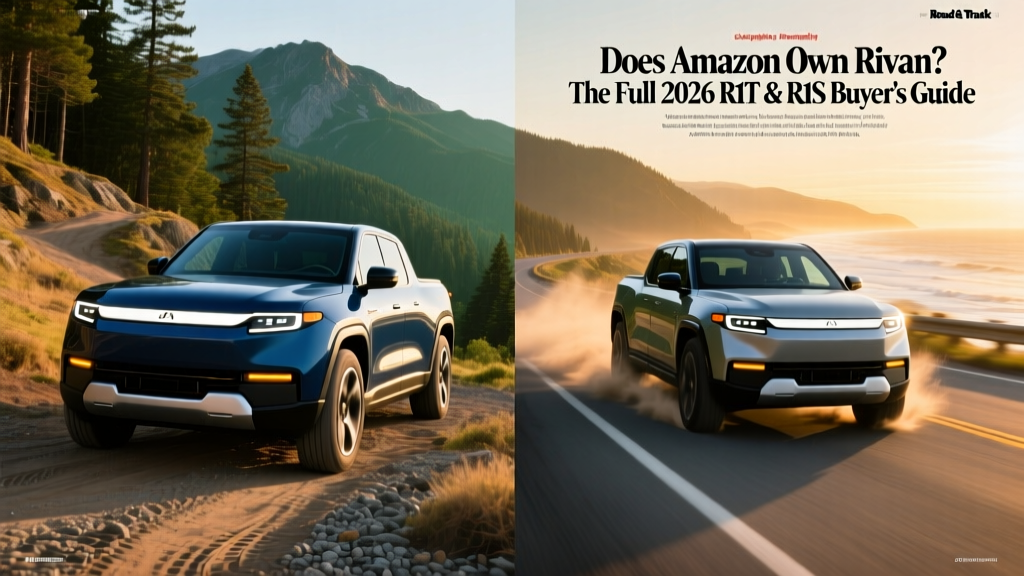
The 2026 Rivian R1T (crew-cab pickup) and R1S (three-row SUV) share the same skateboard platform, battery options, and dual/quad-motor powertrains. Both received a major Gen 2 update starting with the 2025 model year that simplified wiring, reduced weight, added a heat pump, and introduced the Rivian Autonomy Platform with enhanced ADAS. These are performance-adventure vehicles: blisteringly quick, genuinely off-road capable, and practical enough for daily family use — if you can absorb the premium price tag.
| Spec | Dual-Motor (Standard) | Tri-Motor | Quad-Motor |
|---|---|---|---|
| Drivetrain | AWD (2 motors) | AWD (3 motors) | AWD (4 motors, torque vectoring) |
| Horsepower | 533 hp | 850 hp | 1,025 hp |
| 0-60 mph | 4.5 sec | 2.9 sec | 2.5 sec |
| Battery (usable) | 92 kWh (Standard) / 118 kWh (Large) NMC | 141 kWh (Max) NMC | 141 kWh (Max) NMC |
| EPA Range (R1T) | 270 mi (Std) / 352 mi (Lg) | 420 mi (Max) | 420 mi (Max) |
| Max DC Fast Charge | 200 kW | 220 kW | 220 kW |
| 10-80% DCFC Time | ~28 min (Large Pack) | ~35 min (Max Pack) | ~35 min (Max Pack) |
| Level 2 Home Charging | 11.5 kW (~25 mi/hr) | 11.5 kW (~25 mi/hr) | 11.5 kW (~25 mi/hr) |
| Towing Capacity | 11,000 lbs | 11,000 lbs | 11,000 lbs |
Real-World Range: What the EPA Sticker Doesn't Tell You
EPA Estimated: 352 miles (Dual-Motor, Large Pack, 20" wheels)
Real-World Highway (70-75 mph): Expect ~280-310 miles. The R1T's boxy aerodynamics and 6,800+ lb curb weight hit efficiency hard at sustained speed.
Cold Weather (below 32°F): Plan for 20-30% range reduction, yielding ~220-260 miles in freezing conditions without preconditioning. The Gen 2 heat pump helps, but physics still wins.
Towing: With a 5,000+ lb trailer, range drops to roughly 150-180 miles. Plan charging stops accordingly.
Rivian offers three battery sizes for 2026: the Standard Pack (~92 kWh usable, NMC chemistry), the Large Pack (~118 kWh usable, NMC), and the Max Pack (~141 kWh usable, NMC). All use nickel-manganese-cobalt (NMC) cells — Rivian has not adopted LFP (lithium iron phosphate) chemistry for its consumer vehicles, prioritizing energy density for range and performance over the lower cost and longer cycle life that LFP provides. If you want the 420-mile Max Pack range, be prepared for a significant price premium and longer charging times due to the larger battery.
Efficiency on the Dual-Motor Large Pack lands around 70 MPGe combined (roughly 48 kWh/100 mi) per fueleconomy.gov. That is thirstier than a Tesla Model Y or Hyundai Ioniq 5, but competitive for a body-on-frame truck with genuine off-road hardware.
Charging Speed: DC Fast Charge and Home Level 2 Breakdown
| Charging Level | Power / Rate | Miles Added per Hour | Notes |
|---|---|---|---|
| Level 1 (120V) | ~1.4 kW | ~3 mi/hr | Emergency/trickle only |
| Level 2 (240V, 48A) | 11.5 kW | ~25 mi/hr | Full charge overnight (~10-14 hrs for Large Pack) |
| DC Fast Charge (peak) | 200-220 kW | ~600+ mi/hr (peak) | 10-80% in 28-35 min; tapers significantly above 80% |
Rivian uses the NACS (North American Charging Standard / Tesla-style) connector for all 2026 models, meaning native access to Tesla Supercharger V3 and V4 stalls — a major advantage over CCS-only vehicles. At a 250 kW Supercharger or Electrify America station, the Large Pack peaks around 200 kW and sustains roughly 150-170 kW through the 20-60% state-of-charge window before tapering. The Max Pack can pull up to 220 kW peak but takes longer overall due to its larger capacity.
For home charging, Rivian's Wall Connector (or any J1772/NACS Level 2 EVSE) on a 60A circuit delivers 11.5 kW, adding about 25 miles of range per hour. A full Large Pack charge from 10% to 100% takes roughly 10-12 hours — feasible overnight for most commuters. If your daily driving is under 60 miles, even a 32A Level 2 setup (7.7 kW) will replenish your battery by morning.
Pricing, Trims, and Federal Tax Credit Eligibility
| Configuration | Base MSRP | Federal Tax Credit (§30D) | Effective Price (if eligible) |
|---|---|---|---|
| R1T Dual-Motor Standard Pack | $69,900 | Up to $7,500 | ~$62,400 |
| R1T Dual-Motor Large Pack | $75,900 | Up to $7,500 | ~$68,400 |
| R1T Tri-Motor Max Pack | $99,900 | Up to $7,500 | ~$92,400 |
| R1T Quad-Motor Max Pack | $109,900 | Up to $7,500 | ~$102,400 |
Destination fee (~$1,800) not included. Prices subject to change; verify at Rivian.com.
The federal EV tax credit under IRS §30D offers up to $7,500 for qualifying new EVs, but eligibility is not automatic. Here is what you need to know for Rivian in 2026:
- MSRP Cap: Pickup trucks (R1T) must have an MSRP at or below $80,000 to qualify. This means the Dual-Motor Standard and Large Pack trims qualify, but the Tri-Motor and Quad-Motor Max Pack trims (above $80,000 MSRP) do not qualify for the federal credit. The R1S SUV has a higher $80,000 cap as well (SUVs/vans/pickups share the same cap).
- Buyer Income Limits: Modified adjusted gross income (MAGI) must not exceed $300,000 (joint filers), $225,000 (head of household), or $150,000 (single filers).
- Battery Sourcing Requirements: The $7,500 credit is split into two halves — $3,750 for critical minerals sourcing and $3,750 for battery component manufacturing. Rivian has worked to increase North American and FTA-partner sourcing, but the exact credit amount per configuration can vary. Check the fueleconomy.gov tax credit lookup for the specific trim you are considering.
- Point-of-Sale Transfer: As of 2024, you can transfer the credit to the dealer at purchase, reducing your out-of-pocket cost immediately rather than waiting to claim it on your tax return.
Bottom line: If you want the credit, target a Dual-Motor R1T under $80,000 MSRP and confirm your income eligibility. Consult a tax professional for your specific situation — rules are subject to legislative changes.
Interior, Cargo, and Technology
The R1T is a crew-cab pickup with seating for five and a 4.5-foot bed (54 inches long). Total cargo volume behind the rear seats is 11 cu ft (in-cab), plus the bed and a front trunk (frunk) offering 11 cu ft — one of the largest frunks in any EV, perfect for storing charging cables or a cooler. The R1T's signature feature is the Gear Tunnel (available on certain configurations), a lockable pass-through storage compartment between the cab and bed that holds long items like skis or fishing rods.
Inside, Rivian uses a minimalist design anchored by a 15.6-inch landscape touchscreen running Rivian's proprietary OS. Wireless Apple CarPlay and Android Auto are standard. The digital instrument cluster is 12.3 inches. Build quality on Gen 2 models (2025+) is noticeably improved over early 2022-2024 units, with better panel gaps and more consistent materials. Vegan leather upholstery is standard; real leather is not offered.
Rear-seat space is generous: 38.5 inches of legroom (R1T), which is competitive with a Ford F-150 Lightning and superior to many midsize trucks. The R1S adds a third row, though it is best suited for children — adults will find it tight on longer trips.
Driver Assistance: Rivian's driver-assist suite (Rivian Autonomy Platform) includes adaptive cruise control, lane-centering, automatic emergency braking, and blind-spot monitoring. This is an SAE Level 2 system — the driver must remain attentive and keep hands on the wheel. It is not self-driving. Hands-free driving on mapped highways has been rolling out via OTA updates, but as of early 2026, it is not as broadly available as GM's Super Cruise or Ford's BlueCruise. Rivian is actively expanding this capability.
Pros, Cons, and Who Should Buy
Pros
- Class-leading performance: 2.5-second 0-60 (Quad-Motor) is supercar territory in a pickup
- Native NACS connector — seamless Supercharger access without adapters
- Genuine off-road capability: 14.9" ground clearance (max), 43" wading depth, tank turns (Quad-Motor)
- Massive frunk and Gear Tunnel storage
- Over-the-air updates continuously add features
- Strong build quality on Gen 2 (2025+) models
Cons
- Premium pricing — most trims above $75,000; performance trims exceed $100,000
- Efficiency lags behind unibody EVs (70 MPGe vs. 100+ for crossovers)
- Real-world highway and cold-weather range drop is significant for the boxy shape
- Service center network is still growing — rural owners may face long tow distances
- Third row in R1S is cramped for adults
- Tri/Quad-Motor trims do not qualify for the $7,500 federal tax credit (MSRP cap)
Who this EV suits best: The Rivian R1T is ideal for adventure-oriented buyers who need truck utility (towing, hauling, off-roading) but want EV performance and daily-driver comfort. It works well as a family vehicle with a bed. The R1S fits families needing three rows who prioritize capability over minivan practicality. If you tow frequently, plan routes around charging — the range hit is real. If you mostly commute under 60 miles and want a weekend adventure rig, the R1T Large Pack is the sweet spot.
Warranty and Long-Term Ownership
Rivian provides a 5-year/60,000-mile limited vehicle warranty and an 8-year/175,000-mile battery and drive-unit warranty. The battery warranty guarantees that the pack will retain at least 70% of its original capacity during the coverage period. This is competitive with Tesla's 8-year/150,000-mile (or 120,000-mile depending on model) battery warranty and slightly more generous on mileage.
Rivian's NMC batteries have shown modest degradation in early high-mileage reports — roughly 5-8% loss over the first 50,000 miles based on owner community data. The Gen 2 thermal management system with heat pump should improve long-term longevity, but multi-year data is still accumulating. As with all NMC packs, avoiding frequent 100% charges and DC fast-charging only when necessary will help preserve state of health (SoH).
Insurance costs for the R1T/R1S tend to run 15-25% higher than comparable gas trucks due to repair costs and vehicle price. Get quotes before purchasing — they vary significantly by state and driver profile.
Is the Rivian R1T Worth It vs. the Competition?
The R1T's direct rivals are the Ford F-150 Lightning (lower price, less performance, more conventional truck feel), the Chevrolet Silverado EV (400-mile range available, but larger and less agile), and the Tesla Cybertruck (stainless steel, polarizing design, similar performance claims). Against these, the Rivian stands out for its combination of on-road performance, off-road chops, and thoughtful storage solutions. It is the most expensive option in most configurations, but it also feels the most purpose-built for the adventure-EV buyer.
If you do not need a truck bed, the R1S competes with the Tesla Model X, Kia EV9, and upcoming three-row electric SUVs. The R1S offers more off-road capability than any of them, but at a higher price and lower efficiency.
Frequently Asked Questions
Does Amazon own Rivian in 2026?
No. Amazon is a major shareholder (estimated 16-18% stake) and a commercial customer (100,000 EDV vans ordered), but Rivian is an independent public company traded on NASDAQ under ticker RIVN. Amazon does not control Rivian's consumer vehicle strategy.
What is the real-world range of the Rivian R1T?
The EPA rates the Dual-Motor Large Pack R1T at 352 miles. In real-world highway driving at 70-75 mph, expect 280-310 miles. In freezing temperatures, plan for 220-260 miles. Towing cuts range roughly in half.
How fast does the Rivian R1T charge?
On a DC fast charger, the Large Pack peaks at 200 kW and charges from 10-80% in about 28 minutes. The Max Pack peaks at 220 kW but takes ~35 minutes for 10-80% due to its larger 141 kWh capacity. At home on Level 2 (11.5 kW), expect ~25 miles of range per hour.
Does the Rivian R1T qualify for the $7,500 federal EV tax credit?
The Dual-Motor trims with MSRP at or below $80,000 qualify, subject to buyer income limits ($300K joint / $150K single) and battery-sourcing requirements. Tri-Motor and Quad-Motor trims exceed the $80,000 MSRP cap and do not qualify. Always verify current eligibility on irs.gov and consult a tax professional.
Is the Rivian R1T good for towing?
It tows up to 11,000 lbs, which is competitive with full-size gas trucks. However, towing drastically reduces range — expect 150-180 miles with a heavy trailer. If you tow long distances frequently, charging logistics will be your biggest challenge.
Can I use Tesla Superchargers with a Rivian?
Yes. All 2026 Rivian models come with the NACS (Tesla-style) charge port natively, so you can plug directly into Supercharger V3 and V4 stalls without an adapter. Rivian also supports other networks like Electrify America and EVgo via the same port.
What is Rivian's battery warranty?
Rivian covers the battery and drive units for 8 years or 175,000 miles, whichever comes first. The warranty guarantees the battery will retain at least 70% of its original capacity during that period.