The Electric SRT in 60 Seconds
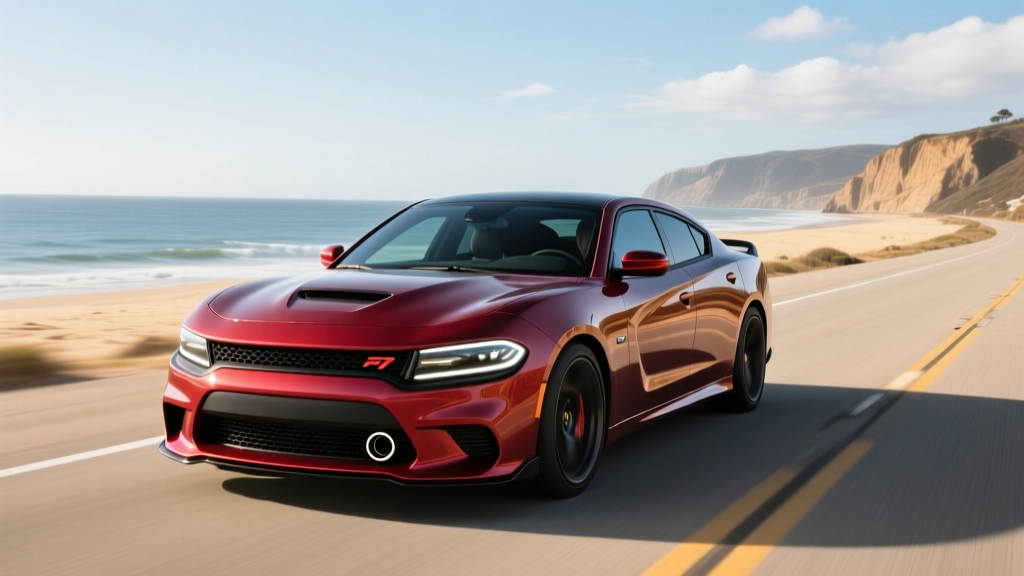
The "electric SRT" refers to the Dodge Charger Daytona EV, specifically the high-performance Scat Pack trim producing up to 670 horsepower and 627 lb-ft of torque with the Direct Connection Stage 2 upgrade. The base R/T trim delivers 496 hp. EPA range sits at 317 miles (R/T) and 260 miles (Scat Pack). Pricing starts around $61,590 for the R/T and climbs to $75,590 for the Scat Pack (before incentives). It's one of the fastest-accelerating production muscle cars ever built — 0-60 in 3.3 seconds for the Scat Pack — but real-world highway range drops to roughly 210-230 miles, and DC fast charging peaks at 175 kW, meaning 10-80% takes about 27 minutes. If you want tire-shredding performance with zero tailpipe emissions, this is the EV. If you need 400-mile road-trip range or the cheapest cost-per-mile, keep reading before you sign.
What Exactly Is the Electric SRT?
Dodge retired the Challenger and Charger gas muscle cars after 2023, replacing them with the Charger Daytona EV built on Stellantis's STLA Large platform. While Dodge hasn't officially slapped the "SRT" badge on the EV (yet), the Scat Pack trim carries the performance torch with track-tuned suspension, launch control, and power figures that eclipse the old 6.2L supercharged Hellcat V8 in straight-line acceleration. The term "electric SRT" has stuck in enthusiast communities as shorthand for the top-performance Charger Daytona EV.
For 2025-2026, Dodge offers two main trims:
- Charger Daytona R/T: 496 hp, 404 lb-ft, 317-mile EPA range, starting at ~$61,590
- Charger Daytona Scat Pack: 670 hp (Stage 2), 627 lb-ft, 260-mile EPA range, starting at ~$75,590
Both use a 100.6 kWh (gross) lithium-ion NMC battery pack with an 800-volt architecture, dual motors, and standard all-wheel drive.
Range, Charging, and the Real-World Reality Check
The EPA numbers look respectable on paper, but muscle-car aerodynamics and 5,800+ pound curb weights eat electrons fast on the highway. Here's what the data actually means for your driving life.
| Spec | R/T | Scat Pack |
|---|---|---|
| Battery (gross / usable) | 100.6 kWh / ~92 kWh | 100.6 kWh / ~92 kWh |
| Chemistry | NMC | NMC |
| EPA Range | 317 miles | 260 miles |
| Real-World Highway (75 mph) | ~250-270 miles | ~210-230 miles |
| Cold-Weather Range (20°F) | ~230-250 miles | ~185-205 miles |
| Peak DC Fast Charge | 175 kW | 175 kW |
| 10-80% DC Fast Charge | ~27 minutes | ~27 minutes |
| Level 2 Home Charging | 11.5 kW (~44 mi/hr) | 11.5 kW (~34 mi/hr) |
| Horsepower | 496 hp | 670 hp (Stage 2) |
| 0-60 mph | 4.7 seconds | 3.3 seconds |
| Drivetrain | Dual-motor AWD | Dual-motor AWD |
| Curb Weight | ~5,838 lbs | ~5,888 lbs |
| Base MSRP | ~$61,590 | ~$75,590 |
| Battery Warranty | 8 yr / 100,000 mi | 8 yr / 100,000 mi |
Real-World Range Expectations
EPA Sticker: 317 mi (R/T) / 260 mi (Scat Pack)
Highway (75 mph, 70°F): ~250-270 mi (R/T) / ~210-230 mi (Scat Pack)
Cold Weather (20°F, mixed): ~230-250 mi (R/T) / ~185-205 mi (Scat Pack)
Why the drop? The Charger Daytona's blunt muscle-car profile creates significant aerodynamic drag at highway speeds, and cold temperatures reduce NMC battery efficiency by 15-25%. The Scat Pack's wider 20-inch wheels and stickier tires add rolling resistance. Plan charging stops accordingly on road trips over 200 miles.
Charging Speed Context
The 800V architecture enables 175 kW peak DC fast charging — adequate but not class-leading. Competitors like the Hyundai Ioniq 5 N (240 kW peak, ~18 min 10-80%) and Lucid Air (300+ kW) charge noticeably faster. The Charger Daytona's charge curve tapers significantly above 80% SoC, so plan to unplug at 80% on road trips rather than waiting for a full charge. At a Level 2 home charger (11.5 kW / 48A), a full charge from empty takes roughly 8.5-9 hours — plug in overnight and wake up full.
Electric SRT vs. Gas Hellcat: Cost and Performance Breakdown
The old Charger SRT Hellcat Redeye (2023) produced 797 hp from a supercharged 6.2L V8, but the electric Scat Pack's instant torque and AWD traction give it a 0-60 advantage despite lower peak horsepower. Here's how ownership costs compare over five years and 75,000 miles.
| Category | Scat Pack EV ($75,590 MSRP) | Hellcat Gas (est. $82,000 MSRP) |
|---|---|---|
| Purchase Price (after incentives) | ~$75,590* | ~$82,000 |
| Fuel / Energy (75k mi) | ~$3,400 (home charging avg) | ~$11,250 (15 MPG, $3.60/gal) |
| Maintenance | ~$1,200 (tires, cabin filter, fluid) | ~$4,800 (oil, brakes, plugs, belts) |
| Insurance (avg annual) | ~$3,200/yr ($16,000 total) | ~$3,500/yr ($17,500 total) |
| Estimated Depreciation | ~$30,000 | ~$28,000 |
| 5-Year Total Cost | ~$126,190 | ~$143,550 |
*Federal §30D tax credit eligibility for the Charger Daytona EV is uncertain for 2026 due to battery sourcing and critical-mineral requirements. Check current IRS guidance before assuming a $7,500 credit. The Scat Pack MSRP exceeds the $55,000 sedan cap under some interpretations of the vehicle classification — verify with a tax professional.
The EV saves roughly $7,850 in fuel and $3,600 in maintenance over five years, but higher depreciation and uncertain tax-credit eligibility narrow the gap. Your actual savings depend heavily on local electricity rates, whether you can charge at home, and how many miles you drive annually.
Who Should Buy the Electric SRT (And Who Shouldn't)
The Charger Daytona EV fills a very specific niche: enthusiasts who want muscle-car performance with modern EV tech. It's not a practical commuter or a road-trip champion. Here's a practical decision framework.
Decision Framework: Is the Electric SRT Right for You?
- Choose the Charger Daytona EV if:
- You have Level 2 home charging (240V / 48A+ circuit) and drive under 200 miles daily
- You prioritize 0-60 performance and instant torque over maximum range
- You live in a mild-to-moderate climate (cold weather cuts Scat Pack range to ~190 miles)
- You want a 4-door coupe with usable rear seats and a hatchback trunk (17.4 cu ft cargo)
- You're okay with 27-minute DC fast-charge stops on road trips
- Look elsewhere if:
- You regularly drive 300+ miles between charging stops (consider Lucid Air or Tesla Model S)
- You lack home charging access and depend entirely on public infrastructure
- You live in extreme cold (below 10°F regularly) and need reliable 250+ mile range year-round
- You want the lowest total cost of ownership (a Tesla Model 3 Performance is faster to 60 and costs ~$20K less)
- You need a tow vehicle (the Charger Daytona is not rated for towing)
Federal Tax Credit & Incentive Reality for 2026
The IRS §30D clean vehicle credit offers up to $7,500 for qualifying new EVs, but eligibility depends on three factors that complicate the Charger Daytona's case:
§30D Credit Requirements (2026)
- MSRP Cap: Sedans must be under $55,000; SUVs/trucks under $80,000. The Charger Daytona is classified as a sedan — both trims exceed $55,000. However, some dealers may classify it differently. Verify with your tax advisor.
- Buyer Income Cap: AGI must not exceed $150,000 (single), $225,000 (head of household), or $300,000 (joint).
- Battery Sourcing: Critical minerals and battery components must meet phased-in domestic/free-trade sourcing thresholds that tighten each year. Stellantis has not publicly confirmed full compliance for the Charger Daytona's battery pack.
- Point-of-Sale Transfer: If eligible, you can transfer the credit to the dealer at purchase for an immediate price reduction rather than waiting for tax filing.
Bottom line: Do not count on the $7,500 credit for the Charger Daytona EV until you've confirmed eligibility with a tax professional and verified the vehicle's VIN on fueleconomy.gov. State and utility incentives may still apply — check AFDC's state incentive database for local rebates.
Common Electric SRT Misconceptions
| Myth | Fact |
|---|---|
| "It's just as fast as a Hellcat in every way" | The Scat Pack EV hits 0-60 in 3.3s (quicker than a Redeye), but top speed is electronically limited to ~130 mph vs. the Hellcat's 203 mph. Quarter-mile and track lap times vary. |
| "317 miles of range means 317 miles of driving" | EPA range assumes mixed driving at moderate speeds. At sustained 75-80 mph highway speeds, expect ~250 miles (R/T) or ~210 miles (Scat Pack). Cold weather drops it further. |
| "It charges as fast as a Tesla" | At 175 kW peak, the Charger Daytona charges slower than Tesla Model S (250 kW) and Hyundai Ioniq 5 (240 kW). A 10-80% charge takes ~27 minutes vs. ~15-18 minutes for faster competitors. |
| "No maintenance means zero upkeep costs" | EVs skip oil changes and spark plugs, but the Charger Daytona's 5,800+ lb weight and 670 hp chew through tires quickly. Budget $1,200-$1,800 per set of performance tires every 15,000-25,000 miles. |
| "The battery will need replacing in 5 years" | NMC batteries in modern thermal-managed packs typically retain 85-90% capacity after 100,000 miles. Dodge covers the battery for 8 years/100,000 miles against defects and excessive degradation (below 70% capacity). |
First-Time EV Buyer Essentials for the Charger Daytona
If this is your first EV, here's what the brochure won't tell you:
Home Charging Is Non-Negotiable
The Charger Daytona's 100.6 kWh battery makes Level 1 (120V) trickle charging essentially useless — you'd add only ~3-4 miles of range per hour, meaning a full charge would take over 24 hours. You need a Level 2 home charger (240V, 48A circuit) to fully recharge overnight. Budget $800-$2,500 for a quality Level 2 unit (ChargePoint Home Flex, Emporia Vue, or Wallbox Pulsar Plus) plus $500-$2,000 for professional electrical installation, depending on your panel capacity and run distance. If your home has a 100A electrical panel, you may need a $1,500-$3,000 panel upgrade to 200A to support a 48A charger.
Tire Costs Are the Hidden Expense
Heavy EVs with high torque wear tires 20-40% faster than equivalent gas cars. The Scat Pack's 305-width rear tires (Goodyear Eagle F1 SuperCar 3) cost roughly $350-$450 each. Plan for a full set replacement every 20,000-25,000 miles if you drive aggressively.
Insurance Will Be Higher
Performance EVs carry higher insurance premiums due to repair costs, battery replacement risk, and acceleration-related claim data. Expect quotes 15-30% above an equivalent gas muscle car. Get quotes from at least three insurers before purchasing.
Public Charging Requires Planning
The Charger Daytona uses the CCS1 connector for DC fast charging (Stellantis has announced a future NACS transition, but 2025-2026 models ship with CCS). Networks like Electrify America, EVgo, and ChargePoint support CCS natively. Download multiple charging apps and keep accounts funded before road trips. Preconditioning the battery (via the vehicle's navigation-routed preconditioning feature) before arriving at a DC charger significantly improves charge speed in cold weather.
Frequently Asked Questions
Does the electric SRT have a frunk?
No. The Charger Daytona EV does not have a front trunk (frunk). The hood houses the "eFrunk" delete — Dodge opted for a solid front end for structural rigidity and the signature "Fratzonic" exhaust sound system hardware. Rear cargo space is 17.4 cubic feet via the hatchback liftgate, which is practical for a coupe.
Can I get a manual transmission or RWD in the Charger Daytona EV?
No. The Charger Daytona EV is dual-motor AWD only with a single-speed reduction gear. There is no manual, no RWD-only mode for daily driving (though a "drift mode" can bias torque rearward on closed courses). If you want a rear-drive EV muscle experience, the Ford Mustang Mach-E GT is the closest alternative.
What is the Fratzonic exhaust sound?
Dodge replaced the V8 rumble with a digitally generated "Fratzonic chambered exhaust" system that projects sound through external speakers and the cabin. It mimics a performance exhaust note synchronized to throttle input and speed. Reactions are polarizing — some enthusiasts appreciate the auditory feedback, others find it synthetic. You can turn it off for silent operation.
How does the Charger Daytona EV compare to the Tesla Model S Plaid?
The Model S Plaid (1,020 hp, 0-60 in 1.99s, ~$89,990) is significantly quicker and has faster 250 kW DC charging and 396-mile EPA range. But the Charger Daytona offers a more traditional muscle-car aesthetic, a hatchback, physical buttons, and Dodge's performance brand cachet. The Plaid is the performance benchmark; the Daytona is the emotional choice.
Will Dodge release an actual "SRT" badge variant?
Dodge has not confirmed an SRT-branded Charger Daytona EV as of early 2026. The Scat Pack with Stage 2 Direct Connection upgrade currently serves as the performance flagship. Stellantis has hinted at higher-output variants, but any future SRT model remains unannounced with no confirmed specs or pricing.
Is the Charger Daytona EV eligible for the used EV tax credit?
If you purchase a qualifying used Charger Daytona EV (model year 2025 or later, from a dealer, under $25,000 sale price), it could be eligible for up to $4,000 under the §25E used clean vehicle credit. However, given the vehicle's MSRP, it will take significant depreciation before used prices fall below $25,000 — likely not before 2029-2030 at the earliest.