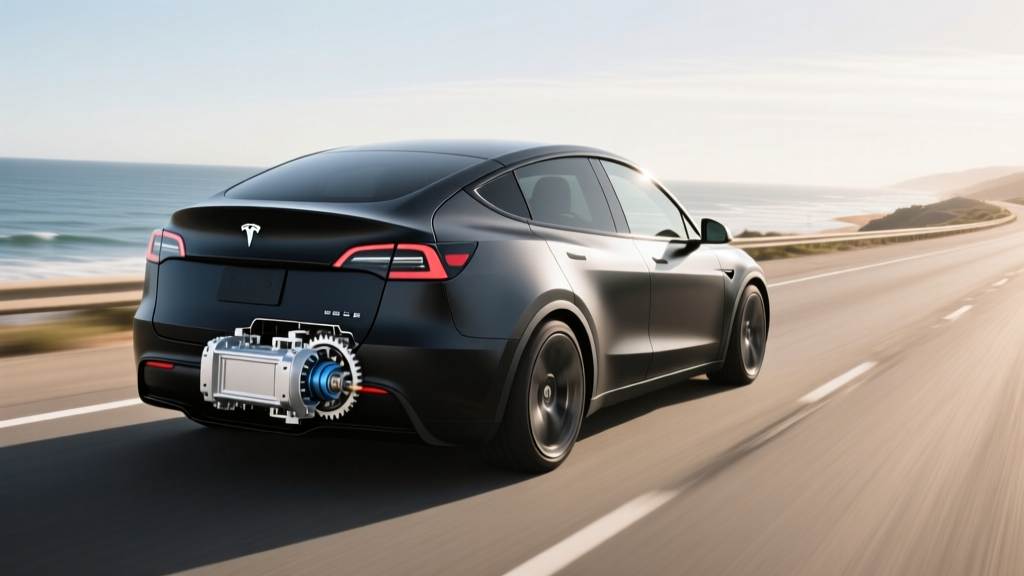
Search "do Teslas have a transmission" and you'll find forums full of conflicting answers. The short version: yes, every Tesla has a transmission — but it's nothing like the multi-speed automatic or manual gearbox in a gas car. It's a single-speed reduction gear, and understanding why Tesla uses one reveals a lot about how the 2026 Model Y delivers its performance, efficiency, and driving feel.
This deep-dive review uses the current-generation 2026 Tesla Model Y as our case study. We'll break down the drivetrain engineering, then move into everything else a buyer needs: EPA range, real-world charging speeds, interior space, pricing, and whether the federal §30D tax credit applies.
The Engineering: Why Tesla Uses a Single-Speed Reduction Gear
Internal combustion engines produce usable torque across a narrow RPM band — typically 1,500 to 5,000 RPM. To keep the engine in that sweet spot as vehicle speed climbs, gas cars need 6, 8, or even 10 forward gears. An electric motor, by contrast, delivers maximum torque from 0 RPM and can spin efficiently up to 15,000–20,000+ RPM. That enormous usable rev range means a single fixed gear ratio can cover everything from a standing start to highway cruising.
In the 2026 Model Y, that single-speed reduction gear sits between the motor(s) and the axle, multiplying torque by roughly 9:1 to 10:1. There are no shift events, no torque interruptions, and no clutch or torque converter. The result is seamless, linear acceleration that gas-car drivers often describe as "effortless."
Tesla briefly experimented with a two-speed transmission in the original 2008 Roadster prototype, but the added weight, complexity, and shift-harshness weren't worth the marginal efficiency gain. Every production Tesla since — including all Model S, 3, X, and Y variants — has used a single-speed unit.
2026 Tesla Model Y: Full Spec Breakdown
| Spec | Long Range RWD | Long Range AWD | Performance AWD |
|---|---|---|---|
| Drivetrain | RWD (single motor) | Dual-Motor AWD | Dual-Motor AWD |
| Horsepower | ~346 hp | ~384 hp | ~456 hp |
| 0–60 mph | 5.8 sec | 4.8 sec | 3.5 sec |
| Transmission | Single-speed reduction gear (all trims) | ||
| Battery (usable) | ~75 kWh (LFP) | ~75 kWh (NMC) | ~75 kWh (NMC) |
| EPA Range | 320 mi | 308 mi | 285 mi |
| MPGe (combined) | 122 MPGe | 117 MPGe | 111 MPGe |
| Efficiency | 27 kWh/100 mi | 29 kWh/100 mi | 30 kWh/100 mi |
| Max DC Fast Charge | ~170 kW | ~250 kW | ~250 kW |
| 10–80% DCFC Time | ~32 min | ~25 min | ~25 min |
| Level 2 Home Charge | 11.5 kW (~44 mi/hr) | 11.5 kW (~44 mi/hr) | 11.5 kW (~44 mi/hr) |
| Cargo (rear seats up) | 34 cu ft | ||
| Cargo (rear seats folded) | 72 cu ft | ||
| Frunk | 4.1 cu ft | ||
| Rear Legroom | 41.6 in | ||
| Battery Warranty | 8 yr / 120,000 mi | 8 yr / 120,000 mi | 8 yr / 120,000 mi |
| Base MSRP | $44,990 | $47,990 | $52,490 |
Range: EPA Sticker vs. Real-World Driving
EPA estimate: 308 miles
70-mph highway loop: ~265–280 miles (sustained speed reduces regen benefit)
City/suburban mixed: ~295–310 miles (frequent regen recovers energy)
Cold weather (below 32 °F): ~230–260 miles (cabin heat + battery resistance)
Tip: The Model Y's heat pump significantly reduces winter range loss compared to older resistive-heater EVs, but expect a 15–25% drop in deep cold.
Tesla's efficiency is among the best in the segment. At 29 kWh/100 mi (Long Range AWD), the Model Y extracts more miles per kilowatt-hour than competitors like the Ford Mustang Mach-E (31 kWh/100 mi) or Hyundai Ioniq 5 (30 kWh/100 mi). That efficiency edge comes partly from the single-speed drivetrain — no parasitic losses from a torque converter, clutch packs, or shift mechanisms.
For context, fueleconomy.gov lists the combined MPGe at 117 for the Long Range AWD trim, making it one of the most efficient electric SUVs on sale.
Charging Speeds: DC Fast, Level 2, and the Charge-Curve Reality
Charging is where kW (power — the rate of energy flow) and kWh (energy — the battery's total capacity) matter most. The Model Y Long Range AWD's 75 kWh battery can accept up to 250 kW of DC fast-charging power — but only at the peak of the charge curve.
| Charge Level | Power | Speed (approx.) | Typical Use Case |
|---|---|---|---|
| Level 1 (120V outlet) | ~1.4 kW | ~5 mi/hr | Emergency / overnight trickle |
| Level 2 (240V, 48A) | 11.5 kW | ~44 mi/hr | Home daily charging |
| DC Fast (V3 Supercharger) | Peak 250 kW | 10–80% in ~25 min | Road trips |
Charge-curve reality check: The 250 kW peak only holds roughly between 10% and 35% state of charge. Above 50%, the rate tapers to ~120 kW; above 80%, it drops below 50 kW to protect battery health. That's why Tesla (and the industry) quotes 10–80% times rather than 0–100%. Charging from 80% to 100% at a Supercharger can add another 25–30 minutes — plan your road-trip stops accordingly.
At home on a Wall Connector (240V, 48 amps), a full overnight session adds roughly 44 miles of range per hour of charging — more than enough to replenish a day's driving in 3–4 hours.
Performance: How the Single-Speed Gearbox Feels on the Road
Without shift events, acceleration in the Model Y is continuous and linear. The Long Range AWD hits 60 mph in 4.8 seconds — quicker than most V6 sport sedans — and the Performance trim drops that to 3.5 seconds, rivaling supercars from a decade ago.
The trade-off of a single-speed gear is top-end efficiency. At very high sustained speeds (above 85 mph), the motor operates at extremely high RPM where efficiency dips slightly. This is why EVs lose proportionally more range at highway speeds than gas cars do. For the vast majority of driving — city, suburban, and even 70–75 mph highway cruising — the single-speed setup is optimal.
The dual-motor AWD system uses independent front and rear motors with no mechanical linkage between them. Torque distribution is managed entirely by software, giving the Model Y traction control response times measured in milliseconds — faster than any mechanical AWD system.
Pricing, Trims, and Federal Tax Credit Eligibility
| Trim | Base MSRP | Est. After §30D Credit | §30D Eligible? |
|---|---|---|---|
| Long Range RWD | $44,990 | ~$37,490 | Yes (if buyer meets income & sourcing rules) |
| Long Range AWD | $47,990 | ~$40,490 | Yes (if buyer meets income & sourcing rules) |
| Performance AWD | $52,490 | ~$44,990 | Yes (under $80,000 SUV cap) |
The IRS §30D clean vehicle credit offers up to $7,500, but eligibility is not automatic. Key requirements for 2026:
- MSRP cap: SUVs must be priced at or below $80,000 (all Model Y trims qualify).
- Buyer income cap: Modified AGI ≤ $300,000 (joint), ≤ $225,000 (head of household), ≤ $150,000 (single).
- Battery sourcing: Critical minerals and battery components must meet phased-in domestic/free-trade-agreement thresholds — these tighten annually. Tesla's North American battery supply chain has generally met these requirements, but verify at the point of sale.
- Point-of-sale transfer: Since 2024, buyers can transfer the credit to the dealer for an immediate price reduction rather than waiting for a tax refund.
Always confirm current-year eligibility on irs.gov and consult a tax professional. Rules change annually, and battery-sourcing compliance can shift with supply-chain updates.
Interior, Cargo, and Standout Technology
The refreshed Model Y interior features a 15.4-inch center touchscreen running Tesla's latest software, ventilated front seats, ambient lighting, and a rear-seat entertainment screen. Build quality on the current generation has improved noticeably over early Fremont-built cars — panel gaps are tighter and materials are more premium.
Cargo space stands at 34 cu ft behind the second row and 72 cu ft with seats folded — competitive with the Hyundai Ioniq 5 (36/60 cu ft) and slightly less than the Ford Mustang Mach-E (29/60 cu ft, though its frunk is larger). The 4.1 cu ft frunk is useful for charging cables or small bags.
Driver assistance: Basic Autopilot (traffic-aware cruise + lane centering) is standard. Full Self-Driving (Supervised) remains a $8,000 add-on or $99/month subscription. Crucially, FSD is a SAE Level 2 system — the driver must remain attentive with hands on the wheel at all times. It is not autonomous driving.
Tesla Autopilot and FSD (Supervised) are SAE Level 2 driver-assist systems. They do not make the vehicle self-driving. The driver is legally and practically responsible for all vehicle operation. Keep hands on the wheel and eyes on the road.
Pros, Cons, and Who Should Buy the 2026 Model Y
- Class-leading efficiency (29 kWh/100 mi)
- 250 kW DCFC — 10–80% in ~25 min
- Supercharger network — the most reliable public charging ecosystem
- Spacious cargo area (72 cu ft max) + frunk
- Strong §30D tax credit eligibility
- Over-the-air updates continuously add features
- No physical buttons — all controls via touchscreen
- FSD (Supervised) is expensive and still Level 2
- Limited dealer/service center footprint vs. legacy brands
- Rear visibility is compromised by the sloping roofline
- Ride can feel firm on rough pavement (especially Performance trim)
- No Apple CarPlay / Android Auto integration
Who the Model Y suits best: Tech-forward commuters and small families who want a practical electric SUV with access to the best fast-charging network available. The Long Range AWD at ~$40,490 (after credit) is the value sweet spot — 308 miles of EPA range, dual-motor traction, and enough cargo space for weekend trips.
Who should look elsewhere: Buyers who prioritize physical controls, want Apple CarPlay, or need a third row (the Model Y's optional third row is very small). If you tow frequently, note the Model Y's 3,500-lb limit — adequate for a small trailer, not a boat or camper.
Frequently Asked Questions
Do Teslas have a transmission?
Yes — every Tesla has a single-speed reduction gear (sometimes called a "1-speed transmission"). It uses a fixed gear ratio of approximately 9:1 to 10:1 to multiply the electric motor's torque. There are no gear shifts, no clutch, and no torque converter.
Why don't Teslas need a multi-speed transmission like gas cars?
Electric motors produce maximum torque from 0 RPM and operate efficiently across a very wide rev range (up to 18,000+ RPM). A gasoline engine's narrow power band requires multiple gears to stay efficient. The single-speed gear eliminates shift lag, mechanical complexity, and maintenance.
What is the real-world range of the 2026 Model Y?
The EPA rates the Long Range AWD at 308 miles. In real-world driving, expect ~265–280 miles on a sustained 70-mph highway trip, ~295–310 miles in mixed city driving, and ~230–260 miles in cold weather (below 32 °F) due to battery resistance and cabin heating demand.
How fast does the Model Y charge at home and on road trips?
At home on a 240V Level 2 Wall Connector (11.5 kW), you'll add ~44 miles of range per hour — a full overnight charge takes about 7–8 hours. On a Tesla V3 Supercharger (250 kW peak), 10–80% takes approximately 25 minutes, though the charge rate tapers significantly above 80%.
Does the 2026 Model Y qualify for the $7,500 federal tax credit?
All Model Y trims fall under the $80,000 SUV MSRP cap, making them potentially eligible. However, the buyer must also meet income limits (≤ $300K joint / $150K single) and the vehicle's battery must satisfy critical-mineral and component-sourcing thresholds that tighten each year. Verify current eligibility at irs.gov.
Is the Model Y worth buying vs. the Hyundai Ioniq 5 or Ford Mach-E?
The Model Y wins on charging network access (Superchargers), efficiency, and software. The Ioniq 5 offers faster 800V charging (~18 min 10–80% on 350 kW chargers), physical buttons, and Apple CarPlay. The Mach-E offers a sportier drive feel and Ford's dealer network. All three are strong — the best choice depends on your priorities: network (Tesla), charging speed and ergonomics (Hyundai), or dealer service access (Ford).
Does the single-speed transmission require maintenance?
Effectively no. The reduction gear uses a small amount of lubricating fluid that Tesla considers sealed for life. There are no transmission fluid changes, clutch replacements, or shift-linkage adjustments — a significant long-term cost advantage over multi-speed automatics.