If you've ever browsed a Tesla forum or chatted with a delivery-center specialist, you've probably wondered: do Tesla employees get a discount on the vehicles they build and sell? It's a fair question — legacy automakers have offered employee pricing for decades. But Tesla operates differently, and the answer reveals a lot about how the company structures compensation, demand, and retail pricing in 2026.
Below, we unpack what Tesla actually offers its workforce, then pivot to the vehicle most employees and buyers alike gravitate toward: the 2026 Tesla Model 3 Long Range AWD. This is our full review — EPA range, real-world efficiency, DC fast-charging curves, pricing, and federal tax credit eligibility — so you can evaluate the Model 3 with the same rigor an insider would.
Do Tesla Employees Get a Discount? The 2026 Reality
The short answer: No, Tesla does not offer a traditional employee purchase discount on new vehicles in 2026. Unlike Ford, GM, or Toyota — which run well-publicized "A-Plan," "Z-Plan," or "Supplier Discount" programs — Tesla has historically avoided employee pricing on cars. The company sells direct-to-consumer at fixed MSRPs with no dealer markups or negotiation, so there's no "invoice price" gap to bridge.
That said, Tesla employees do receive several financial benefits that indirectly reduce the cost of EV ownership:
- Stock-based compensation (RSUs): Most full-time Tesla employees receive restricted stock units. If the stock performs well, those RSUs can effectively subsidize a vehicle purchase — though this is compensation, not a discount.
- Free Supercharging credits: Some Tesla roles (particularly in sales, service, and delivery) have included complimentary Supercharging credits, though the scope of this perk has narrowed since 2023.
- Employee referral programs: Tesla periodically runs referral incentives that employees can leverage, though these are typically identical to public referral programs.
- Demo/loaner vehicle access: Service-center and store employees sometimes drive demonstrator or loaner vehicles that accumulate miles — these occasionally become available as used inventory at reduced prices, which is the closest thing to an "employee deal" Tesla offers.
The bottom line? If you're a Tesla employee shopping for a new Model 3 in 2026, you'll pay the same MSRP as anyone else. Your real financial edge comes from RSUs, potential Supercharging perks, and familiarity with the product. For everyone else, understanding the actual cost of ownership — including the federal tax credit — matters far more than chasing a non-existent discount.
2026 Tesla Model 3 Long Range: Quick Verdict
The 2026 Model 3 Long Range AWD remains Tesla's best all-around sedan. After the "Highland" refresh (introduced for the 2024 model year and refined through 2026), it's quieter, rides better, and features a significantly upgraded interior. With an EPA-estimated 341 miles of range, brisk 4.2-second 0-60 times, and access to Tesla's Supercharger network (now open to all brands via NACS), it's a compelling package — especially at its post-credit price point.
| Spec | Value |
|---|---|
| EPA Range | 341 miles |
| Battery (usable) | ~79 kWh, NMC chemistry |
| Drivetrain | Dual-motor AWD |
| Horsepower | ~384 hp (combined) |
| 0-60 mph | 4.2 seconds |
| Peak DC Fast Charge | 250 kW |
| 10-80% DC Charge Time | ~25 minutes |
| Level 2 Home Charge Rate | 11.5 kW (~44 mi/hr) |
| EPA Efficiency | 131 MPGe / 25 kWh/100mi |
| Cargo Volume | 23 cu ft (trunk + frunk combined) |
| Rear Legroom | 35.3 inches |
| Base MSRP | $47,740 (incl. destination) |
| Battery Warranty | 8 years / 120,000 miles |
Range & Real-World Efficiency: Beyond the EPA Sticker
The EPA rates the 2026 Model 3 Long Range AWD at 341 miles on a full charge. That's among the best in the luxury electric sedan segment, trailing only the Lucid Air Pure (419 mi) and edging out the BMW i4 eDrive40 (307 mi) and Hyundai Ioniq 6 Long Range (342 mi).
- EPA Sticker: 341 miles
- Mixed driving (city + suburban, 65-70°F): ~320-335 miles achievable
- Sustained highway (75 mph, 85°F): ~275-295 miles
- Cold weather (25°F, highway + cabin heat): ~230-260 miles
- Mountain/towing: N/A (not rated for towing)
Source: EPA fueleconomy.gov estimates; real-world figures based on aggregated owner data and independent testing.
Efficiency is where Tesla continues to lead. At 25 kWh per 100 miles (combined), the Model 3 Long Range converts electricity into miles more effectively than nearly any competitor. For context, the BMW i4 eDrive40 uses about 29 kWh/100mi, and the Polestar 2 Long Range uses roughly 27 kWh/100mi. That efficiency gap means cheaper charging costs and more miles per kilowatt-hour at the charger.
One important note: the Model 3 Long Range uses an NMC (nickel manganese cobalt) battery pack, which offers higher energy density than LFP chemistry. Tesla recommends daily charging to 80% for NMC packs and 100% only before long trips. If you prefer a battery you can charge to 100% daily without concern, the Model 3 RWD (which uses an LFP pack) may suit you better — though with a 272-mile range trade-off.
Charging Speed: DC Fast, Level 2, and the Supercharger Advantage
Charging speed is a top concern for EV buyers, and the Model 3 Long Range delivers solid — if not class-leading — performance here.
| Charging Level | Power / Rate | Time / Miles Added |
|---|---|---|
| DC Fast Charge (V3 Supercharger) | Peak 250 kW | 10-80% in ~25 minutes |
| DC Fast Charge (CCS adapter, 350 kW station) | Peak ~250 kW (vehicle-limited) | 10-80% in ~25 minutes |
| Level 2 (Tesla Wall Connector, 48A) | 11.5 kW | ~44 miles per hour |
| Level 2 (standard 240V/32A outlet) | 7.7 kW | ~30 miles per hour |
| Level 1 (120V household) | ~1.4 kW | ~4-5 miles per hour |
The Model 3's charge curve peaks at 250 kW around 10-20% state of charge, then tapers progressively. You'll see sustained rates of ~170-200 kW through 50% SoC, dropping to ~75 kW by 80%. This is why Tesla quotes 10-80% times rather than 0-100% — charging above 80% slows dramatically, as it does in all EVs.
The real differentiator remains the Tesla Supercharger network. With over 25,000 V3/V4 stalls across North America, it remains the most reliable DC fast-charging ecosystem. Plug-in rates are high, stall availability is strong, and the navigation system preconditions the battery automatically when you route to a charger — a feature that meaningfully improves real-world charging speeds in cold weather.
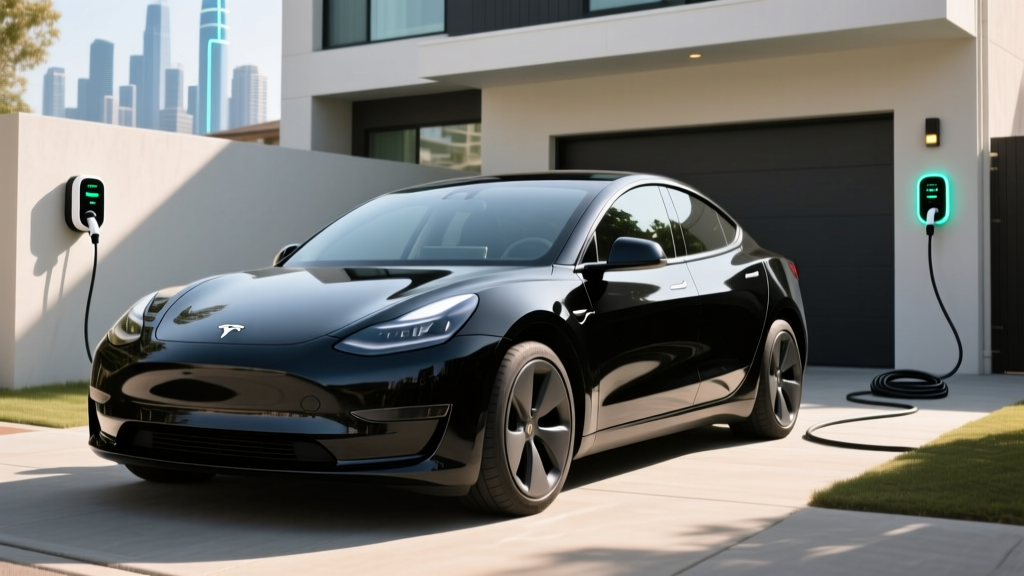
For home charging, the Tesla Wall Connector at 48 amps delivers 11.5 kW, adding roughly 44 miles of range per hour. A full overnight charge (8 hours) restores about 350 miles — more than the battery holds. Most owners install a NEMA 14-50 outlet (~$500-$1,500 for installation depending on panel proximity) and use the Mobile Connector, which maxes out at 32 amps (7.7 kW) on that circuit.
Performance, Ride Quality, and Daily Drivability
The dual-motor AWD powertrain produces approximately 384 horsepower and rockets the Model 3 Long Range to 60 mph in 4.2 seconds. That's comfortably quicker than the BMW i4 eDrive40 (5.5 sec) and the Polestar 2 Long Range (4.5 sec), though the Hyundai Ioniq 6 Long Range AWD (4.5 sec) is close.
Post-Highland, the ride quality has improved substantially. Tesla retuned the suspension, added frequency-selective dampers, and improved sound insulation. The result is a sedan that's still sporty but no longer punishing over broken pavement. Road noise at 70 mph is noticeably reduced — a frequent complaint with pre-2024 Model 3s.
Steering remains quick and precise, though some enthusiasts still find it numb compared to a BMW 3 Series. Regenerative braking offers one-pedal driving with strong deceleration (up to ~0.3g), and the brake pedal feel is natural — a weak point in some competitors.
Interior, Tech, and Driver Assistance
The 2026 Model 3 interior reflects Tesla's minimalist ethos, for better or worse:
- 15.4-inch center touchscreen handles navigation, media, climate, and vehicle controls. No physical buttons exist for climate or volume (a rear 8-inch touchscreen for rear passengers handles their climate and media).
- Ventilated front seats (added in the Highland refresh) with improved cushioning.
- Ambient lighting and premium materials (vegan leather, textile dash inserts) elevate the cabin above pre-refresh models.
- 22-speaker audio system with immersive sound quality rivaling luxury brands.
On the driver-assistance front, Tesla Autopilot (standard) provides adaptive cruise control and lane centering. Full Self-Driving (Supervised) remains an optional upgrade (~$8,000 or $99/month subscription in 2026) and adds automated lane changes, traffic light/stop sign recognition, and city-street navigation.
Both Autopilot and FSD (Supervised) are SAE Level 2 driver-assistance systems. The driver must remain fully engaged, hands on the wheel (or providing steering-torque confirmation), and eyes on the road at all times. Tesla's "Full Self-Driving" branding is misleading — this is not a Level 4 autonomous system like Waymo's driverless robotaxi service. You are the driver.
Notable drawbacks include the lack of a traditional instrument cluster (speed and range info appear on the upper-left corner of the center screen), no Apple CarPlay or Android Auto integration, and turn signals activated by a steering-wheel button rather than a stalk (a Highland change that divides opinion).
Pricing, Tax Credits, and Total Cost of Ownership
The 2026 Tesla Model 3 Long Range AWD starts at $47,740 (including destination). Our as-tested model with Ultra Red paint ($2,000), 19-inch Nova wheels ($1,500), and FSD Supervised ($8,000) came to $59,240.
| Item | Amount |
|---|---|
| Base MSRP (Long Range AWD) | $47,740 |
| Federal Tax Credit (§30D) | Up to $7,500* |
| Effective Price (after credit) | From ~$40,240* |
| As-Tested MSRP | $59,240 |
| As-Tested After Credit | ~$51,740* |
*Federal tax credit eligibility depends on multiple factors per IRS §30D rules:
- MSRP cap: Sedans must be under $55,000 MSRP (the base Long Range qualifies; heavily optioned builds may exceed the cap).
- Income cap: Modified AGI must not exceed $150,000 (single), $225,000 (head of household), or $300,000 (joint filers).
- Battery sourcing: Critical minerals and battery components must meet phased-in domestic/free-trade sourcing thresholds for the full $7,500 ($3,750 for minerals + $3,750 for components). Tesla's US-built packs generally qualify for the full amount in 2026, but verify at purchase.
- Point-of-sale transfer: You can transfer the credit to Tesla at purchase, reducing your out-of-pocket cost immediately rather than waiting for tax filing.
For 5-year ownership costs, the Model 3 Long Range benefits from low fueling costs (~$600/year in electricity at 12,000 miles/year and $0.15/kWh), minimal maintenance (no oil changes, reduced brake wear from regen), and strong resale value. Insurance premiums run higher than average for the segment (~$1,800-$2,400/year depending on profile). Overall, the EPA's fuel cost calculator estimates annual electricity costs at roughly $600-$700 versus $2,000+ for a comparable gasoline sedan.
Pros and Cons
- Class-leading efficiency (25 kWh/100mi)
- 341-mile EPA range — among the best in the segment
- Supercharger network access + NACS standard
- Strong performance (4.2s 0-60) with practical daily comfort
- Excellent infotainment and OTA update cadence
- Full $7,500 federal tax credit eligibility (base trim, income-qualified buyers)
- No Apple CarPlay / Android Auto
- Steering-wheel turn signal buttons are divisive
- FSD (Supervised) remains expensive and is still Level 2
- Rear seat legroom (35.3") is tight vs. BMW i4 or Hyundai Ioniq 6
- NMC battery requires 80% daily charge limit for longevity
- No physical instrument cluster or climate buttons
Who Should Buy the 2026 Model 3 Long Range?
- Choose the Model 3 Long Range if: You want maximum range and efficiency in a sporty sedan, value Supercharger network reliability, and can charge at home. Ideal for commuters with 40-80 mile round trips and occasional road trippers.
- Choose the BMW i4 eDrive40 instead if: You prioritize traditional luxury materials, physical controls, Apple CarPlay, and a more engaging steering feel — and can accept 307 miles of range.
- Choose the Hyundai Ioniq 6 Long Range if: You want comparable range (342 mi), a more distinctive design, and a lower starting price — though with less charging infrastructure confidence outside the home.
- Choose the Model 3 RWD if: You want an LFP battery (charge to 100% daily), lower price (~$38,990), and don't need AWD or 341 miles of range.
Frequently Asked Questions
Do Tesla employees get a discount on new vehicles in 2026?
No. Tesla does not offer a traditional employee discount program. Employees pay the same fixed MSRP as all consumers. Financial benefits come through RSU stock compensation, occasional Supercharging credits, and access to used demo/loaner inventory at reduced prices.
What is the real-world range of the 2026 Model 3 Long Range?
The EPA rates it at 341 miles. In real-world mixed driving at moderate temperatures, expect 320-335 miles. Sustained highway driving at 75 mph reduces this to roughly 275-295 miles. In cold weather (below 30°F) with cabin heating, plan for 230-260 miles.
How fast does the Model 3 Long Range charge?
On a V3 Supercharger or equivalent 250 kW DC fast charger, the Model 3 Long Range charges from 10-80% in approximately 25 minutes. At home on a 48-amp Level 2 Wall Connector, it adds about 44 miles of range per hour (11.5 kW).
Does the 2026 Model 3 Long Range qualify for the $7,500 federal tax credit?
Yes — the base MSRP of $47,740 falls under the $55,000 sedan cap, and Tesla's US-manufactured battery packs meet 2026 critical-mineral and component sourcing requirements. However, buyer income must not exceed IRS thresholds ($150K single / $300K joint). Verify current eligibility on the IRS clean vehicle credit page before purchase.
Is the Model 3 Long Range worth it vs. the BMW i4 or Hyundai Ioniq 6?
If range, efficiency, and charging-network reliability are your top priorities, the Model 3 Long Range is hard to beat. If you prefer a traditional luxury interior, physical buttons, and Apple CarPlay, the BMW i4 is a strong alternative. The Ioniq 6 matches range at a lower price but lacks Supercharger network access (though it uses the growing NACS-compatible CCS infrastructure).
What battery does the Model 3 Long Range use?
The 2026 Model 3 Long Range uses an NMC (nickel manganese cobalt) lithium-ion pack with approximately 79 kWh of usable capacity. Tesla recommends daily charging to 80% for NMC chemistry and 100% only before long trips. The battery is warranted for 8 years or 120,000 miles, whichever comes first, with a minimum 70% capacity retention threshold.