The Short Answer
Most electric vehicles do not have a traditional multi-speed transmission. Instead, nearly every EV on the road in 2026 uses a single-speed reduction gear — a fixed-ratio gearbox that transfers torque from the electric motor to the wheels. Because electric motors produce maximum torque from 0 RPM and can rev to 15,000–20,000 RPM, they don't need multiple gears the way internal-combustion engines do. A few exceptions exist (the Porsche Taycan and Audi e-tron GT use a two-speed gearbox on the rear axle), but for the vast majority of buyers, an EV drivetrain means one gear, no shifting, and dramatically fewer moving parts.
Why Gas Cars Need Multi-Speed Transmissions — and EVs Don't
To understand why EVs skip the transmission, you have to look at the physics of how each powertrain produces power. A gasoline engine has a narrow power band — typically between 1,500 and 5,500 RPM — where it produces usable torque and horsepower. Below that range, it stalls. Above it, the redline cuts fuel delivery. A multi-speed transmission (whether a 6-speed manual, 8-speed automatic, or CVT) exists to keep the engine in that sweet spot as vehicle speed changes.
An electric motor operates on entirely different principles. A permanent-magnet synchronous motor (the type used in the Tesla Model Y, Hyundai Ioniq 5, and Ford Mustang Mach-E) generates peak torque the instant current flows — at 0 RPM. It then maintains strong, linear power delivery all the way up to 15,000 RPM or higher. That enormous rev range means a single fixed gear ratio (typically between 8:1 and 10:1) can cover everything from a standstill to 120+ mph without ever falling out of its effective power band.
| Component | Gas Vehicle (ICE) | Battery Electric Vehicle (BEV) |
|---|---|---|
| Transmission type | 6–10 speed automatic, CVT, or manual | Single-speed reduction gear (most); 2-speed rare (Porsche Taycan) |
| Moving drivetrain parts | Hundreds (gears, clutch packs, torque converter, bands, solenoids) | ~10–20 (motor rotor, reduction gear set, differential) |
| Transmission fluid changes | Every 30,000–60,000 miles | Reduction gear fluid: typically every 60,000–100,000 miles or sealed for life |
| Peak torque availability | Narrow RPM band (e.g., 1,500–4,500 RPM) | Instant, from 0 RPM |
| 0–60 mph (comparable models) | ~6.5–8.0 sec (e.g., Toyota RAV4 gas AWD) | ~5.0–7.0 sec (e.g., Tesla Model Y LR AWD: 4.8 sec) |
| Drivetrain maintenance cost (10 yr) | $1,500–$4,000+ (fluid, clutch, potential rebuild) | $100–$400 (fluid check/change only) |
How an EV's Single-Speed Reduction Gear Works
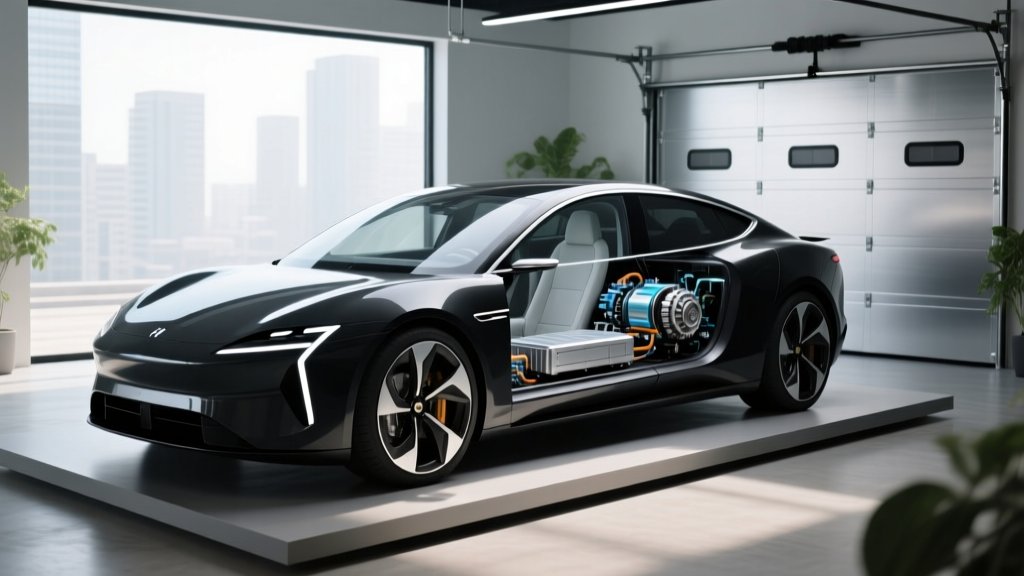
The component that replaces a transmission in most EVs is called a reduction gear (sometimes called a "single-speed gearbox" or "e-axle" when integrated with the motor and differential). Here's the basic layout:
- Electric motor spins the input shaft at up to ~18,000 RPM.
- Reduction gear set (a pair of helical gears) reduces that speed by a fixed ratio — usually around 9:1 — multiplying torque proportionally.
- Differential distributes that torque to the left and right wheels while allowing them to rotate at different speeds in corners.
- Half-shafts carry the final drive torque to each wheel.
This entire assembly often weighs 80–150 pounds and fits in a housing roughly the size of a carry-on suitcase. Compare that to a modern 8-speed automatic transmission alone, which weighs 180–220 pounds before you add the torque converter, flex plate, and associated cooling lines.
The Two-Speed Exception: Porsche Taycan and Audi e-tron GT
Porsche engineers added a two-speed transmission on the rear axle of the Taycan (and the mechanically identical Audi e-tron GT) to solve a specific problem: balancing brutal launch acceleration with high-speed efficiency. First gear (ratio ~16:1) provides explosive off-the-line torque for 0–60 mph runs. Second gear (~8:1) engages around 50–60 mph for efficient highway cruising and top-speed runs up to 161 mph. The shift is seamless and managed automatically. This is an engineering choice for a performance sedan, not a necessity — the Tesla Model S Plaid hits 0–60 in 1.99 seconds with a single-speed gearbox.
What This Means for Maintenance and Long-Term Costs
The elimination of a multi-speed transmission is one of the biggest ownership-cost advantages EVs hold over gas cars. Here's a realistic cost comparison over five years and 75,000 miles of driving:
| Cost Category | Gas Vehicle (e.g., 2026 Toyota RAV4 AWD) | EV (e.g., 2026 Tesla Model Y LR AWD) |
|---|---|---|
| Transmission fluid service | $300–$600 (1–2 services) | $0–$150 (reduction gear fluid, if required) |
| Engine oil changes | $500–$900 (10–15 changes) | $0 |
| Spark plugs, belts, filters | $400–$700 | $0 |
| Brake pad replacement | $400–$800 (1–2 sets) | $0–$300 (regen braking extends pad life to 80,000+ mi) |
| Fuel / electricity (75,000 mi) | $7,500–$9,400 (28 MPG avg @ $3.50–$4.50/gal) | $2,250–$4,125 (3.5–4.0 mi/kWh @ $0.12–$0.15/kWh home; higher on DCFC) |
| Total drivetrain + energy | $9,100–$12,400 | $2,250–$4,575 |
Sources: fueleconomy.gov for EPA efficiency data; electricity costs based on EIA average residential rates. Actual costs vary by region, driving style, and charging mix.
The maintenance savings are real, but they don't tell the full story. EV insurance premiums tend to run 15–25% higher than equivalent gas vehicles due to higher repair costs after collisions and the specialized labor required for high-voltage systems. Factor that $200–$400/year premium increase into your total cost of ownership.
Common Misconceptions About EV Drivetrains
| Myth | Fact |
|---|---|
| "EVs have no gears at all." | EVs have a reduction gear set — it's a fixed-ratio gear, not zero gears. The motor doesn't connect directly to the wheels. |
| "EVs need transmission fluid changes just like gas cars." | Most EV reduction gears use a small volume of gear oil that's either sealed for life or requires a single change at 60,000–100,000 miles. No clutch packs, no bands, no torque converter fluid. |
| "Without a transmission, EVs can't go fast on the highway." | Most EVs reach 100–155 mph on a single gear. The Tesla Model S tops 200 mph. The motor's 15,000+ RPM range covers all legal (and most illegal) speeds. |
| "EV motors wear out like gas engines." | Electric motors have one moving part (the rotor on bearings). There's no combustion, no piston rings, no valve train. Motors routinely last 300,000+ miles. It's the battery that degrades — not the motor. |
| "Regenerative braking replaces the transmission." | Regen is a motor function, not a transmission function. The motor acts as a generator when you lift off the accelerator, converting kinetic energy back into battery charge. The reduction gear is still there transferring torque in both directions. |
Real-World Ownership: What the Single-Speed Design Means for You
The simplicity of an EV drivetrain shows up in daily driving in ways that matter:
Smoothness. Without gear shifts, acceleration is a single, uninterrupted surge. There's no shift shock, no hunting for the right gear on a hill, no torque-converter slush. This is particularly noticeable in stop-and-go traffic, where a gas car's transmission is constantly shifting between 1st, 2nd, and 3rd.
Instant response. Press the accelerator and torque arrives in milliseconds — no downshift delay, no turbo spool-up. This makes merging onto highways and pulling into traffic gaps noticeably easier and safer.
Highway efficiency trade-off. The one genuine downside of a single-speed gear is that the motor operates at very high RPM at sustained highway speeds (e.g., 10,000–12,000 RPM at 75 mph). While electric motors are still far more efficient than gas engines at high RPM (~88–93% efficiency vs. ~25–30% thermal efficiency for ICE), there is a measurable efficiency drop at highway speeds compared to city driving. This is why most EVs achieve lower real-world range at 75 mph than their EPA combined estimate suggests. Expect a 10–20% reduction from EPA range at sustained 70–80 mph highway driving, and up to 30–40% reduction in cold weather (below 30°F) when the battery must also power cabin heating.
Towing. If you plan to tow, the single-speed design means the motor runs at high RPM under heavy load, which increases energy consumption dramatically. A Ford F-150 Lightning rated for 320 miles of EPA range may deliver only 130–170 miles when towing a 5,000-pound trailer at highway speed. This isn't a transmission limitation — it's physics — but it's a critical planning factor for anyone who tows frequently.
Decision Framework: Does the Drivetrain Difference Affect Your Purchase?
Choose an EV if:
- You want minimal drivetrain maintenance over a 10+ year ownership horizon (no transmission rebuilds, no clutch replacements, no CVT failures).
- You commute in stop-and-go traffic where the single-speed, instant-torque design is a clear advantage.
- You have access to home Level 2 charging (a 240V outlet or installed EVSE), which makes daily refueling effortless and cheap ($0.10–$0.15/kWh in most states).
- You value smooth, linear acceleration and one-pedal driving (using regen to slow without touching the brake pedal).
Consider a hybrid (HEV/PHEV) or wait if:
- You regularly tow heavy loads over long distances — the efficiency penalty at high load is significant for BEVs.
- You live in an apartment or area without reliable home or workplace charging access and your region has sparse DC fast-charging infrastructure.
- You drive in extreme cold (below 0°F regularly) and need every mile of range — a PHEV like the Toyota RAV4 Prime (42 mi electric-only, 38 MPG combined on gas) gives you electric commuting with gas-powered range security.
- You're on a tight upfront budget — while a used EV may qualify for the §25E used-EV credit (up to $4,000), new EV MSRPs remain higher than comparable gas models before incentives.
Frequently Asked Questions
Do Tesla vehicles have a transmission?
No. All Tesla models (Model 3, Model Y, Model S, Model X, and Cybertruck) use a single-speed reduction gear. The Model S Plaid achieves a 1.99-second 0–60 mph time with three motors and no multi-speed gearbox. Tesla has never produced a vehicle with a traditional transmission.
Do any electric vehicles have a multi-speed transmission?
Yes, but very few. The Porsche Taycan and Audi e-tron GT use a two-speed automatic on the rear axle. The original first-generation Tesla Roadster (2008) initially shipped with a two-speed gearbox but was quickly revised to a single-speed unit due to reliability issues. For 2026, essentially every mainstream EV — from the Chevrolet Equinox EV to the Rivian R1S — uses a single-speed design.
Will an EV's reduction gear need to be replaced?
Extremely unlikely under normal ownership. The reduction gear is a simple set of hardened steel helical gears running in an oil bath. There are no clutch packs to wear, no bands to burn, no solenoids to fail. With proper fluid maintenance (if required by the manufacturer), the reduction gear should outlast the vehicle. The electric motor's bearings are the more likely wear item, and even those typically last 200,000+ miles.
Does the lack of a transmission make EVs cheaper to insure?
No — the opposite, unfortunately. Despite having fewer mechanical parts, EVs typically cost 15–25% more to insure than comparable gas vehicles. Insurers factor in higher purchase prices, expensive battery replacement after collisions, specialized repair training, and limited body-shop availability for high-voltage safety procedures. The drivetrain simplicity saves on maintenance, not on premiums.
How does regenerative braking relate to the transmission?
Regen is entirely a function of the electric motor and power electronics, not the reduction gear. When you lift off the accelerator, the inverter reverses the motor's role — instead of consuming electricity to spin the wheels, the spinning wheels drive the motor as a generator, pushing current back into the battery. The reduction gear simply transfers torque in both directions. Regen can recover 15–30% of energy in city driving, which is why EVs often achieve better efficiency in stop-and-go traffic than on the highway.
Do hybrids have transmissions?
Yes. Traditional hybrids (HEVs) like the Toyota Prius use a planetary gearset (Toyota's e-CVT / Hybrid Synergy Drive) that blends power from the gas engine and electric motor(s). Plug-in hybrids (PHEVs) like the Jeep Wrangler 4xe use conventional multi-speed automatics (an 8-speed ZF in the Wrangler's case) with an electric motor integrated into the transmission housing. The transmission is necessary because the gas engine still needs gear ratios to operate efficiently across its narrow power band.
The absence of a multi-speed transmission is one of the defining engineering differences between EVs and gas vehicles. It's the reason EVs accelerate so smoothly, require so little drivetrain maintenance, and have far fewer failure points over a 150,000-mile ownership cycle. For most buyers, it's a benefit they'll appreciate every day without thinking about it — right up until they realize they've put 80,000 miles on the odometer and never once visited a shop for a fluid change.