Quick Answer: Do Electric Vehicles Have Radiators?
Yes, most electric vehicles have radiators — but they work differently than the single large radiator in a gas car. A modern EV typically uses two to four separate cooling circuits with their own radiators, heat exchangers, and coolant loops to manage temperatures across the battery pack, electric motor(s), power electronics (inverter/charger), and cabin HVAC. Liquid cooling is essential because EV batteries degrade rapidly if they exceed roughly 95–104°F (35–40°C) or drop below freezing during charging.
Unlike a gas engine that dumps ~60–70% of fuel energy as waste heat through one big radiator, an EV's thermal management system is precision-engineered to keep multiple components in narrow temperature windows — typically within 2–5°F of their ideal operating range.
How EV Cooling Systems Actually Work
A gas-powered car has a relatively simple thermal job: keep the engine block near ~195–220°F using one radiator, a water pump, and a thermostat. An EV's thermal management system is far more complex in architecture, even though it generates less total waste heat.
Here's what an EV needs to cool or heat simultaneously:
- Battery pack: Must stay between roughly 59–95°F (15–35°C) for optimal performance and longevity. The 84 kWh NMC pack in a Hyundai Ioniq 5 or the 82 kWh LFP pack in a Tesla Model 3 RWD generates heat during fast charging and hard acceleration.
- Electric motor(s): Permanent-magnet motors can operate up to ~250°F but perform best when stator windings stay cooler. A 320-hp rear motor in a Model Y generates significant heat under sustained highway driving or towing.
- Power electronics (inverter, onboard charger, DC-DC converter): These convert DC battery power to AC for the motor and step down voltage for 12V systems. IGBT or silicon-carbide (SiC) semiconductors must stay below ~250°F junction temperature.
- Cabin HVAC: A heat pump (standard on most 2025–2026 EVs including Tesla, Hyundai/Kia, BMW, and Ford) moves heat rather than generating it, using a dedicated refrigerant loop with its own condenser and evaporator — separate from the coolant radiators.
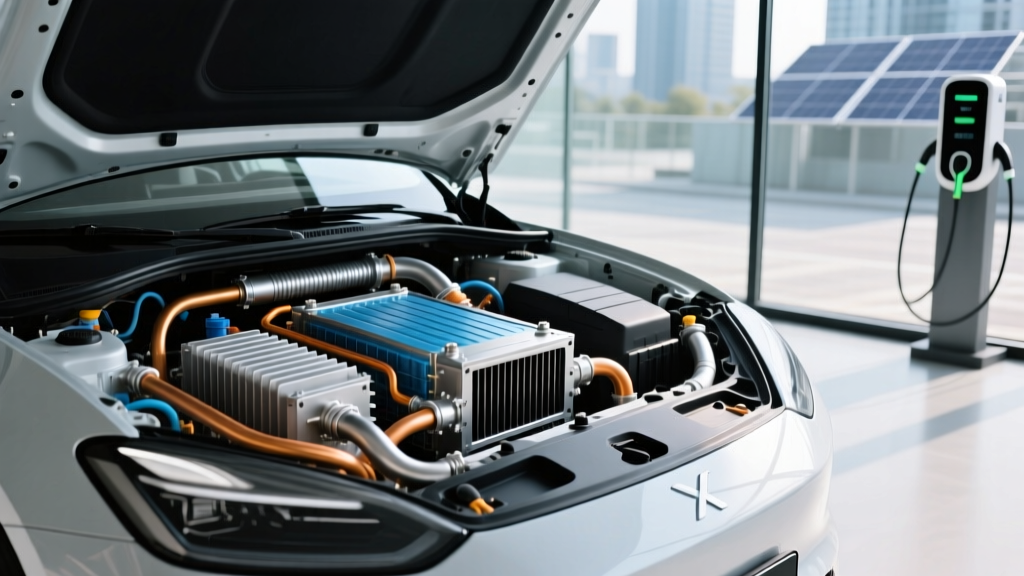
To handle these different temperature requirements, automakers use multiple coolant loops — often a low-temperature loop (for battery and electronics) and a high-temperature loop (for the motor), plus a refrigerant loop for the heat pump/AC. Each loop may have its own radiator or heat exchanger mounted in the front fascia.
EV Radiators vs. Gas Car Radiators: A Side-by-Side Comparison
| Feature | Gas Car Radiator | EV Radiator/Thermal System |
|---|---|---|
| Number of radiators | 1 main + 1 heater core | 2–4 radiators/heat exchangers |
| Coolant temperature target | ~195–220°F (90–105°C) | ~59–95°F (15–35°C) for battery loop |
| Coolant type | Ethylene glycol/water mix | Propylene glycol/water or dielectric fluid (some direct-cooling systems) |
| Waste heat generated | Very high (~65% of fuel energy) | Low (~5–10% of battery energy) |
| Active heating needed? | No — engine produces excess heat | Yes — battery needs preheating in cold weather |
| Heat pump integration | N/A | Yes — shares thermal loops for efficiency |
| Estimated coolant volume | 1.5–3 gallons | 3–6+ gallons across all loops |
| Coolant change interval | 30,000–60,000 miles | 60,000–150,000 miles (some "lifetime fill") |
The key insight: EV radiators are generally smaller individually than a gas car radiator because total waste heat is lower, but the system as a whole is more complex because of multiple temperature targets and the integration with the heat pump for cabin heating and battery preconditioning.
Why Thermal Management Is Critical for EV Range and Battery Life
Temperature is the single biggest variable affecting real-world EV range and long-term battery health. Here's what the data shows:
- Cold-weather range loss: At 20°F, an EV without a heat pump can lose 30–40% of its EPA-rated range. With a heat pump (standard on most 2025–2026 models), that loss drops to roughly 15–25%. A Tesla Model Y Long Range (EPA 320 miles) might deliver ~240–270 real-world miles in freezing conditions with heat pump preconditioning, per fueleconomy.gov data and independent cold-weather testing.
- Fast-charging speed: DC fast charging requires the battery to be in its optimal temperature window. Preconditioning — where the car's thermal system heats the battery before you arrive at a charger — can cut 10–80% charge times by 20–40%. A Tesla Model 3 preconditioned for a Supercharger can hit peak 250 kW and reach 10–80% in ~18 minutes; without preconditioning, that same session could take 25–30+ minutes due to charge-curve throttling.
- Battery degradation: Research from NREL and real-world fleet data show that batteries kept between 20–80% SoC and within the 59–86°F thermal window degrade roughly 1–2% per year. Batteries frequently exposed to 95°F+ without active cooling can degrade 3–5%+ annually. This is exactly why liquid-cooled EV batteries (virtually all modern EVs) vastly outlast older passively-cooled designs like the early Nissan Leaf, which saw 20–30% capacity loss within 5 years in hot climates.
Common EV Cooling Misconceptions — Myth vs. Fact
| Myth | Fact |
|---|---|
| "EVs don't need radiators because they don't have engines." | EVs have 2–4 radiators/heat exchangers managing battery, motor, and electronics cooling. The thermal system is more architecturally complex than a gas car's. |
| "EVs never overheat." | Battery packs can overheat during repeated fast charging, towing, or track use. Thermal management systems actively prevent this, but sustained high-load driving in hot weather will trigger power limiting to protect the battery. |
| "EV coolant never needs changing." | Some manufacturers specify "lifetime" coolant, but most recommend replacement at 60,000–150,000 miles. Contaminated or degraded coolant can damage the battery cooling plate — a costly repair. |
| "EVs don't need coolant — they're air-cooled." | Virtually every EV sold in the US since 2020 uses liquid cooling. The last notable air-cooled EV was the early Nissan Leaf (2011–2017), which suffered accelerated degradation in hot climates precisely because of this. |
| "EV radiators are expensive to replace." | Individual EV radiator replacement typically costs $300–$800 per unit — comparable to gas cars. The expensive component is the battery cooling plate (integrated into the pack), which is covered under the 8-year/100,000-mile federal battery warranty. |
Real-World Ownership Costs: EV Cooling Maintenance vs. Gas Car
One of the most practical questions for first-time EV buyers is whether the cooling system adds hidden costs. Here's a concrete maintenance and operating cost breakdown comparing a typical 2025–2026 EV (e.g., Tesla Model 3 RWD, ~$38,990 MSRP before credits) against a comparable gas sedan (e.g., Toyota Camry LE, ~$28,500 MSRP):
| Cost Category (5-Year / 75,000 mi) | EV (Model 3 RWD) | Gas (Camry LE) |
|---|---|---|
| Coolant service | $0–$150 (most intervals exceed 75k mi) | $200–$400 (2–3 flushes) |
| Radiator replacement | $0 (rarely needed in first 5 years) | $0–$600 (uncommon but possible) |
| Oil changes | $0 | $500–$1,000 (10–15 changes) |
| Transmission fluid | $0 (single-speed reduction gear, sealed) | $150–$300 |
| Brake pads (regen saves wear) | $0–$200 | $400–$800 |
| Fuel / electricity | $2,500–$4,000 (home charging at $0.14/kWh) | $6,000–$8,500 (gas at ~$3.50/gal, 32 MPG combined) |
| Insurance (typically 15–25% higher for EVs) | $7,500–$9,500 | $6,000–$7,500 |
| Estimated 5-Year Total | ~$10,000–$13,850 | ~$13,250–$19,100 |
Sources: fueleconomy.gov for efficiency data; insurance estimates based on industry averages. Actual costs vary by state, driving patterns, and electricity rates.
The takeaway: EV cooling maintenance is cheaper and less frequent than gas-car cooling maintenance. You'll never replace a water pump, thermostat housing, or head gasket — common gas-car cooling failures that run $500–$2,000+. The EV's thermal system is largely sealed and low-maintenance, with the main service item being periodic coolant testing and replacement at extended intervals.
What About Air-Cooled EVs? Are Any Still Sold?
No. As of 2025–2026, every new EV sold in the US market uses liquid cooling for the battery pack. The last notable air-cooled EV was the first-generation Nissan Leaf (2011–2017), which used passive air cooling and suffered well-documented battery degradation issues — particularly in hot climates like Arizona and Texas, where capacity loss of 20–30% within 5 years was common.
Some very low-speed neighborhood electric vehicles (NEVs) and electric motorcycles may still use air cooling, but no mainstream highway-capable EV does. Liquid cooling became the industry standard because:
- It enables DC fast charging at 150–350 kW without overheating the battery
- It allows battery preconditioning for cold-weather charging and range optimization
- It maintains uniform cell temperatures, reducing uneven degradation across the pack
- It integrates with heat-pump HVAC systems for whole-vehicle thermal efficiency
First-Time EV Buyer: What You Should Know About EV Thermal Systems
Decision Framework: Does EV Thermal Management Affect Your Purchase?
Choose an EV with a heat pump + liquid cooling if:
- You live where winter temperatures regularly drop below 32°F (the heat pump recovers 15–25% range vs. resistive heating)
- You plan to DC fast-charge frequently on road trips (preconditioning is essential for peak charge speeds)
- You want maximum battery longevity — liquid cooling keeps cells in the ideal 59–86°F window
- You tow or drive in mountainous terrain (sustained high loads demand active thermal management)
Don't worry about cooling system complexity if:
- You're concerned about maintenance costs — EV cooling maintenance is simpler and cheaper than gas cars
- You fear radiator failures — EV radiators are smaller, run cooler, and fail less often than gas-car radiators
- You're comparing to a hybrid — PHEVs like the Toyota RAV4 Prime have both a gas-engine cooling system AND a separate EV battery cooling system, making them the most thermally complex option
Key Questions for Your EV Purchase
- Does the model have a heat pump? Most 2025–2026 EVs do (Tesla, Hyundai/Kia, BMW, Ford, VW). Some budget models may still use resistive PTC heating, which consumes more battery in cold weather. Check the spec sheet.
- What's the battery warranty? Federal law mandates a minimum 8-year/100,000-mile battery warranty covering defects and capacity loss below a stated threshold (typically 60–70% retention). The cooling system is integral to meeting this warranty. Per IRS §30D guidelines, vehicles must meet battery component and critical mineral sourcing requirements for the federal tax credit — up to $7,500 with MSRP caps ($55,000 sedans, $80,000 SUVs/trucks), income limits ($150K single / $300K joint), and point-of-sale transfer availability.
- Can you precondition via the app? Every major EV brand offers app-based preconditioning. Use it before fast charging and before cold-weather departures — it warms the battery using grid power (while plugged in) rather than battery energy, preserving range.
Frequently Asked Questions
How many radiators does a Tesla Model Y have?
The Tesla Model Y uses a "Superbottle"-successor system called the Octovalve, which integrates up to 8 thermal management pathways with at least 2–3 radiators/heat exchangers in the front fascia. This system manages battery, motor, power electronics, and cabin heat-pump loops through a single integrated manifold — reducing parts count and improving efficiency over earlier designs.
Do EVs need antifreeze?
Yes. EV cooling systems use a propylene glycol/water mixture (or in some cases, specialized dielectric coolant for direct-to-cell cooling systems). Unlike gas cars that use ethylene glycol (toxic), many EVs use propylene glycol, which is less toxic. Never mix EV coolant with conventional antifreeze — contamination can damage the battery cooling plate and void the warranty.
Can an EV overheat in hot weather?
The liquid cooling system prevents the battery from reaching dangerous temperatures, but sustained high-load driving (towing uphill in 100°F+ heat) can cause the system to limit power output to protect components. This is called "thermal throttling" and is a protective measure, not a failure. On a practical level, you may notice reduced acceleration or slower charge speeds during extreme heat events — the car is prioritizing battery protection over performance.
What happens if an EV coolant leaks?
A coolant leak in the battery cooling loop will trigger a dashboard warning and may disable high-voltage systems as a safety precaution. Unlike a gas car where a coolant leak leads to engine overheating in minutes, an EV will typically give ample warning and enter a reduced-power "limp" mode. Repair costs for a cooling line or radiator are comparable to gas cars ($300–$800), but a leak into the battery pack itself is a major repair — which is why the 8-year/100,000-mile battery warranty matters.
Do hybrids have more radiators than EVs or gas cars?
Yes — plug-in hybrids like the Toyota RAV4 Prime or Jeep Wrangler 4xe effectively have two complete thermal systems: a gas-engine cooling loop with its own radiator, plus a separate high-voltage battery and power-electronics cooling loop. This makes PHEVs the most maintenance-intensive option from a cooling-system perspective, though still less than two separate vehicles.