The Short Answer
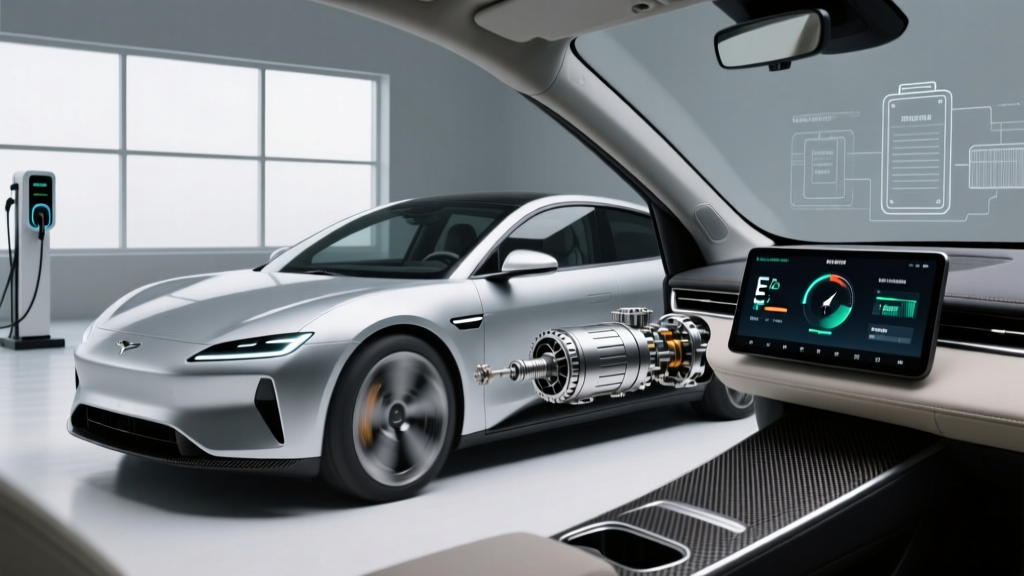
No, nearly all production electric vehicles do not need a multi-speed transmission. Instead, most EVs use a single-speed reduction gear (typically a 9:1 to 10:1 ratio) that transfers torque from the electric motor to the wheels. This works because electric motors produce maximum torque at 0 RPM and can spin safely up to 15,000–20,000 RPM — a range wide enough to cover everything from a standing start to 100+ mph highway speeds without shifting. The result is seamless, instant acceleration with far fewer moving parts than a gas car's 6-, 8-, or 10-speed automatic transmission.
Why Gas Cars Need Gears and EVs Don't
Internal combustion engines (ICE) have a narrow power band. A typical gas engine produces usable torque only between roughly 1,500 and 5,000 RPM and redlines around 6,000–7,000 RPM. To keep the engine in that sweet spot across different speeds, a multi-speed transmission is mandatory. A 2026 Toyota Camry with its 8-speed automatic, for example, must constantly shift to match engine RPM to road speed.
Electric motors behave entirely differently. A permanent-magnet synchronous motor (the type used in the Tesla Model Y, Hyundai Ioniq 5, and Ford Mustang Mach-E) generates peak torque the instant current flows — at 0 RPM. It then maintains a broad, flat torque curve up to a base speed (typically 4,000–6,000 RPM), after which power tapers but the motor continues spinning safely to 15,000+ RPM. That single, wide arc of usable output eliminates the need for gear changes.
The single-speed reduction gear — sometimes called a "fixed-ratio gearbox" — multiplies the motor's torque by roughly 9 or 10 times before sending it to the differential and wheels. There are no clutches, bands, torque converters, or shift solenoids to wear out.
Are There Any EVs With Multiple Gears?
Yes, but they are rare exceptions:
- Porsche Taycan: Uses a 2-speed transmission on the rear axle. First gear provides aggressive launch acceleration (0-60 mph in 2.4 seconds for the Turbo S), while second gear optimizes high-speed efficiency. This adds roughly $1,500–$2,000 in drivetrain complexity and weight.
- Audi e-tron GT: Shares the Taycan's J1 platform and the same 2-speed rear axle.
- Original Tesla Roadster (2008): Started with a 2-speed gearbox but Tesla abandoned it for a single-speed unit due to reliability issues — a lesson the industry largely absorbed.
For 99% of EVs on the road in 2026 — from the Chevrolet Equinox EV ($33,600 MSRP) to the Rivian R1T ($79,900 MSRP) — a single-speed reduction gear handles the job. The engineering consensus is clear: the added weight, cost, and complexity of a multi-speed transmission rarely justify the marginal efficiency gains for passenger vehicles.
EV vs Gas Drivetrain: Parts, Maintenance, and Cost
The single-speed gearbox is one of the biggest reasons EVs cost less to maintain over their lifetime. Here's how the drivetrains compare:
| Attribute | EV (Single-Speed) | Gas Car (Multi-Speed AT) |
|---|---|---|
| Transmission gears | 1 fixed ratio | 6–10 speeds |
| Moving parts in drivetrain | ~20–30 | ~200+ |
| Transmission fluid changes | Every 60,000–100,000 mi (some sealed-for-life) | Every 30,000–60,000 mi ($150–$300 per service) |
| Typical transmission replacement cost | $2,000–$4,000 (reduction gear, rare) | $3,500–$7,000 (automatic transmission) |
| Clutch / torque converter | None | Yes — wears over time |
| Estimated 10-year drivetrain maintenance | $200–$500 | $1,200–$2,500 |
Data from fueleconomy.gov confirms that EVs also eliminate oil changes ($30–$70 each, 2–3 per year), spark plug replacements ($200–$600), exhaust system repairs, and timing belt services. Over a 10-year ownership period, the drivetrain maintenance savings alone can total $1,500–$3,000.
How the Single-Gear Design Affects Real-World Driving
The fixed-ratio setup shapes the EV driving experience in measurable ways:
Acceleration: Instant and Linear
Because peak torque hits at 0 RPM, EVs launch harder than equivalently powered gas cars off the line. A 2026 Tesla Model Y Long Range (384 hp, single-speed) hits 0-60 mph in 4.8 seconds, while a 2026 BMW X3 xDrive30i (248 hp, 8-speed AT) takes 6.0 seconds — despite both being in a similar price bracket (~$48,000–$52,000). No shift interruptions, no turbo lag, no downshift hesitation.
Highway Efficiency: A Minor Trade-Off
At sustained 80 mph, an electric motor spinning at 12,000+ RPM operates slightly outside its peak efficiency zone. A theoretical 2-speed transmission could drop the motor RPM at highway speeds and recover an estimated 2–5% in range. For a 320-mile EPA-rated EV, that's roughly 6–16 extra miles. Most engineers agree this gain isn't worth the added weight (20–40 lbs), cost, and potential reliability risk.
Regenerative Braking Integration
The single-speed reduction gear also enables seamless regenerative braking. When you lift off the accelerator, the motor reverses its role and becomes a generator, sending energy back into the battery. The fixed gear ratio allows precise, predictable regen feel — a key reason one-pedal driving works so smoothly in EVs like the Hyundai Ioniq 5 and Chevrolet Bolt EV.
Top Speed Limitations
Some EVs are electronically governed to relatively modest top speeds (110–130 mph for most non-performance models) partly because the motor would exceed its safe RPM limit in the single fixed gear at higher velocities. A 2-speed transmission could raise that ceiling — which is exactly why Porsche uses one in the Taycan (top speed: 161 mph).
Total Ownership Cost: EV vs Gas (2026 Data)
The simpler drivetrain is just one piece of the ownership economics. Here's a 5-year cost projection comparing a 2026 Tesla Model Y Long Range AWD against a 2026 Toyota RAV4 AWD (gas) — two of the best-selling vehicles in America:
| Cost Category (5 Years / 75,000 mi) | 2026 Tesla Model Y LR AWD | 2026 Toyota RAV4 AWD (Gas) |
|---|---|---|
| Purchase price (MSRP) | $48,990 | $33,500 |
| Federal §30D tax credit (if eligible) | −$3,750 to −$7,500* | $0 |
| Fuel / electricity cost | $3,100 (home L2 @ $0.14/kWh avg) | $7,900 (gas @ $3.40/gal, 30 MPG combined) |
| Maintenance (scheduled + drivetrain) | $1,200 | $3,800 |
| Insurance (avg national) | $9,500 | $6,800 |
| Estimated depreciation | $18,500 | $13,200 |
| 5-year total cost | ~$40,540–$44,290 | ~$52,000 |
*Federal §30D credit eligibility depends on buyer income caps ($150K single / $300K joint), vehicle MSRP caps ($55K sedans / $80K SUVs), and battery critical-mineral sourcing requirements per IRS guidelines. Credit can now be transferred at point of sale as a down-payment reduction. Verify current-year rules with a tax professional.
The EV wins on fuel and maintenance — driven largely by that simple single-speed drivetrain and the absence of an ICE. But insurance and depreciation can offset some savings. The break-even point varies by state electricity rates, annual mileage, and credit eligibility.
Common EV Drivetrain Myths vs Facts
| Myth | Fact |
|---|---|
| "EVs have no transmission at all." | They have a single-speed reduction gearbox — still a transmission, just a simpler one. |
| "No gears means EVs can't go fast." | The Lucid Air Sapphire (1,234 hp, single-speed) hits 200+ mph. Gear count doesn't limit top speed; motor RPM and power do. |
| "EV transmissions need frequent fluid changes." | Most EV reduction gears are sealed or require service only every 60,000–100,000 miles. Some are filled with lifetime fluid. |
| "More gears would make EVs way more efficient." | Studies show a 2-speed adds at most 2–5% highway range while adding weight, cost, and failure points. Not worth it for most use cases. |
| "If the single-speed gear fails, the whole motor must be replaced." | The reduction gear is a separate, serviceable unit bolted to the motor. Replacement costs $2,000–$4,000 — far less than a full motor swap. |
What First-Time EV Buyers Should Know About the Drivetrain
The single-speed design has practical ownership implications beyond the engineering:
- No transmission fluid dipstick to check. Most EV reduction gears are sealed. If your service tech says you need a "transmission flush" on your EV, get a second opinion.
- Drivetrain warranty coverage is strong. Federal law mandates that EV battery and powertrain components (including the reduction gear and motor) carry a minimum 8-year / 100,000-mile warranty. Many automakers match or exceed this — Hyundai and Kia offer 10-year / 100,000-mile coverage on the full EV powertrain.
- AWD EVs often use two motors, not a mechanical driveshaft. A Tesla Model Y Dual Motor or Ford Mach-E AWD has one motor on each axle — no driveshaft, no transfer case, no center differential. That's another layer of simplicity vs a gas AWD system.
- Towing and heavy loads don't require a "low gear." Electric motors produce peak torque at 0 RPM, so towing a 3,500-lb trailer in a Rivian R1S doesn't demand gear reduction the way a gas truck's transmission does. The motor simply draws more current.
Decision Framework: Does the Single-Gear EV Drivetrain Work for You?
Choose a single-speed EV if:
- You value low maintenance costs and fewer mechanical failure points
- Your daily driving is under 250 miles round-trip (covers 95% of American commutes)
- You have access to Level 2 home charging (a 240V / 40A circuit adds ~25–35 miles of range per hour)
- You prioritize smooth, shift-free acceleration in stop-and-go traffic
- You plan to own the vehicle 7+ years and want to minimize long-term drivetrain costs
Consider a gas or hybrid vehicle instead if:
- You regularly tow over 5,000 lbs and drive in remote areas with limited charging infrastructure
- You live in an apartment or condo without charging access and your area has sparse public DC fast-charging networks
- You frequently drive in extreme cold (below 0°F) where EV range can drop 20–40%
- Your budget is under $30,000 and you need a new vehicle (few new EV options exist below this threshold in 2026)
Frequently Asked Questions
Do electric cars have a clutch?
No. Clutches exist to disconnect a running gas engine from the transmission during gear changes. Since electric motors don't idle and don't shift gears, there is no clutch, no torque converter, and no flywheel. The motor simply stops spinning when the car stops.
Can you shift gears in an electric car?
Not in any meaningful sense. Some EVs (like certain Porsche Taycan trims) offer simulated shift feel through software and sound design, but there are no physical gear changes happening. The single-speed reduction gear is always engaged.
Why don't all EVs use a 2-speed transmission for better range?
The efficiency gain is marginal — typically 2–5% on the highway — while the added weight, cost ($1,500–$2,000+), complexity, and potential reliability concerns outweigh the benefit. Porsche uses one in the Taycan for performance reasons (harder launches, higher top speed), not primarily for range.
How long does an EV single-speed gearbox last?
In most cases, the life of the vehicle. Reduction gears have very few wear components — typically just bearings and seals. Failures before 150,000 miles are uncommon, and the unit is covered under the federally mandated 8-year / 100,000-mile powertrain warranty minimum.
Do hybrids have gears?
Yes — hybrids vary widely. Toyota's e-CVT (used in the RAV4 Hybrid and Prius) uses a planetary gearset that seamlessly blends engine and motor power — technically a continuously variable transmission. Plug-in hybrids like the Jeep Wrangler 4xe use a conventional 8-speed automatic alongside the electric motor. The transmission complexity in hybrids sits between a pure EV and a conventional gas car.