The Short Answer: Most EVs Have Just One Gear
Do electric cars have gears? Most electric vehicles use a single-speed reduction gear — not a multi-gear transmission like a gas car. Because electric motors produce maximum torque from 0 RPM and can safely rev to 15,000–20,000 RPM, there's no need for multiple gear ratios. You get instant, seamless acceleration with no shift shock, no clutch wear, and no transmission fluid changes. A handful of performance EVs (like the Porsche Taycan) use a two-speed gearbox on the rear axle for optimized top-speed efficiency, but 95%+ of EVs on the road today are single-speed.
Why Electric Motors Don't Need Multiple Gears
Internal combustion engines (ICE) have a narrow power band — typically producing useful torque only between ~1,500 and ~5,000 RPM. A multi-speed transmission (6-speed, 8-speed, or CVT) is required to keep the engine in that sweet spot as vehicle speed changes.
Electric motors operate on entirely different physics:
- Torque delivery: Maximum torque is available from 0 RPM. When you press the accelerator in a Tesla Model Y or Hyundai Ioniq 5, full pulling force is immediate — no downshift, no turbo spool-up, no lag.
- RPM range: EV motors spin freely up to 15,000–20,000 RPM (compared to ~6,500 RPM redline for most gas engines). A single fixed reduction ratio of roughly 9:1 or 10:1 covers the entire speed range from 0 to 120+ mph.
- Efficiency curve: Electric motors maintain 85–95% efficiency across most of their RPM range, unlike gas engines that peak around 30–40% thermal efficiency in a narrow band.
The result is a drivetrain with far fewer moving parts. According to fueleconomy.gov, electric drivetrains convert over 77% of electrical energy from the grid to power at the wheels, compared to just 12–30% for gasoline vehicles.
EV Single-Speed vs. Gas Multi-Speed: A Drivetrain Comparison
| Attribute | Typical EV (Single-Speed) | Typical Gas Car (8-Speed Auto) |
|---|---|---|
| Gear ratios | 1 (fixed reduction ~9:1) | 6–10 forward gears |
| Transmission fluid changes | Never (sealed unit, lifetime fill) | Every 30,000–60,000 miles (~$150–$300) |
| Shift shock / hesitation | None — seamless linear delivery | Noticeable during hard acceleration |
| Moving parts in drivetrain | ~5–20 (motor, reduction gear, differential) | ~200+ (gears, clutch packs, torque converter, bands) |
| Typical drivetrain failure rate | Very low (<2% over 150k miles) | Moderate (transmission rebuilds: $3,000–$7,000) |
| 0–30 mph acceleration feel | Instant, no delay | Downshift lag, turbo spool (0.5–1.5 sec delay) |
| Regenerative braking | Yes — recaptures energy, reduces brake wear | No — friction brakes only |
The Exceptions: EVs That Use Two-Speed Gearboxes
A few high-performance EVs break the single-speed rule:
- Porsche Taycan: Uses a two-speed transmission on the rear axle. First gear provides explosive launch acceleration (0–60 mph in 2.6 seconds for the Turbo S); second gear optimizes high-speed efficiency and top speed (161 mph). This is a genuine multi-gear setup, but it's an engineering choice for a $100K+ performance car, not a necessity.
- Rimac Nevera: The hypercar uses individual motors per wheel with single-speed reductions, but some prototypes explored multi-speed concepts.
- Audi e-tron GT: Shares the Taycan's J1 platform and two-speed rear axle.
For everyday EVs — the Tesla Model 3, Ford Mustang Mach-E, Chevrolet Equinox EV, Hyundai Ioniq 5, Kia EV6, Nissan Ariya — the answer is consistently one fixed gear ratio.
What This Means for Maintenance Costs and Ownership
The single-speed drivetrain is one of the biggest long-term cost advantages EVs hold over gas vehicles. Here's a realistic ownership cost comparison using a 2026 Tesla Model Y Long Range (AWD, ~310 miles EPA, ~$46,630 MSRP before incentives) versus a comparably equipped 2026 Toyota RAV4 gas AWD (~$34,000 MSRP).
| Cost Category (5 Years / 75,000 Miles) | EV (Tesla Model Y LR) | Gas (Toyota RAV4 AWD) |
|---|---|---|
| Transmission fluid / service | $0 | $300–$600 |
| Engine oil changes | $0 | $500–$800 |
| Brake pad replacement | $0–$200 (regen extends life 2–3x) | $400–$800 |
| Spark plugs / air filters | $0 | $200–$400 |
| Fuel / electricity | ~$2,400 (at $0.14/kWh avg) | ~$6,750 (at $3.50/gal, 28 MPG avg) |
| Drivetrain failure risk | Negligible | $3,000–$7,000 if transmission fails |
| Total estimated maintenance + fuel | ~$2,600 | ~$8,550+ |
The single-speed design eliminates transmission-related service entirely. Over 5 years, the EV owner saves roughly $5,900 in combined fuel and maintenance, according to data cross-referenced with EPA efficiency figures.
Federal tax credit note: Under current IRS §30D rules, the Model Y may qualify for up to $7,500 in clean vehicle credits if it meets battery sourcing, critical mineral, MSRP cap ($80,000 for SUVs), and buyer income limits ($300K joint / $150K single). Eligibility changes frequently — confirm on irs.gov and consider point-of-sale transfer at the dealer.
Real-World Ownership: What First-Time EV Buyers Should Know
Is a Single-Speed EV Right for Your Situation?
- If you have home charging access (garage/driveway with a 240V outlet or Level 2 install): An EV is ideal. You'll wake up "full" every morning, never visit a gas station for daily driving, and the single-speed drivetrain means zero transmission maintenance. Budget $500–$1,500 for a Level 2 home charger install (equipment + electrician).
- If you rely solely on public charging: An EV still works, but plan your routes. Use apps like PlugShare or the Tesla app to map DC fast chargers along your commute. Expect 20–40 minute charging stops on road trips (10–80% at 150–250 kW chargers). The single-speed drivetrain advantage still applies.
- If you live in extreme cold (below 10°F regularly): Expect 20–30% range loss in winter. The single-speed drivetrain isn't affected, but battery chemistry is. Choose an EV with a heat pump (standard on most 2025+ models) and precondition the battery before driving.
- If you tow frequently: EVs handle towing well thanks to instant torque at low RPM (no gear hunting on hills). But towing cuts range 30–50%. A Ford F-150 Lightning tows up to 10,000 lbs but drops from ~230 miles EPA to ~100–130 miles while towing heavy.
- If you're considering a hybrid instead: PHEVs like the Toyota RAV4 Prime still use multi-speed automatic transmissions (e.g., an eCVT) because they have both a gas engine and electric motor. You'll still need transmission fluid changes on the ICE side.
Common Misconceptions About EV Gears and Drivetrains
| Myth | Fact |
|---|---|
| "EVs have no gears at all" | Most have a single-speed reduction gear (typically 9:1 or 10:1 ratio). It's a gear — just not a multi-speed transmission. |
| "EVs can't go fast without multiple gears" | Most EVs reach 100–155 mph on a single gear. The Tesla Model S Plaid hits 200 mph with a single-speed setup (carbon-sleeve rotor motor). |
| "Single-speed means less efficient at highway speeds" | There's a slight efficiency drop at very high RPM, but electric motors remain 85%+ efficient. The trade-off for simplicity and reliability is worth it for 99% of drivers. |
| "EV transmissions will need expensive replacement" | The reduction gear is one of the most durable components. It's bathed in sealed lubricant with no scheduled service. Failures before 200,000 miles are extremely rare. |
| "EVs need engine braking on steep hills" | Regenerative braking provides even stronger deceleration than engine braking — often enough for true one-pedal driving. Brake pads routinely last 100,000+ miles on EVs. |
The Engineering Behind the Reduction Gear
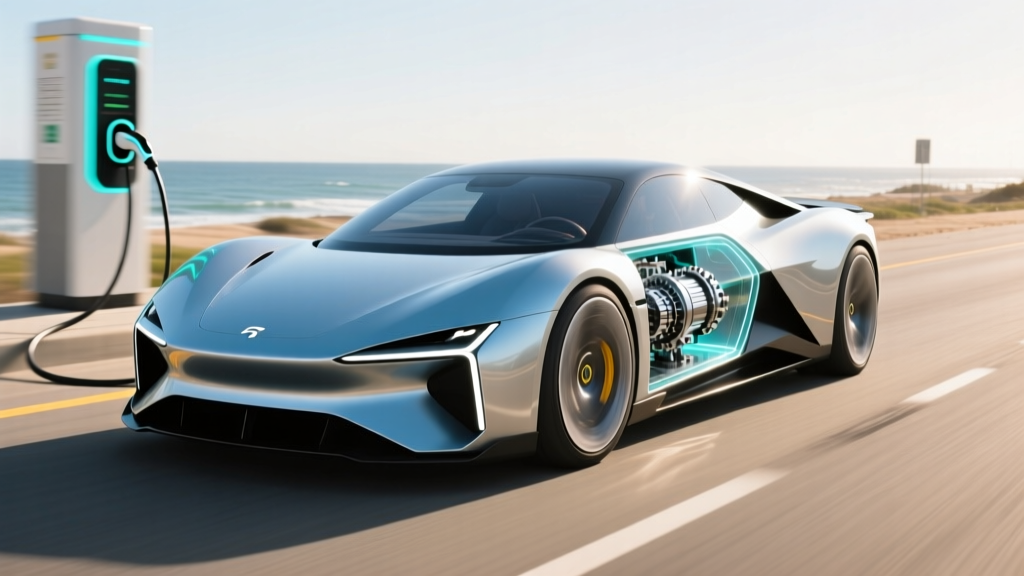
The single-speed unit in most EVs is technically called a reduction gear or final drive. Here's what it does:
- The electric motor spins at high RPM (up to ~18,000 RPM).
- A set of helical or planetary gears reduces that speed by roughly 9:1 or 10:1.
- The output drives the differential, which splits torque to the wheels.
In some EVs (like the Tesla Model 3/Y), the motor, reduction gear, and inverter are packaged into a single integrated drive unit roughly the size of a carry-on suitcase. This compact packaging is what enables the frunk (front trunk) space that gas cars can't offer.
The entire assembly typically weighs 60–120 lbs, compared to 200–400 lbs for a conventional automatic transmission. Fewer parts, less weight, less complexity — and no gear hunting on highway on-ramps.
Frequently Asked Questions
Do Teslas have gears?
All current Tesla models (Model 3, Model Y, Model S, Model X, Cybertruck) use a single-speed reduction gear. The Model S Plaid achieves 0–60 mph in 1.99 seconds and a top speed of 200 mph with no gear shifts. Tesla has never used a multi-speed transmission in any production vehicle.
Do electric cars have a clutch?
No. Because there's only one gear ratio and the electric motor can start from a standstill without stalling, there is no clutch, no torque converter, and no launch control mechanism in the traditional sense. You press the accelerator and go.
Can you shift gears in an EV manually?
No — there are no gears to shift. Some EVs offer selectable regen modes (e.g., Hyundai Ioniq 5's paddle shifters adjust regen intensity from 0 to 3, plus i-Pedal one-pedal mode). These simulate a "slowing" feel but don't change any gear ratio.
Why does the Porsche Taycan have two gears?
Porsche's two-speed rear-axle transmission lets the Taycan use a short first gear for maximum launch acceleration and a tall second gear for high-speed efficiency. It's a performance optimization for a $100K+ sports sedan, not a requirement for EV operation. The front motor remains single-speed.
Will an EV's single-speed gear need maintenance?
Under normal ownership, no. The reduction gear is a sealed unit filled with lifetime lubricant. Unlike a gas car's transmission that requires fluid flushes every 30,000–60,000 miles ($150–$300 per service), the EV's reduction gear requires zero scheduled maintenance. Most manufacturers warranty the drive unit for 8 years / 100,000 miles.
Are hybrids different — do they have gears?
Yes. Traditional hybrids (HEVs) and plug-in hybrids (PHEVs) still use multi-speed transmissions or eCVTs because the gasoline engine needs gear ratios to operate efficiently. The Toyota RAV4 Prime PHEV, for example, uses an eCVT. If you want a fully gearless drivetrain experience, a battery-electric vehicle (BEV) is the answer.
Bottom Line for Buyers
The single-speed drivetrain is one of the most underappreciated advantages of going electric. It's the reason EVs feel instantly responsive at stoplights, require virtually no drivetrain maintenance, and have fewer points of mechanical failure. When comparing your next vehicle, factor in the $5,000–$6,000 in 5-year fuel and maintenance savings alongside the purchase price — and remember that the simplicity of a single gear is a big part of why those savings exist.