The Quick Answer: No, Electric Cars Don't Have Alternators
Electric vehicles do not have alternators. Unlike gas-powered cars that use an engine-driven alternator to charge the 12V battery and power accessories, EVs use a DC-DC converter to step down high-voltage battery power (typically 400V–800V) to 12V. This eliminates a common failure point found in ICE vehicles, reduces mechanical complexity, and contributes to the lower maintenance costs EV owners experience over the vehicle's lifetime.
If you're researching EV ownership for the first time, the absence of an alternator is one of many mechanical simplifications that distinguish electric drivetrains from internal combustion engines. But understanding why there's no alternator — and what replaces it — reveals important truths about EV maintenance, reliability, and total cost of ownership that every buyer should know before signing a purchase agreement.
Why Gas Cars Need Alternators (And EVs Don't)
In a conventional gas or diesel vehicle, the alternator is a belt-driven generator mounted to the engine. As the crankshaft spins, the alternator produces electricity to:
- Recharge the 12V lead-acid battery
- Power headlights, infotainment, HVAC blower motors, and ECU systems
- Supply spark plugs (in gasoline engines) and fuel injectors
The alternator is necessary because an internal combustion engine generates no electricity on its own — it only produces mechanical rotational force. Without the alternator, the 12V battery would drain within minutes and the car would stall.
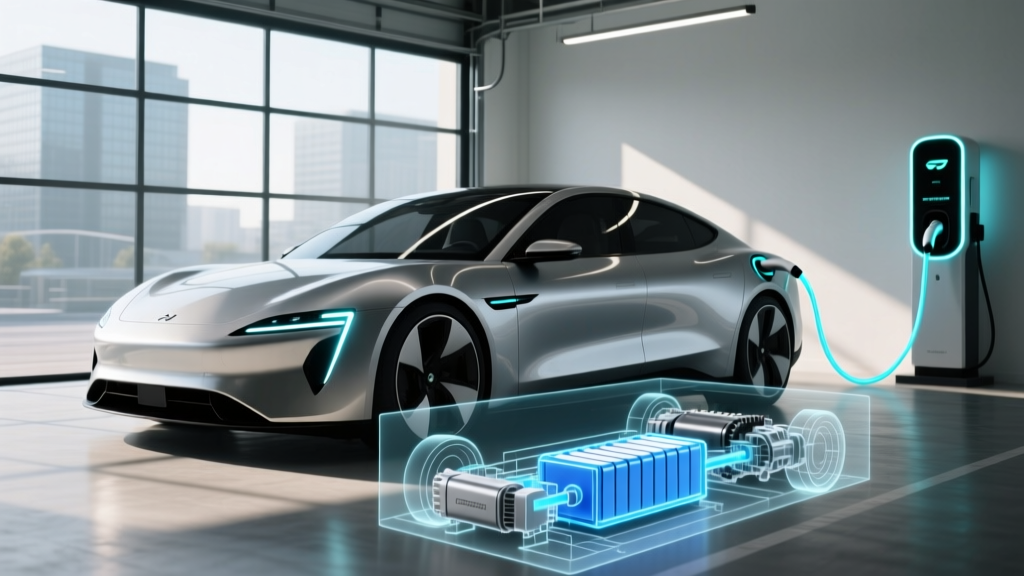
An electric vehicle has no engine, no serpentine belt, and no need for a mechanical generator. Instead, the high-voltage traction battery (typically 50–100+ kWh) already stores massive electrical energy. A DC-DC converter — a solid-state electronic device roughly the size of a shoebox — steps that high-voltage DC down to 12V DC, performing exactly the same role as an alternator but with zero moving parts.
DC-DC Converter vs. Alternator: By the Numbers
| Attribute | ICE Alternator | EV DC-DC Converter |
|---|---|---|
| Moving Parts | Yes (bearings, brushes, rotor, belt) | None (solid-state electronics) |
| Typical Output | 100–200 amps at 12–14V (~1.2–2.8 kW) | 1.5–3.5 kW at 12–14V |
| Failure Rate | Common wear item (5–10 year lifespan) | Very low (often outlasts the vehicle) |
| Replacement Cost | $350–$900 (parts + labor) | $800–$2,000 (rarely needed) |
| Efficiency Loss | ~2–5% of engine output (parasitic drag) | ~1–2% conversion loss |
| Maintenance Required | Belt inspection, bearing/bush wear | None under normal operation |
The parasitic drag of an alternator is one reason gas cars lose efficiency to accessory loads. In an EV, the DC-DC converter draws from the traction battery with minimal loss, and the vehicle's overall efficiency (measured in MPGe or kWh/100mi) already accounts for this draw.
What This Means for EV Maintenance Costs
The absence of an alternator is one piece of a much larger maintenance story. According to fueleconomy.gov, electric vehicles have significantly fewer moving parts in their drivetrains compared to internal combustion vehicles. This translates to real-dollar savings over ownership.
Here's what you don't need to service or replace on a battery-electric vehicle:
- No alternator or serpentine belt
- No oil changes (no engine oil)
- No spark plugs, ignition coils, or timing belts
- No transmission fluid (most EVs use single-speed reduction gears)
- No exhaust system, catalytic converter, or muffler
- No fuel pump, fuel filter, or fuel injectors
5-Year Maintenance & Operating Cost Breakdown
| Cost Category (5 Years / 75,000 mi) | Average Gas Car | Average EV | EV Savings |
|---|---|---|---|
| Fuel / Electricity | $7,500–$9,400 | $2,250–$3,750 | $3,750–$7,150 |
| Oil Changes | $500–$1,000 | $0 | $500–$1,000 |
| Brake Pads/Rotors | $800–$1,500 | $200–$500 | $300–$1,300 |
| Transmission Service | $300–$600 | $0 | $300–$600 |
| Alternator Replacement (if needed) | $350–$900 | $0 | $350–$900 |
| Coolant/Other Fluids | $400–$800 | $150–$350 | $50–$650 |
| Total Estimated | $9,850–$14,200 | $2,600–$4,600 | $5,250–$10,600 |
EV brake wear is dramatically lower thanks to regenerative braking, which uses the electric motor to slow the vehicle and recapture energy. Many EV owners report original brake pads at 80,000+ miles. The fuel savings column assumes national averages of ~$3.40/gallon for gas and ~$0.14/kWh for residential electricity — your local rates will shift these numbers, sometimes significantly.
Common Misconceptions About EVs and Alternators
The question "do electric cars have alternators" often stems from broader confusion about how EVs generate, store, and manage electricity. Let's address the most common myths with facts.
| Myth | Fact |
|---|---|
| "EVs can recharge themselves while driving using an alternator" | EVs recover energy through regenerative braking, not alternators. Regen recaptures kinetic energy during deceleration — typically adding 15–30% range in stop-and-go driving — but it cannot create net energy. The laws of thermodynamics still apply. |
| "The 12V battery in an EV is a weakness" | Every EV still has a 12V battery (often AGM or lithium-iron-phosphate) to run lights, computers, and door locks. The DC-DC converter keeps it charged. A dead 12V battery can strand an EV just like a gas car — but this is no more common than in ICE vehicles. |
| "No alternator means no way to jump-start an EV" | EVs can be jump-started via their 12V battery using standard jumper cables or a portable jump pack, same as any car. You're jump-starting the 12V system, not the high-voltage traction battery. |
| "Hybrids have alternators" | Some hybrids use integrated motor-generators that perform alternator-like functions, but many modern hybrids (Toyota, Honda, Hyundai) use motor-generators within the transaxle rather than traditional belt-driven alternators. |
| "EVs need more maintenance because of the battery" | The traction battery requires no routine maintenance. Federal law mandates battery warranties of at least 8 years/100,000 miles. Most modern NMC and LFP batteries retain 85–95% capacity at 100,000 miles based on fleet degradation data. |
Real-World EV Ownership: What First-Time Buyers Should Know
Understanding that an EV has no alternator is useful context, but the bigger question for first-time buyers is whether an EV fits their daily life. Here are the practical realities that matter more than any single component:
Home Charging Access Is the Biggest Factor
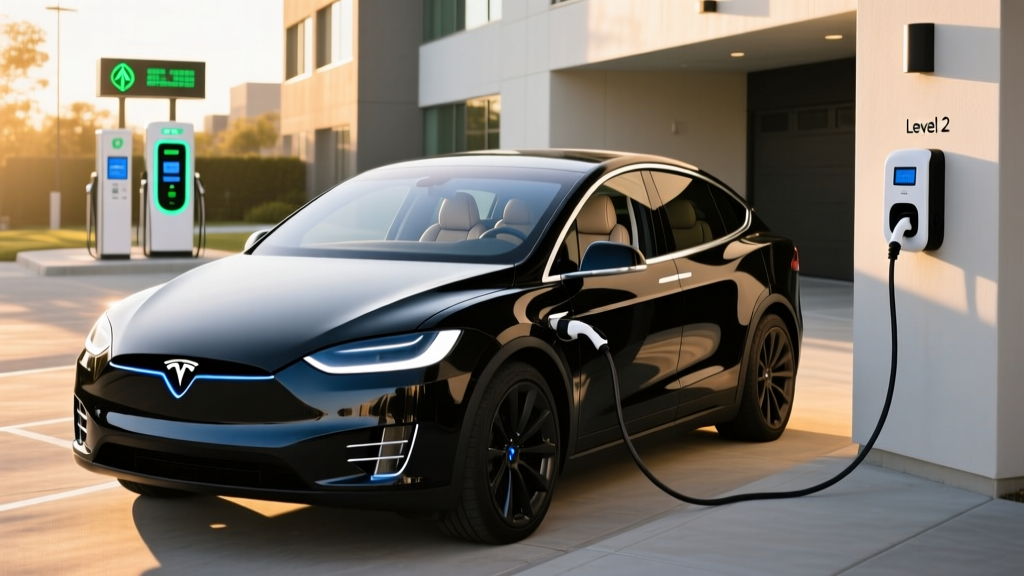
Over 80% of EV charging happens at home. If you have a garage or driveway where you can install a Level 2 charger (240V, typically 7.7–11.5 kW), an EV integrates seamlessly into daily life — you wake up to a full "tank" every morning. A Level 2 installation typically costs $800–$2,500 including equipment and electrician labor, though homes needing a 200-amp panel upgrade may see costs reach $3,500–$5,000.
If you cannot charge at home (apartment, street parking, no dedicated circuit), EV ownership is still possible but requires more planning around public charging. This is the single biggest practical barrier, not range or alternators.
Cold Weather Reduces Range — Plan Accordingly
All EVs lose range in freezing temperatures due to battery chemistry and cabin heating demands. Expect 20–35% range reduction at 20°F compared to the EPA sticker. A vehicle rated at 300 miles EPA might deliver 195–240 miles in sustained cold-weather highway driving. EVs with heat pumps (standard on most 2025–2026 models from Hyundai, Kia, Tesla, and others) mitigate this loss by 5–10 percentage points.
Charging Speed Matters More Than Peak Range
A vehicle that charges at 250 kW peak (adding ~200 miles in 15 minutes) is more practical for road trips than one with 50 miles more range but only 150 kW peak charging. Look at the 10–80% charge time, not just the EPA range number. The Tesla Model 3 Long Range (2026) reaches 10–80% in roughly 18 minutes at a V3/V4 Supercharger; the Hyundai Ioniq 5 does it in ~18 minutes on a 350 kW charger thanks to its 800V architecture.
EV vs. Gas vs. Hybrid: A Decision Framework
The absence of an alternator is one of dozens of mechanical differences between EVs and gas cars. But your purchase decision should be driven by your driving patterns, budget, and infrastructure — not by any single component. Use this framework:
Choose a Battery Electric Vehicle (BEV) if:
- You have reliable home or workplace Level 2 charging access
- Your daily driving is under 250 miles (covers ~95% of American drivers)
- You want the lowest per-mile fuel cost ($0.04–$0.06/mi on residential electricity vs. $0.12–$0.16/mi for gas)
- You plan to keep the vehicle 5+ years to recoup the higher purchase price through fuel and maintenance savings
- You qualify for the federal §30D tax credit (up to $7,500, subject to MSRP caps, income limits, and battery-sourcing requirements — verify at irs.gov)
Choose a Plug-In Hybrid (PHEV) if:
- You want 25–50 miles of electric-only range for daily commuting but need gas-engine flexibility for frequent long trips
- You lack reliable home charging but can plug in occasionally
- You live in an area with limited DC fast-charging infrastructure
- You're not ready to commit to full electric but want to reduce fuel consumption 40–70%
Choose a Conventional Hybrid (HEV) if:
- You have zero charging access (no garage, no workplace charger, no public infrastructure)
- You want better fuel economy (40–55 MPG combined) without any plug-in behavior change
- Upfront cost is a primary concern (HEVs typically add only $1,000–$2,500 over a gas-only model)
Stick with Gas (for now) if:
- You regularly tow heavy loads (>5,000 lbs) over long distances
- You drive 400+ miles daily in remote areas with no charging infrastructure
- Your budget cannot accommodate the higher upfront cost even after incentives
Total Cost of Ownership: The Full Picture
Let's compare a representative 2026 EV, PHEV, and gas vehicle over 5 years and 75,000 miles. We'll use the Tesla Model 3 RWD (~$38,990 MSRP), Toyota RAV4 Prime PHEV (~$44,500 MSRP), and Toyota RAV4 LE AWD gas (~$31,500 MSRP) as benchmarks.
| 5-Year / 75K Miles | Tesla Model 3 RWD (BEV) | RAV4 Prime (PHEV) | RAV4 LE AWD (Gas) |
|---|---|---|---|
| Purchase Price (MSRP) | $38,990 | $44,500 | $31,500 |
| Federal Tax Credit | Up to $7,500* | Up to $7,500* | $0 |
| Effective Purchase | ~$31,490 | ~$37,000 | $31,500 |
| Fuel/Energy (5 yr) | $2,600 | $3,800 | $8,100 |
| Maintenance (5 yr) | $1,800 | $3,200 | $4,500 |
| Insurance (5 yr avg) | $9,500 | $7,800 | $7,200 |
| Total 5-Year Cost | ~$45,390 | ~$51,800 | ~$51,300 |
*Federal §30D credit eligibility depends on buyer income (≤$150K single / $300K joint), vehicle MSRP caps ($55K sedans / $80K SUVs/trucks), and battery critical-mineral and component sourcing rules that tighten annually. The credit can be transferred to the dealer at point of sale as an instant discount. Always verify current eligibility at irs.gov before purchasing.
The EV wins on total cost here primarily through fuel and maintenance savings, but note the insurance premium — EVs typically cost 15–25% more to insure due to higher repair costs after collisions and specialized parts. Get quotes before buying.
Frequently Asked Questions
Do Tesla vehicles have alternators?
No. Tesla vehicles (Model 3, Model Y, Model S, Model X, Cybertruck) use DC-DC converters to step down their high-voltage battery to 12V for accessories and the auxiliary battery. No Tesla has ever used a belt-driven alternator.
Can an EV's DC-DC converter fail like an alternator?
It can, but it's far less common. DC-DC converters have no moving parts and are sealed units. When they do fail, replacement typically costs $800–$2,000 depending on the vehicle. This is covered under the vehicle's basic warranty (typically 3 years/36,000 miles) or powertrain warranty (5–8 years/60,000–100,000 miles) in most cases.
Why do EVs still have a 12V battery if they have a huge main battery?
The 12V battery powers safety-critical systems (lights, door locks, airbag controllers, computers) that must function even if the high-voltage system is disconnected — for example, after a collision. It's a safety redundancy requirement. Some newer models (like certain Tesla vehicles from 2022+) use a 12V lithium-iron-phosphate battery instead of lead-acid for longer lifespan and lighter weight.
Do hybrids have alternators?
It depends on the design. Traditional mild hybrids may retain a conventional alternator. Full hybrids and PHEVs (Toyota Hybrid Synergy Drive, Hyundai/Kia TMED-II) typically use one or more motor-generators integrated into the transaxle that serve the function of an alternator, starter motor, and drive motor simultaneously — but these are not belt-driven alternators in the traditional sense.
Does regenerative braking replace the alternator's function?
Not exactly. Regenerative braking recovers kinetic energy during deceleration and sends it back to the high-voltage traction battery — it's an efficiency feature, not an accessory-power system. The DC-DC converter handles the alternator's actual role: providing 12V power for accessories and keeping the 12V battery charged. Regen and the DC-DC converter serve entirely different functions.
Will I save money buying an EV in 2026?
If you have home charging, drive typical American mileage (~13,500 miles/year), and qualify for the federal tax credit, most EVs break even or save money over 5 years compared to an equivalent gas car — despite higher purchase prices and insurance premiums. The savings widen significantly at years 7–10 as fuel savings compound and the gas car requires more maintenance. Use the DOE's EV cost calculator with your local electricity rates and driving patterns for a personalized estimate.
The Bottom Line
Electric cars do not have alternators — they use solid-state DC-DC converters that are more reliable, more efficient, and require zero maintenance. This is one of many mechanical simplifications that make EVs cheaper to operate over their lifetimes. But the alternator question is really a proxy for a larger concern: how different is EV ownership from what I'm used to?
The honest answer is that EV ownership is simpler in maintenance but demands more planning around charging. If you can charge at home, the transition is nearly effortless. If you can't, the calculus changes. Focus your research on charging access, real-world range (not just the EPA sticker), and total cost of ownership — not on individual components you'll never need to service.