Quick Answer: What It Actually Takes to Build Your Own EV
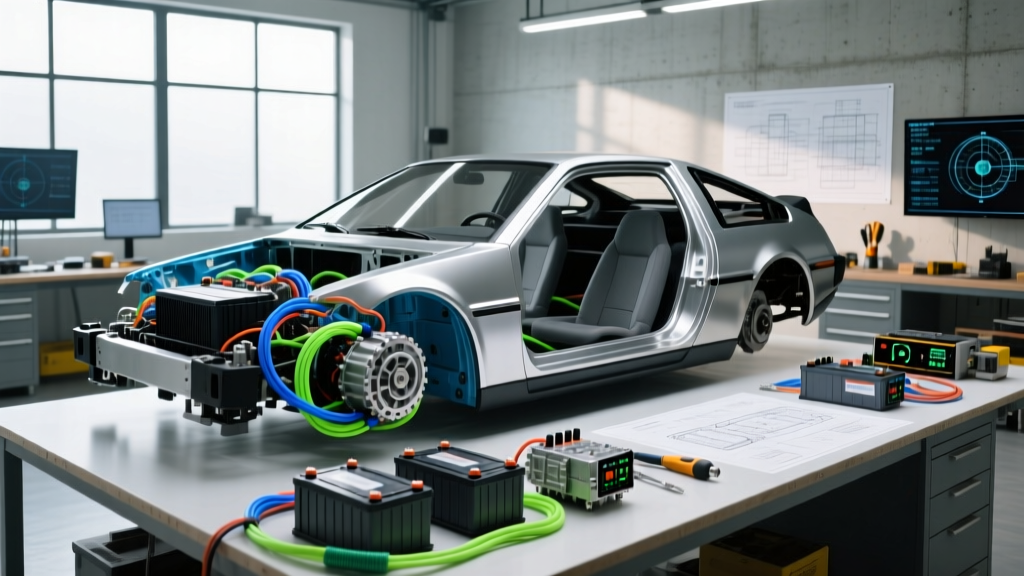
If you're researching how to build an electric vehicle, you're likely considering an EV conversion — replacing a gas car's engine, fuel tank, and exhaust with an electric motor, battery pack, and power electronics. In 2026, a realistic DIY conversion costs between $12,000 and $35,000+ in parts alone, takes 200–600 hours of skilled labor, and typically yields 60–150 miles of range depending on battery size. Before you commit, understand that a conversion rarely beats a used production EV on cost-per-mile-of-range, and it comes with real trade-offs in safety certification, insurance, and resale value.
Why People Want to Build Their Own Electric Vehicle
The appeal of an EV conversion is straightforward: you love a specific car — a classic Porsche 911, a vintage VW Bus, a rugged old Toyota Land Cruiser — and you want to keep driving it without the maintenance headaches and fuel costs of an aging internal combustion engine. Conversions preserve the soul of a beloved vehicle while modernizing its powertrain.
Some builders are motivated by sustainability, others by the engineering challenge, and a growing number by the desire for a unique daily driver that no one else has. The conversion community has grown steadily, supported by companies like EV West and NetGain that sell turnkey motor-and-controller kits, and by open-source battery management system (BMS) projects that simplify pack integration.
But the romantic vision hides hard math. Let's break it down.
The Real Cost to Build an Electric Vehicle at Home
A conversion budget breaks into five major component groups. Prices below reflect 2026 market rates for commonly available aftermarket EV parts.
| Component | Budget Build | Mid-Range Build | High-End Build |
|---|---|---|---|
| Electric motor + controller | $2,500–$4,000 | $5,000–$8,000 | $8,000–$14,000 |
| Battery pack (cells + BMS + enclosure) | $4,000–$8,000 (15–25 kWh) | $8,000–$16,000 (30–50 kWh) | $16,000–$25,000 (60+ kWh) |
| Charger + DC-DC converter | $800–$1,500 | $1,500–$3,000 | $3,000–$5,000 |
| Wiring, adapters, mounts, cooling | $1,500–$3,000 | $3,000–$5,000 | $5,000–$8,000 |
| Instrumentation, safety systems, misc. | $500–$1,000 | $1,000–$2,500 | $2,500–$4,000 |
| Total parts | $9,300–$17,500 | $17,500–$34,500 | $34,500–$56,000 |
These numbers cover parts only. If you pay a professional conversion shop, add $15,000–$40,000 in labor. If you do it yourself, add hundreds of hours and the cost of welding equipment, high-voltage safety gear, and specialty tools.
EV Conversion vs. Buying a Used Production EV
This is the comparison most first-time builders skip, and it's the most important one. Let's stack a mid-range conversion against a realistic used-EV alternative.
| Factor | DIY Conversion (Mid-Range) | Used 2022–2024 EV (e.g., Chevy Bolt, Model 3) |
|---|---|---|
| Total cost | $17,500–$34,500 + donor car + labor | $15,000–$28,000 |
| EPA-equivalent range | 80–150 mi (estimated, uncertified) | 220–350 mi (EPA certified) |
| DC fast charging | Rarely available; most conversions are Level 2 only | Standard (50–250 kW peak) |
| Battery warranty | None (cells may have mfr. warranty) | 8 yr / 100,000 mi (federal mandate) |
| Regenerative braking | Limited or absent | Full one-pedal driving |
| Safety systems (ABS, airbags, ADAS) | Donor-car original; may be compromised by conversion | Full factory systems intact |
| Insurance | Difficult; specialty insurers, higher premiums | Standard EV coverage available |
| Resale value | Very low; niche buyer pool | Follows standard EV depreciation |
| Federal tax credit (§30D) | Not eligible (not a new qualifying vehicle) | Used EV credit up to $4,000 (§25E) if eligible |
The used production EV wins on nearly every practical metric. The conversion wins on emotional value — you get to keep driving a car you love, with a unique story under the hood.
What Range Can You Actually Get from a Home-Built EV?
Range in a conversion is a function of battery capacity (measured in kWh, or kilowatt-hours — the total energy stored) and vehicle efficiency (how many watt-hours the car uses per mile).
A typical converted car — say, a 1970s VW Beetle weighing around 2,000 lbs with the battery added — might achieve 250–350 Wh/mi. A heavier vehicle like a classic Ford Bronco could consume 400–550 Wh/mi. Here's what that means for usable range:
- 20 kWh usable pack at 300 Wh/mi = ~66 miles of real-world range
- 40 kWh usable pack at 300 Wh/mi = ~133 miles
- 40 kWh usable pack at 500 Wh/mi (heavy SUV) = ~80 miles
For context, a 2026 production Hyundai Ioniq 5 achieves roughly 270–290 Wh/mi and offers an EPA-rated range of up to 315 miles on its 84 kWh (usable) battery pack. Aerodynamics, thermal management, and regenerative braking give production EVs a massive efficiency advantage over most conversions.
Cold-weather caveat: Expect 20–35% range loss in freezing temperatures with any battery, but conversions typically lack the sophisticated heat-pump thermal management that production EVs use to mitigate this. Plan for worst-case range, not best-case.
Charging a Home-Built EV: What You Need to Know
Most DIY conversions support Level 2 AC charging only — typically at 3.3 kW to 7.2 kW, depending on the onboard charger you install. This means a full charge from a 40 kWh pack takes roughly 6–12 hours on a 240V home circuit.
DC fast charging (Level 3) is technically possible in a conversion but adds significant cost ($3,000–$8,000 for a CHAdeMO or CCS-compatible DC charger module), complexity (high-voltage contactors, liquid cooling, CAN bus integration), and weight. Most builders skip it, which means road trips require overnight stops — not quick 20-minute top-ups.
For home charging, you'll need a dedicated 240V circuit (typically 30–50 amps) installed by a licensed electrician. Expect to pay $500–$2,000 for the circuit installation depending on your panel capacity and run distance. A panel upgrade from 100A to 200A service, if needed, adds $1,500–$3,500.
Legal, Safety, and Insurance Realities
This is where many conversion projects stall. Key considerations:
- Registration and inspection: Most U.S. states allow EV conversions to be registered, but the process varies widely. Some states require a special "converted vehicle" inspection; others treat it as a custom/homebuilt vehicle. Check your state DMV requirements before starting.
- Safety: Removing the engine changes crash dynamics. The original engine block often serves as a structural mass in frontal collisions. High-voltage battery packs must be securely mounted, shielded, and equipped with manual disconnect switches. Improper installations pose fire and electrocution risk.
- Insurance: Major insurers often won't cover conversions under standard policies. You'll likely need a specialty insurer (Hagerty, Grundy, or similar) that handles modified/classic vehicles. Premiums are typically higher than a stock vehicle.
- No federal tax credit: The IRS §30D clean vehicle credit applies only to new qualifying vehicles from certified manufacturers. A home conversion does not qualify. However, if you purchase a used production EV instead, the §25E used EV credit may provide up to $4,000 (subject to income limits, vehicle price caps, and dealer reporting requirements).
Decision Framework: Should You Build or Buy?
Build a Conversion If:
- You have a specific donor car with deep personal or collector value
- You have fabrication skills (welding, electrical, mechanical) or a trusted shop
- You're comfortable with 60–150 miles of range and no DC fast charging
- You view this as a passion project, not a cost-saving measure
- You have a second vehicle for longer trips
Buy a Production EV If:
- You need reliable daily transportation with 200+ miles of range
- You want DC fast charging for road trips
- You want a battery warranty (8 yr/100,000 mi is standard)
- You want standard insurance, registration, and resale value
- You want to benefit from federal or state EV tax credits
Consider a PHEV If:
- You lack home charging access or have range anxiety
- You want some electric driving (25–45 mi) with a gas backup
- You're not ready to commit fully to electric
Common Misconceptions About Building Your Own EV
| Myth | Fact |
|---|---|
| "Converting my car to electric will save me money vs. buying an EV." | A mid-range conversion ($20,000–$35,000 in parts) plus a donor car rarely costs less than a used Chevy Bolt EV ($15,000–$20,000) with more range, fast charging, and a warranty. |
| "I can just drop in a Tesla motor and battery." | Tesla's drive units and battery packs use proprietary CAN bus protocols and thermal management. While some builders have adapted salvaged Tesla components, integration is complex and unsupported. |
| "Any car can be converted." | Technically true, but lightweight, simple cars (air-cooled VWs, old Miatas, classic Minis) are far easier and cheaper. Heavy, complex modern cars with extensive electronics are poor candidates. |
| "Electric conversions are maintenance-free." | The EV drivetrain needs less maintenance than a gas engine, but you still have suspension, brakes, steering, cooling systems, and a high-voltage battery that degrades over time and may need cell-level balancing. |
| "I'll get 200+ miles of range easily." | Only with a very large (60+ kWh) battery pack, which costs $16,000–$25,000+ in cells alone and adds 800–1,200 lbs to the vehicle, further reducing efficiency. |
Getting Started: First Steps if You Decide to Build
If you've weighed the trade-offs and still want to pursue a conversion, here's a practical sequence:
- Choose your donor car wisely. Lightweight, simple, and rust-free is ideal. Popular conversion platforms include the VW Beetle, VW Bus, classic Porsche 911, Mazda Miata, and older Toyota trucks.
- Calculate your target range and work backward to battery size. Estimate Wh/mi (300 for a light car, 450+ for a heavy one), multiply by desired range, and add a 20% buffer for degradation and cold weather.
- Select your motor type. AC induction motors (like the NetGain Hyper9 or HPEVS AC-50) are more efficient and offer regenerative braking. DC series motors are cheaper but less capable.
- Source cells carefully. New LiFePO4 (LFP) cells from reputable suppliers offer safety and longevity (~3,000+ cycles). Salvaged EV battery modules are cheaper but come with unknown degradation history. Never use consumer-grade lithium-ion cells (laptop batteries, etc.) for a vehicle pack.
- Plan your high-voltage safety systems. Manual service disconnects, fuses, contactors, and an inertia cutoff switch are non-negotiable. Budget for proper high-voltage cabling (orange-jacketed, rated for your system voltage).
- Document everything. Photos, wiring diagrams, and parts receipts help with registration, insurance, and any future troubleshooting.
Frequently Asked Questions
How long does an EV conversion take?
For an experienced hobbyist working weekends, expect 6–18 months. Professional shops typically quote 3–6 months for a full conversion. First-time builders should budget at least a year and be prepared for troubleshooting delays.
What battery chemistry is best for a conversion?
LFP (lithium iron phosphate) is the most common choice for DIY builds. It's safer (higher thermal runaway threshold), lasts longer (3,000–5,000 cycles vs. 1,000–2,000 for NMC), and is more forgiving of imperfect BMS tuning. The trade-off is lower energy density — you'll need a physically larger, heavier pack for the same kWh. NMC offers more range per pound but requires more precise thermal management and cell balancing.
Can I use a salvaged EV battery pack?
Yes, and many builders do. Salvaged packs from wrecked Nissan Leafs, Chevy Bolts, or Tesla Model S vehicles can be sourced for $3,000–$10,000 depending on capacity and condition. However, you must test cell health (capacity and internal resistance), integrate a compatible BMS, and accept that you have no warranty and limited knowledge of the pack's history.
Is a converted EV street-legal?
In most U.S. states, yes — but the process varies. Some states (like California) have relatively straightforward procedures for registering converted vehicles, while others require special inspections or have emissions-testing exemptions you must apply for. Research your specific state's DMV requirements before purchasing parts.
How does charging cost compare to gas for a conversion?
At the U.S. average electricity rate of ~$0.17/kWh (2026), charging a 40 kWh conversion battery from empty costs about $6.80. If that yields 100 miles of range, your fuel cost is roughly $0.068/mile. A comparable gas car getting 25 MPG at $3.30/gallon costs $0.132/mile — nearly double. The per-mile savings are real, even if the upfront conversion cost isn't.
Do I need a special electrical panel at home?
Not necessarily. A Level 2 charger drawing 3.3 kW needs only a 20-amp 240V circuit — most home panels can accommodate this. A 7.2 kW charger needs a 40-amp circuit. If your panel is already near capacity (common in older homes with 100A service), an upgrade to 200A may be required, costing $1,500–$3,500 installed. Have a licensed electrician evaluate your panel before you buy charging equipment.