Tesla officially ended production of the Model X in late 2025, shifting its large-SUV focus toward the next-generation platform and the Cybertruck's expanding market role. But for buyers who need a three-row electric family hauler with falcon-wing doors and Supercharger network access, the question remains: are discontinued Tesla Model X sales worth pursuing in 2026, or has the clock run out on this polarizing EV?
The short answer is yes — but only if you find one at the right price, understand the real-world range tradeoffs, and accept that Tesla's support for a discontinued model may evolve. Below, we break down every spec, cost, and ownership factor you need before pulling the trigger on remaining new inventory or a low-mileage used example.
2025 Tesla Model X: Final Model Year Specs at a Glance
The 2025 Model X was offered in two trims: the dual-motor Long Range and the tri-motor Plaid. Here are the definitive numbers from the final production run.
| Specification | Long Range AWD | Plaid AWD |
|---|---|---|
| EPA Range | 348 miles | 320 miles |
| Battery (usable) | ~100 kWh, NMC | ~100 kWh, NMC |
| Drivetrain | Dual-Motor AWD | Tri-Motor AWD |
| Horsepower | 670 hp | 1,020 hp |
| 0–60 mph | 3.8 seconds | 2.5 seconds |
| Top Speed | 155 mph | 163 mph |
| Peak DC Fast Charge | 250 kW | 250 kW |
| 10–80% DC Charge Time | ~30 minutes | ~30 minutes |
| Level 2 Home Charge Rate | 11.5 kW (~44 mi/hr) | 11.5 kW (~44 mi/hr) |
| MPGe (combined) | 103 MPGe | 98 MPGe |
| kWh/100 mi | 33 kWh | 35 kWh |
| Seating | 5, 6, or 7 passengers | 5 or 6 passengers |
| Cargo (behind 3rd row) | 15.0 cu ft | 15.0 cu ft |
| Cargo (max, seats folded) | 85.1 cu ft | 85.1 cu ft |
| Towing Capacity | 5,000 lbs | 5,000 lbs |
| Battery Warranty | 8 yr / 150,000 mi | 8 yr / 150,000 mi |
| Final Base MSRP | $79,990 | $94,990 |
Sources: fueleconomy.gov, Tesla 2025 specifications.
Real-World Range: What the EPA Number Doesn't Tell You
Long Range: EPA 348 miles. Expect ~280–310 miles on sustained highway driving at 70–75 mph. In cold weather (below 32°F), plan for 230–270 miles of usable range.
Plaid: EPA 320 miles. Expect ~255–285 miles highway; cold weather drops this to ~210–250 miles.
The Model X uses a ~100 kWh NMC (nickel manganese cobalt) battery pack. NMC chemistry offers high energy density — critical for pushing a 5,185-pound SUV past 300 miles — but it is more sensitive to extreme temperatures than LFP (lithium iron phosphate). Tesla's heat pump and active thermal management help, but physics is physics: a large SUV with a 0.24 drag coefficient still consumes significantly more energy at highway speeds than a sedan.
On a 70°F day with mixed city/highway driving, owners consistently report achieving 90–95% of the EPA sticker. But load up all seven seats, attach a cargo box to the roof, and cruise at 80 mph through the Rockies, and you'll see that number drop to 75% or below. This isn't a flaw unique to Tesla — it's the reality of any large, heavy EV.
Charging Speed: Supercharger Network and Home Setup
Charging infrastructure is where the Model X still holds an edge, even as a discontinued model. Tesla's Supercharger network remains the most reliable and widespread DC fast-charging system in North America, and the Model X retains full access.
| Charging Level | Power (kW) | Speed (miles of range/hour) | Notes |
|---|---|---|---|
| Level 1 (120V household) | ~1.4 kW | ~3–5 mi/hr | Emergency/trickle only |
| Level 2 (240V home, 48A) | 11.5 kW | ~44 mi/hr | Full overnight charge in ~9 hrs |
| DC Fast Charge (Tesla Supercharger V3) | Peak 250 kW | ~200 mi in 15 min | 10–80% in ~30 min |
| DC Fast Charge (CCS adapter, 3rd-party) | Up to 250 kW | Varies by station | Requires Tesla CCS adapter (included) |
The Model X peaked at 250 kW on V3 Superchargers — respectable but no longer class-leading. The Hyundai Ioniq 9 and Rivian R2 platform vehicles now push 300–350 kW. More importantly, the Model X charge curve tapers significantly above 80% state of charge (SoC). The 10–80% sprint takes roughly 30 minutes, but that final 20% can add another 25–30 minutes. For road trips, plan your stops around the 80% mark to minimize total charging time.
At home, the 11.5 kW onboard charger means a 48-amp Level 2 circuit (requiring a 60-amp breaker) will replenish roughly 44 miles of range per hour. A full 0–100% charge takes approximately 9 hours. If your home electrical panel can't support a 60-amp dedicated circuit, a 32-amp setup (40-amp breaker) delivers about 7.7 kW, or roughly 30 miles per hour of charging — still sufficient for most daily driving needs.
Pricing, Tax Credits, and the Discontinued-Model Discount
With production ended, remaining new Model X inventory is being sold at varying discounts depending on the dealer and region. Here's where pricing stands in early 2026:
| Trim | Final MSRP | Typical Remaining-Inventory Price | Federal §30D Credit Eligibility |
|---|---|---|---|
| Long Range AWD | $79,990 | $72,000–$78,000 | Not eligible (MSRP cap: $80,000 for SUVs; battery sourcing rules may also disqualify) |
| Plaid AWD | $94,990 | $85,000–$92,000 | Not eligible (exceeds $80,000 SUV MSRP cap) |
The federal EV tax credit under IRS §30D imposes a manufacturer's suggested retail price (MSRP) cap of $80,000 for SUVs. The Long Range Model X barely squeaked under that cap at $79,990, but the battery critical-mineral and component sourcing requirements introduced in 2023–2024 created additional hurdles. As of the final production run, Tesla's supply chain did not consistently meet all sourcing thresholds for the full $7,500 credit. The Plaid, at $94,990, exceeded the cap outright.
Additionally, buyer income caps apply: modified adjusted gross income (AGI) must not exceed $300,000 (married filing jointly), $225,000 (head of household), or $150,000 (individual). The credit is non-refundable but can now be transferred to the dealer as a point-of-sale discount if all criteria are met.
For used Model X purchases, the separate used EV credit (up to $4,000 or 30% of the sale price, whichever is lower) may apply if the used sale price is $25,000 or less, the buyer's income falls below lower thresholds ($150,000 joint / $75,000 individual), and the vehicle is at least two model years old. Given current used Model X pricing, finding one at or below $25,000 is unlikely in 2026.
Performance, Tech, and Daily Livability
Even as a discontinued model, the Model X's performance credentials remain formidable. The Long Range dual-motor setup delivers 670 hp and a 3.8-second 0–60 time — faster than nearly every three-row SUV on the road, gas or electric. The Plaid's tri-motor, 1,020-hp configuration is genuinely supercar-quick at 2.5 seconds, though its real-world utility beyond bragging rights is debatable.
The 17-inch center touchscreen runs Tesla's latest software with navigation, streaming, gaming, and over-the-air updates. The 12.4-inch instrument cluster and yoke-or-wheel steering option carry over. Autopilot (basic lane-keep and adaptive cruise) is standard; Full Self-Driving (Supervised) was available as a $8,000 add-on or $99/month subscription.
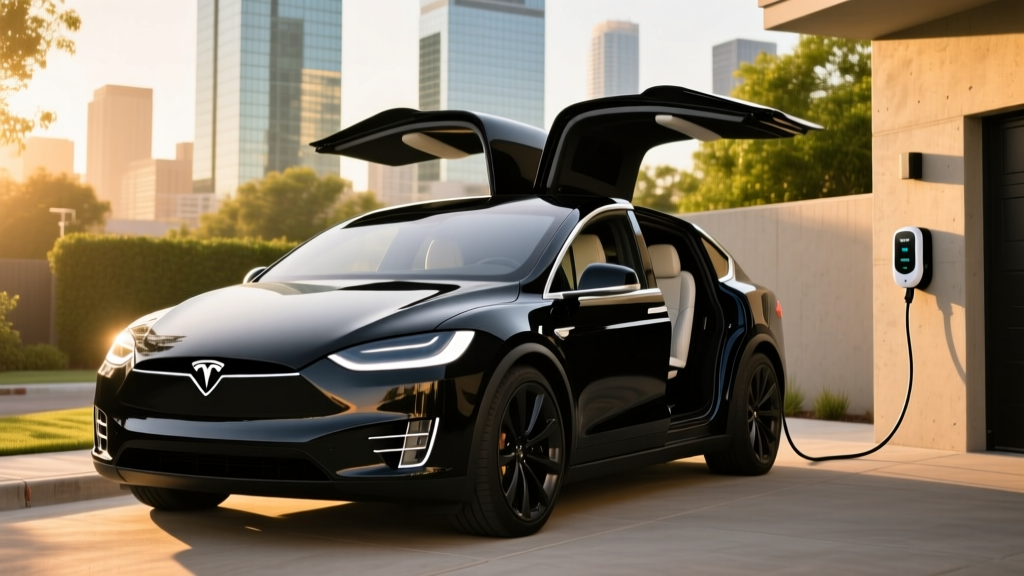
The falcon-wing rear doors remain the Model X's signature feature. They open vertically, making third-row access easier in tight parking spaces — when they work correctly. Tesla improved the door seal and sensor reliability over the years, but owners still report occasional sensor glitches in heavy rain or when bike racks are nearby. The panoramic windshield is expansive, the cabin is quiet, and the HEPA air filtration system (with "Bioweapon Defense Mode") is genuinely effective.
Cargo space measures 15.0 cubic feet behind the third row, expanding to 85.1 cubic feet with both rear rows folded. The front trunk (frunk) adds approximately 6.5 cubic feet. Legroom is generous: 41.2 inches up front, 38.4 inches in the second row, and a tight 32.7 inches in the third — adequate for children but not adults on longer trips.
Pros and Cons: Honest Assessment
- 348-mile EPA range (Long Range) remains competitive for a three-row SUV
- Access to Tesla Supercharger network — the most reliable in North America
- Class-leading acceleration: 3.8s (LR) and 2.5s (Plaid) 0–60 mph
- Falcon-wing doors ease third-row access in tight spaces
- 5,000-lb towing capacity
- Over-the-air software updates continue post-discontinuation
- Strong battery warranty: 8 years / 150,000 miles
- Discontinued — long-term parts availability and resale value uncertain
- No federal §30D tax credit eligibility for most buyers
- 250 kW peak DC charge rate trails newer competitors (300–350 kW)
- Falcon-wing doors still prone to sensor/leak issues in adverse weather
- Third-row legroom (32.7 in) is tight for adults
- High insurance premiums relative to segment
- Plaid trim offers little practical advantage over Long Range for most buyers
Model X vs. the Competition: Is It Still Worth It?
With the Model X out of production, buyers looking at remaining inventory are cross-shopping against current-production rivals. Here's how the key competitors stack up:
- Rivian R1S (2026): Quad-motor, 410-mile max range, 350 kW charging, ~$79,900 starting. More rugged, better third row, eligible for §30D credit. Lacks Supercharger access (uses CCS/NACS adapters).
- Hyundai Ioniq 9 (2026): Three-row, ~350-mile range, 350 kW 800V charging, ~$58,000 starting. Better value, faster charging, NACS native. Less performance, no falcon-wing novelty.
- Kia EV9 (2026): Three-row, ~304-mile range, 236 kW charging, ~$55,000 starting. Most affordable three-row EV, NACS native. Significantly less range and performance.
- Mercedes EQS SUV (2026): ~350-mile range, 200 kW charging, ~$105,000 starting. More luxurious, far more expensive, slower charging.
- You need Supercharger network reliability for frequent long-distance road trips
- You want supercar-level acceleration in a three-row SUV
- You find remaining inventory at a meaningful discount ($72K or below for Long Range)
- You value Tesla's software ecosystem and OTA update cadence
- Federal tax credit eligibility matters to your budget
- You want the latest 800V charging architecture (300+ kW)
- You need a genuinely usable adult-sized third row (Rivian R1S, Ioniq 9)
- Long-term parts availability and warranty support from an active production line concerns you
Ownership After Discontinuation: What to Expect
Tesla has committed to supporting the Model X with parts, service, and software updates for a minimum of 10 years after the end of production, per standard automotive industry practice and various state franchise laws. The 8-year/150,000-mile battery and drive unit warranty remains fully in effect for all remaining new and certified pre-owned units.
However, discontinued models historically see slower parts fulfillment and longer service wait times as supply chains deprioritize low-volume components. The falcon-wing door actuators, in particular, are a Model X–specific part with no shared platform equivalent — if those become scarce, repair times could stretch. Tesla's mobile service and third-party EV specialists provide a partial safety net, but this is a genuine risk factor worth weighing.
Depreciation is harder to predict. Discontinued models sometimes hold value well among enthusiasts (the original Tesla Roadster) and sometimes drop sharply as buyers move to newer platforms (BMW i3). The Model X's niche appeal, Supercharger access, and strong battery warranty suggest moderate depreciation, but it will likely underperform current-production competitors in resale value over a 5-year horizon.
Frequently Asked Questions
What is the real-world range of the Tesla Model X?
The Long Range achieves an EPA-estimated 348 miles, but expect 280–310 miles on sustained highway driving and 230–270 miles in cold weather. The Plaid's EPA estimate is 320 miles, with real-world highway driving yielding 255–285 miles.
How fast does the Model X charge at home and on DC fast chargers?
On a Tesla V3 Supercharger, the Model X peaks at 250 kW and charges from 10–80% in approximately 30 minutes. At home on a 48-amp Level 2 charger (11.5 kW), it adds roughly 44 miles of range per hour, with a full charge taking about 9 hours.
Does the Tesla Model X qualify for the federal EV tax credit?
Most buyers will not qualify for the $7,500 §30D credit on a new Model X. The Long Range's $79,990 MSRP barely meets the $80,000 SUV cap, but battery critical-mineral sourcing requirements have generally disqualified it. The Plaid exceeds the MSRP cap outright. Buyer income limits also apply — see IRS §30D guidelines.
Is it risky to buy a discontinued EV like the Model X?
There is moderate risk. Tesla has committed to parts and software support for at least 10 years, and the battery warranty remains valid. However, proprietary components like falcon-wing door actuators may become harder to source over time, and resale value is uncertain compared to current-production models.
How does the Model X tow compared to competitors?
The Model X is rated for 5,000 pounds of towing capacity, which is competitive with the Rivian R1S (7,700 lbs is higher) and the Hyundai Ioniq 9 (5,000 lbs). Note that towing at or near capacity reduces range by 30–50%, depending on speed, terrain, and trailer aerodynamics.
Will Tesla continue sending software updates to the Model X?
Yes. Tesla has confirmed over-the-air software updates will continue for the Model X, including safety features, infotainment improvements, and bug fixes. Major new feature rollouts may eventually prioritize current-production vehicles, but core functionality will be maintained.