The Short Answer on Diesel Electric Trucks
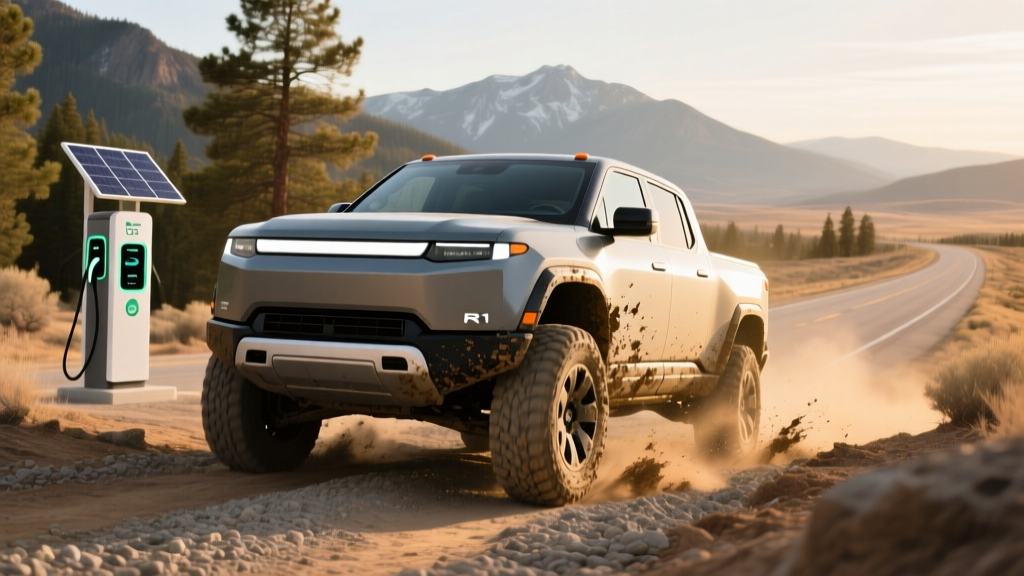
As of 2026, there is no mass-produced diesel electric truck available to U.S. consumers that combines a diesel engine with a battery-electric drivetrain in a single light-duty pickup. The term is most commonly confused with two separate categories: diesel-powered pickups (like the Ram 2500 Cummins or Ford F-250 Power Stroke) and battery-electric pickups (like the Ford F-150 Lightning, Rivian R1T, or Chevrolet Silverado EV). A few medium-duty commercial trucks use diesel-electric hybrid drivetrains, but these are not consumer vehicles. If you're cross-shopping diesel and electric pickups, the real decision comes down to towing demands, daily mileage, fuel costs, and whether you can charge at home.
Why "Diesel Electric Truck" Is a Misunderstood Search
The phrase "diesel electric truck" typically surfaces from one of three buyer intents:
- Intent 1: Buyers who want diesel torque AND electric efficiency in one vehicle — essentially a diesel-electric hybrid pickup. This doesn't exist in the consumer market.
- Intent 2: Diesel truck owners exploring whether to switch to an electric pickup and wanting a side-by-side comparison.
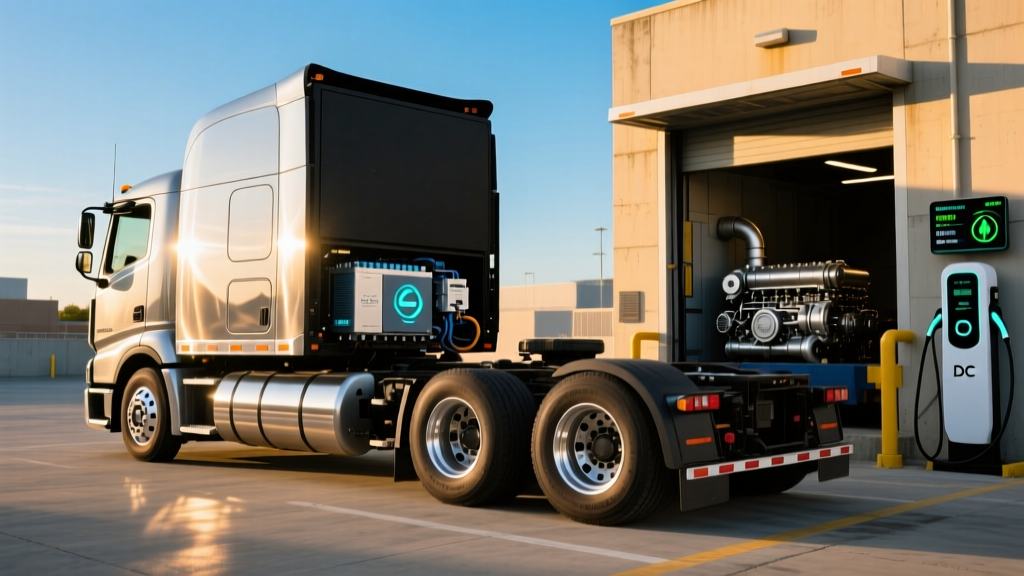
- Intent 3: Confusion with locomotive-style diesel-electric systems (where a diesel generator powers electric motors), which are used in heavy rail and some Class 8 semi-trucks but not consumer pickups.
Let's address what actually exists and help you make the right call between a modern diesel pickup and a battery-electric alternative.
Diesel Pickup vs Electric Pickup: 2026 Spec Showdown
The table below compares three representative 2026 models across the key metrics that truck buyers care about: torque, towing, range, fueling/charging cost, and purchase price.
| Spec | 2026 Ford F-250 6.7L Power Stroke Diesel | 2026 Ford F-150 Lightning (Extended Range) | 2026 Rivian R1T Dual-Motor Max Pack |
|---|---|---|---|
| Powertrain | 6.7L V8 turbo diesel | Dual-motor BEV (131 kWh usable, NMC) | Dual-motor BEV (~149 kWh usable, NMC) |
| Horsepower | 500 hp | 580 hp | 665 hp |
| Torque | 1,200 lb-ft | 775 lb-ft | 829 lb-ft |
| Max Towing | 22,000 lbs (gooseneck) | 10,000 lbs | 11,000 lbs |
| Range / Tank | ~550 miles (34-gal tank, ~16 mpg) | EPA 320 mi (real-world highway ~265 mi) | EPA 410 mi (real-world highway ~340 mi) |
| Fuel / Charge Cost per Mile | ~$0.25/mi (diesel at $3.90/gal) | ~$0.05/mi (home L2 at $0.14/kWh) | ~$0.05/mi (home L2 at $0.14/kWh) |
| Refuel / Recharge Time | ~8 min (fill tank) | DC fast: 10-80% in ~38 min (peak 150 kW) | DC fast: 10-80% in ~30 min (peak 220 kW) |
| Starting MSRP | ~$55,000 (XLT) | ~$59,990 (XLT 312A) | ~$89,900 (Dual-Motor Max) |
| Federal Tax Credit (§30D) | Not eligible | Up to $7,500 (subject to income/MSRP/sourcing rules) | Up to $7,500 (subject to income/MSRP/sourcing rules) |
| Powertrain Warranty | 5 yr / 60,000 mi | 8 yr / 100,000 mi (battery) | 8 yr / 120,000 mi (battery) |
Sources: fueleconomy.gov, Ford F-150 Lightning specs, Rivian R1T. Prices and specs reflect 2026 model year where published; verify with dealer.
The Real Cost of Ownership: Diesel vs Electric Over 5 Years
Purchase price is only part of the equation. Here's a 5-year/75,000-mile cost breakdown assuming 15,000 miles/year, home charging for the EVs, and national-average fuel/electricity prices.
| Cost Category | F-250 Diesel | F-150 Lightning | Rivian R1T Max |
|---|---|---|---|
| Purchase Price (MSRP base) | $55,000 | $59,990 | $89,900 |
| Federal Tax Credit | $0 | -$7,500* | -$7,500* |
| Fuel / Electricity (5 yrs) | $18,750 | $3,750 | $3,750 |
| Maintenance (5 yrs) | $4,500 (DEF, oil, filters) | $1,200 (cabin filter, tires, fluid top-off) | $1,400 |
| Estimated Insurance (5 yrs) | $8,500 | $9,800 | $11,500 |
| 5-Year Total (before resale) | $86,750 | $67,240 | $99,050 |
*Tax credit caveat: The §30D credit requires adjusted gross income below $150K (single) or $300K (joint), vehicle MSRP under $80,000 for trucks, and compliant battery mineral sourcing. The Rivian R1T Max Pack exceeds the MSRP cap and would not qualify. The F-150 Lightning XLT qualifies if buyer income and sourcing requirements are met. Always verify current rules at IRS.gov and consult a tax professional.
Where Diesel Still Wins — and Where It Doesn't
Diesel Advantages (Honest Assessment)
- Heavy towing over long distances: If you regularly tow 15,000+ lbs across state lines, diesel's 550-mile range and 8-minute refuel are unbeatable. An electric truck towing at max capacity can see range drop by 40-50%, cutting a 320-mile EPA estimate to ~160-190 real-world miles.
- Remote/rural operation: No charging infrastructure needed. Diesel stations are everywhere, even in rural counties where DC fast chargers remain scarce.
- Proven heavy-duty durability: The 6.7L Power Stroke and 6.7L Cummins are built for 300,000+ mile service lives with proper maintenance.
Where Electric Trucks Pull Ahead
- Daily commuting and light hauling: If 90% of your driving is under 200 miles/day with home charging, an EV pickup costs roughly $0.05/mile in energy vs $0.25/mile for diesel — a $3,000/year savings at 15K miles.
- Instant torque for worksite use: Electric motors deliver peak torque from 0 RPM. The F-150 Lightning's 775 lb-ft hits instantly, making it responsive for trailer maneuvering and job-site positioning.
- V2L (Vehicle-to-Load) capability: The F-150 Lightning's Pro Power Onboard can output up to 9.6 kW of 240V power — enough to run job-site tools, a tailgate setup, or even back up essential home circuits during an outage. No diesel truck offers this without a separate generator.
- Near-zero routine maintenance: No oil changes, no DEF fluid, no fuel filters, no exhaust system repairs. EV pickups eliminate the $800-$1,200 annual diesel maintenance line item.
Common Misconceptions About Diesel Electric Trucks
| Myth | Fact |
|---|---|
| "I can buy a diesel-electric hybrid pickup from Ford or Ram." | No automaker sells a consumer diesel-electric hybrid pickup in the U.S. as of 2026. The Ram 1500 REV is a battery-electric truck (with a gas range-extender variant announced), not diesel. |
| "Electric trucks can't tow anything serious." | The F-150 Lightning tows 10,000 lbs and the Rivian R1T tows 11,000 lbs — sufficient for most boat, horse, and equipment trailers. However, range drops significantly under max load. For 20,000+ lb gooseneck towing, diesel remains the only practical option. |
| "Electric trucks are cheaper overall." | Lower operating costs are real, but purchase price, insurance premiums (often 15-25% higher for EVs), and potential home charging installation ($500-$2,500 for Level 2) must be factored in. |
| "Diesel is going away, so I should switch to electric now." | Diesel heavy-duty trucks remain in full production and will for years. EPA emissions rules are tightening, but Cummins and Ford's Power Stroke platforms are compliant and widely supported. |
| "I can charge an electric truck on a standard 120V outlet overnight." | Level 1 (120V) charging adds roughly 2-3 miles per hour. An F-150 Lightning's 131 kWh battery would take 50+ hours from empty. A 240V Level 2 home charger (adding ~20-25 mi/hr) is practically mandatory for truck owners. |
Real-World Ownership Considerations Before You Decide
Home Charging Access Is the Dealbreaker
Electric truck ownership is fundamentally different depending on your charging situation. If you have a garage or driveway where a Level 2 (240V, 48-amp) charger can be installed, daily operation is seamless — plug in at night, wake up to 300+ miles of range. The installation typically costs $800-$2,500 depending on whether your electrical panel needs an upgrade from 100A to 200A service.
If you rely on street parking, apartment living, or workplace-only charging, an electric truck becomes a logistical challenge. Public DC fast charging costs $0.30-$0.50/kWh (comparable to or exceeding diesel per mile), and sessions take 30-45 minutes. Plan realistically.
Cold-Weather Range Loss Is Real
Battery chemistry matters in winter. NMC batteries (used in the F-150 Lightning and R1T) typically lose 20-30% of range at 20°F compared to mild-weather EPA estimates. A Lightning rated at 320 miles EPA may deliver 220-250 miles in a January commute. Diesel trucks also lose efficiency in cold weather, but the impact on range is less dramatic due to the sheer fuel-tank capacity.
Preconditioning — warming the battery while still plugged in — recovers some of this loss and is essential for DC fast charging in cold weather, where charge speeds can be halved without it.
Driving Pattern Match
Your daily mileage profile determines which powertrain makes financial sense:
- Under 100 miles/day, home charging available: Electric truck wins on cost. You'll spend ~$1.75/day on electricity vs ~$12/day on diesel.
- 100-250 miles/day, mixed highway and city: Electric truck works if you can charge at home and don't regularly tow heavy loads. Plan road-trip charging stops.
- 250+ miles/day or frequent heavy towing: Diesel remains the pragmatic choice. The refueling speed and range under load are irreplaceable with current battery technology.
Decision Framework: Which Truck Powertrain Fits You?
Choose a Diesel Pickup If:
- You regularly tow over 12,000 lbs for distances exceeding 200 miles
- You operate in rural areas with limited DC fast-charging infrastructure
- Your daily driving regularly exceeds 300 miles without predictable charging stops
- You need a heavy-duty (¾-ton or 1-ton) chassis for commercial or agricultural work
- You want proven 300K+ mile powertrain longevity with established service networks
Choose an Electric Pickup If:
- Your daily driving is under 250 miles and you have reliable home Level 2 charging
- You primarily tow under 10,000 lbs or haul light-to-moderate loads
- You want V2L capability for job-site power or home backup
- You want to eliminate diesel maintenance costs ($800-$1,500/year) and DEF fluid
- You qualify for the §30D federal tax credit and your chosen model meets MSRP/sourcing rules
- You value instant torque, quiet operation, and lower per-mile energy cost
Wait and Revisit If:
- You need heavy towing but want lower fuel costs — watch for range-extender EV trucks (gas or diesel generator paired with electric drive) that may arrive in the 2027-2028 timeframe
- You can't install home charging yet but expect to move or gain access within 1-2 years
- You're interested in solid-state battery trucks promising faster charging and greater range, though these remain in pre-production as of 2026
Frequently Asked Questions
Does any automaker make a diesel-electric hybrid pickup truck?
No. As of 2026, no major automaker sells a consumer-grade diesel-electric hybrid pickup in the United States. Diesel-electric drivetrains exist in heavy commercial vehicles (Class 8 trucks, buses, locomotives) but have not been adapted for light-duty consumer pickups. The closest analogues are plug-in hybrid trucks like the forthcoming Ram 1500 Ramcharger, which pairs a gasoline V6 range-extender with a battery-electric drivetrain — but this uses gas, not diesel.
What's the most affordable electric pickup truck in 2026?
The Ford F-150 Lightning starts at approximately $54,990 for the base Pro trim (fleet-oriented) and $59,990 for the consumer XLT trim with the standard-range battery. After the potential $7,500 federal tax credit (if you meet income and sourcing requirements), effective pricing can dip below $52,500 — competitive with mid-trim diesel F-250 pricing.
How much does it cost to install a Level 2 home charger for an electric truck?
Expect $500-$1,500 for the charger hardware (a quality 48-amp unit like the ChargePoint Home Flex or Ford Charge Station Pro) plus $500-$2,000 for electrician labor and permitting. If your home's electrical panel needs upgrading from 100A to 200A service, add $1,500-$3,000. Total realistic range: $1,000-$4,500 depending on your home's existing electrical infrastructure.
Can an electric truck handle cold winters?
Yes, but with reduced range. Expect 20-30% range loss at temperatures below 20°F with NMC battery chemistry. preconditioning the battery while plugged in mitigates this and is critical for maintaining DC fast-charge speeds. Both the F-150 Lightning and Rivian R1T include heat pump systems that improve cold-weather cabin heating efficiency compared to resistive heaters. Diesel trucks also face cold-weather challenges (gelled fuel, block heaters) but don't experience the same degree of range reduction.
Is diesel fuel more expensive than charging an electric truck?
Per mile, yes — significantly. At $3.90/gallon diesel and 16 mpg, a diesel truck costs roughly $0.24/mile in fuel. An electric truck charging at home at $0.14/kWh and averaging 2.0 mi/kWh costs about $0.07/mile. However, public DC fast charging at $0.40/kWh pushes the EV cost to ~$0.20/mile, nearly closing the gap. Your savings depend heavily on home charging access.
Will I qualify for the $7,500 federal EV tax credit?
Eligibility for the §30D Clean Vehicle Credit depends on multiple factors: your adjusted gross income must be under $150,000 (single) or $300,000 (married filing jointly); the truck's MSRP must be under $80,000; and the vehicle's battery must meet critical-mineral and battery-component sourcing requirements that tighten annually. The credit can now be transferred to the dealer at point of sale as an instant discount. Verify current eligibility at IRS.gov and consult a tax professional before relying on the credit in your purchase decision.
The Bottom Line
The "diesel electric truck" as a single consumer vehicle doesn't exist — and won't for the foreseeable future. The real choice is between a proven diesel heavy-duty pickup and a rapidly maturing battery-electric light-duty truck. Each excels in different use cases. Diesel dominates in heavy towing, long-distance rural operation, and refueling convenience. Electric wins on daily operating cost, maintenance simplicity, instant torque, and worksite power capability.
Your decision should hinge on three concrete factors: your typical towing load, your daily mileage, and your ability to install a Level 2 home charger. Run the numbers against your actual driving pattern — not the brochure — and the right powertrain becomes clear.