Did Trump Ban Tesla in the US? The Short Answer
No. Tesla has not been banned in the United States under any administration, including Donald Trump's. There is no executive order, federal legislation, or regulatory action that prohibits the sale, manufacture, or ownership of Tesla vehicles on US soil. The rumor surfaces periodically on social media, often conflating unrelated trade policy, Elon Musk's political entanglements, or isolated international regulatory actions with a nonexistent domestic ban.
What has changed for Tesla buyers in 2026 is the federal EV tax credit landscape, state-level emissions policy, and the competitive EV market itself. If you're researching whether a Tesla is still a viable purchase, the real question isn't about a ban — it's whether the 2026 Model Y delivers enough range, charging speed, and value to justify its price in an increasingly crowded segment.
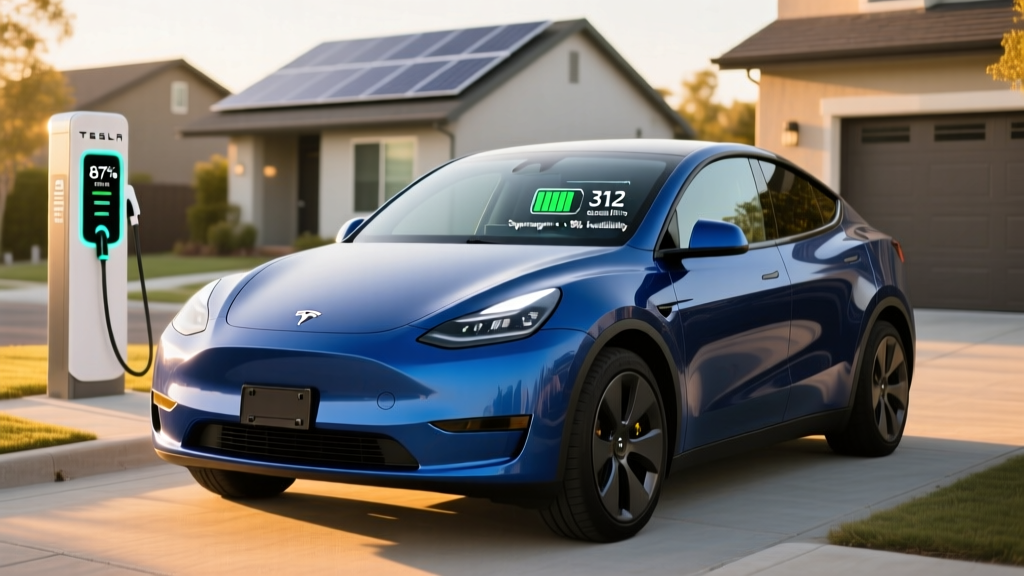
Below, we break down the 2026 Tesla Model Y Long Range AWD with the exact numbers buyers need: EPA range, real-world efficiency, DC fast-charging curves, §30D tax credit eligibility, and how it stacks up against the Hyundai Ioniq 5, Ford Mustang Mach-E, and Chevrolet Equinox EV.
2026 Tesla Model Y Long Range: Spec Sheet at a Glance
| Specification | 2026 Model Y Long Range AWD |
|---|---|
| EPA Range | 320 miles |
| Battery Capacity | 78.1 kWh usable (NMC chemistry) |
| Drivetrain | Dual-motor AWD |
| Horsepower | 384 hp (combined) |
| 0–60 mph | 4.8 seconds |
| Peak DC Fast Charge | 250 kW (V3 Supercharger) |
| 10–80% DC Charge Time | ~27 minutes |
| Level 2 Home Charging | 11.5 kW (~44 mi/hr) |
| MPGe (Combined) | 111 MPGe |
| Efficiency | 30 kWh/100 mi |
| Cargo Volume | 76.2 cu ft (rear seats folded) |
| Rear Legroom | 38.8 inches |
| Base MSRP | $44,990 (before destination) |
| Destination Fee | $1,390 |
| Battery Warranty | 8 years / 120,000 miles |
Range and Efficiency: EPA vs. Real-World Driving
Tesla's efficiency remains a class benchmark. At 30 kWh per 100 miles, the Model Y sips electrons more frugally than the Ford Mustang Mach-E Extended Range (34 kWh/100 mi) and roughly matches the Hyundai Ioniq 5 (30 kWh/100 mi). This efficiency advantage matters on road trips: fewer kWh consumed per mile means shorter charging stops and lower electricity costs over the vehicle's life.
The 78.1 kWh usable battery pack uses nickel-manganese-cobalt (NMC) chemistry, which offers higher energy density than lithium iron phosphate (LFP) but is more sensitive to sustained high states of charge. Tesla recommends daily charging to 80% for NMC packs and 100% only before long trips. This contrasts with the LFP packs in the Model Y Standard Range, which Tesla says can be charged to 100% daily without accelerated degradation.
Charging Speed: Supercharger Network and Home Setup
| Charging Level | Power | Speed / Time | Notes |
|---|---|---|---|
| Level 1 (120V) | ~1.4 kW | ~5 mi/hr | Emergency/trickle only |
| Level 2 (240V, 48A) | 11.5 kW | ~44 mi/hr | Full charge in ~7.5 hrs |
| DC Fast (V3 Supercharger) | 250 kW peak | 10–80% in ~27 min | Sustained ~170 kW avg |
| DC Fast (CCS adapter) | Up to 150 kW | 10–80% in ~38 min | Non-Tesla networks |
The Model Y's charge curve at a V3 Supercharger is front-loaded: it pulls a full 250 kW from roughly 5% to 25% state of charge, then tapers to 170–190 kW through 50%, and drops further to under 100 kW past 70%. This is why the 10–80% time of ~27 minutes is a more useful metric than the peak kW number alone. Tesla's navigation system preconditions the battery en route to a Supercharger, warming it to optimal temperature for maximum charge acceptance — a feature that materially improves real-world charge speeds in cold weather.
For home charging, a 48-amp Level 2 circuit (requiring a 60-amp breaker) delivers 11.5 kW, adding roughly 44 miles of range per hour. A typical overnight session from 30% to 80% takes about 3.5 hours. Installation costs range from $800 to $2,500 depending on panel capacity and conduit run length. Homes with 100-amp electrical panels may require a $2,000–$4,000 panel upgrade to support a dedicated 60-amp EV circuit — a factor many buyers overlook during purchase planning.
With Tesla's NACS connector now adopted as the industry standard by Ford, GM, Rivian, and others, the Model Y enjoys native access to the Supercharger network (over 25,000 stalls in North America as of early 2026) without an adapter. For Electrify America, EVgo, or ChargePoint stations, Tesla sells a CCS-to-NACS adapter (~$175) that unlocks those networks at up to 150 kW.
Performance, Interior, and Technology
The dual-motor AWD powertrain delivers 384 horsepower and a 4.8-second 0–60 mph time — brisk enough for confident highway merging and passing, though the Performance trim (456 hp, 3.5 seconds) exists for enthusiasts willing to trade ~15 miles of range for acceleration.
Inside, the minimalist cabin centers on a 15.4-inch touchscreen running Tesla's proprietary infotainment OS. There are no physical buttons for climate, media, or mirrors — everything routes through the screen, including glovebox release and windshield wiper speed. This design polarizes buyers: some find it clean and intuitive; others consider it distracting while driving.
Notable tech features include:
- Autopilot (standard): SAE Level 2 adaptive cruise control and lane centering. Requires continuous driver supervision — hands must remain on the wheel.
- Full Self-Driving Supervised ($8,000 option): Also SAE Level 2. Adds automatic lane changes, traffic light recognition, and Navigate on Autopilot. Despite the name, the driver must remain fully engaged at all times. This is not autonomous driving.
- Sentry Mode: 360-degree camera recording when parked, with app-based alerts.
- Over-the-air updates: Feature additions and performance tweaks delivered wirelessly.
- Heat pump (standard): Significantly reduces cabin-heating energy draw in cold weather compared to resistive heaters, preserving 15–25 additional miles of winter range.
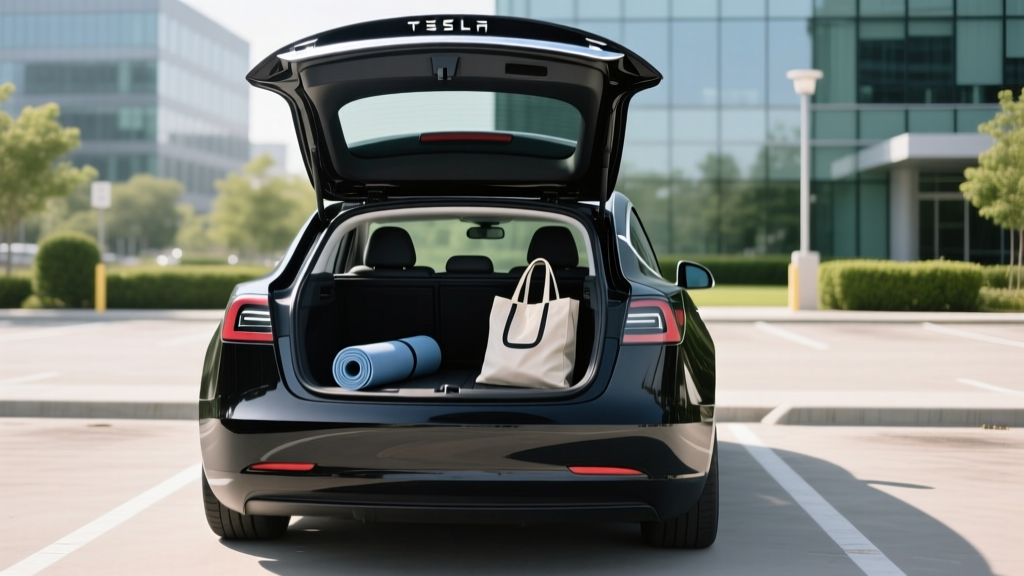
Cargo space measures 30.2 cubic feet behind the rear seats and 76.2 cubic feet with them folded — competitive with the Ioniq 5 (72.6 cu ft) and ahead of the Mach-E (59.7 cu ft). A front trunk (frunk) adds 4.1 cubic feet for charging cables or a small bag. Rear legroom of 38.8 inches accommodates adults comfortably on longer trips.
Pricing, Trims, and Federal Tax Credit Eligibility
| Trim | MSRP (incl. destination) | Est. After §30D Credit |
|---|---|---|
| Long Range AWD | $46,380 | $38,880* |
| Performance AWD | $51,630 | $44,130* |
*Estimated price assumes full $7,500 §30D credit eligibility. Individual eligibility varies.
The 2026 Model Y Long Range AWD qualifies for the full $7,500 federal EV tax credit under IRS §30D, provided the buyer meets all requirements. As of 2026, the IRS clean vehicle credit rules stipulate:
- MSRP cap: SUVs must be priced at or below $80,000. The Model Y clears this easily.
- Income cap: Modified adjusted gross income must not exceed $150,000 (single), $225,000 (head of household), or $300,000 (joint filers).
- Battery sourcing: A percentage of critical minerals and battery components must be sourced from the US or free-trade-agreement countries. Tesla's US-built battery packs and cells from Panasonic's Nevada gigafactory have consistently met this threshold for 2025–2026.
- Point-of-sale transfer: Buyers can elect to transfer the credit to the dealer at purchase, reducing the out-of-pocket price by $7,500 upfront rather than waiting for a tax refund.
The Model Y's $46,380 as-tested price (Long Range, destination included) drops to approximately $38,880 with the full credit — placing it in direct competition with the Hyundai Ioniq 5 SEL ($45,500 MSRP, $38,000 after credit) and the Chevrolet Equinox EV RS ($43,400 MSRP, $35,900 after credit). Consult a tax professional to confirm personal eligibility before relying on the credit in purchase calculations.
How It Compares: Model Y vs. Key Rivals
| Attribute | Tesla Model Y LR | Hyundai Ioniq 5 SEL | Ford Mach-E ER |
|---|---|---|---|
| EPA Range | 320 mi | 310 mi | 312 mi |
| Battery | 78.1 kWh NMC | 77.4 kWh NMC | 91 kWh NMC |
| Peak DC Charge | 250 kW | 233 kW | 150 kW |
| 10–80% Time | ~27 min | ~18 min | ~45 min |
| 0–60 mph | 4.8 sec | 5.1 sec | 5.6 sec |
| Cargo (rear folded) | 76.2 cu ft | 72.6 cu ft | 59.7 cu ft |
| Base MSRP | $44,990 | $45,500 | $46,895 |
The Ioniq 5's 800-volt architecture enables a faster 10–80% charge despite a slightly lower peak kW, thanks to a flatter charge curve. The Mach-E lags in charging speed — a meaningful drawback for frequent road trippers. The Model Y's advantage lies in the Supercharger network's reliability and density, which remains a significant ownership perk for drivers without home charging or those who travel long distances regularly.
Pros
- Class-leading efficiency (30 kWh/100 mi)
- Supercharger network access (native NACS)
- Spacious cargo area with flat-load floor
- Standard heat pump for cold-weather range
- Over-the-air feature updates
- Strong §30D tax credit eligibility
Cons
- Touchscreen-only controls (no physical buttons)
- Autopilot/FSD is Level 2, not autonomous
- Ride quality firm on rough pavement
- No Apple CarPlay or Android Auto
- Insurance premiums above segment average
- NMC battery limits daily 100% charging
Who Should Buy the 2026 Model Y?
The Model Y Long Range is best suited for buyers who:
- Have access to home Level 2 charging (the single biggest ownership satisfaction factor)
- Take regular road trips and value Supercharger network convenience
- Need a compact SUV with genuine cargo versatility for family gear
- Prefer over-the-air updates and a tech-forward interface
- Qualify for the §30D tax credit, bringing effective pricing below $40,000
Buyers who prioritize physical controls, ride comfort, or Apple CarPlay integration should test-drive the Ioniq 5 or Mach-E before committing. Those without home charging access should carefully map public charging infrastructure in their area — the Supercharger advantage diminishes if the nearest station is 20+ miles away.
Frequently Asked Questions
Did Trump or any US administration ban Tesla?
No. Tesla continues to manufacture and sell vehicles in the United States without restriction. The company operates Gigafactories in Texas and Nevada, and its vehicles are sold in all 50 states. Rumors of a ban are unfounded and often stem from confusion with unrelated trade disputes or foreign regulatory actions.
What is the real-world range of the 2026 Model Y?
The EPA rates it at 320 miles. Real-world highway driving at 70–75 mph typically yields 260–285 miles. Cold weather (below freezing) can reduce range to 210–240 miles. City driving with regenerative braking often exceeds 330 miles.
How fast does the Model Y charge at home and on the road?
At a V3 Supercharger (250 kW peak), 10–80% takes approximately 27 minutes with battery preconditioning. At home on a 48-amp Level 2 circuit (11.5 kW), expect ~44 miles of range per hour of charging, or a full 30–80% session in about 3.5 hours.
Does the 2026 Model Y qualify for the $7,500 federal tax credit?
Yes, provided the buyer's income falls below IRS caps ($150K single / $300K joint), the MSRP is under $80,000 (it is), and battery sourcing requirements are met (Tesla's US-built packs currently qualify). The credit can be transferred to the dealer at point of sale for an immediate price reduction. Confirm eligibility with a tax professional.
Is the Model Y worth buying over the Ioniq 5 or Mach-E?
If Supercharger network access and cargo space are priorities, yes. If faster peak charging (Ioniq 5's 800V architecture), physical buttons, or Apple CarPlay matter more, the Ioniq 5 is a strong alternative. The Mach-E appeals to buyers who prefer a more traditional driving feel and dealer service network, but its slower DC charging is a road-trip drawback.
What's the battery warranty?
Tesla covers the Model Y battery and drive units for 8 years or 120,000 miles, whichever comes first, with a minimum 70% capacity retention threshold over that period. This is competitive with Hyundai's 10-year/100,000-mile battery warranty and Ford's 8-year/100,000-mile coverage.